

Illustrative dental consultation with an older patient and her chosen support person
General & Family Dentistry

Caregiver-Assisted Dental Visits in Oakville

Support workers often accompany a client to a dental visit and then pass the details to the next shift. Plan that kind of appointment from Oakville so nothing important falls between handovers.

For support workers and the people they assist

What happens when the person at the visit isn’t the one at home tonight?

In many households, the person who drives a client to the dentist is not the one who will brush their teeth that evening. Rotating staff, agency workers and relatives who take turns all share the job. For someone coming from Oakville, a caregiver-assisted appointment is partly about the visit itself and partly about making sure what we discuss reaches everyone who helps.

That starts with a conversation before booking. Explain how the patient communicates, what puts them at ease, and anything about mobility, seating, swallowing or medical history that could affect treatment. Our team can then say what is realistic here, and whether a different clinic or setting might suit particular needs better.

The patient is still the person we are talking with. A worker’s notes and day-to-day knowledge can be invaluable, especially when symptoms are hard for the patient to put into words, but those notes support their participation rather than replace it. Plans should follow the individual, not a general idea of what a diagnosis usually means.

Plan a visit with a support worker
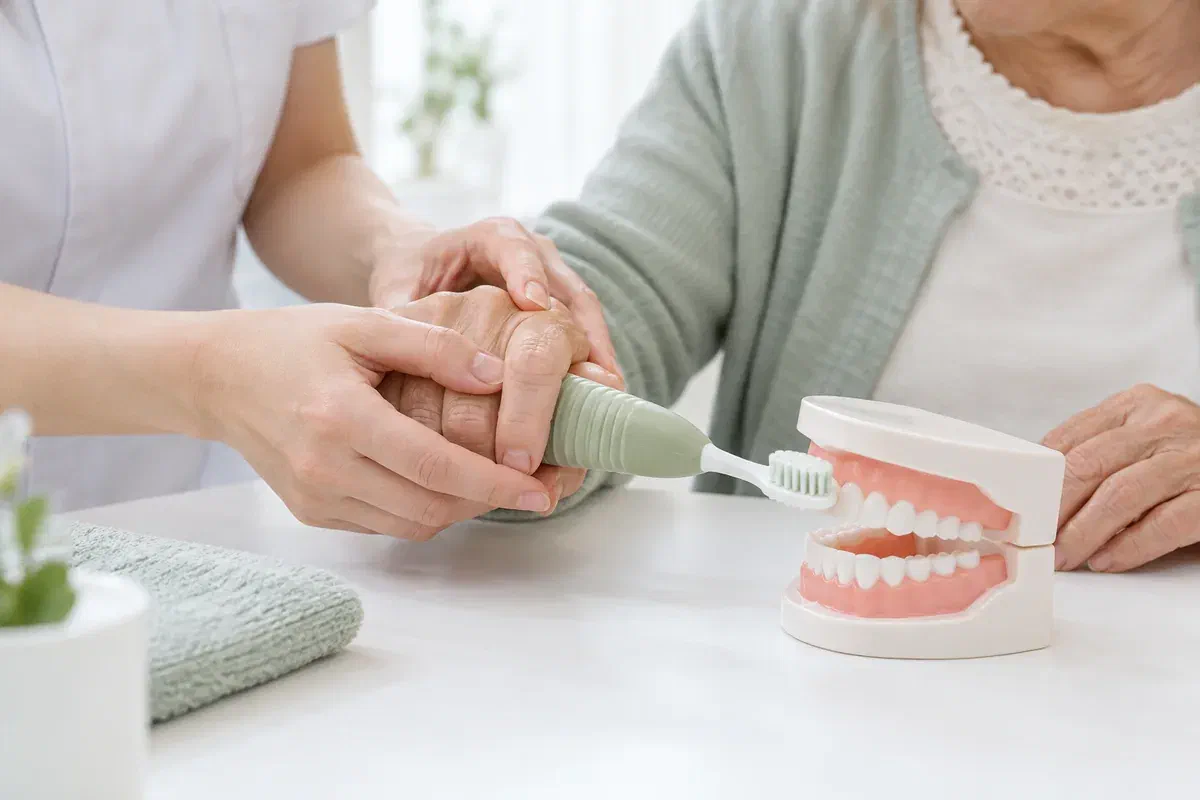
Illustrative practice with a larger toothbrush handle and a dental model
Useful details to send ahead

Beyond the chart: how does a visit actually go?

Charts list conditions, but two clients with the same one can respond very differently to a dental chair. Share what earlier appointments taught you about what helps and what tends to unsettle.

Ways of communicating

Tell us about picture boards, signing, a communication device, hearing or vision differences, or a first language other than English. Some people need extra time to reply. Explain how staff usually assist so the patient can still answer for themselves.

Transfers, posture and stamina

Mention a wheelchair, a transfer belt, difficulty tilting back, or a short window of comfortable sitting. Ask us to confirm what is possible rather than assuming lifting help or specific equipment. Safety considerations may change how long the visit lasts, or where it is best held.

Shift-log observations

Notes may mention refused meals, blood on the brush, a denture left out, or new pushback during mouth care. Bring dates and specifics. Such changes call for a dental assessment rather than an assumption that they reflect behaviour or the client’s known condition.

If the client has marked pain, swelling, trouble eating or drinking, or another sudden worrying change, please call. A visit planned for familiarity should never postpone urgent assessment.

What a prepared companion contributes

One appointment, carried into every shift

Staff who assist with daily care can describe exactly what that care involves: whether the client tolerates an electric brush, how long they will keep their mouth open, which teeth get skipped. Advice built on those specifics is far more likely to be followed by a team of several people than general guidance written for an ideal routine.

It is worth agreeing in advance how the worker fits into the visit. A client might want staff beside them throughout, or prefer that the worker joins only for check-in and instructions. Note the preference on the booking. It can be revisited whenever the client’s needs or wishes change.

Patient information: NIDCR — oral health support and individualized care

Records that save guesswork

An accurate medication administration record, relevant care-plan sections and dated observations give the dental team useful context. Highlight anything that needs checking with the client’s physician, pharmacist or another clinician.

Techniques the whole team can repeat

Ask for a brushing or flossing approach suited to the client’s reach and tolerance. One person may manage with an adapted handle; another needs staff to do the brushing. A demonstration lets the attending worker show colleagues later.

Instructions in writing

Agree, with the client’s consent, who receives information and how it will be shared with the household or agency. Confirm warning signs, home care and the next booking before leaving, so evening staff are not guessing.

Steps for a supported appointment

Preparation does most of the work.

Get in touch before booking when a visit depends on specific support. We can cover the purpose of the appointment, what paperwork to bring, and whether any needs require more planning.

  1. Outline the client’s needs

    Describe the dental concern, preferred communication, and what help the worker will provide. Tell us who is coming and their relationship to the client. Flag access or medical needs early so the setting can be considered before the day, not on arrival.

  2. Sort out consent clearly

    Any proposed treatment is discussed with the client, and the dentist works through the correct consent process. Accompanying someone, even as a paid worker, does not create authority to approve treatment. If another person must decide, that decision-maker and any supporting documents need to be identified.

  3. Proceed at the client’s pace

    Explanations are adjusted to the client. Agree on a way to signal a pause, discuss positioning, and keep an eye on how they are managing. A first appointment might focus mostly on assessment and planning, with treatment scheduled separately if needed.

  4. Wrap up with a shared summary

    Results, options, fees and follow-up are reviewed with the client and, where suitable, an authorized representative. Ask questions until the home-care steps make sense. Decide who books the next visit and who reports new symptoms or routine difficulties.

Daily mouth care

Helping hands, and room for independence

Assistance might be a verbal prompt, a hand-over-hand guide, or complete brushing by staff. Ask for advice matched to the person’s abilities and any swallowing or positioning precautions, not a routine designed for another client.

Explain, then involve

Tell the client what is about to happen and let them do any part they can. Someone might hold the brush for the front teeth while staff finish the back. If brushing becomes painful or distressing, stop and ask us what could be behind it.

Match the equipment

Check whether a built-up handle, an electric brush or a different cleaning aid could help. Selection should consider grip, coordination and safe use. Never put fingers between the teeth or prise the mouth open to complete care.

Log changes precisely

Record bleeding, swelling, refused foods, denture problems or a change in how well care is tolerated. Include the date and what was seen. Precise notes help far more than a general entry saying the client was uncooperative.

Formats we can discuss

Which setup fits this client?

The best next step depends on what is happening in the mouth and how much support is involved. Ask what can be done comfortably in our office, and when another provider makes more sense.

Help with history and recall

A visit with staff present

An accompanying worker can supply background and keep track of instructions while the client takes part in decisions. Decide beforehand when staff should speak up, and whether the client wants any of the discussion held privately.

Building familiarity gradually

Short or stepwise visits

When clinically suitable, a brief introductory appointment or care spread over stages can be considered. The goal of each visit and its limits should be understood. Urgent problems still need prompt assessment, whatever the usual pace.

When needs exceed this setting

Referral for other facilities

Some medical, mobility or treatment requirements are best met somewhere with different resources. We can discuss referral and continuity. Even an experienced worker at the client’s side cannot extend what a general office is equipped to do.

Questions from agencies and families

What staff and relatives want to know

Workers, relatives and clients all ask us how to prepare. Arrangements should follow the client’s wishes and the clinical purpose of the appointment.

(905) 876-4488
Our client lives in a group home. Who should come to the appointment with them?
Ideally someone the client knows and trusts, who can share accurate information about daily care. If a different person holds decision-making authority, let us know ahead of time so the consent process can be planned. Tell us who will attend when you book.
Can the support worker and a family member both attend?
Ask when booking, and explain each person’s role. Two companions can help in some situations, but the room can feel crowded for others. The client’s preference matters most, along with practical space and the purpose of the visit.
Is a paid support worker allowed to approve treatment for a client?
Not simply by being their worker. The dentist must follow the proper consent process, which may involve a substitute decision-maker identified under the applicable rules. Tell us about any arrangements in place and ask which documents to bring.
How should the next shift learn about instructions from the visit?
Agree on this before leaving, with the client’s consent. The attending worker can note the main points, ask for anything to be clarified, and confirm who receives information. Clear written notes reduce the chance of steps being lost between staff.
What if the client refuses to open their mouth once they are in the chair?
Let the team know and do not try to force it. We can discuss the safest next step, which may be a short look, another booking, adjusted preparation, or referral. Pain or other urgent signs still need a route to timely assessment.
Is there anything specific to plan when bringing a client from Oakville?
Call before booking to confirm access and support arrangements, so nobody makes the trip only to find something needs rearranging. Bring the medication record and care notes, and allow extra time if transfers or transport scheduling tend to run long.
Supported visits for Oakville clients

Let’s get the handover right from the start.

Reach our Bronte Street practice by phone to describe the client’s dental concern and the support they will have on the day. Share communication or access needs early. We will talk through arrangements and the information to bring.

Specific access or support needs are best settled by phone. Booking forms submitted through the website do not secure equipment, transfer help or a time.

Visit Milton Dental Clinic
Unit 1, 342 Bronte St. S, Milton, ON L9T 5B7
Get directions Clinic hours
Monday–Thursday
11am–7pm
Friday–Sunday
By appointment only

Areas we serve

  • Milton
  • Oakville
  • Mississauga
  • Georgetown
  • Halton Hills
  • Acton
  • Campbellville
  • Brampton
  • Burlington
  • Puslinch
  • Rockwood
  • Erin
  • Caledon
  • Etobicoke
  • Old Milton
  • Bronte Meadows
  • Timberlea
  • Dorset Park
  • Dempsey
  • Clarke
  • Beaty
  • Coates
  • Harrison
  • Scott
  • Willmott
  • Ford
  • Bowes
  • Cobden
  • Walker
  • Mountain View
  • Milton Heights
  • Hawthorne Village
  • Valley View
  • Fallingbrook
  • Nassagaweya
  • Trafalgar
  • Esquesing
  • Nelson
  • Brookville
  • Moffat
  • Glen Williams
  • Norval
  • Limehouse
  • Stewarttown
  • Ashgrove
  • Hornby
  • Silver Creek
  • Speyside
  • Scotch Block
  • North Oakville
  • River Oaks
  • Glen Abbey
  • West Oak Trails
  • Palermo
  • Bronte Creek
  • College Park
  • Joshua Creek
  • Uptown Core
  • Preserve
  • Iroquois Ridge
  • Lisgar
  • Meadowvale
  • Meadowvale Village
  • Churchill Meadows
  • Erin Mills
  • Central Erin Mills
  • Streetsville
  • East Credit
  • Creditview
  • Heartland
  • Sheridan
  • Mount Pleasant
  • Credit Valley
  • Huttonville
  • Churchville
  • Springbrook
  • Northwest Brampton
  • Bram West
  • Fletcher's Meadow
  • Fletcher's Creek South
  • Alton Village
  • Orchard
  • Millcroft
  • Headon Forest
  • Tansley
  • Brant Hills
  • Tyandaga
  • Kilbride
  • Lowville
  • Aberfoyle
  • Morriston
  • Arkell
  • Hillsburgh
  • Freelton
  • Carlisle
  • Waterdown
  • Flamborough
  • Mountsberg

How can we help?

Milton Dental Clinic

Have a question about your smile? Choose the option that works best for you.

For urgent dental concerns, please call.
Messages are reviewed during clinic hours.