

Illustrative consultation about three-dimensional dental imaging
General & Family Dentistry

CBCT 3D Dental Scans in Burlington

Thinking about an implant for a gap that has been there a while? From Burlington, learn how CBCT 3D dental scans can inform that kind of planning, what the images can and cannot settle, and how a result feeds into your options.

Planning ahead from Burlington

Bone, nerves and sinuses: the hidden part of an implant plan

What you see in the mirror is a gap. What a clinician needs to understand before placing an implant is underneath: the height and width of the bone, and how close important structures lie. A standard X-ray flattens all of that into one plane. Cone-beam computed tomography, or CBCT, uses X-rays to produce a three-dimensional record of the teeth, jaw and surrounding anatomy. It is a separate thing from the surface scanner used to take a digital impression.

That depth can be useful when planning depends on it, but the scan still needs a reason specific to you. Expect your clinician to explain which question the images should answer, how the result might change the approach, what other imaging could do instead, and how much radiation is involved.

Reach out to Milton Dental Clinic to talk about imaging as part of treatment planning. Share any referral and details of past X-rays or scans. Ask where a scan would be done, who will interpret it, and how the report will reach the clinician leading your treatment. An online enquiry does not confirm a scan, on-site imaging or its suitability for you.

Discuss imaging for treatment planning
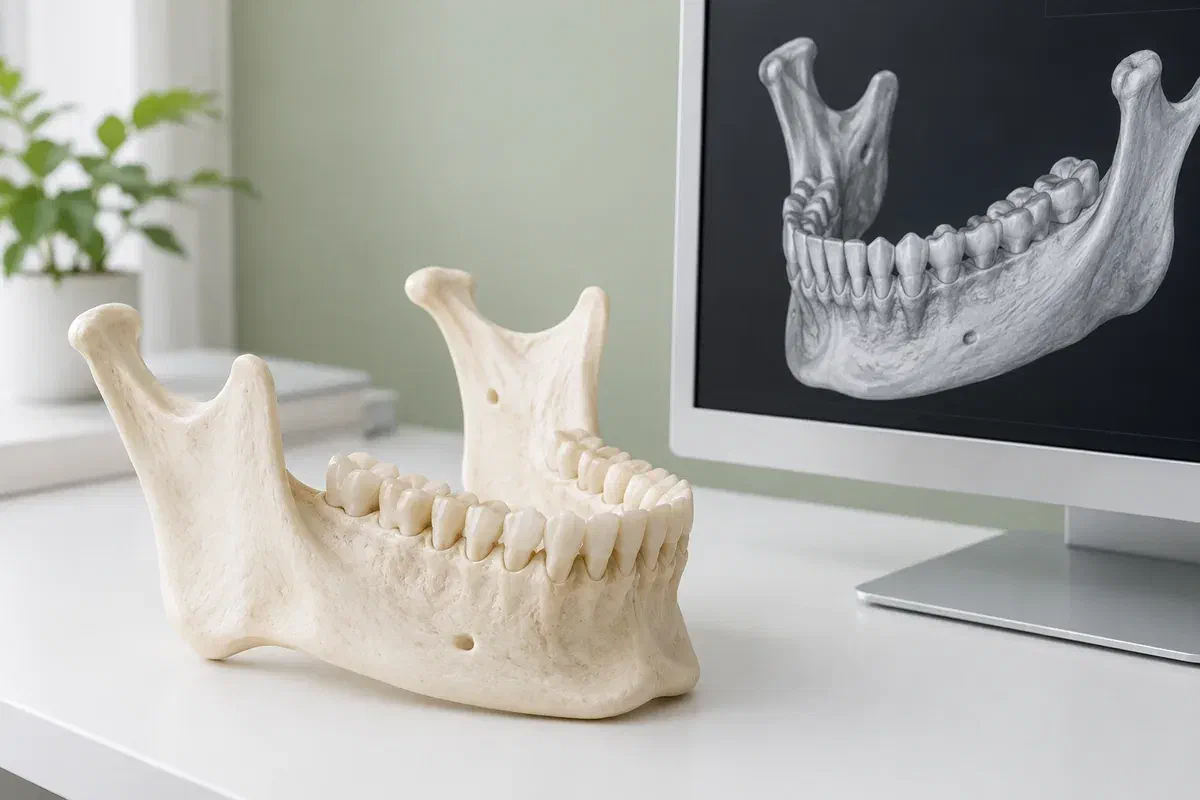
Illustrative jaw teaching model beside a generic three-dimensional dental rendering
Where three dimensions may help

Not every plan needs one, but some do

These are situations in which a clinician might bring up CBCT. They are starting points for a conversation rather than a rule that a scan must follow.

Measuring the site for an implant

Implant or surgical planning may call for a clearer sense of available bone and where nerves, sinuses or neighbouring roots sit. Ask which detail is in doubt, how the answer would affect the plan, and whether a bridge, denture or another approach would still be possible.

A tooth that keeps raising questions

Certain root canal cases or other dental problems are not fully explained by routine images. Further imaging may add information, but diagnosis still relies on your symptoms and the exam. The scan itself might not provide a definitive explanation.

A tooth out of place

A tooth stuck below the gum, or some other irregular feature on an earlier film, can leave its exact location or size in doubt. Your clinician should say why the chosen imaging area suits that doubt. A wider field does not automatically mean a better answer for a focused concern.

Even in implant planning, ask whether the images already available, or a lower-dose X-ray, could supply what is needed before a CBCT is arranged.

What a 3D data set offers

Cross-sections where a flat film shows overlap

A qualified clinician can turn a CBCT data set, view it in slices and examine an area from several perspectives. When the scan is appropriately selected, this can support diagnosis, procedure planning and later evaluation. Any of those advantages has to be weighed against the radiation and the question at hand.

Because CBCT uses ionizing radiation, it generally means more exposure than conventional dental X-rays. Dose depends on the machine, its settings and the region scanned. The aim is an exam that is as limited as possible while still answering the question adequately. That is different from promising no risk, or one dose for all.

Patient information: FDA — dental cone-beam computed tomography

A plan that depends on it

Ask what choice hinges on the scan. A sound explanation ties the image to something you will decide, like whether a site can support a particular implant, not to how advanced the technology sounds.

Interpreted with everything else

The scan is read alongside your history, the exam and other records. Ask who is responsible for reading it, and how anything found outside the planning question will be reported to you.

Files that follow your treatment

Planning can involve more than one office. Ask how the images and report will be sent, with your consent, so whoever performs the procedure has the completed exam in hand.

The usual sequence

From the planning chat to the report

Your scan and your planning consultation may be separate visits, possibly in different places. Confirm the provider, the location, the cost and how results will be reported before making the trip from Burlington.

  1. Agree on why it is needed

    The clinician reviews the reason for 3D imaging and whether existing images already answer it. Mention dates and places of any earlier scans. Ask what extra information is expected and how it could change the plan.

  2. Prepare for the appointment

    Follow the imaging provider’s instructions. Let them know if you are or might be pregnant, struggle to keep still or need help with positioning. You may be asked to remove metal items such as jewellery near the scan area.

  3. Hold still for the scan

    The team guides you into position and explains how to stay motionless while the equipment rotates around your head. Exact steps vary with the unit and the area. Speak up about discomfort before the scan begins.

  4. Talk through the findings

    A CBCT needs proper interpretation. Find out roughly when a report is expected and which clinician will go through it with you. What turns up may lead to more assessment or a change in the proposed treatment.

What to do next

Imaging is a step, not the destination.

Imaging gathers information for a decision. It becomes useful once it is interpreted and acted on, which takes a little more coordination when the scan happens away from the office planning your treatment.

Check how results reach you

Ask whether to book a results appointment or wait to be contacted by the referring clinician. If surgery or another procedure depends on the report, confirm it has been received before considering the plan settled.

Note what was scanned

Write down the date, the provider and the area imaged. If someone suggests a new exam later, mention this one first. It may not be sufficient for a new question, but a review can help avoid an unnecessary repeat.

Keep symptoms on the radar

Waiting for a scan or its report should not delay care for worsening pain, swelling or a new problem. Tell the treating team about any change in the meantime so they can reconsider how soon you should be seen.

Matching imaging to the plan

Three ways to gather the information

The clinical question should decide the imaging, not the other way round. Ask whether the benefit justifies a CBCT, and whether another approach would answer the same question.

When the exam and records are enough

What is already known

History, an exam and existing images may be sufficient to make a decision. Discussing an implant or other treatment does not automatically require a new scan. Ask your clinician to explain any remaining uncertainty.

When a two-dimensional view suffices

Intraoral or panoramic X-rays

A conventional image may give the needed information. It plays a different role from CBCT. Your clinician can say what that film would reveal about the site and where its detail would fall short.

When depth is essential

A CBCT with a clear indication

Here a qualified provider picks the type of exam and arranges a proper report. Field size and exposure settings are tailored to what must be seen and to you as a patient. The mere availability of a bigger or sharper image is not an indication.

Implant-planning questions

What people weighing treatment ask us

Bring any referral or written plan you have received. Talking it through helps clarify what is being requested and whether your clinician or the imaging provider can best answer each practical question.

(905) 876-4488
Can a CBCT show whether I have enough bone for an implant?
It can give a clinician three-dimensional information about bone and nearby structures, which may help with that assessment. The decision also depends on your exam, health history and the type of restoration planned, so the scan is one input rather than a yes or no on its own.
If the scan shows limited bone, does that rule out an implant?
Not necessarily. Your clinician may discuss other approaches, further assessment or alternatives such as a bridge or denture. Ask what the findings mean for each option before deciding.
Is a digital impression for my implant crown the same as a CBCT?
No. A digital impression uses light to record the surface of teeth and gums. CBCT uses X-rays to look at internal structures. Planning may involve one, both or neither, so ask which is being recommended and why.
Can I ask for a copy of my CBCT images?
Ask the imaging provider or the office that holds your records how copies or transfers are handled. Sharing usually requires your authorization, and the format may matter if another clinician needs to view the data.
Does it matter how large an area is scanned?
Yes. The area imaged affects both the information captured and the exposure. For a focused question, a smaller field may be appropriate. Your clinician should explain why the proposed area fits what they need to see.
What if I cannot keep my head still?
Movement can blur the images. Tell the team in advance if a tremor, discomfort or anxiety makes holding still difficult. They can explain the positioning and discuss what may help in your situation.

Patient information: RCDSO — dental CT scanner requirements

Burlington imaging questions

Plan the scan around the decision.

If an implant or other procedure is on the table, our Bronte Street team can go over where 3D imaging might sit in that plan. Send your referral or questions and we will help map the next step. Before any scan, double-check who is taking it and when.

Submitting the form is an enquiry rather than a booked scan. For pain or swelling that is getting worse, please phone instead.

Visit Milton Dental Clinic
Unit 1, 342 Bronte St. S, Milton, ON L9T 5B7
Get directions Clinic hours
Monday–Thursday
11am–7pm
Friday–Sunday
By appointment only

Areas we serve

  • Milton
  • Oakville
  • Mississauga
  • Georgetown
  • Halton Hills
  • Acton
  • Campbellville
  • Brampton
  • Burlington
  • Puslinch
  • Rockwood
  • Erin
  • Caledon
  • Etobicoke
  • Old Milton
  • Bronte Meadows
  • Timberlea
  • Dorset Park
  • Dempsey
  • Clarke
  • Beaty
  • Coates
  • Harrison
  • Scott
  • Willmott
  • Ford
  • Bowes
  • Cobden
  • Walker
  • Mountain View
  • Milton Heights
  • Hawthorne Village
  • Valley View
  • Fallingbrook
  • Nassagaweya
  • Trafalgar
  • Esquesing
  • Nelson
  • Brookville
  • Moffat
  • Glen Williams
  • Norval
  • Limehouse
  • Stewarttown
  • Ashgrove
  • Hornby
  • Silver Creek
  • Speyside
  • Scotch Block
  • North Oakville
  • River Oaks
  • Glen Abbey
  • West Oak Trails
  • Palermo
  • Bronte Creek
  • College Park
  • Joshua Creek
  • Uptown Core
  • Preserve
  • Iroquois Ridge
  • Lisgar
  • Meadowvale
  • Meadowvale Village
  • Churchill Meadows
  • Erin Mills
  • Central Erin Mills
  • Streetsville
  • East Credit
  • Creditview
  • Heartland
  • Sheridan
  • Mount Pleasant
  • Credit Valley
  • Huttonville
  • Churchville
  • Springbrook
  • Northwest Brampton
  • Bram West
  • Fletcher's Meadow
  • Fletcher's Creek South
  • Alton Village
  • Orchard
  • Millcroft
  • Headon Forest
  • Tansley
  • Brant Hills
  • Tyandaga
  • Kilbride
  • Lowville
  • Aberfoyle
  • Morriston
  • Arkell
  • Hillsburgh
  • Freelton
  • Carlisle
  • Waterdown
  • Flamborough
  • Mountsberg

How can we help?

Milton Dental Clinic

Have a question about your smile? Choose the option that works best for you.

For urgent dental concerns, please call.
Messages are reviewed during clinic hours.