

Illustrative consultation about three-dimensional dental imaging
General & Family Dentistry

CBCT 3D Dental Scans in Milton

A scan suggestion at an ordinary appointment can catch you off guard. Talk through CBCT 3D dental scans in Milton: what question the image is meant to settle, what it involves, and how the answer shapes the next step in your care.

3D imaging, explained in Milton

Why would a dentist want to see in three dimensions?

Most dental decisions rest on an exam and the flat X-rays taken at routine visits. Occasionally a question remains that those tools cannot settle, such as how close a planned implant would come to a nerve. Cone-beam computed tomography, or CBCT, uses X-rays to build a three-dimensional view for that kind of question. It is not the optical scanner used to record tooth surfaces for a crown.

So when a scan comes up, the useful thing to ask is what it would tell your dentist that is not already known. A good answer names a specific uncertainty and the treatment choice that hinges on it. It should also cover the alternatives, what the image cannot show, and the radiation involved, so you can weigh the recommendation instead of simply accepting it.

Get in touch with Milton Dental Clinic if you would like to go over a scan recommendation. Have any referral handy, along with dates of recent X-rays. Ask where imaging would take place, who reads it, and how the report gets back to the dentist planning your care. Sending an enquiry does not confirm a scan appointment or that CBCT suits your situation.

Ask about a 3D scan recommendation
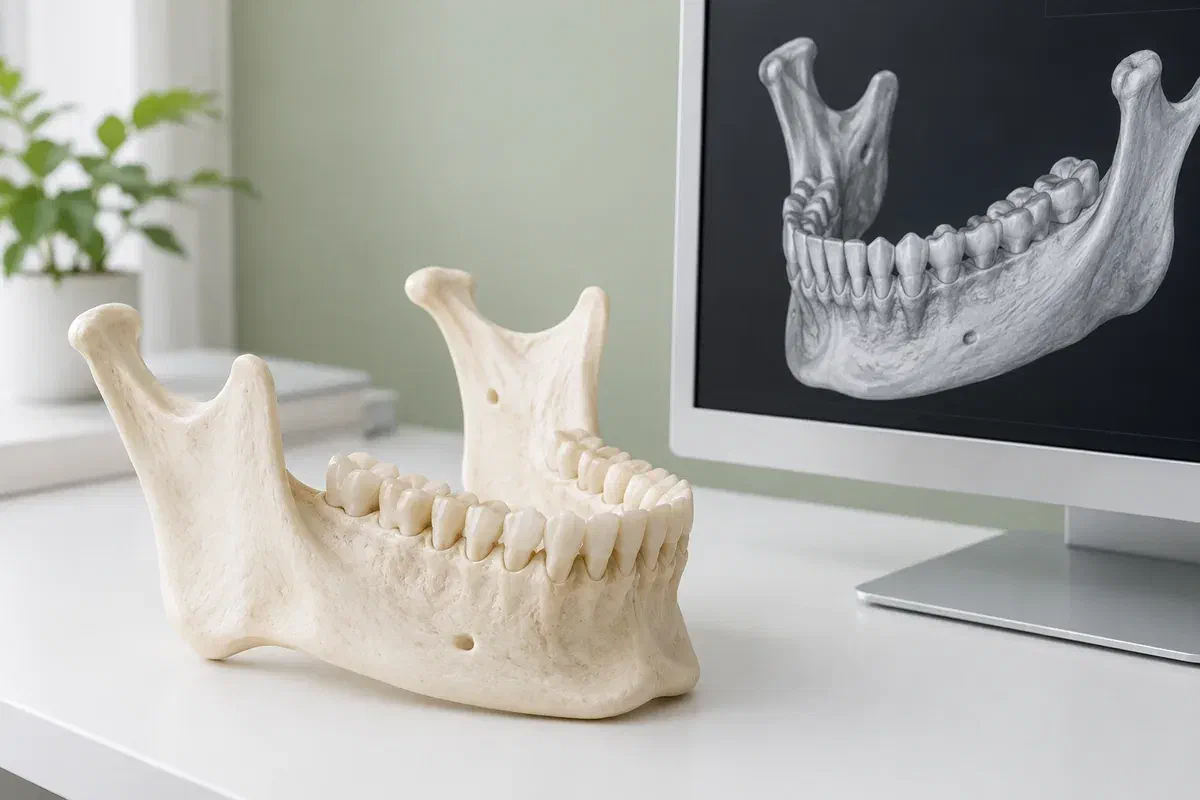
Illustrative jaw teaching model beside a generic three-dimensional dental rendering
When the conversation turns to CBCT

Three situations where depth can matter

These are common reasons a dentist might raise 3D imaging. Having one of them does not mean you need a scan; it means the question is worth discussing.

Mapping bone before an implant or surgery

Placing an implant or planning certain surgery can depend on how much bone is available and where nerves, sinuses and neighbouring roots lie. Ask which of those details is uncertain, how the result could change the plan, and whether a different treatment would still be possible.

A tooth problem that will not explain itself

Some root canal cases or lingering dental problems leave an important question open after the usual images. A scan can add information, but it is only one piece of the diagnosis. Your symptoms and the exam still count, and the image may not give a clear answer.

Something unexpected on an earlier X-ray

A tooth that has not come in, or another unusual finding, may need a better sense of its position or size. Your dentist should explain why the area chosen for imaging fits the question. Scanning a wider region is not automatically more helpful for a focused problem.

A 3D scan is not a routine add-on to every check-up. It is fair to ask whether existing images or a lower-dose X-ray would give your dentist enough to go on.

What depth adds to the picture

Some answers only appear from another angle.

A three-dimensional data set lets a trained clinician look at a region in slices and from several directions. Used for the right reason, that can support a diagnosis, help plan a procedure or check how an area has changed, always balanced against the exposure.

CBCT relies on ionizing radiation, and it usually means a larger dose than standard dental X-rays. How much depends on the machine, its settings and the size of the area captured. The goal is a scan kept as limited as the question allows while still giving enough detail to be useful. No one can honestly promise zero risk or quote one dose for everyone.

Patient information: FDA — dental cone-beam computed tomography

A decision tied to the result

Ask what will be decided differently once the scan is read. A clear reason links the image to a choice in your care, like understanding anatomy before a procedure, rather than praising the equipment.

Read in context, not in isolation

The scan is interpreted with your health history, the exam and your other records. Find out who reads it and how they will tell you about anything they notice beyond the original question.

Records that can travel when needed

Sometimes an imaging provider takes the scan and a different clinician treats you. Ask how the images and report will be sent, with your permission, so your next appointment can actually use them.

How a scan usually unfolds

Four steps, each with a clear owner

Being scanned and talking about treatment can happen at different appointments, sometimes in different places. Before you head out, confirm who is doing the scan, where, the fee and how the report will be shared.

  1. Check the reason and what is on file

    Your dentist reviews why 3D imaging is being considered and whether earlier images already answer it. If you have had scans elsewhere, share when and where. Ask what new information the scan should provide and how it could alter the plan.

  2. Prepare and mention anything relevant

    Follow the instructions you are given. Let the team know if you are or might be pregnant, find it hard to stay still, or need help with positioning. You may be asked to take off jewellery, glasses or removable appliances near the area.

  3. Take the scan that was prescribed

    Staff position you and explain how to keep still while the unit rotates around your head. The routine depends on the equipment and the area. If something feels uncomfortable, say so beforehand.

  4. Go over the findings together

    A scan has to be properly interpreted, not glanced at. Ask when the results should be ready and who will walk you through them. Depending on what they show, you may be offered further assessment or a revised plan.

Once the scan is done

Keep the result moving toward a decision

Imaging gathers information; it does not treat anything. The value comes from a proper reading and a clear follow-up, which matters even more when the scan was taken somewhere other than the office managing your care.

Know who makes the next move

Find out whether you should book a results visit or wait to hear from the dentist who referred you. If a procedure depends on the report, check that it has arrived before assuming everything is ready to go ahead.

Write down the basics

Keep a note of the date, the imaging provider and the area scanned. If another clinician suggests new imaging later, mention this one first. It may or may not be enough, but looking at it can prevent an unneeded repeat.

Treat new symptoms on their own terms

Having a scan booked or finished is no reason to sit on worsening pain, swelling or another new problem. Call the treating team if anything changes while you wait for results, so they can decide whether you need to be seen sooner.

Matching the image to the need

Pick the least imaging that answers the question.

Which imaging makes sense depends on what your dentist needs to know. Ask whether the expected benefit justifies a scan and whether another approach would answer the same question.

When enough is already known

Exam and the records you have

Your history, an exam and current images may be all that is needed to decide. Talking about treatment does not automatically call for a new scan. Your dentist should be open about any uncertainty that is left.

When a flat view is enough

Standard dental X-rays

Intraoral or panoramic X-rays can sometimes supply the information required. They do a different job from CBCT. Ask why a particular view is being suggested and whether it shows enough detail for the assessment.

When depth is genuinely needed

A CBCT scan with a clear reason

A qualified provider chooses a suitable scan and a way to report it. The size of the area and the settings should fit the diagnostic need and your own circumstances. A bigger or more detailed image should never be the only reason to order one.

Common CBCT questions

Before you agree to a 3D scan

Bring whatever referral or note you were given. Talking it over helps sort out what is being asked for and who, the dentist or the imaging provider, can answer each practical question.

(905) 876-4488
Why was a 3D scan suggested when my regular X-rays looked fine?
Routine X-rays show a flat view, which suits most check-up questions. A scan may be raised when a specific planning or diagnostic question needs depth that a flat image cannot give. Ask your dentist to name that question and what would change if the scan were skipped.
Is CBCT the same thing as a hospital CT scan?
They are related technologies, but dental CBCT is designed for the teeth and jaws and uses a cone-shaped beam rather than the setup of a typical medical CT. You usually sit or stand rather than lie down. Ask the provider what their particular unit involves.
Will I have to lie inside a tunnel for the scan?
Generally no. Most dental CBCT units have you sit or stand while an arm rotates around your head. If tight spaces or holding still worry you, tell the team ahead of time.
Does a CBCT scan carry any radiation?
Yes. It uses ionizing radiation, usually more than routine dental X-rays. Your dentist should explain the expected benefit, the alternatives and how the scan is kept to the area needed. Doses differ between machines and settings, so a single published number will not describe your scan.
Can my dentist simply use the X-rays already on file?
Often that is the first thing to check. If existing images answer the question, a new scan may not be needed. If they do not, your dentist should explain what is missing and why another view or a 3D scan would help.
Does filling out the online form book me a CBCT scan?
No. The form starts a conversation about the recommendation and any referral you have. It does not confirm that a scan is appropriate or where it would happen. The team can explain the next step and what still needs to be arranged.

Patient information: RCDSO — dental CT scanner requirements

Talk to us about CBCT in Milton

Bring your questions about the scan.

Reach out to our Bronte Street practice with your imaging questions and any referral details. We can talk about where a scan fits in your dental assessment and what should happen next. Please confirm the imaging provider and appointment details before going in for a scan.

Online requests are enquiries, not confirmed scan bookings. Call if an area is painful or swollen and needs to be looked at soon.

Visit Milton Dental Clinic
Unit 1, 342 Bronte St. S, Milton, ON L9T 5B7
Get directions Clinic hours
Monday–Thursday
11am–7pm
Friday–Sunday
By appointment only

Areas we serve

  • Milton
  • Oakville
  • Mississauga
  • Georgetown
  • Halton Hills
  • Acton
  • Campbellville
  • Brampton
  • Burlington
  • Puslinch
  • Rockwood
  • Erin
  • Caledon
  • Etobicoke
  • Old Milton
  • Bronte Meadows
  • Timberlea
  • Dorset Park
  • Dempsey
  • Clarke
  • Beaty
  • Coates
  • Harrison
  • Scott
  • Willmott
  • Ford
  • Bowes
  • Cobden
  • Walker
  • Mountain View
  • Milton Heights
  • Hawthorne Village
  • Valley View
  • Fallingbrook
  • Nassagaweya
  • Trafalgar
  • Esquesing
  • Nelson
  • Brookville
  • Moffat
  • Glen Williams
  • Norval
  • Limehouse
  • Stewarttown
  • Ashgrove
  • Hornby
  • Silver Creek
  • Speyside
  • Scotch Block
  • North Oakville
  • River Oaks
  • Glen Abbey
  • West Oak Trails
  • Palermo
  • Bronte Creek
  • College Park
  • Joshua Creek
  • Uptown Core
  • Preserve
  • Iroquois Ridge
  • Lisgar
  • Meadowvale
  • Meadowvale Village
  • Churchill Meadows
  • Erin Mills
  • Central Erin Mills
  • Streetsville
  • East Credit
  • Creditview
  • Heartland
  • Sheridan
  • Mount Pleasant
  • Credit Valley
  • Huttonville
  • Churchville
  • Springbrook
  • Northwest Brampton
  • Bram West
  • Fletcher's Meadow
  • Fletcher's Creek South
  • Alton Village
  • Orchard
  • Millcroft
  • Headon Forest
  • Tansley
  • Brant Hills
  • Tyandaga
  • Kilbride
  • Lowville
  • Aberfoyle
  • Morriston
  • Arkell
  • Hillsburgh
  • Freelton
  • Carlisle
  • Waterdown
  • Flamborough
  • Mountsberg

How can we help?

Milton Dental Clinic

Have a question about your smile? Choose the option that works best for you.

For urgent dental concerns, please call.
Messages are reviewed during clinic hours.