

Illustrative consultation about three-dimensional dental imaging
General & Family Dentistry

CBCT 3D Dental Scans in Oakville

A referral slip for a 3D scan often raises more questions than it answers. For people coming from Oakville, we can help unpack a CBCT request: why it was made, who will take and read the images, and where the results need to go.

From Oakville, with a referral in hand

Who asked for the scan, and what do they need to know?

A CBCT request can come from a general dentist, a specialist or another office you visited once. Knowing which clinician wants the images, and why, makes every later step easier. Cone-beam computed tomography uses X-rays to capture three-dimensional detail of teeth, bone and surrounding structures. It is not the optical wand used to make a digital impression.

The scan should exist to answer a defined question, perhaps about the anatomy around a planned implant or a problem that a routine exam and flat X-rays have not resolved. If the reason on the referral is vague, it is reasonable to ask for it in plain words, along with the alternatives, what the scan might miss, and the radiation dose involved.

You are welcome to contact Milton Dental Clinic about a referral you have received. Bring the paperwork and any record of earlier images. Ask where the scan would happen, who will interpret it, and how the report gets to the clinician who will treat you. Sending an online enquiry does not confirm on-site scanning, an appointment or that the scan is suitable.

Ask about a CBCT referral
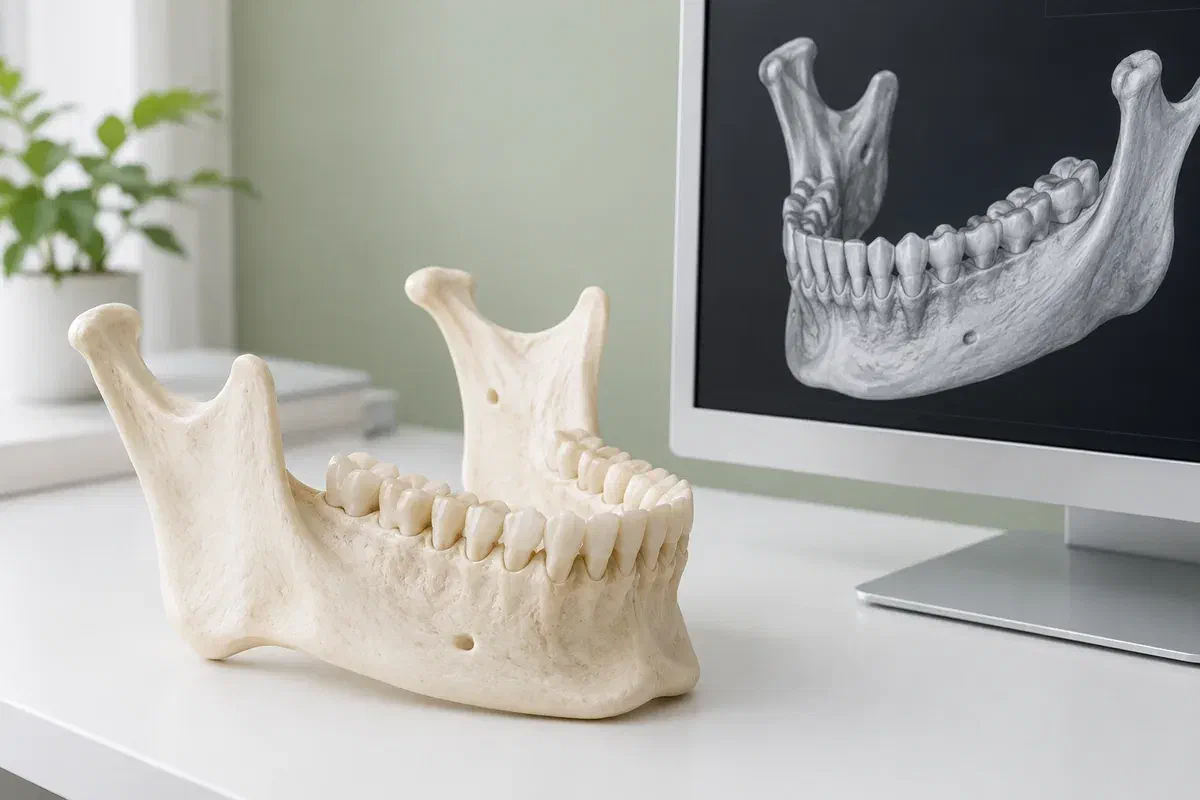
Illustrative jaw teaching model beside a generic three-dimensional dental rendering
What a referral might be about

Reasons a clinician may want depth

Referrals for 3D imaging usually trace back to a few kinds of question. These are examples for discussion, not a list of conditions that always call for a scan.

Anatomy near a planned procedure

Before an implant or certain surgery, a clinician may need to see the bone and the location of nerves or sinuses. Ask which relationship is unclear, what decision it affects, and whether another treatment approach remains available if the scan shows a limitation.

A difficult diagnostic puzzle

A specialist may request imaging when a root canal problem or other concern has not been explained by existing records. The scan contributes to diagnosis without replacing the examination or your description of symptoms, and it does not always deliver a definite answer.

An unusual tooth position or finding

A tooth that has not erupted, or something seen on another image, may need its location or extent assessed. Ask why the requested area of imaging fits the concern. Including more of the head is not inherently better for a narrow question.

A referral for CBCT should have a reason, not just a checkbox. Ask whether existing images or a lower-dose X-ray could provide what the requesting clinician needs.

Why the requesting clinician may want it

Depth for a decision, weighed against dose

Three-dimensional imaging lets the reading clinician review an area in cross-sections and from several angles. Chosen carefully, it can support diagnosis, surgical or treatment planning, and follow-up evaluation. That benefit has to be weighed against the exposure, case by case.

CBCT is an ionizing radiation exam, and it typically delivers more dose than conventional dental X-rays. The amount varies with the scanner, its settings and the region covered. A well-planned exam stays as small as the question allows while still being diagnostically adequate. It cannot be promised as risk-free, and no single dose applies to every patient.

Patient information: FDA — dental cone-beam computed tomography

A clear link to treatment

Ask the referring clinician what they will decide once the scan is read. The answer should connect the image to a real choice, such as understanding anatomy before surgery, rather than to the sophistication of the equipment.

One part of the whole picture

The images are read together with your medical and dental history, the exam and other records. Confirm who is responsible for the interpretation and how unexpected findings will be passed on.

Images that reach the right desk

When the imaging provider and the treating clinician are different, ask how the scan and report will be sent with your authorization, so the follow-up appointment can rely on the finished exam.

Following a referral through

Map out who does what.

Scanning, reading and treatment planning may be handled by different people at different addresses. Confirm the provider, where to go, the fee and how reporting will work before you leave home, particularly if another office made the request.

  1. Clarify the request and prior images

    The responsible clinician confirms why the scan is wanted and whether earlier imaging already covers it. Share the dates and locations of any previous scans. Ask what the new images should add and how they might shift the treatment plan.

  2. Prepare according to the provider

    Follow the imaging provider’s directions. Tell them if you are or might be pregnant, have difficulty holding still, or need positioning help. Metal items near the head, such as earrings or hairpins, may need to be removed.

  3. Complete the requested scan

    The team positions you and explains how to stay still while the unit moves around your head. Specifics depend on the device and the area requested. Raise any discomfort or concern before the scan starts.

  4. Review results with your clinician

    Proper interpretation is part of the exam. Ask when the report will be ready and which clinician will discuss it with you. The findings may lead to further assessment or a revised treatment plan.

When the scan is behind you

Make the report count.

Imaging gathers facts. Its usefulness depends on interpretation and follow-up, which can slip through the cracks when the scan, the reading and the treatment happen in different places.

Confirm the hand-off

Ask whether you are expected to book a results appointment or wait to hear from the referring office. If a procedure is scheduled around the report, check that it has arrived before treating the plan as final.

Keep your own summary

Record the date, the imaging provider and the area examined. Tell any future clinician about it before they propose new imaging. It may not cover a different question, but reviewing it first can help avoid needless repetition.

Report new symptoms promptly

A scan in progress is not a reason to put off care for increasing pain, swelling or another new concern. Let the treating team know about changes while you wait so they can decide whether to see you sooner.

Comparing imaging choices

Is a scan the right tool here?

The clinical question should drive the imaging. Ask whether the expected benefit justifies the requested exam, and whether a simpler method could give the same answer.

When available information suffices

Clinical exam and current records

Your history, an exam and the images already taken may be enough for a decision. A treatment discussion does not automatically trigger new imaging. The clinician should say plainly what remains uncertain.

When a flat image answers the question

Two-dimensional dental X-rays

Selected intraoral or panoramic views may provide the needed information. They have a different role from CBCT. Ask why a specific view is proposed and whether its detail is enough for the assessment.

When three dimensions are necessary

A justified 3D scan

A qualified provider chooses the scan and how it will be reported. The field and settings should reflect the diagnostic need and your circumstances. A larger or more detailed image being possible is not, on its own, a reason to take one.

Referral questions

Sorting out a CBCT request

Have the referral with you when you call. It helps us understand what was requested and whether the referring clinician or the imaging provider should answer particular practical questions.

(905) 876-4488
My specialist asked for a CBCT. Can my general dentist see the results too?
Often yes, with your authorization. Ask the imaging provider or referring office how the scan and report can be shared, and tell them which clinicians are involved in your care so the information reaches everyone who needs it.
The referral does not explain why. What should I ask?
Ask what specific question the scan is meant to answer, how the result could change your treatment, and whether existing images or a different X-ray could provide the same information. You are entitled to a clear explanation before agreeing.
Who checks that a dental CT scanner is properly permitted in Ontario?
In Ontario, the Royal College of Dental Surgeons of Ontario sets requirements for dental CT scanners used by dentists. You can ask the imaging provider about their arrangements, and the RCDSO publishes information about these requirements.
Should I get a scan before my first implant consultation?
Usually it makes sense to be assessed first. The clinician can then decide whether three-dimensional information is needed, when, and of what area. Bring details of earlier images instead of booking a scan on your own.
Is a CBCT safe to have if I might be pregnant?
Tell both the referring clinician and the imaging team before the scan. They will weigh the clinical need, the timing and appropriate precautions for your situation. Do not cancel a needed assessment without first discussing why the imaging was requested.
Can I plan the scan and the follow-up on one trip from Oakville?
Sometimes, but it depends on where the scan is done and when the report will be ready. Ask both the imaging provider and the treating office about timing before you book, so you are not making a trip for results that have not arrived.

Patient information: RCDSO — dental CT scanner requirements

3D imaging questions from Oakville

Let us help you read the referral.

Reach our Bronte Street practice with your questions and any referral details. We can explain where a scan may fit in your dental assessment and help clarify the next step. Confirm the imaging provider and appointment arrangements before you travel for a scan.

Online requests are enquiries, not confirmed scan appointments. Call if a painful or swollen area needs prompt assessment.

Visit Milton Dental Clinic
Unit 1, 342 Bronte St. S, Milton, ON L9T 5B7
Get directions Clinic hours
Monday–Thursday
11am–7pm
Friday–Sunday
By appointment only

Areas we serve

  • Milton
  • Oakville
  • Mississauga
  • Georgetown
  • Halton Hills
  • Acton
  • Campbellville
  • Brampton
  • Burlington
  • Puslinch
  • Rockwood
  • Erin
  • Caledon
  • Etobicoke
  • Old Milton
  • Bronte Meadows
  • Timberlea
  • Dorset Park
  • Dempsey
  • Clarke
  • Beaty
  • Coates
  • Harrison
  • Scott
  • Willmott
  • Ford
  • Bowes
  • Cobden
  • Walker
  • Mountain View
  • Milton Heights
  • Hawthorne Village
  • Valley View
  • Fallingbrook
  • Nassagaweya
  • Trafalgar
  • Esquesing
  • Nelson
  • Brookville
  • Moffat
  • Glen Williams
  • Norval
  • Limehouse
  • Stewarttown
  • Ashgrove
  • Hornby
  • Silver Creek
  • Speyside
  • Scotch Block
  • North Oakville
  • River Oaks
  • Glen Abbey
  • West Oak Trails
  • Palermo
  • Bronte Creek
  • College Park
  • Joshua Creek
  • Uptown Core
  • Preserve
  • Iroquois Ridge
  • Lisgar
  • Meadowvale
  • Meadowvale Village
  • Churchill Meadows
  • Erin Mills
  • Central Erin Mills
  • Streetsville
  • East Credit
  • Creditview
  • Heartland
  • Sheridan
  • Mount Pleasant
  • Credit Valley
  • Huttonville
  • Churchville
  • Springbrook
  • Northwest Brampton
  • Bram West
  • Fletcher's Meadow
  • Fletcher's Creek South
  • Alton Village
  • Orchard
  • Millcroft
  • Headon Forest
  • Tansley
  • Brant Hills
  • Tyandaga
  • Kilbride
  • Lowville
  • Aberfoyle
  • Morriston
  • Arkell
  • Hillsburgh
  • Freelton
  • Carlisle
  • Waterdown
  • Flamborough
  • Mountsberg

How can we help?

Milton Dental Clinic

Have a question about your smile? Choose the option that works best for you.

For urgent dental concerns, please call.
Messages are reviewed during clinic hours.