

Illustrative conversation with a dental hygienist before an appointment
General & Family Dentistry

Dental Hygiene Appointments in Old Milton

Crowns, bridges and fillings from years past all need cleaning too. Hygiene care for Old Milton looks at the gums around that work and shows you how to keep each surface clean.

Hygiene visits near Old Milton

Decades of dental work deserve careful upkeep.

By midlife, many mouths carry a history: a bridge placed fifteen years ago, a few crowns, fillings of different ages. Each one adds an edge or a gap where plaque can settle, and the gum tissue beside that work needs as much attention as natural teeth do. A hygiene appointment is a chance to check those borders.

Our Bronte Street practice sits a short way from Milton's historic downtown, and plenty of people who come to us from those established streets have kept the same routine for years. That habit may have served you well. Still, mouths change with age, medicines and new dental work, so a fresh look at your technique can be worthwhile.

Mention anything that has shifted lately. A floss that now snags, a crown that collects food, a dry feeling in the morning or gums that look longer than they used to are all clues. They steer the team towards the care your mouth needs, instead of a fixed routine applied to everyone.

Request a hygiene visit
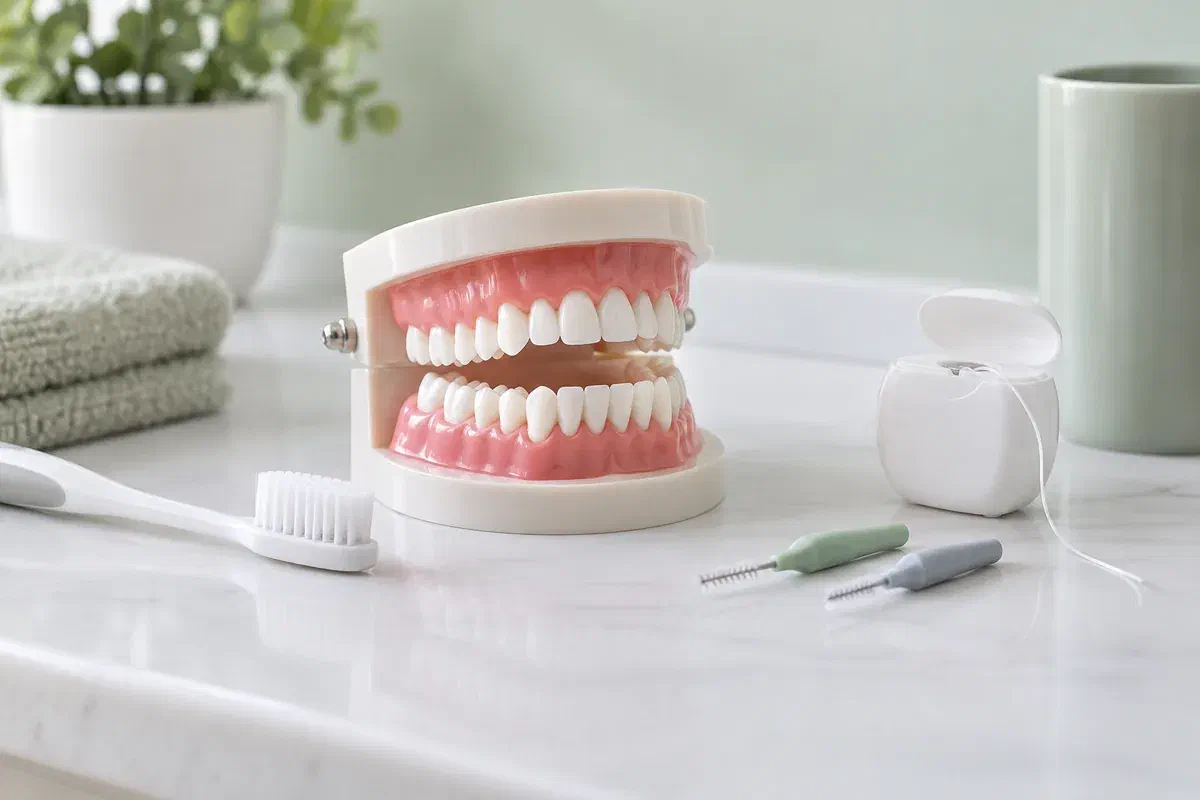
Dental teaching model with a toothbrush, interdental brushes, and floss
Old Milton concerns we hear

Food traps, dry mornings and tender edges.

A problem does not have to hurt to be worth raising. Point to the tooth or area involved, say how long it has been going on and describe what you already do about it.

Gums that bleed beside older work

Tissue next to a crown or bridge can become inflamed when plaque gathers at the margin. Bleeding there is not proof that you brush too hard. Tell us whether it is one spot or widespread, and whether you have noticed swelling or a tooth that feels looser.

Surfaces your brush cannot reach

The underside of a bridge, the back of a last molar and the junction between crown and root are classic hiding places. Hardened deposits there will not budge with brushing. Ask the hygienist to show you the spot and the aid that fits it.

Sensitive roots or a difficult past cleaning

Receding gums can leave root surfaces exposed and quick to react to cold or instruments. If a past visit was hard to tolerate, explain what happened. The team can go over the plan, take breaks when you signal and talk about ways to keep you comfortable.

Bring an up-to-date list of medicines and mention recent surgery, joint replacements or any instructions from your physician. Your history guides safe care, even at a routine cleaning.

What you gain from the visit

Clean margins, healthier gums and a technique that fits.

Plaque begins as a soft film that daily cleaning can lift. Left in place, it hardens into tartar, which only professional instruments remove. Both can contribute to gum inflammation, so your hygienist assesses the surrounding tissue as well as the build-up, especially around restorations.

There is also room to learn. A threader for a bridge, a smaller interdental brush or a different grip can turn a frustrating task into a manageable one. Ask to see the exact area in a hand mirror, then tell us whether the method suits your hands and the time you have.

Patient information: NIDCR — oral hygiene and professional care

A gum history you can follow

Measurements recorded over several visits show whether things are stable, improving or slipping. Ask which numbers are encouraging and which ones the team will keep an eye on. That makes your home efforts easier to judge.

Cleaning suited to your mouth

A maintenance visit and treatment for gum disease are different appointments with different aims. Your hygienist should explain which one the findings support and whether everything can be done today or needs a later visit.

Aids that match your restorations

Bridges, implants and tight contacts each call for a particular tool. Ask for suggestions based on your own dental work and on any stiffness in your fingers or wrists. One well-chosen aid often beats several that sit unused.

Step by step

A careful visit that explains as it goes.

Let the team know what you would like to understand and agree a simple way to ask for a pause. Speaking up about tender areas or tricky tools makes the time far more useful.

  1. Review medicines and recent changes

    We update your medical details, including prescriptions that may cause dry mouth, and ask what you have noticed since your last cleaning. Mention sensitivity, bleeding and any spots you skip. If it has been a long time, that is simply useful information.

  2. Examine gums, margins and deposits

    The hygienist checks tissue health, build-up along restorations and gum measurements. Findings may point to a dentist's examination or X-rays as well. Hygiene care is one piece of a broader assessment, not a substitute for it.

  3. Clean around natural teeth and dental work

    Hand scalers or ultrasonic instruments are chosen to suit each area, including crowns and bridges. Polishing or fluoride is offered when it helps, not automatically. Tell us if a root surface feels sharp so the approach can be adjusted.

  4. Rehearse the routine and set a review

    Before you leave, try any new aid in front of the hygienist so questions can be answered on the spot. Ask whether more gum treatment or a recheck is planned, and why that timing suits you. The next visit should have a clear aim.

Looking after it at home

Small, regular care keeps restorations in good shape.

Your own routine and professional cleaning work as a pair. Follow any instructions tailored to today's care, and ask if you are unsure how to look after a tender area.

Brush where tooth meets gum

A soft brush and fluoride toothpaste, angled towards the gumline and the edges of crowns, does more than heavy pressure. If an area is hard to reach because of a bridge or a stiff shoulder, ask about a different handle or brush head.

Clean under and between restorations

Use the threader, floss or interdental brush recommended for each space. Do not force an aid into a tight contact or snap floss into the gum. If something repeatedly catches on a crown edge, let us know so the area can be checked.

Call about changes that persist

Mild tenderness after care often fades, but contact us if pain grows or bleeding does not settle. A new swelling, a crown that feels loose or a change in your bite needs assessment. Do not wait for a routine recall when something is different.

Which kind of care fits

Maintenance, gum treatment or focused coaching.

The findings help determine the right approach. Ask what they mean for you and whether further assessment is needed before the plan is finalised.

For stable gums and well-kept restorations

Ongoing hygiene maintenance

Deposits are removed, gum health is reviewed and home care is fine-tuned. How often you return should depend on your mouth. Even without symptoms, regular checks help catch changes around older dental work early.

When gum disease is diagnosed

Periodontal treatment

Care may involve cleaning below the gumline, a reassessment visit or referral to a periodontist. It is a different kind of treatment, not just a firmer polish. Ask about the diagnosis, how many visits to expect and how progress will be measured.

When access or dexterity gets in the way

Coaching for hard-to-clean areas

The visit can concentrate on cleaning under bridges, around implants or between crowded teeth, and on aids that suit your grip. Practice should focus on the exact area that troubles you, with time to ask questions.

Patient information: NIDCR — gum disease assessment and treatment

Your questions answered

Practical answers for mouths with a history.

Recommendations depend on your gums and on the dental work you already have. Find out what is included, what it costs and how comfort will be managed before care begins.

(905) 876-4488
Can ultrasonic cleaning damage my crowns or older fillings?
Instruments are chosen and used with existing restorations in mind. If you have porcelain crowns, veneers or implants, mention them so the hygienist can select a suitable approach. Tell us if a filling feels rough or chipped, since that may need a dentist’s assessment.
My mouth feels dry since starting a new medication. Should I mention it?
Yes. Many common medicines reduce saliva, and a dry mouth can affect comfort and the risk of decay. Bring your medication list. The team can discuss what they see and suggest ways to manage it, and you can raise it with your physician too.
How should I clean around a dental implant?
Implants need daily cleaning much like natural teeth, though the tools may differ. Ask the hygienist to demonstrate an aid that fits the space around your implant. Report bleeding, tenderness or a change in how the crown feels.
Do I still need hygiene visits if I wear a partial denture?
Your remaining teeth and gums still need care, and the areas where a partial rests can collect plaque. Bring the denture to your appointment so the fit and the surrounding tissue can be checked. Ask how best to clean both the appliance and your teeth.
Does a hygiene booking cover everything a dentist would check?
Not always. Hygiene care focuses on gums, deposits and prevention, while a dentist’s examination looks at decay, restorations and other conditions. Ask what your booking covers and whether an exam or X-rays are due.
Is there a better time of day to book if I'm coming from Old Milton?
Our hours run Monday to Thursday from 11am to 7pm, and Friday to Sunday by appointment only. Many people prefer a time that avoids rushing. Ask the team about openings that suit your week, especially if you need a longer appointment.
Book hygiene care from Old Milton

Keep your teeth and dental work comfortable for years to come.

Get in touch with our Bronte Street practice to arrange a cleaning. Bring questions about dry mouth, tender roots, bridge aids or how often you should return. We will explain what we find and work out the next steps with you.

If a crown feels loose, a tooth aches or something has changed, mention it when you book so an assessment can be planned alongside your hygiene care.

Visit Milton Dental Clinic
Unit 1, 342 Bronte St. S, Milton, ON L9T 5B7
Get directions Clinic hours
Monday–Thursday
11am–7pm
Friday–Sunday
By appointment only

Areas we serve

  • Milton
  • Oakville
  • Mississauga
  • Georgetown
  • Halton Hills
  • Acton
  • Campbellville
  • Brampton
  • Burlington
  • Puslinch
  • Rockwood
  • Erin
  • Caledon
  • Etobicoke
  • Old Milton
  • Bronte Meadows
  • Timberlea
  • Dorset Park
  • Dempsey
  • Clarke
  • Beaty
  • Coates
  • Harrison
  • Scott
  • Willmott
  • Ford
  • Bowes
  • Cobden
  • Walker
  • Mountain View
  • Milton Heights
  • Hawthorne Village
  • Valley View
  • Fallingbrook
  • Nassagaweya
  • Trafalgar
  • Esquesing
  • Nelson
  • Brookville
  • Moffat
  • Glen Williams
  • Norval
  • Limehouse
  • Stewarttown
  • Ashgrove
  • Hornby
  • Silver Creek
  • Speyside
  • Scotch Block
  • North Oakville
  • River Oaks
  • Glen Abbey
  • West Oak Trails
  • Palermo
  • Bronte Creek
  • College Park
  • Joshua Creek
  • Uptown Core
  • Preserve
  • Iroquois Ridge
  • Lisgar
  • Meadowvale
  • Meadowvale Village
  • Churchill Meadows
  • Erin Mills
  • Central Erin Mills
  • Streetsville
  • East Credit
  • Creditview
  • Heartland
  • Sheridan
  • Mount Pleasant
  • Credit Valley
  • Huttonville
  • Churchville
  • Springbrook
  • Northwest Brampton
  • Bram West
  • Fletcher's Meadow
  • Fletcher's Creek South
  • Alton Village
  • Orchard
  • Millcroft
  • Headon Forest
  • Tansley
  • Brant Hills
  • Tyandaga
  • Kilbride
  • Lowville
  • Aberfoyle
  • Morriston
  • Arkell
  • Hillsburgh
  • Freelton
  • Carlisle
  • Waterdown
  • Flamborough
  • Mountsberg

How can we help?

Milton Dental Clinic

Have a question about your smile? Choose the option that works best for you.

For urgent dental concerns, please call.
Messages are reviewed during clinic hours.