
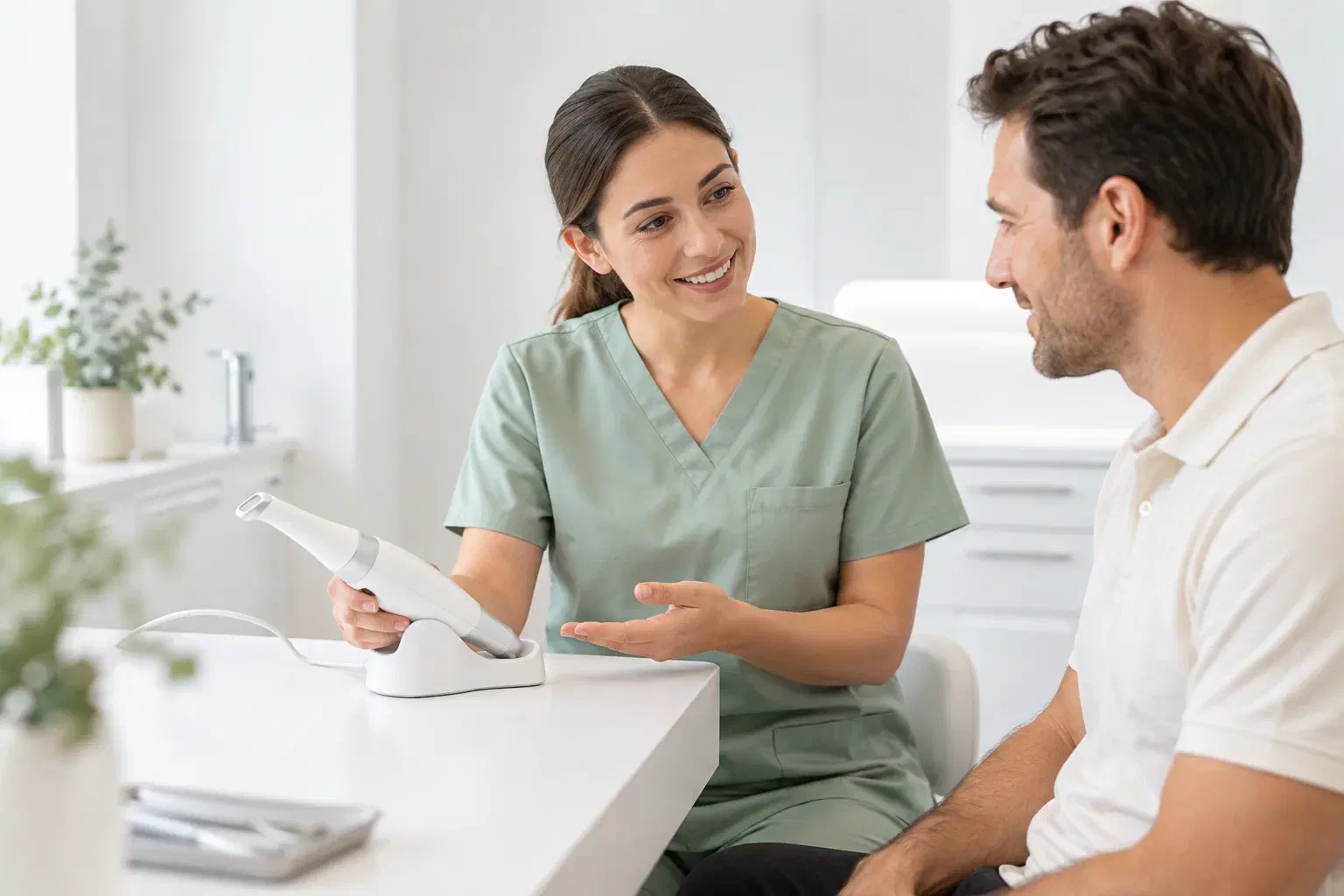
Illustrative discussion of an optical dental scanner, not a photograph of clinic equipment
General & Family Dentistry

Digital Dental Impressions in Acton

Only one tooth needs a crown, so why does the scanner cover both jaws? Coming from Acton, learn how a digital impression records the bite as well as the tooth, why that matters for fit, and what the visit is likely to involve.

Bite and fit, explained for Acton

One tooth treated, both jaws recorded.

It can seem odd that the scanner keeps going well after it has covered the tooth being treated. The explanation is that teeth work in pairs. A new crown or appliance has to fit the tooth it sits on, sit comfortably beside its neighbours and meet the teeth opposite in the right way. An impression gathers all of that, and an optical scanner records it as a digital surface model.

That model is a set of measurements, not a treatment. For suitable cases, scanning can take the place of trays of impression material for both jaws. Whether it suits you depends on what must be recorded, the work proposed and how precise the record has to be. Even with a careful bite record, a new piece may need small adjustments once it is in place.

Ask how the impression and bite record would be taken for your care, and what arrangements are available. If you have had trouble with gagging, a stiff or sore jaw, or an earlier impression, tell us. Our team can explain the steps and suitability, rather than assuming a single method fits every bite.

Ask how your bite will be recorded
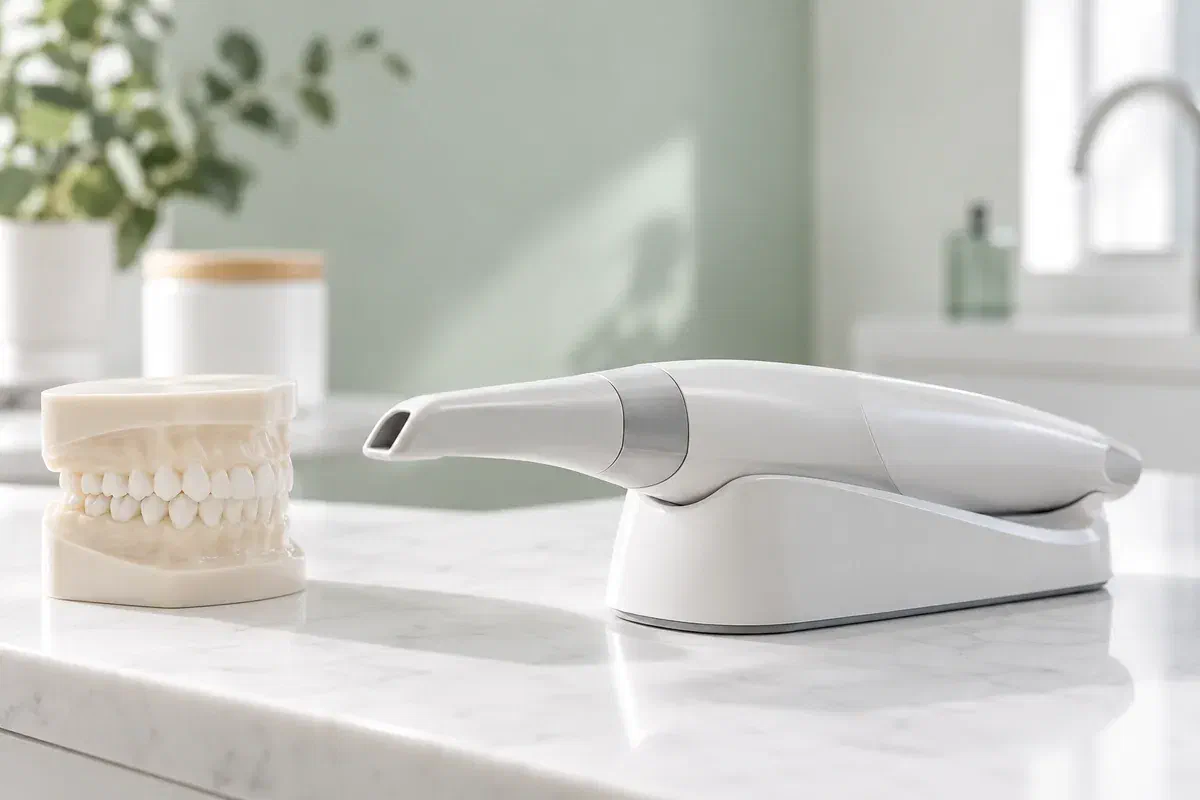
Illustrative unbranded optical scanner beside a dental teaching model
Reasons for recording

Fit depends on more than one tooth.

An impression should be tied to a specific piece of work. Ask which teeth on each jaw will be captured and how the bite information will be used when the work is designed.

A restoration that has to meet its opposite

A crown or similar restoration is shaped so that it contacts the teeth opposite without sitting too high or too low. That means recording the prepared tooth, its neighbours and the bite. Some appliances need both full arches. Ask what your case requires.

Jaw or gag concerns

Holding two separate trays can be hard for some people, especially with a sensitive gag reflex or a tired jaw. Describe what has bothered you. Where suitable, scanning may be worth raising, though it still means time with your mouth open and is not guaranteed to be easy.

A bite that has shifted

New fillings, worn teeth, a lost tooth or movement over time can all change how your teeth meet. An earlier record may no longer match. Let the team know what has changed, and they will decide whether an existing file still provides what is needed.

Scans of both jaws still show only the surfaces of teeth and gums. They are not X-rays or CBCT images and do not replace imaging needed to look at roots, bone or the joint itself.

What the bite record adds

A model of how your teeth meet.

With an optical system, the two jaws can be scanned separately and then related to each other through a record of your bite. The team can usually see during the visit if a section is missing or the bite has not registered clearly, and repeat it. The finished file then goes into the clinical and laboratory steps that produce your work.

Some people find scanning more comfortable than biting into trays, although it varies and how long it takes depends on what is being recorded. Before you start, discuss breaks, how wide you can open and how to signal if your jaw gets tired.

Patient information: UCLH — digital impressions in dental care

Seeing upper and lower together

When the system supports it, the team can show you both arches on screen and how they fit together. That helps explain why the opposing jaw matters. The model assists with planning and is not a diagnosis.

Information for designing contact

An adequate file may be shared through the appropriate professional workflow so the piece can be shaped to meet its opposing teeth. Ask what happens next and who is responsible. A scan does not, on its own, fix the delivery date.

Contact points verified

The record must capture every detail the planned work depends on, including the bite. If that information is unclear, the team may repeat it or use another method. That check is part of getting a useful impression.

During the appointment

Upper, lower, then the two together.

The visit will depend on the treatment. Ask in advance whether you are coming only for records, or whether a tooth will also be prepared or a temporary placed.

  1. Go over the purpose

    Your dentist explains what the impression is for, which teeth and bite information are needed and whether scanning suits your case and is available. Ask about other options and fees, and mention any jaw or gag concerns.

  2. Get the surfaces ready

    The teeth to be scanned need to be dry and visible. Depending on the procedure, the gum around a prepared tooth may be managed so its edges can be seen. Fine detail there is important for a crown.

  3. Scan each jaw

    A wand is guided around the relevant teeth on the upper and lower jaws while the models form on screen. Follow the team’s directions about head and jaw position, and use the agreed signal if you need to rest.

  4. Record and check the bite

    You will usually be asked to close your teeth together in a specific way so the two models can be related. The team reviews the result and repeats it if needed. Confirm your next visit, temporary care steps and when the fit will be checked.

In the days after

Notice your bite, and tell us if it changes.

The scan itself rarely needs recovery time. If a tooth was prepared, freezing used or a temporary placed during the same visit, those may come with separate advice.

Be gentle with a temporary

A temporary restoration needs the chewing and cleaning care the dentist explains. If it loosens, breaks, feels high when you bite or becomes sore, call us. A completed scan of the final work is no reason to put up with a damaged temporary.

Report a changed bite

If a tooth chips, a filling is replaced elsewhere or your teeth start meeting differently after the scan, let us know. The bite record may need to be reviewed. New pain or swelling should be looked at rather than accepted as normal.

Have the fit and bite checked

When the crown or appliance is ready, it is tried in and the way your teeth meet is checked. Small adjustments are common. Being designed digitally does not replace that step, or a follow-up if your bite feels wrong later.

How the record can be taken

Three ways to capture teeth and bite.

The dentist considers what information the work needs and whether it can be recorded dependably. Ask why one method is recommended, instead of assuming the most modern option is always best.

Used when a surface model suits the work

Scanning both arches

Upper and lower scans plus a digital bite record can support a suitable restorative or appliance workflow. Check that it is right for your case and offered here. Recording is a first stage; assessment, design, making and fitting come later.

Used when physical impressions are advised

Trays and a bite registration

Material impressions of each jaw, with a separate bite record, may still be preferred for some needs. Explain any trouble you have had so comfort can be planned. A tray-made crown can meet your bite just as well when the record is sound.

Used when more information is required

Further records

Photographs, additional bite records, X-rays or another impression may help answer separate questions. Ask what each adds. Surface models cannot reveal everything about the teeth, the jaw joint or whether a treatment is suitable.

Acton questions about bite and fit

Why the opposite teeth matter.

Ask about the work being planned, how your bite will be recorded and what happens afterwards. Answers should link each part of the record to how the finished piece will fit.

(905) 876-4488
Why scan my lower teeth when the crown is on an upper tooth?
The crown has to meet the lower teeth properly when you bite and chew. Recording the opposing teeth lets the work be shaped to that contact. Without it, the new piece could sit too high or miss its partner.
What if my jaw is sore on the day of the scan?
Tell the team at the start. A sore jaw can affect how you open and how you bite, which may matter for the bite record. They can take more breaks, or discuss whether another day would give a more reliable record.
Do I need to bite down hard for the bite record?
Usually you are asked to close together naturally in a particular position, not to clench. Follow the instructions given at the time, and ask if anything is unclear. The team will repeat it if the record does not look right.
Can the scan show that I grind my teeth?
A surface model may show wear, but deciding whether grinding is happening and what to do about it comes from an examination and your history. Mention clenching or grinding to the dentist, as it may affect the type of work planned.
How is a new crown matched to the height of my other teeth?
The design uses the scans of both jaws and the bite record to shape the crown so it meets neighbouring and opposing teeth. At the fitting, the dentist checks the bite and adjusts if needed.
Can I book records near the end of the day if I’m driving in from Acton?
Ask the front desk. Clinic hours are Monday to Thursday, 11am to 7pm, with Friday to Sunday by appointment only. Let us know how long your treatment visit may take so a suitable time can be arranged.
Arranging a visit from Acton

Talk to us about your bite before the scan.

Call our Bronte Street practice to discuss your planned crown, bridge or appliance and any concerns about your bite or about impressions. We can explain which records may be needed and confirm the arrangements for your care. Questions about comfort, timing and fit are welcome.

Confirm whether scanning suits your treatment and is available. The scanner illustrations shown are not photographs of clinic equipment.

Visit Milton Dental Clinic
Unit 1, 342 Bronte St. S, Milton, ON L9T 5B7
Get directions Clinic hours
Monday–Thursday
11am–7pm
Friday–Sunday
By appointment only

Areas we serve

  • Milton
  • Oakville
  • Mississauga
  • Georgetown
  • Halton Hills
  • Acton
  • Campbellville
  • Brampton
  • Burlington
  • Puslinch
  • Rockwood
  • Erin
  • Caledon
  • Etobicoke
  • Old Milton
  • Bronte Meadows
  • Timberlea
  • Dorset Park
  • Dempsey
  • Clarke
  • Beaty
  • Coates
  • Harrison
  • Scott
  • Willmott
  • Ford
  • Bowes
  • Cobden
  • Walker
  • Mountain View
  • Milton Heights
  • Hawthorne Village
  • Valley View
  • Fallingbrook
  • Nassagaweya
  • Trafalgar
  • Esquesing
  • Nelson
  • Brookville
  • Moffat
  • Glen Williams
  • Norval
  • Limehouse
  • Stewarttown
  • Ashgrove
  • Hornby
  • Silver Creek
  • Speyside
  • Scotch Block
  • North Oakville
  • River Oaks
  • Glen Abbey
  • West Oak Trails
  • Palermo
  • Bronte Creek
  • College Park
  • Joshua Creek
  • Uptown Core
  • Preserve
  • Iroquois Ridge
  • Lisgar
  • Meadowvale
  • Meadowvale Village
  • Churchill Meadows
  • Erin Mills
  • Central Erin Mills
  • Streetsville
  • East Credit
  • Creditview
  • Heartland
  • Sheridan
  • Mount Pleasant
  • Credit Valley
  • Huttonville
  • Churchville
  • Springbrook
  • Northwest Brampton
  • Bram West
  • Fletcher's Meadow
  • Fletcher's Creek South
  • Alton Village
  • Orchard
  • Millcroft
  • Headon Forest
  • Tansley
  • Brant Hills
  • Tyandaga
  • Kilbride
  • Lowville
  • Aberfoyle
  • Morriston
  • Arkell
  • Hillsburgh
  • Freelton
  • Carlisle
  • Waterdown
  • Flamborough
  • Mountsberg

How can we help?

Milton Dental Clinic

Have a question about your smile? Choose the option that works best for you.

For urgent dental concerns, please call.
Messages are reviewed during clinic hours.