
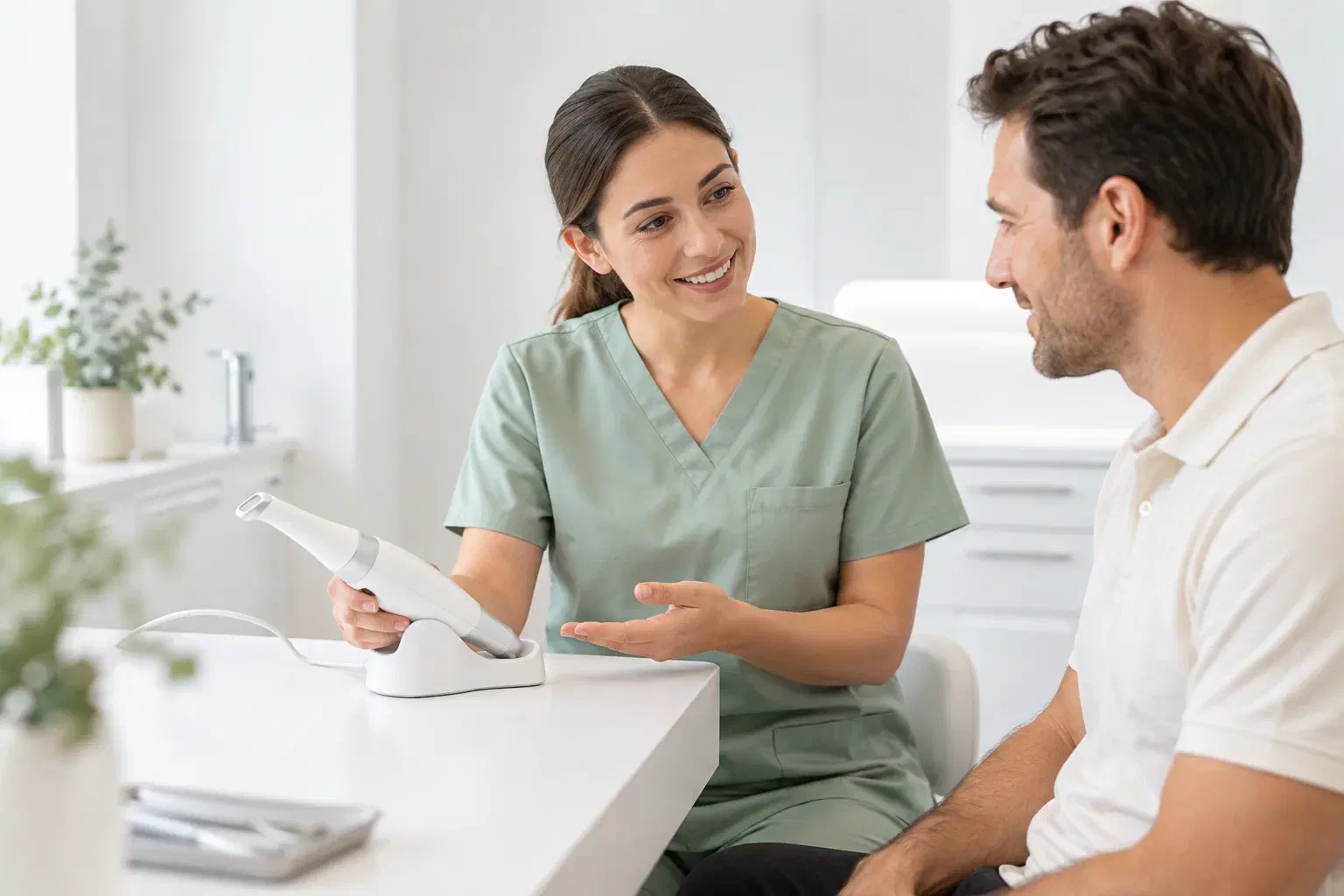
Illustrative discussion of an optical dental scanner, not a photograph of clinic equipment
General & Family Dentistry

Digital Dental Impressions in Campbellville

A jaw that clicks, aches or will not open far can make any impression harder. For households in Campbellville, learn how an optical scan may be paced around limited opening, what it still asks of you and when another method is wiser.

Campbellville, and a jaw that needs care

Open only as far as is comfortable.

Some people dread impressions not because of gagging but because their jaw protests. Holding wide for minutes at a time while material sets can leave it aching for days. Knowing what the impression is for helps when planning around that. It captures the shape and position of teeth and surrounding tissue so a crown, appliance or plan can be built, and an optical scanner records this as a digital model.

The scan is an information-gathering step and does not treat the tooth or the jaw. For suitable cases it can replace trays of impression material, and because it is built up in sections there may be room for rests along the way. Suitability still depends on the area involved, the work planned and the detail needed. Some mouths and cases are better served by another approach.

Describe your jaw when you book: how far it opens, whether it clicks or locks and how long it tolerates being held open. Also mention gagging or a past impression that went badly. With that, our team can explain how your record would be taken and what can be arranged, instead of assuming one method suits everyone.

Ask about pacing your impression
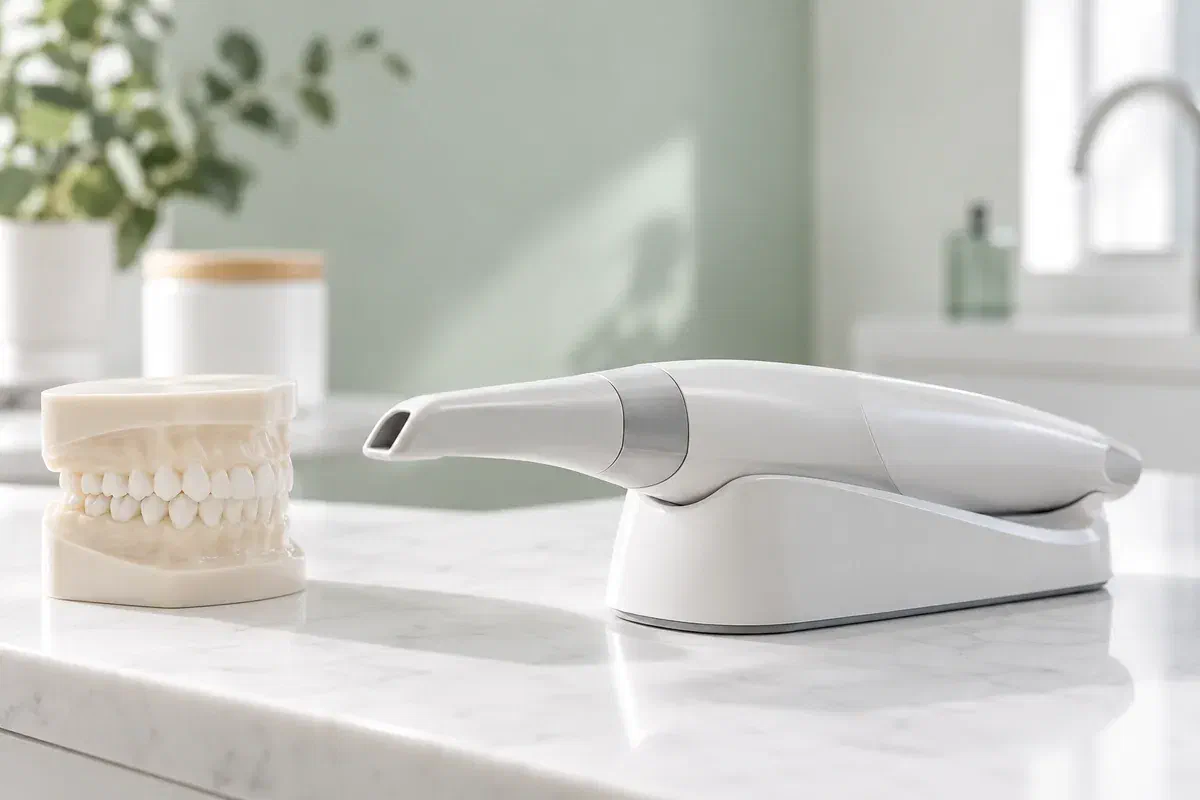
Illustrative unbranded optical scanner beside a dental teaching model
Why an impression may be needed

A record for the work, planned around your jaw.

The scan should serve a defined treatment. Ask which teeth will be recorded and how the resulting model will be used, so the visit asks no more of your jaw than the work requires.

Dental work that needs a precise model

A crown or another suitable restoration may require detail of a prepared tooth, the teeth beside it and the bite. Some appliances depend on a full-arch model. Find out what your case needs, so time with your mouth open is spent on what matters.

Discomfort from holding your mouth open

If your jaw tires, aches or opens only partway, say so before the appointment. Scanning may be worth discussing where it suits the work, since it can sometimes be done in shorter stretches. It still requires access to the teeth, so some strain is possible.

Changes since an earlier record

A moved tooth, new dental work or a revised plan can make an old impression unreliable. Mention any changes. The team will judge whether an existing file still shows what this treatment depends on, which may spare you a repeat.

A digital impression maps only the outer surfaces of teeth and gums. It is a different examination from an X-ray or CBCT scan, and it tells nothing about the jaw joint, roots or bone, which may need separate assessment.

How scanning can be gentler on the jaw

Rest between sections, not a single long hold.

Material impressions generally need to stay in place until they set. A scanner, by contrast, builds the model piece by piece, so the team can often stop, let you close and rest, and then pick up where they left off. Missing patches are visible on screen and can be filled in later in the same visit. The record then moves into the clinical and laboratory work for your treatment.

That flexibility helps some people a great deal and others less, and total scanning time depends on the case. Discuss beforehand how often you would like to pause, how far your jaw opens without pain and what head or chair position helps.

Patient information: UCLH — digital impressions in dental care

Progress you can follow

If the system displays it, the team can show how much of the model is complete, which can make a long visit feel more manageable. They can also explain why neighbouring or opposing teeth are included. The model supports planning only.

A file for the design stage

A suitable record may be passed through the proper professional workflow to help design and make your piece. Ask who carries out that stage and what it involves. Completing a scan does not determine when the work will be ready.

Completeness without starting over

The model needs every detail the restoration or appliance relies on. If an area is incomplete, it can usually be rescanned rather than repeating the whole record, although another method is sometimes needed instead.

A paced appointment

Short stretches, with room to close and rest.

What happens on the day depends on the treatment. Ask whether the visit is for records alone, or whether preparing a tooth or placing a temporary will extend how long you need to keep open.

  1. Plan the rests in advance

    The dentist explains the purpose of the impression and whether a scan is appropriate and offered for your care. Talk about alternatives, fees and how your jaw behaves. Agree on a signal for stopping and how often to break.

  2. Make the teeth easy to read

    The scanner needs dry, visible surfaces. Depending on the procedure, the team may handle the gum around a tooth. For a tooth prepared for a crown, its edges need clear capture, which may take a little focused time.

  3. Scan in pieces

    The wand moves over the relevant teeth while the model builds, with pauses whenever you need them. Opposing teeth and your bite may be recorded too. Open only as far as is comfortable, and tell the team if your jaw starts to ache.

  4. Review and wrap up

    The team checks the model for completeness and suitability, scanning again or changing method if necessary. Confirm your next appointment, any temporary care and when the finished piece will be fitted and checked.

Looking after yourself afterwards

Give your jaw a rest, and follow the treatment advice.

There is usually no recovery from a scan alone, although a jaw that has been held open may feel tired. Other care done at the same visit, such as freezing or a temporary, may have its own instructions.

Protect any temporary restoration

Follow the dentist’s guidance on eating and cleaning if a temporary has been placed. Call us if it loosens, breaks or becomes sore. Having the final work scanned already does not make a damaged temporary something to ignore.

Mention lasting jaw pain or other changes

A tired jaw usually settles, but tell us if pain persists, your jaw locks or your bite feels different. The same applies if a tooth breaks or work is replaced elsewhere. The record may need review, and new symptoms deserve assessment.

Come back for the fitting

Your restoration or appliance needs to be tried in and checked for how it sits, how you bite on it and how comfortable it feels. Adjustments may be needed. A digital workflow does not remove that visit or later follow-up.

Options to discuss

Which record will your jaw tolerate best?

Your jaw’s limits sit alongside a clinical question: what must be recorded, and which method will record it dependably. Ask why a method is recommended, rather than assuming the newest option is automatically the most suitable.

When scanning fits the work and your jaw

Sectional optical scanning

A scanner builds a virtual model that can serve a suitable restorative or appliance process, with rests between sections where possible. Confirm it is right for your case and offered. Design, manufacture and fitting follow as separate stages.

When a physical mould is preferable

A material impression

Trays and material may still be advised for certain clinical needs. If so, describe your jaw limits so timing and positioning can be considered. Choosing this route does not mean the finished dental work will be inferior.

When the jaw or the information needs a closer look

Further assessment

Photographs, bite records, imaging or an examination of the jaw may be needed to answer other questions. Ask what each adds. A surface scan cannot show everything about the teeth, the joint or whether treatment is suitable.

Campbellville questions about jaw comfort

Scanning with a jaw that needs gentleness.

Pacing tends to be the big question, but bring anything about the planned work or the recording method too. Answers should balance what the record needs with what your jaw can manage.

(905) 876-4488
I have jaw joint problems. Is a digital impression still possible?
Often it can be considered, but it depends on how far you can open, the teeth to be recorded and the work planned. Tell the dentist about your jaw history. If scanning is not practical, other ways of recording can be discussed.
How long will I need to hold my mouth open at one stretch?
That varies with the area and the scanner’s progress, but scanning can often be split into short sections. Agree in advance how long you are comfortable with, and signal whenever you need to close and rest.
Should I take something for jaw pain before the appointment?
Ask your dentist, physician or pharmacist what is appropriate for you, especially if you take other medicines. Let the team know about any pain on the day so they can adjust the pace of the visit.
Does chair or head position make a difference?
It can. Small changes in how you are reclined or how your head is turned may make it easier to reach some teeth without opening as wide. Tell the team what feels better or worse as you go.
What if my jaw clicks or locks during the scan?
Signal straight away so the team can stop. Let them know whether this happens often and what usually helps. The dentist may adjust the plan for the visit or discuss assessing the jaw before continuing.
Can my records visit be combined with other care to save a trip from Campbellville?
Ask when booking. Sometimes records, a check-up or another procedure can share an appointment, but it depends on what is needed and how long your jaw can comfortably manage in one sitting.
Planning from Campbellville

Tell us how your jaw behaves, and we’ll pace the record.

Contact our Bronte Street practice to discuss the restoration or appliance you need, along with any jaw discomfort or past difficulty with impressions. We can explain the records likely to be needed and confirm the arrangements for your care. Questions about comfort, pacing and timing are welcome.

Scanning suitability and availability depend on your treatment and should be confirmed. The scanner images on this page are illustrative only.

Visit Milton Dental Clinic
Unit 1, 342 Bronte St. S, Milton, ON L9T 5B7
Get directions Clinic hours
Monday–Thursday
11am–7pm
Friday–Sunday
By appointment only

Areas we serve

  • Milton
  • Oakville
  • Mississauga
  • Georgetown
  • Halton Hills
  • Acton
  • Campbellville
  • Brampton
  • Burlington
  • Puslinch
  • Rockwood
  • Erin
  • Caledon
  • Etobicoke
  • Old Milton
  • Bronte Meadows
  • Timberlea
  • Dorset Park
  • Dempsey
  • Clarke
  • Beaty
  • Coates
  • Harrison
  • Scott
  • Willmott
  • Ford
  • Bowes
  • Cobden
  • Walker
  • Mountain View
  • Milton Heights
  • Hawthorne Village
  • Valley View
  • Fallingbrook
  • Nassagaweya
  • Trafalgar
  • Esquesing
  • Nelson
  • Brookville
  • Moffat
  • Glen Williams
  • Norval
  • Limehouse
  • Stewarttown
  • Ashgrove
  • Hornby
  • Silver Creek
  • Speyside
  • Scotch Block
  • North Oakville
  • River Oaks
  • Glen Abbey
  • West Oak Trails
  • Palermo
  • Bronte Creek
  • College Park
  • Joshua Creek
  • Uptown Core
  • Preserve
  • Iroquois Ridge
  • Lisgar
  • Meadowvale
  • Meadowvale Village
  • Churchill Meadows
  • Erin Mills
  • Central Erin Mills
  • Streetsville
  • East Credit
  • Creditview
  • Heartland
  • Sheridan
  • Mount Pleasant
  • Credit Valley
  • Huttonville
  • Churchville
  • Springbrook
  • Northwest Brampton
  • Bram West
  • Fletcher's Meadow
  • Fletcher's Creek South
  • Alton Village
  • Orchard
  • Millcroft
  • Headon Forest
  • Tansley
  • Brant Hills
  • Tyandaga
  • Kilbride
  • Lowville
  • Aberfoyle
  • Morriston
  • Arkell
  • Hillsburgh
  • Freelton
  • Carlisle
  • Waterdown
  • Flamborough
  • Mountsberg

How can we help?

Milton Dental Clinic

Have a question about your smile? Choose the option that works best for you.

For urgent dental concerns, please call.
Messages are reviewed during clinic hours.