
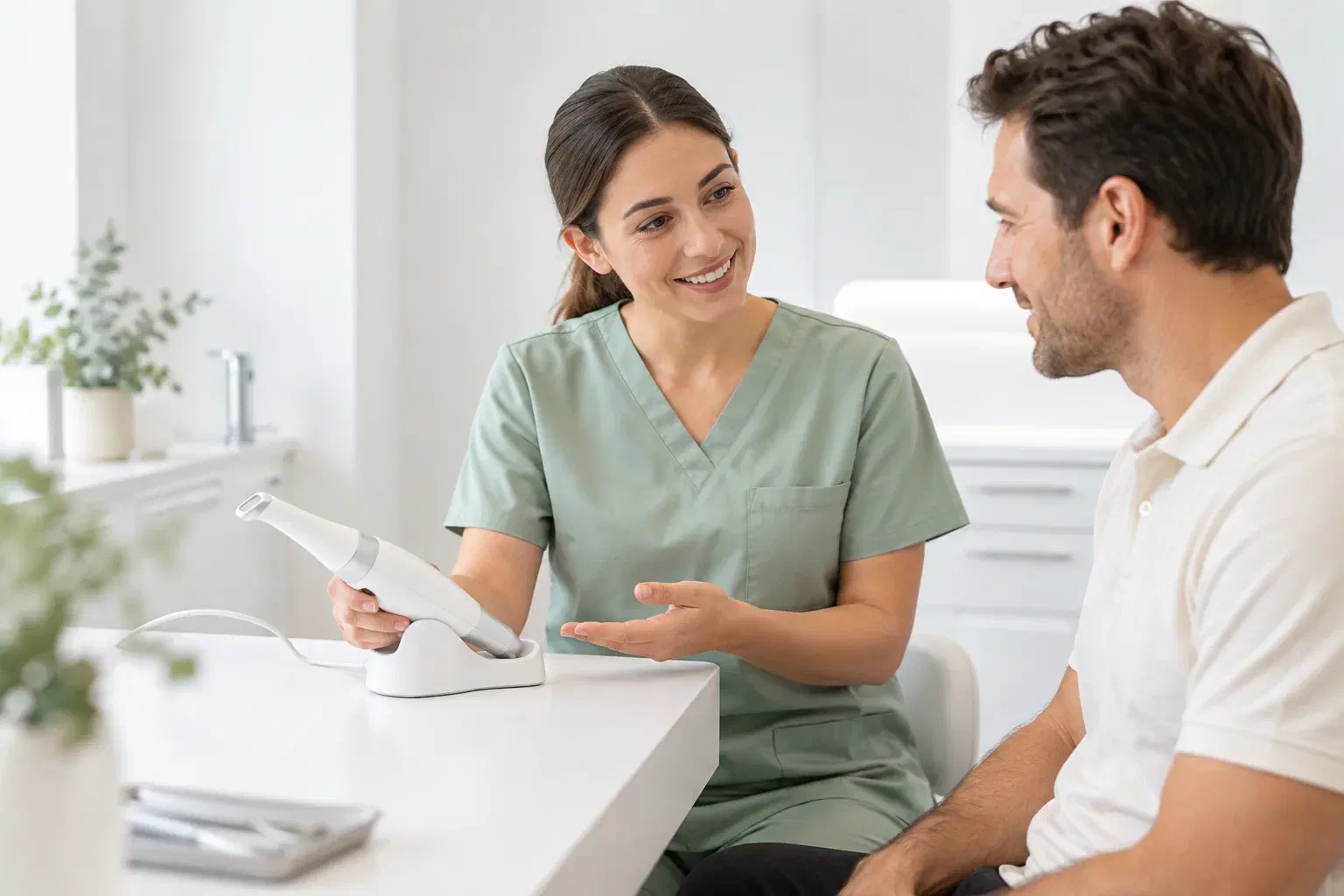
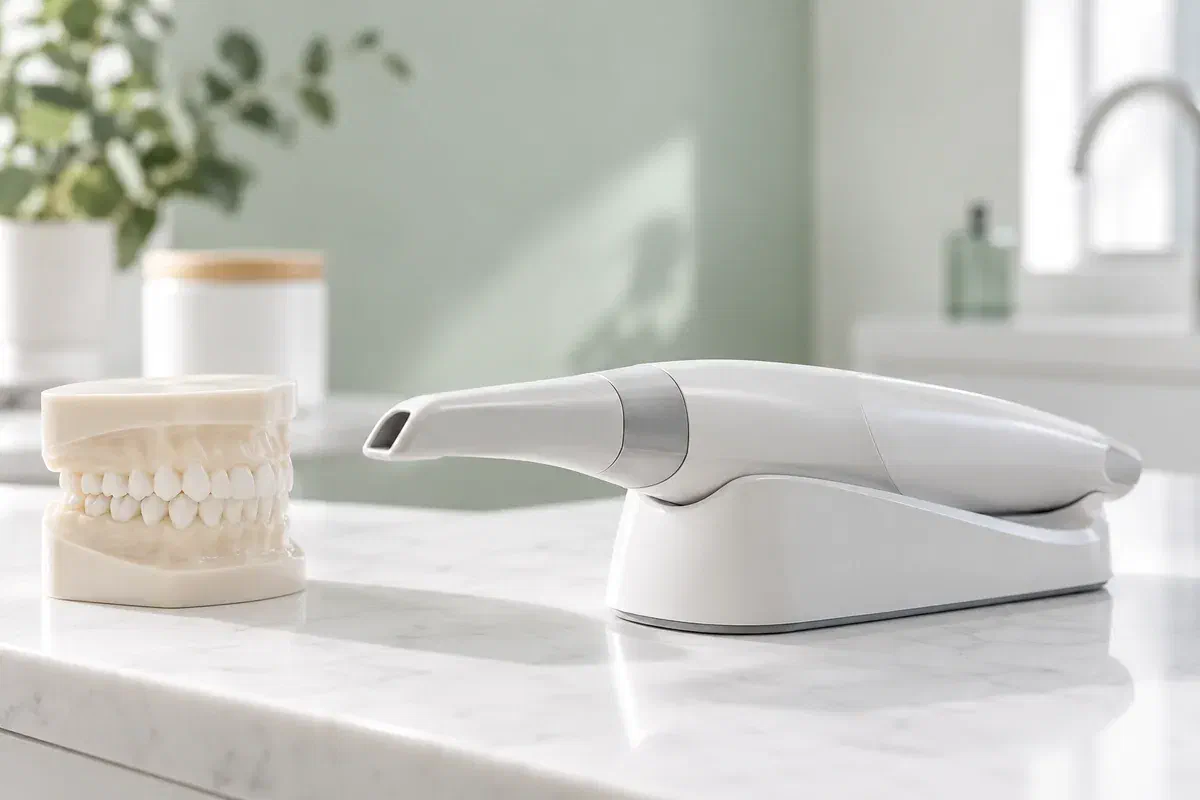
Illustrative discussion of an optical dental scanner, not a photograph of clinic equipment
General & Family Dentistry

Digital Dental Impressions in Old Milton

Remember biting into a tray of cold putty for an old crown? Learn how optical scanning can record teeth instead in suitable cases, what has not changed about the purpose of an impression, and how to raise comfort concerns in Old Milton.

Then and now, in Old Milton

The putty tray has a newer alternative.

Many people who had a crown or partial denture made years ago recall a tray of thick material held in place until it set. The goal of that step has stayed the same: capture the shape and position of teeth and nearby tissue so dental work can be planned and built. What can differ now is the tool. An optical scanner records the same surfaces as a digital model.

It helps to think of the scan as a way of gathering information. It is not a treatment, and it does nothing to the tooth itself. In suitable situations it can replace the tray, but that depends on which part of the mouth needs recording, the kind of work proposed and how much detail is required. Some impressions are still better taken with material.

If an earlier impression left you uneasy, say so when you book. Tell us whether gagging, a stiff jaw or difficulty holding your mouth open was the issue. Our team can explain how the record would be collected for your treatment and which arrangements are available, rather than assuming that one technique fits every mouth.

Ask which impression method suits you
Illustrative unbranded optical scanner beside a dental teaching model
What usually prompts the question

Treatment first, technique second.

A scan is only useful when it answers a need in your care plan. Ask which teeth and surfaces will be recorded, and how the finished model will be used in designing or making the work.

Replacing or adding dental work

An ageing crown, a gap to be filled or a new appliance may each call for a detailed record of the teeth involved and how they bite together. The prepared tooth, its neighbours and the opposite jaw can all matter. Begin with what the treatment needs, not with the scanner.

An uncomfortable memory of impression trays

Gagging, a sense of fullness or the taste of the material can make trays hard going. Describe what happened before. Scanning may be an option where it suits the work, yet a wand still has to move around the teeth, so some discomfort is possible.

Older records on file

Teeth move, fillings get replaced and plans change. A model taken some time ago may no longer reflect your mouth. Tell the team what has happened since, and expect them to judge whether an old file still provides what the current work requires.

Surface scanning records shape only. It is a different thing from an X-ray or a CBCT examination, and it cannot show roots, bone or other structures that may need to be imaged separately.

What scanning brings to the chair

Errors spotted early, before anything is made.

With a material impression, a flaw might not be noticed until the mould has set and been inspected. A digital model builds on screen, so missing or unclear sections can often be seen during the visit and recorded again. The file then moves into whatever clinical and laboratory steps your work involves. Usefulness, not novelty, is the measure.

Not holding a mouthful of material is easier for some people, though comfort is personal and scanning time depends on how much needs recording. Before starting, agree on how to signal a pause, how wide you can comfortably open and what head position works for you.

Patient information: UCLH — digital impressions in dental care

A model you can be shown

When the system displays it, the team can point out what has been recorded and why teeth beside the treated one, or the opposite arch, are included. The image helps with planning but does not diagnose anything on its own.

Support for the people making the work

A suitable file can be sent through the appropriate professional workflow so a restoration or appliance can be designed and made. Ask who handles that stage and what it involves. Sending a scan does not by itself fix a delivery date.

Gaps caught before you go home

A record must contain every detail the planned work depends on. If a section is incomplete, another pass or a different recording method may be needed. That checking is part of the job, not a sign that something went wrong.

How the appointment tends to unfold

Purpose, preparation, capture and review.

Your visit will depend on the treatment behind it. Ask whether the appointment is only for taking records, or whether tooth preparation, a temporary or another procedure is planned as well.

  1. Talk through the reason for recording

    The dentist outlines why an impression is needed and whether scanning is appropriate and offered for your case. This is the time to ask about limits, alternatives and fees. Mention gagging, restricted opening or positioning needs.

  2. Make the surfaces visible

    For the scanner to work, the teeth being recorded must be dry enough and easy to reach. Depending on the procedure, gum tissue around a tooth may need gentle management. A tooth prepared for a crown needs its finishing edges captured clearly.

  3. Scan the teeth, then the bite

    A small handheld scanner is guided around the relevant teeth as the model forms. Opposing teeth and the way they meet may also be recorded. Follow the team’s cues on positioning, and use the agreed signal whenever you need a moment.

  4. Confirm the record and the next visit

    The team checks that the information is good enough for its intended use, scanning again or switching method if necessary. Before you leave, confirm the next appointment, any instructions for temporary work and when the finished piece will be checked.

Between the scan and the fitting

Mind the temporary, and report anything new.

A scan by itself normally needs no recovery. Freezing, tooth shaping, a temporary restoration or other treatment done during the same visit may each bring their own instructions.

Treat the temporary gently

If you go home with a temporary crown or similar piece, follow the dentist’s advice about food and cleaning. Call if it loosens, breaks or becomes sore. The final work having been scanned does not make a damaged temporary safe to leave alone.

Let us know if anything changes

A broken tooth, a filling replaced at another office or a bite that suddenly feels different can affect the existing record. The team may need to review it. New pain or swelling should be checked rather than put down to waiting for the lab.

Attend the fitting visit

Every restoration or appliance needs to be checked when it is delivered. Ask about fit, bite, comfort and cleaning, and whether adjustments are needed. Digital manufacture does not replace that evaluation, or a follow-up if something later feels wrong.

Comparing the approaches

Which kind of impression fits your treatment?

The choice depends on what must be recorded and whether it can be captured reliably. When a method is suggested, ask what makes it right for you, instead of assuming that the newer option is always preferable.

Suited to work where surface detail is enough

Digital scan

The scanner produces a virtual model that may be used in an appropriate restorative or appliance process. Confirm suitability and availability for your case. Recording is only one part; assessment, design, manufacture and fitting each follow separately.

When a physical mould serves the work best

Material impression

Trays and impression material remain a sound choice for certain clinical needs or arrangements. Share any past difficulty so comfort can be considered. Choosing this route does not mean the dental work that follows will be of lower quality.

Useful if information is still missing

More records, or reassessing the plan

Bite records, photographs, X-rays or a further impression may be needed to answer other questions. Ask what each one contributes. A surface scan cannot tell the whole story about a tooth, its supporting tissue or whether a treatment is suitable.

Asked often in Old Milton

Scanning questions, answered plainly.

Ask about the work being planned, the method that suits your situation and what happens after the record is taken. Every answer should link the scan to a real clinical purpose.

(905) 876-4488
I have an older bridge. Can a scanner record around it?
Often existing dental work can be scanned along with natural teeth, but some surfaces and materials are harder to capture clearly. The dentist decides whether a scan will give the detail needed for the planned work, or whether another method or extra records would be better.
Is there any taste or smell with a digital scan?
There is no impression material to taste. You will feel the scanner tip moving and may notice air or a little drying of the teeth. Tell the team if anything about the sensation bothers you so you can take a break.
If I wear a partial denture, will it come out for the scan?
Usually removable pieces are taken out so the teeth and tissue underneath can be recorded, but the dentist will explain what is needed for your treatment. Bring the denture with you, along with any questions about how it fits now.
Does scanning mean fewer visits for a new crown?
Visit numbers depend on the treatment and on how the crown is designed and made. A scan records information; it is not a promise about timing. Ask how many appointments to plan for and whether a temporary will be placed while you wait.
Why go back over a tooth that was already scanned?
The model may be missing detail in that area. Moisture, movement, cheek or tongue position and hard-to-reach surfaces can all affect the capture. A second pass fills the gap before the record goes on to the next stage.
Can I ask for a material impression instead?
Yes, you can raise it. The dentist will explain which method suits the work and what each involves. In some cases a material impression is the recommended choice anyway, and in others the reasons for scanning can be talked through together.
Old Milton impressions, planned together

Tell us about past impressions, and we’ll plan this one with you.

From Milton’s historic downtown, call our Bronte Street practice to discuss the restoration or appliance you need and how the impression might be taken. We can explain the records involved and confirm the arrangements for your care. Questions about comfort and timing are welcome.

Please confirm suitability and availability for your treatment. The scanner illustrations on this page are not photographs of clinic equipment.

Visit Milton Dental Clinic
Unit 1, 342 Bronte St. S, Milton, ON L9T 5B7
Get directions Clinic hours
Monday–Thursday
11am–7pm
Friday–Sunday
By appointment only

Areas we serve

  • Milton
  • Oakville
  • Mississauga
  • Georgetown
  • Halton Hills
  • Acton
  • Campbellville
  • Brampton
  • Burlington
  • Puslinch
  • Rockwood
  • Erin
  • Caledon
  • Etobicoke
  • Old Milton
  • Bronte Meadows
  • Timberlea
  • Dorset Park
  • Dempsey
  • Clarke
  • Beaty
  • Coates
  • Harrison
  • Scott
  • Willmott
  • Ford
  • Bowes
  • Cobden
  • Walker
  • Mountain View
  • Milton Heights
  • Hawthorne Village
  • Valley View
  • Fallingbrook
  • Nassagaweya
  • Trafalgar
  • Esquesing
  • Nelson
  • Brookville
  • Moffat
  • Glen Williams
  • Norval
  • Limehouse
  • Stewarttown
  • Ashgrove
  • Hornby
  • Silver Creek
  • Speyside
  • Scotch Block
  • North Oakville
  • River Oaks
  • Glen Abbey
  • West Oak Trails
  • Palermo
  • Bronte Creek
  • College Park
  • Joshua Creek
  • Uptown Core
  • Preserve
  • Iroquois Ridge
  • Lisgar
  • Meadowvale
  • Meadowvale Village
  • Churchill Meadows
  • Erin Mills
  • Central Erin Mills
  • Streetsville
  • East Credit
  • Creditview
  • Heartland
  • Sheridan
  • Mount Pleasant
  • Credit Valley
  • Huttonville
  • Churchville
  • Springbrook
  • Northwest Brampton
  • Bram West
  • Fletcher's Meadow
  • Fletcher's Creek South
  • Alton Village
  • Orchard
  • Millcroft
  • Headon Forest
  • Tansley
  • Brant Hills
  • Tyandaga
  • Kilbride
  • Lowville
  • Aberfoyle
  • Morriston
  • Arkell
  • Hillsburgh
  • Freelton
  • Carlisle
  • Waterdown
  • Flamborough
  • Mountsberg

How can we help?

Milton Dental Clinic

Have a question about your smile? Choose the option that works best for you.

For urgent dental concerns, please call.
Messages are reviewed during clinic hours.