

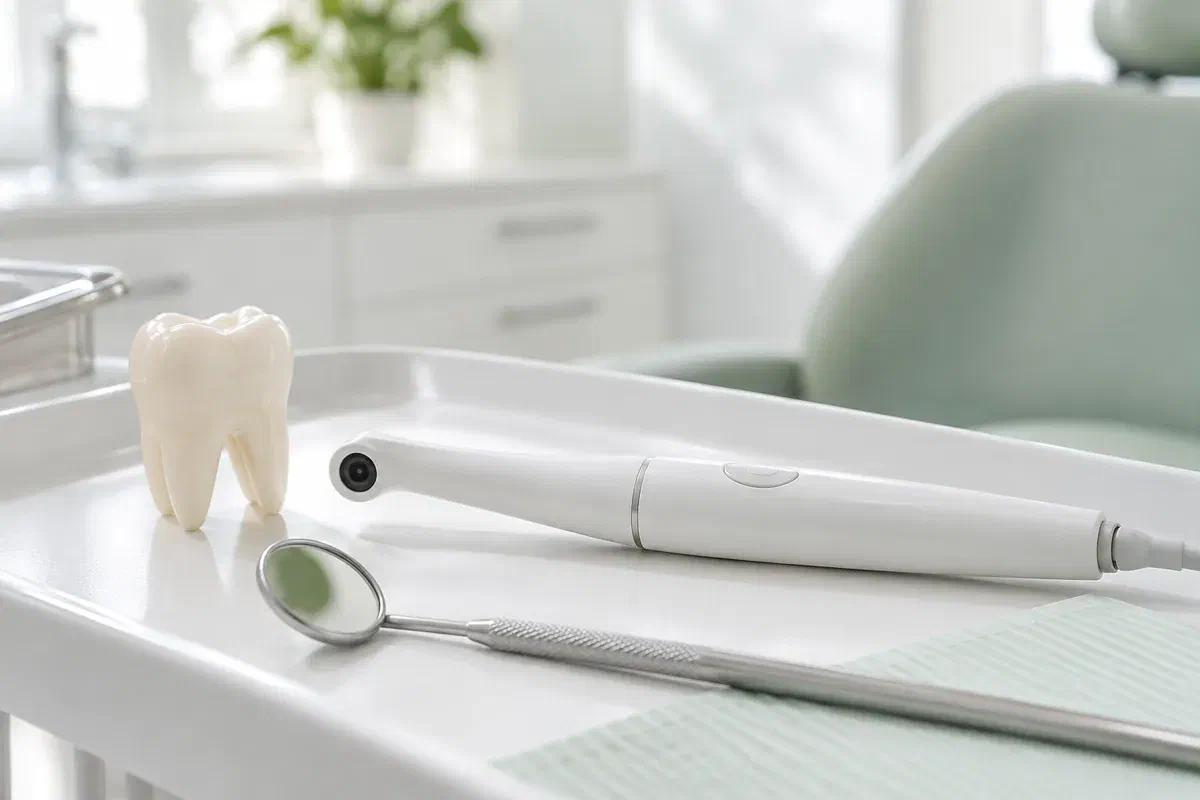
Illustrative dental consultation with a small intraoral camera, not actual clinic equipment
General & Family Dentistry

Intraoral Camera Examinations in Old Milton

Decades of fillings and crowns can make a mouth hard to keep track of, and plenty of long-time Old Milton households know the feeling. A close-up photo from an intraoral camera lets you see which piece of older dental work your dentist is talking about, and ask sensible questions before anything is changed.

Old Milton, older dental work

Seeing the filling you had placed years ago

Many people have a mouth full of history: a filling from childhood, a crown from a decade ago, a tooth that was repaired after a fall. When a dentist mentions one of them, it can be hard to know which. An intraoral camera is a small pen-like device that photographs the reachable surfaces of teeth and gums, giving you a magnified view of the exact restoration in question.

The image adds to the exam rather than completing it. Light, angle, saliva and what the lens can physically reach all shape how a tooth looks on screen. Before explaining what a mark or edge means, your dentist combines the photo with your symptoms, the history of that tooth and anything else found during the examination.

Old Milton is the town’s historic downtown, and our Bronte Street practice is close by, which makes it easy to ask questions in person. Ask whether photos would be useful for the area being discussed and what arrangements are available. Feel free to ask which tooth is shown, what the key feature is and what is still uncertain. A close-up should help you weigh options calmly.

Talk with us about your dental work
Illustrative pen-shaped intraoral camera beside a tooth model and dental mirror
Where a close-up often helps

Older work, worn edges and hidden corners

Photos are most useful with a clear purpose. Point to the tooth or restoration you want to understand, and ask how the picture relates to the rest of the findings.

Enamel that has thinned or chipped with age

Years of chewing can flatten biting surfaces or leave small chips along front edges. A photo can show where that change is, but not how deep it runs or exactly why it happened. Share any sensitivity, grinding habits or bite changes so the picture is not read in isolation.

The edges of long-standing restorations

Fillings and crowns placed long ago can develop visible lines, staining or small ledges where food catches. A close-up helps you see the spot, yet a dark margin is not automatically a problem. Ask what else the dentist will check before recommending a replacement.

Spots around bridges or crowded teeth

Areas under a bridge or between tightly packed teeth can be tricky to clean and impossible to see at home. A photo can identify where buildup collects. It is most valuable when paired with a practical demonstration of how to reach that spot.

A camera photograph is not the same as a dental X-ray or a three-dimensional scan. Each one looks at a different aspect of your teeth, so they should not be swapped for one another.

What a photo brings to the chair

Clearer conversations about teeth you have lived with for years

On screen, the dentist can indicate the exact edge, line or surface under discussion and explain why it matters. That helps most with back teeth and inner surfaces you would never see otherwise. You do not need to interpret each reflection; ask which portion of the image is relevant.

Where appropriate, images can sit in your clinical record over time. Comparing photos from different visits may support a review, but a slightly different angle or light can change how the same tooth appears. A series of pictures still needs to be read together with the exam and your history.

Patient information: Carestream Dental — intraoral camera image capture and review

Telling one restoration from another

With several fillings or crowns, knowing which one is being discussed is half the battle. Ask the dentist to name the tooth and the surface. A magnified view can feel disorienting until the orientation and real size are explained.

A grounded talk about repair or replacement

Use the image to ask what a suggested treatment would correct and which findings point toward it. Leaving the restoration alone, repairing it or replacing it may each be possible. The photo supports the explanation but does not replace a discussion of pros, cons and alternatives.

A baseline for keeping watch

When older work is being monitored, ask what will be compared next time. Photographs can sit alongside notes, symptoms and other records. The plan should also say which changes would justify coming in before the next review.

Step by step

A short detour within your regular exam

Taking photos fits inside a clinical appointment. Mention any tender spots, a jaw that tires easily or a tendency to gag so the team can plan for your comfort.

  1. Explain what you want to understand

    You describe the concern and the dentist examines the area. Ask how a photo might help with this particular question. Some findings cannot be judged visually, and the camera is not a stand-in for a full assessment.

  2. The camera is guided into place

    A slim camera is moved close to the tooth or gum surface to be photographed. The team may reposition it or dry the area to get a clear image. Raise your hand, or use whatever signal you agreed on, if you need a rest.

  3. Go over the picture

    Ask the dentist to point out the feature and to explain the difference between what is visible and what is diagnosed. A photo can show that something is there without showing how deep it is, whether it is changing or what caused it. Other findings round out the explanation.

  4. Decide on the next step

    The conclusion may be advice, watchful waiting, more tests or a review of treatment choices. Confirm why, and when any follow-up should happen. If images are stored or shared for your care, you can ask how they fit into your record and what consent applies.

Afterward

A clear understanding beats a striking image

Being photographed generally needs no recovery. The important part is following the advice or plan that comes from the full examination.

Check that the explanation makes sense

Before you go, confirm what was seen, what it likely means and what is uncertain. Ask about any unfamiliar terms. Even an ordinary filling edge can look worrying when blown up on a screen, so context is everything.

Follow advice tailored to the finding

If the visit uncovered a cleaning challenge, a worn tooth or a gum issue, use the instructions for that specific problem. Ask for a demonstration if it would help. Looking at a picture does not fix a tooth or remove the need for treatment that was planned.

Return for any planned review

If something is being watched, note the next check and which symptoms mean calling sooner. Keeping an image on file does not take the place of future exams. New pain or a tooth that stops working properly should be looked at even if the last photo seemed fine.

Different tools, different answers

Which record suits which question?

Your dentist picks the tool that fits the concern. Ask what a proposed image or record would tell you and how it could change the advice.

For visible detail on teeth and gums

Camera close-ups

Close-ups can document what is on the surface and show where a concern is located. Their usefulness depends on how clear the image is and how it is interpreted. They are excellent for explanation but cannot answer every diagnostic question.

For questions beneath what is visible

Tests and radiographs

Certain symptoms or findings call for clinical tests or X-rays that reveal what a photo cannot. Ask what they are meant to find. A clear surface photo does not remove the need for another investigation that is looking at something else.

For a model of tooth shape and fit

Digital impressions

An optical scanner can capture a three-dimensional impression for suitable crowns, appliances and similar work. That task differs from taking a single close-up. Ask which records your planned care needs and what can be arranged.

Your questions, answered

Practical answers about camera photos

Interpreting the image is the dentist’s job, not yours. Expect the photo to be linked to your exam, with honest notes about uncertainty and room for questions about any next step.

(905) 876-4488
My filling is twenty years old and the photo shows a dark line. Does it need replacing?
Not necessarily. Older fillings often show staining or visible margins that are stable. The dentist will consider other findings, symptoms and sometimes additional tests before suggesting a change. Ask what evidence points toward replacement and whether monitoring is an option.
Can a camera photo show a crack in a tooth?
A close-up may reveal a visible line on the surface, but it cannot show how deep a crack goes or whether it is the source of pain. Fine craze lines are also common and often harmless. The dentist may use other tests to assess a suspected crack.
Is the camera able to photograph the gums as well as the teeth?
Yes, accessible gum tissue can be photographed to show colour, contour or areas where buildup collects. A picture alone does not measure gum health; the dentist uses other checks for that. Ask how the image relates to your overall gum assessment.
What if close-up pictures of my mouth make me uneasy?
Let the team know. You can have findings explained verbally or in another way that works for you. You should still get the information you need to decide on care, without having to stare at an image that makes you uncomfortable.
Can old and new photos tell us if a tooth has changed?
They may help, but differences in light, angle and moisture can affect how a tooth looks. The dentist should read photos alongside symptoms and other records before suggesting that something has progressed. Ask what specific change is being noticed.
Does having an intraoral photo mean my insurance will cover the treatment?
No. A photo may be part of documentation where appropriate, but each plan has its own rules. Clinical advice and coverage decisions are separate matters. Check your benefits directly and ask the clinic whether any records are needed for a claim.
Visit us from Old Milton

Bring your history and your questions

Call our Bronte Street practice and mention which tooth or restoration has been on your mind. Ask whether camera photos would help explain it and what appointment arrangements are available. We will go through what the images show, what they cannot tell us and what a sensible next step looks like.

Photos support a clinical exam. The illustrative images on this page do not depict equipment used at the clinic.

Visit Milton Dental Clinic
Unit 1, 342 Bronte St. S, Milton, ON L9T 5B7
Get directions Clinic hours
Monday–Thursday
11am–7pm
Friday–Sunday
By appointment only

Areas we serve

  • Milton
  • Oakville
  • Mississauga
  • Georgetown
  • Halton Hills
  • Acton
  • Campbellville
  • Brampton
  • Burlington
  • Puslinch
  • Rockwood
  • Erin
  • Caledon
  • Etobicoke
  • Old Milton
  • Bronte Meadows
  • Timberlea
  • Dorset Park
  • Dempsey
  • Clarke
  • Beaty
  • Coates
  • Harrison
  • Scott
  • Willmott
  • Ford
  • Bowes
  • Cobden
  • Walker
  • Mountain View
  • Milton Heights
  • Hawthorne Village
  • Valley View
  • Fallingbrook
  • Nassagaweya
  • Trafalgar
  • Esquesing
  • Nelson
  • Brookville
  • Moffat
  • Glen Williams
  • Norval
  • Limehouse
  • Stewarttown
  • Ashgrove
  • Hornby
  • Silver Creek
  • Speyside
  • Scotch Block
  • North Oakville
  • River Oaks
  • Glen Abbey
  • West Oak Trails
  • Palermo
  • Bronte Creek
  • College Park
  • Joshua Creek
  • Uptown Core
  • Preserve
  • Iroquois Ridge
  • Lisgar
  • Meadowvale
  • Meadowvale Village
  • Churchill Meadows
  • Erin Mills
  • Central Erin Mills
  • Streetsville
  • East Credit
  • Creditview
  • Heartland
  • Sheridan
  • Mount Pleasant
  • Credit Valley
  • Huttonville
  • Churchville
  • Springbrook
  • Northwest Brampton
  • Bram West
  • Fletcher's Meadow
  • Fletcher's Creek South
  • Alton Village
  • Orchard
  • Millcroft
  • Headon Forest
  • Tansley
  • Brant Hills
  • Tyandaga
  • Kilbride
  • Lowville
  • Aberfoyle
  • Morriston
  • Arkell
  • Hillsburgh
  • Freelton
  • Carlisle
  • Waterdown
  • Flamborough
  • Mountsberg

How can we help?

Milton Dental Clinic

Have a question about your smile? Choose the option that works best for you.

For urgent dental concerns, please call.
Messages are reviewed during clinic hours.