
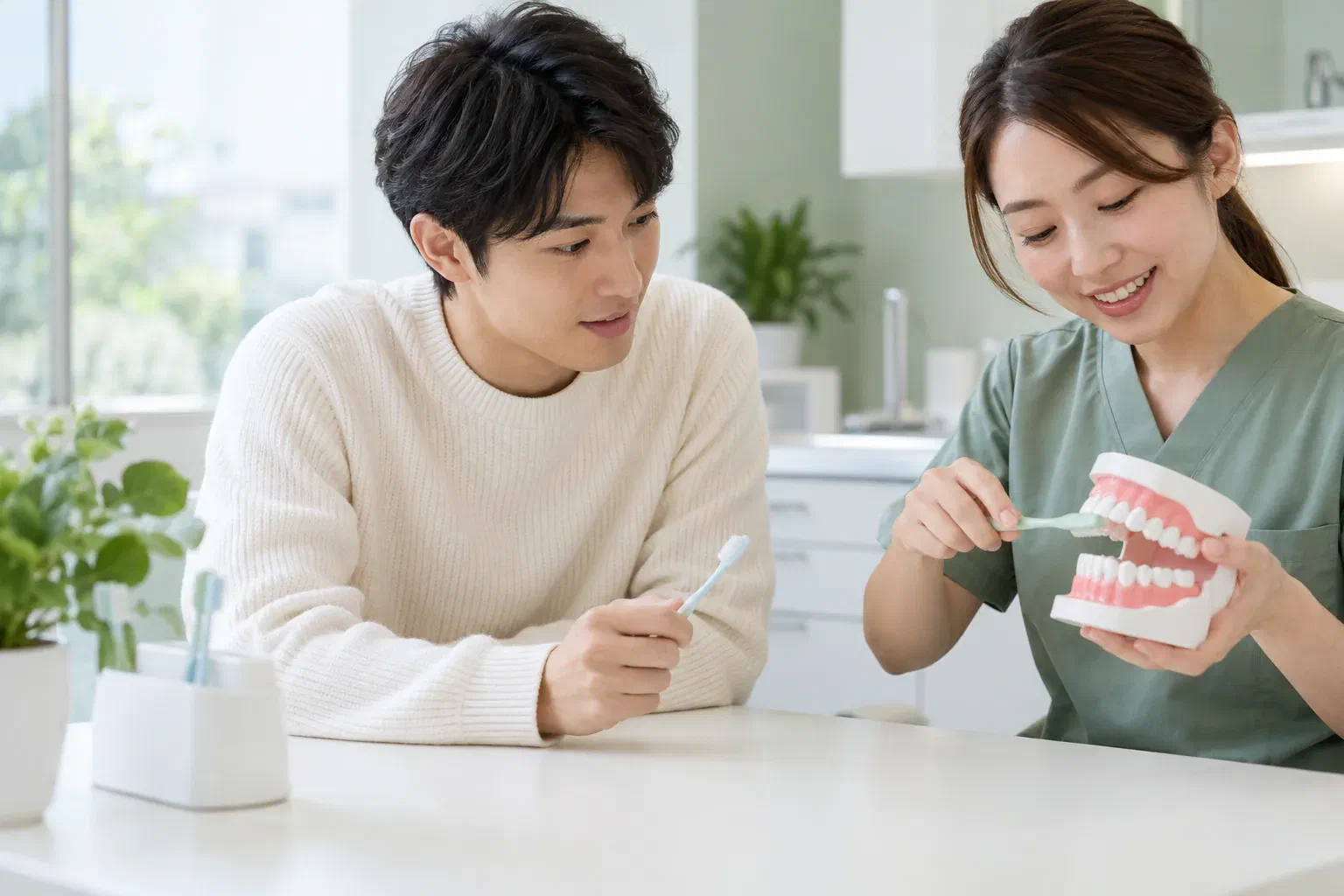
Illustrative brushing demonstration using a dental model
General & Family Dentistry

Oral Hygiene Instruction in Erin

A technique that seems simple in the dental chair can feel very different in front of your own bathroom mirror. We teach with your home routine in mind, so the method still works once you're back at your sink.

From the chair to your own sink

It made sense at the clinic. Then you got home.

In the chair, with a bright light and someone guiding your hand, the angle feels obvious. That evening, standing at a dim mirror with a different brush and a tired arm, the movement slips away. Within a week you're back to the old habit. This happens to a great many people, and it says more about how the lesson was given than about you.

For households in Erin and Hillsburgh, where a return trip takes some planning, we try to teach the way you'll actually clean. Bring the brush and aids from your own bathroom. Tell us what time of day you brush, whether you stand or sit, and what the lighting is like. Then we practise with those conditions in mind, with patience and good humour.

Instruction belongs to your ongoing dental and hygiene care and is shaped by the examination. You'll watch, try, repeat and leave with brief written notes. Not everything has to change immediately, and the tools you already use at home may remain the best ones to learn with.

Plan instruction around your home routine
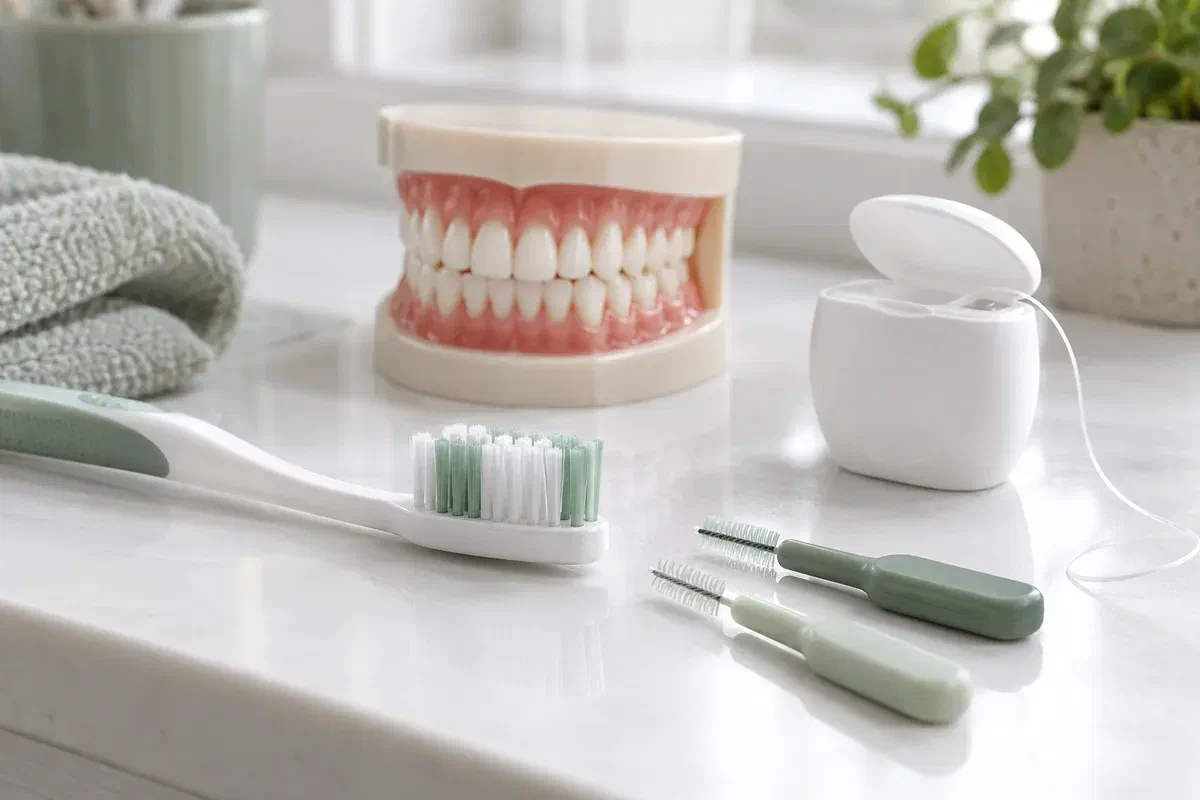
Soft toothbrush, interdental brushes, floss, and dental model for personal care instruction
What gets lost on the way home

Which part slipped away first?

Tell us where things went wrong after a previous lesson, or where you get stuck now: pain, catching, gagging, confusion or impatience. A real example lets us judge whether it's technique or something that needs further assessment.

A space you can't find without help

Crowding, a bridge or another restoration can be hard to locate by feel alone. We'll help you find landmarks you can recognize at home and show the route in. Beneath a bridge, that route differs from the one between natural teeth.

Gums that bleed once you're on your own

Note where bleeding happens and whether it's tender. Irritated gums, a filling or crown with a rough border, or extra force from trying too hard could be involved. Scrubbing harder or using a stronger mouthwash usually won't settle it alone.

Tired hands, low light or sensory issues

Fatigue at night, stiff fingers, a limited reach or dislike of a flavour can all undo a good lesson. Tell us about your real conditions. We'll plan tools, pacing and any help you need with those in mind.

Bring the exact brush and aids you use at home, not a new set bought for the visit. Learning with your own tools makes the method easier to repeat.

Teaching that travels home with you

Practice that holds up on an ordinary weeknight

Daily plaque removal requires reaching the surfaces that need cleaning with a gentle, effective motion. Brushing and interdental aids handle different areas. When you know which areas each must cover, it becomes easier to check your own work at home instead of relying on memory of what someone else did.

We'll ask you to repeat the method several times and then explain it back without prompting, because that is closer to what happens at home. If any part depends on help you won't have, say so. A routine you can run on your own, half asleep, is the one that lasts.

Patient information: NIDCR — oral hygiene techniques and daily care

A reason you can remember

Ask what each movement is meant to clean. A clear purpose helps the step stick when nobody is watching, and lets you notice when an aid isn't reaching. It also stops products piling up for no reason.

Aids you can handle alone

Floss, interdental brushes, holders and other tools suit different spaces and dexterity. Dental work changes access too. We'll show how to use each without supervision, and when to stop rather than push it through.

A follow-up that fills the gaps

A later visit can check whether plaque or gum inflammation has eased and which steps survived at home. Tell us which parts faded. We'll re-teach those rather than repeating the whole lesson.

How we make it stick

Teach, repeat, hand it over.

Tell us honestly what happened after any previous advice. Knowing which parts didn't last is the most useful information we can have, and there's no judgement in it.

  1. Ask about your home setup

    We find out when and where you brush, the light and mirror you use, which aids you own and which areas are hard. Mention discomfort, appliances, recent dental work and any help you have. The exam shows whether instruction alone suits or treatment is also needed.

  2. Demonstrate with your own tools

    We show the technique using your brush and aids, on a model or in your mouth with a hand mirror, so it looks the way it will at home. We'll concentrate on the area you lose track of.

  3. Repeat until you can do it unaided

    You try it several times, then without prompts, while we refine details. Say if a handle is awkward, an aid catches or something hurts. A different tool may suit better than one you'll struggle with alone.

  4. Send you home with notes

    We agree on a few priorities and write down sizes, routes and steps in plain words. Ask when we should review your progress and which symptoms mean calling sooner.

The first weeks at home

Keep the notes by the sink.

Follow the method we practised and call with questions while they're fresh. More pressure, extra products or longer sessions won't necessarily help.

Brush the way you rehearsed

Use fluoride toothpaste and follow the order on your notes, paying attention to the surfaces we demonstrated. A good light and mirror can help. If bristles flatten quickly or brushing hurts, contact us to review pressure.

Find the space, then ease the aid in

Use the landmarks and aid sizes we agreed. Not every gap takes the same size. If a tool snags again and again or causes pain, tell us, since technique, fit or a dental problem may be the reason.

Keep it going when energy is low

If you're unwell, worn out or temporarily less able, ask how to shorten the routine sensibly. A partner or relative could take over a step you've agreed on. Choosing an easier product isn't automatically a replacement for cleaning.

Patient information: NIDCR — cleaning between teeth and the role of professional care

Support for Erin households

Choose what to relearn first

Usually one piece of the routine needs relearning: a movement, a tool, or the way around a restoration. If the exam suggests treatment too, we'll explain it.

When the method fades between visits

Brushing and interdental technique

We can rework brush angle, cleaning order and access to the gumline and the gaps between teeth. Ask to master one area before adding more. The goal is a habit you can keep alone, not a list of products.

When dental work is hard to find by feel

Cleaning around restorations

Each restoration has its own shape, so the right method depends on what's actually in your mouth. Ask which aids suit yours and how to use them without catching any part. Guidance should reflect your own restoration.

When comfort or ability limits what you can do alone

Adapted or assisted care

Possibilities include a fatter handle, a battery or rechargeable brush, an aid that needs less dexterity, or support from someone you live with. They can attend too. You stay involved, and medical or swallowing guidance is respected.

Questions from Erin

Why didn't it stick last time?

Needing another demonstration is normal. Tell us which part fell apart at home, and we'll go over that piece again.

(905) 876-4488
It looked simple in the chair, but I can't repeat it at home. Is that common?
Very. Lighting, a different mirror, tiredness and the lack of someone guiding you all make a difference. Bring your home tools to a visit and tell us which movement slips. We’ll practise until you can do it unaided and write down the key details.
Does a better mirror or light at home make any difference?
Being able to see what you’re doing can help, especially for spaces between teeth or around dental work. Tell us about your setup and we’ll suggest a way of checking your work that suits it.
How long until a new routine starts to feel automatic?
It varies from person to person. Keeping the routine short and following the same order each time tends to help. If it still feels like a struggle after a while, let us know so we can simplify the method.
What should I keep track of before a follow-up visit?
Note which steps you kept up, which you dropped, and any areas that bled, hurt or caught. Bring your brush and aids. That gives the team a clear picture of what to adjust.
Is it all right to change the order of steps once I'm home?
Often, yes, as long as every relevant surface still gets cleaned. Tell us what order works for you and we can check that nothing is being skipped. A sequence you’ll follow consistently is more useful than one you resist.
My partner and I were shown different methods. Which is right?
Both may be. Advice is shaped around each person’s spaces, dental work and abilities, so two people in one household can need different tools or techniques. Ask the team to explain the reason for each method.
Booking from Erin or Hillsburgh

This time, let's make it last.

Contact our Bronte Street practice to discuss brushing, interdental cleaning or care around dental work. Tell us which part of a past lesson didn't survive at home. We'll assess your mouth and give practical, written guidance for your own sink.

If you've noticed pain, bleeding or anything new in your mouth, mention it when booking so it can be assessed too.

Visit Milton Dental Clinic
Unit 1, 342 Bronte St. S, Milton, ON L9T 5B7
Get directions Clinic hours
Monday–Thursday
11am–7pm
Friday–Sunday
By appointment only

Areas we serve

  • Milton
  • Oakville
  • Mississauga
  • Georgetown
  • Halton Hills
  • Acton
  • Campbellville
  • Brampton
  • Burlington
  • Puslinch
  • Rockwood
  • Erin
  • Caledon
  • Etobicoke
  • Old Milton
  • Bronte Meadows
  • Timberlea
  • Dorset Park
  • Dempsey
  • Clarke
  • Beaty
  • Coates
  • Harrison
  • Scott
  • Willmott
  • Ford
  • Bowes
  • Cobden
  • Walker
  • Mountain View
  • Milton Heights
  • Hawthorne Village
  • Valley View
  • Fallingbrook
  • Nassagaweya
  • Trafalgar
  • Esquesing
  • Nelson
  • Brookville
  • Moffat
  • Glen Williams
  • Norval
  • Limehouse
  • Stewarttown
  • Ashgrove
  • Hornby
  • Silver Creek
  • Speyside
  • Scotch Block
  • North Oakville
  • River Oaks
  • Glen Abbey
  • West Oak Trails
  • Palermo
  • Bronte Creek
  • College Park
  • Joshua Creek
  • Uptown Core
  • Preserve
  • Iroquois Ridge
  • Lisgar
  • Meadowvale
  • Meadowvale Village
  • Churchill Meadows
  • Erin Mills
  • Central Erin Mills
  • Streetsville
  • East Credit
  • Creditview
  • Heartland
  • Sheridan
  • Mount Pleasant
  • Credit Valley
  • Huttonville
  • Churchville
  • Springbrook
  • Northwest Brampton
  • Bram West
  • Fletcher's Meadow
  • Fletcher's Creek South
  • Alton Village
  • Orchard
  • Millcroft
  • Headon Forest
  • Tansley
  • Brant Hills
  • Tyandaga
  • Kilbride
  • Lowville
  • Aberfoyle
  • Morriston
  • Arkell
  • Hillsburgh
  • Freelton
  • Carlisle
  • Waterdown
  • Flamborough
  • Mountsberg

How can we help?

Milton Dental Clinic

Have a question about your smile? Choose the option that works best for you.

For urgent dental concerns, please call.
Messages are reviewed during clinic hours.