

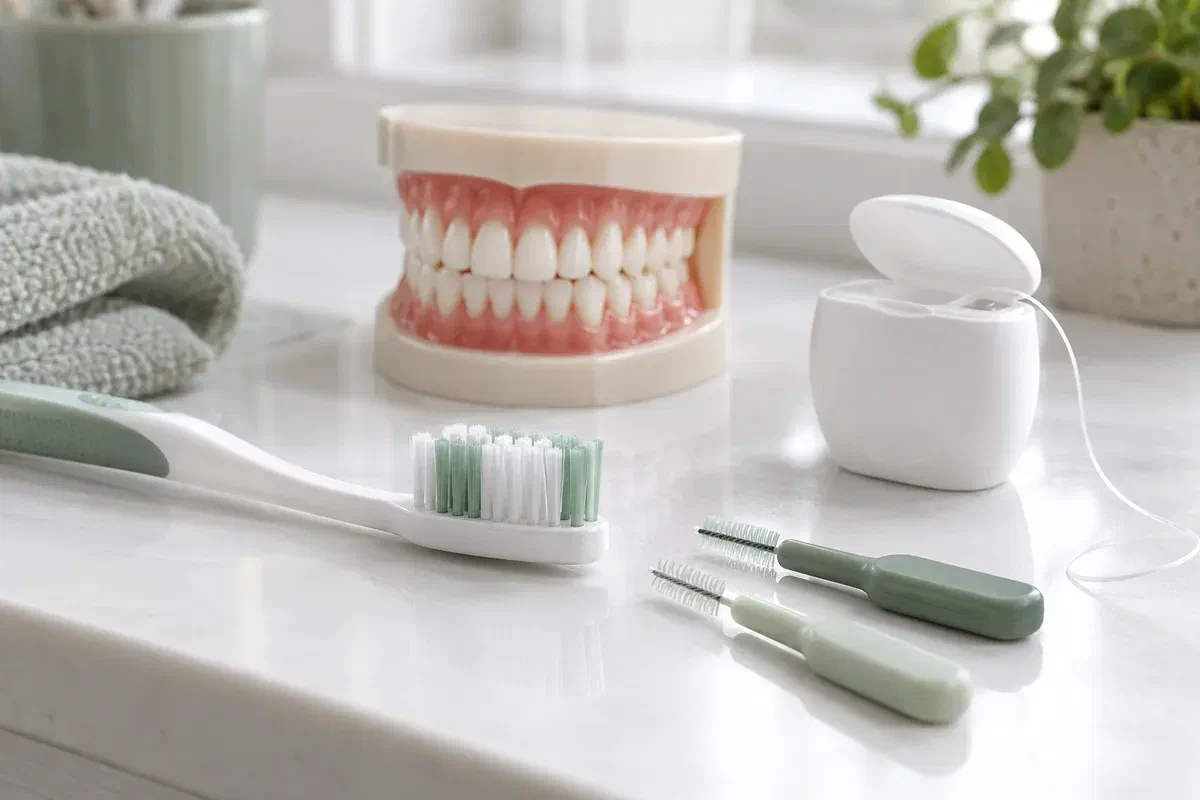
Illustrative brushing demonstration using a dental model
General & Family Dentistry

Oral Hygiene Instruction in Milton

When the same area keeps coming up at your checkup, a hands-on lesson can show you why. We demonstrate brushing and between-teeth cleaning that suit your mouth, your dental work and how your hands move.

Hands-on cleaning help in Milton

The spot your hygienist keeps mentioning has an explanation.

Plenty of people brush every morning and night and still hear that one corner of the mouth has plaque or puffy gums. That is rarely about effort. More often the brush meets the tooth at the wrong angle there, a gap is too tight for the tool, or a crown has changed the shape of the space. Personal instruction looks at that exact place.

In a busy Milton household, brushing tends to happen in a hurry between breakfast and the school run. We start by asking you to show us your normal routine and the tools you actually reach for. From there it becomes easier to see which surface is skipped and why, and nobody is going to lecture you for it.

This guidance fits within your regular dental and hygiene care, and it follows what the examination shows. You might watch a demonstration, try the movement yourself, then leave with one or two clear changes. There is no expectation that you overhaul every product in the bathroom cabinet on the first day.

Book time to review your routine
Soft toothbrush, interdental brushes, floss, and dental model for personal care instruction
Common sticking points

Which part of cleaning feels hardest right now?

Describe what actually happens at the sink. Mention any soreness, snagging, gagging or simple frustration. A concrete example lets us tell a technique problem apart from something that needs a closer look.

A gap or corner you can't get into

Overlapping teeth, a bridge or a filling with an unusual contour can block the usual path for floss or a small brush. Ask us to point out the area and show you a route through it. Under a bridge, the method often differs from cleaning between two natural teeth.

Gums that bleed or feel tender

Tell us where the bleeding shows up and whether the gum feels sore. Inflammation, a rough edge on a restoration or heavy-handed brushing are all possibilities worth checking. Scrubbing harder or reaching for a stronger rinse is not a dependable fix on its own.

Hands, energy or senses that make it harder

Stiff fingers, a short reach, tiredness at the end of the day or a strong reaction to toothpaste flavour all shape what is realistic. Let us know what you can do comfortably, and the plan can account for tools, timing and help from someone else.

Bring the toothbrush and cleaning aids you use now, or describe them. Watching you use them usually tells us more than asking you to recall advice from years ago.

Why a demonstration helps

General advice, made specific to you.

Removing plaque each day means reaching the right surfaces gently and effectively. A toothbrush and an interdental aid don't do the same job, and knowing what each one is for makes the routine easier to follow. Instruction helps you pick a method that suits the spacing, restorations and day-to-day realities of your mouth.

Good guidance also checks that it landed. You can show the movement back to us or practise while we watch. If something sounds unworkable for your mornings, say so then, while we can still change it. A short routine you keep doing beats an elaborate one that fades by the weekend.

Patient information: NIDCR — oral hygiene techniques and daily care

Each step has a purpose

You can ask what a particular movement is meant to clean. Once the reason is clear, the technique is easier to remember, and you are more likely to notice when a tool is missing its target. It also keeps you from buying products you don't need.

Aids that fit your spaces

Floss, interdental brushes, holders and other aids each suit different situations. Size and access matter, especially near crowns and bridges. Any suggestion should come with how to use it and a clear point at which you should stop rather than push it through.

A chance to see what changed

At a later visit we can look at whether plaque, gum inflammation or the practical difficulty has eased. Tell us which parts stuck and which didn't. The routine can be adjusted; the first suggestion is a starting point, not a test.

What happens at the appointment

Watch, try it yourself, then adjust.

It helps a great deal when we know what you do now. Please be honest about shortcuts and obstacles. The goal is cleaner teeth and healthier gums, never a judgement on your habits.

  1. Talk through your current routine

    We ask how and when you brush, what you use between teeth, and where things feel awkward. Mention any pain, appliances, recent treatment or help you get from someone at home. What we see in your mouth tells us whether instruction is enough or treatment is needed too.

  2. See the technique on a model or in your mouth

    We can show angle, movement and the way into a particular space using a model, a hand mirror or a direct demonstration. Ask us to zoom in on the part that confuses you instead of walking through the whole mouth in general terms.

  3. Try it while we watch

    Do the movement yourself or describe it back, so we can correct small details. Speak up if the handle feels clumsy, the aid snags or something hurts. Switching to another tool can make more sense than struggling with one that doesn't fit.

  4. Leave with a short list and a follow-up

    We agree on a few realistic changes and explain any product suggestions. Ask when progress should be checked and which symptoms mean you should call sooner. A written note can help you remember a route under a bridge or the size of a brush.

Back at home in Milton

Steady and gentle wins over fast and forceful.

Use the method we worked out together and keep asking questions as they come up. Pressing harder, adding more products or brushing for ages does not automatically clean better.

Follow the same order each time

Use a fluoride toothpaste and give attention to the surfaces we showed you. Moving around the mouth in a set order makes it harder to skip a spot on a rushed morning. If the bristles flatten quickly or brushing feels painful, ask us to look at your pressure.

Let the aid glide, never force it

Use the tool and approach we chose for each area, keeping in mind that one size may not suit every gap. If an aid keeps catching or causes pain, tell us. The answer could be technique, a different fit, or a closer look at the tooth or restoration.

Scale back sensibly on hard days

Illness, exhaustion or a change in ability can make the full routine difficult. Ask how to simplify it without losing the essential steps. Someone at home may be able to help with agreed tasks, but an easier product is not automatically a replacement for cleaning.

Patient information: NIDCR — cleaning between teeth and the role of professional care

Kinds of guidance we offer

Start with whatever is actually holding you back.

Sometimes a small change in technique is enough. Other times a different tool or help with dental work makes the difference. The exam shows whether professional treatment is needed alongside the advice.

When your routine is close but not quite there

Refining brushing and between-teeth cleaning

We can work on brush angle, the order you clean in, and reaching the gumline and the gaps between teeth. Ask to master one area before adding the next. The point is a routine you can repeat, not a list of brand names.

When dental work changes the way in

Cleaning around crowns, bridges and implants

Restorations often need their own approach based on how they are built. Ask which aids are suitable and how to avoid snagging or harming any part. Advice should match the work in your mouth, not a generic picture.

When comfort or ability shapes the task

Adapted or supported care

We may talk about a thicker handle, a powered brush, another type of aid or a routine shared with a helper. Bring that person along if you'd like. The aim is to keep you involved and to respect any medical or swallowing guidance.

Questions we hear in Milton

Things people ask before their first demonstration

If a technique doesn't make sense yet, it's fine to say so. Tell us what feels awkward and we'll adapt the advice to your teeth and abilities.

(905) 876-4488
Why does my hygienist keep pointing to the same area when I brush every day?
Brushing often is not the same as reaching every surface. A particular tooth may sit at an angle your brush slides past, or a gap may be too tight for the aid you use. We can watch your technique there and suggest a small change in position or tool.
Should I keep flossing if my gums bleed when I start?
Mention it at your visit so the cause can be assessed. Bleeding can reflect gum inflammation, a rough edge on a restoration or a technique that is too forceful. Avoid jamming the floss down hard, and call us if bleeding persists or comes with soreness or swelling.
Is instruction a separate appointment or part of my regular cleaning?
It can be part of your ongoing dental or hygiene care. Let the team know when booking that you’d like time for a demonstration, and say which area worries you, so the visit can be planned with enough room to practise.
My brush bristles flatten within a few weeks. Does that mean anything?
Bristles that splay quickly can be a sign of heavy pressure. Bring the brush to your appointment so we can see it, and ask us to watch how you hold it. A lighter, more controlled movement may clean just as well while being kinder to your gums.
Does a demonstration cover how to clean around an implant?
Yes, it can. Implants and the crowns on them may need a specific approach based on their design. Ask which aids are appropriate and how to avoid catching any component. The guidance should be based on your actual restoration rather than a general diagram.
Can I take tartar off myself once I learn a better technique?
No. Once plaque hardens into tartar, it needs professional removal. Better home care helps keep daily plaque under control and supports the results of a cleaning, but it does not replace professional or gum treatment when those are needed.
Book your demonstration

Show us your toothbrush. We'll take it from there.

Get in touch with our Bronte Street practice about brushing, cleaning between teeth or caring for dental work. Tell us which area gives you trouble and what you've tried so far. We'll assess the concern and offer practical guidance you can use at home in Milton.

If you have pain, bleeding or a new change in your mouth, mention it when you book so it can be checked as well.

Visit Milton Dental Clinic
Unit 1, 342 Bronte St. S, Milton, ON L9T 5B7
Get directions Clinic hours
Monday–Thursday
11am–7pm
Friday–Sunday
By appointment only

Areas we serve

  • Milton
  • Oakville
  • Mississauga
  • Georgetown
  • Halton Hills
  • Acton
  • Campbellville
  • Brampton
  • Burlington
  • Puslinch
  • Rockwood
  • Erin
  • Caledon
  • Etobicoke
  • Old Milton
  • Bronte Meadows
  • Timberlea
  • Dorset Park
  • Dempsey
  • Clarke
  • Beaty
  • Coates
  • Harrison
  • Scott
  • Willmott
  • Ford
  • Bowes
  • Cobden
  • Walker
  • Mountain View
  • Milton Heights
  • Hawthorne Village
  • Valley View
  • Fallingbrook
  • Nassagaweya
  • Trafalgar
  • Esquesing
  • Nelson
  • Brookville
  • Moffat
  • Glen Williams
  • Norval
  • Limehouse
  • Stewarttown
  • Ashgrove
  • Hornby
  • Silver Creek
  • Speyside
  • Scotch Block
  • North Oakville
  • River Oaks
  • Glen Abbey
  • West Oak Trails
  • Palermo
  • Bronte Creek
  • College Park
  • Joshua Creek
  • Uptown Core
  • Preserve
  • Iroquois Ridge
  • Lisgar
  • Meadowvale
  • Meadowvale Village
  • Churchill Meadows
  • Erin Mills
  • Central Erin Mills
  • Streetsville
  • East Credit
  • Creditview
  • Heartland
  • Sheridan
  • Mount Pleasant
  • Credit Valley
  • Huttonville
  • Churchville
  • Springbrook
  • Northwest Brampton
  • Bram West
  • Fletcher's Meadow
  • Fletcher's Creek South
  • Alton Village
  • Orchard
  • Millcroft
  • Headon Forest
  • Tansley
  • Brant Hills
  • Tyandaga
  • Kilbride
  • Lowville
  • Aberfoyle
  • Morriston
  • Arkell
  • Hillsburgh
  • Freelton
  • Carlisle
  • Waterdown
  • Flamborough
  • Mountsberg

How can we help?

Milton Dental Clinic

Have a question about your smile? Choose the option that works best for you.

For urgent dental concerns, please call.
Messages are reviewed during clinic hours.