

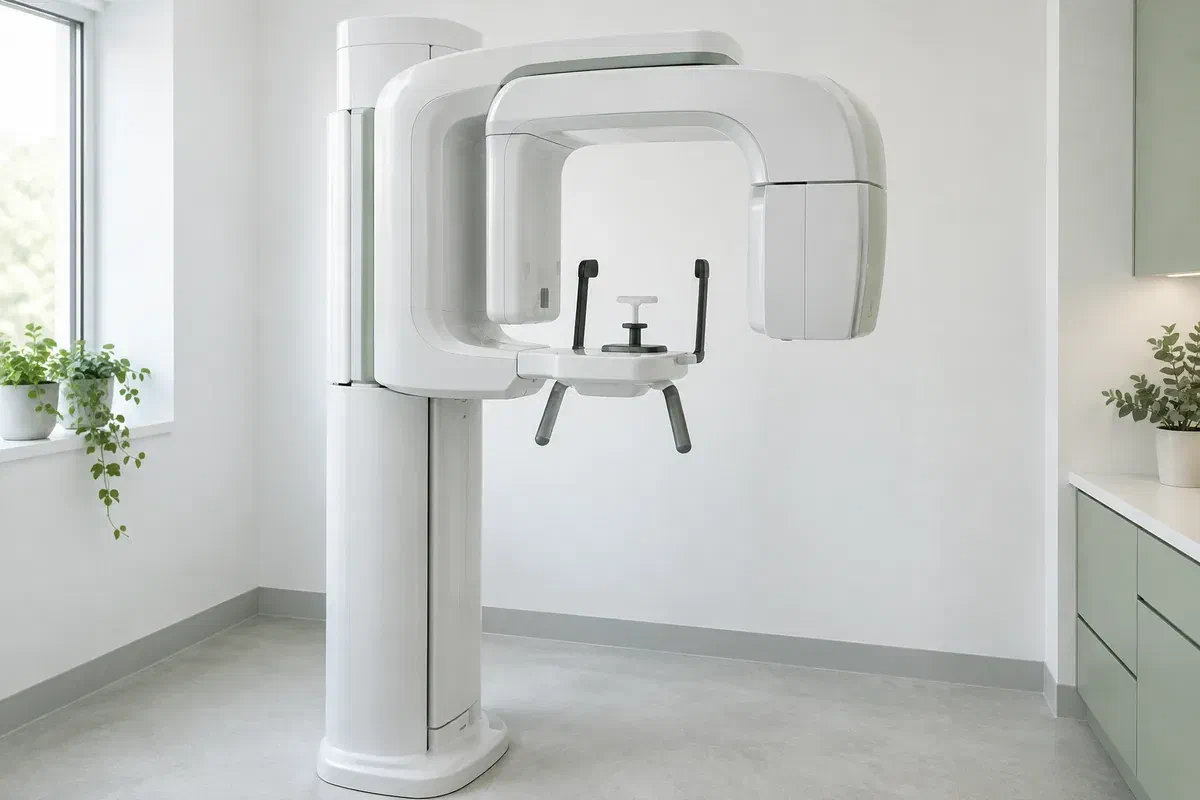
Illustrative discussion near generic panoramic imaging equipment, not actual clinic facilities
General & Family Dentistry

Panoramic Dental X-rays in Erin

You had a big X-ray of your whole mouth not long ago, yet the dentist still wants small ones at your check-up. If you are coming from Erin or Hillsburgh, learn what a panoramic image covers, what it misses, and why the two kinds of X-ray do different jobs.

Wide view, small details · Erin

A big picture doesn’t always mean the full picture.

It is a fair thing to wonder: if one X-ray already showed every tooth, what is left to see? A panoramic image is a broad, flat record of the teeth and both jaws, captured as the machine sweeps around your head. Small intraoral X-rays, such as bitewings, look closely at a few teeth at a time and pick up details the wide view can blur.

Both kinds have a place, and neither should be routine for its own sake. Your dentist chooses based on symptoms, what the examination shows and which images are already on file. Joining a practice or reaching a particular date is not, on its own, a reason. Ask what each image is meant to clarify and how the answer would change your care.

We can explain whether a panoramic view fits your assessment and how imaging would be arranged. Let us know when and where your last X-rays were taken, whether there is any chance of pregnancy, and if standing still or holding a position is difficult. Clear information keeps imaging to what is useful.

Ask how your X-rays fit together
Illustrative unbranded panoramic dental X-ray unit in an empty imaging room
Jobs suited to the wide view

What the panoramic is good at.

This view helps with a particular group of questions about the position of teeth and the overall appearance of the jaws. Your symptoms and examination indicate whether it fits, or whether close-up images or another approach would answer better.

Finding teeth that never surfaced

A wisdom tooth or another unerupted tooth may need to be located. The overview can show roughly where it lies in the jaw. Ask whether finer images would be needed before any treatment, since the picture alone does not determine whether a tooth should be removed.

Seeing a plan across the mouth

Work involving several teeth or both jaws may draw on one broad record. It forms part of the planning, alongside the examination and other images. Ask which decision it supports and what else still needs assessing.

Looking into an unexplained concern

Swelling, discomfort, an injury or a jaw that no longer opens the way it used to may lead to a wider imaging question. Describe what you notice instead of requesting a certain X-ray, and let the examination guide the choice.

Panoramic images spread a curved jaw across a flat surface. That produces overlap and some distortion, and fine details such as small areas of decay between teeth can be hard to see. The image does not replace an examination, targeted X-rays or other tests when indicated.

Where breadth helps

Good for layout. Less suited to fine print.

With both jaws and all the teeth on one record, a panoramic image helps a dentist understand overall layout and relationships. You do not bite on a sensor inside the mouth, which differs from bitewings and other small X-rays. For a close question about one surface, the smaller view is usually better.

Interpretation makes the difference. Ask which part of the picture matters for your concern, whether anything needs a closer look, and what the wide image could not see. Seeing your whole mouth at once is helpful, but it is not the same as having every possible problem checked.

Patient information: RadiologyInfo — panoramic dental X-ray

Placing details in context

A tooth or finding seen alongside the rest of the jaw can make treatment options easier to understand. Ask why the overview helps in your situation. A broader view is useful when the question needs breadth.

Something to pass along

If you are referred, the image and relevant notes may be sent where appropriate. Ask how this is organised and whether the specialist will use it. They will still examine you themselves.

Pointing to the right next view

The wide image sometimes answers the question and sometimes highlights exactly where a close-up is needed. Ask what is still uncertain before agreeing to another X-ray, and what that one would add.

Having the wide image taken

A quick walk-through.

Each provider’s equipment and routine are a little different. Find out which location will take the X-ray, and mention anything affecting your positioning before you are booked.

  1. Check what is already on file

    The dentist looks at your history, the examination and earlier records before recommending this view. Ask what it would add to the images you already have. Tell them about pregnancy or possible pregnancy so the need and precautions can be weighed.

  2. Remove anything that might shadow the image

    Earrings, necklaces, glasses and removable appliances often need to come off. The operator shows you where to place your chin and hands. Mention neck pain, balance problems or limited mobility so adjustments can be made.

  3. Stand or sit still for the sweep

    The unit moves around your head for a short time. You will be guided on positioning your lips, tongue and head. If holding the position is not possible, say so before the exposure begins.

  4. Find out what was seen, and what wasn’t

    The image needs a clinician to review and explain it. Ask who will discuss it, whether close-up X-rays or referral may follow, and why. If another site took the image, ask how it will be transferred to your dentist.

Once it’s done

Put the result in context.

Panoramic imaging generally needs no recovery or aftercare on its own. Separate instructions apply to any other treatment at the same visit.

Ask how it changes the plan

Find out whether the image supports the plan, raises a fresh question or means nothing more is needed for now. Ask for plain explanations of unfamiliar terms. A record is most valuable when you see its effect on your next step.

Book recommended close-ups or referrals

If bitewings, another view or a referral are advised, ask when and how results will be shared. Incidental findings deserve an explanation rather than worry or dismissal. Ask what is known and what needs more information.

Keep track of which X-rays you’ve had

Tell future dentists when and where each image was taken. Existing records can sometimes avoid repeats, depending on their type, quality, the question and changes since.

How the views divide the work

Wide, close, or something more?

Different methods give different information. Ask why a particular image is recommended and how its expected benefit relates to the exposure involved.

The layout of teeth and jaws

A panoramic overview

Suited to selected questions about tooth position and jaw structure. It uses ionizing radiation and should have a clinical reason. It does not take the place of every other kind of dental view.

The detail between and around teeth

Targeted intraoral radiographs

Bitewings and other small images show particular teeth, contact points and nearby bone more clearly. Ask why that detail matters for you. Having a recent panoramic does not automatically mean these are unnecessary.

The question neither view answered

Further imaging when justified

Occasionally another method, such as CBCT, is indicated. It is a separate examination with its own reasons for use, not a routine upgrade. The dentist should explain what remains unanswered and why more information is needed.

Questions about wide and close-up X-rays

Sorting out which image does what.

Imaging choices should follow your examination and what your care actually needs. Share details of earlier X-rays and ask questions before anything is taken.

(905) 876-4488
Why can’t the dentist see cavities between my teeth on the panoramic?
Where neighbouring teeth touch, the panoramic shows less detail and some overlap, and that is exactly where decay often begins. Bitewing X-rays are designed to show those surfaces more clearly.
Does having a panoramic mean I won’t need X-rays for a few years?
Not necessarily. How often you need each type depends on your risk, history and symptoms. Ask your dentist how they decide the interval for you.
Are bitewings and panoramics ever taken at the same visit?
Sometimes, when both are clinically justified for different questions. Ask what each is meant to show so you understand why both are needed.
Can the panoramic show gum disease?
It may show broad patterns in the bone, but assessing gum disease relies on a clinical examination and often close-up X-rays. Ask which records are needed to assess your gums.
Is a panoramic the same as the 3D scan my friend had?
No. A panoramic is two-dimensional, while CBCT provides 3D information for specific indications. Neither is automatically better; the choice depends on the question.
Does ‘digital’ mean the X-ray has no radiation?
No. Digital panoramic units still use ionizing radiation, usually a small amount. Each image should be clinically justified.
Panoramic X-rays for Erin and Hillsburgh

We’ll explain each X-ray before it’s taken.

Get in touch with our Bronte Street practice about your concern and any imaging that has been suggested. Tell us when and where your last X-rays were done and about any positioning needs. We will explain what each image is for, confirm arrangements and show how results guide your care.

X-rays are recommended for clinical reasons only. Equipment photographs are illustrative and are not a confirmation of an on-site unit or of a set appointment arrangement.

Visit Milton Dental Clinic
Unit 1, 342 Bronte St. S, Milton, ON L9T 5B7
Get directions Clinic hours
Monday–Thursday
11am–7pm
Friday–Sunday
By appointment only

Areas we serve

  • Milton
  • Oakville
  • Mississauga
  • Georgetown
  • Halton Hills
  • Acton
  • Campbellville
  • Brampton
  • Burlington
  • Puslinch
  • Rockwood
  • Erin
  • Caledon
  • Etobicoke
  • Old Milton
  • Bronte Meadows
  • Timberlea
  • Dorset Park
  • Dempsey
  • Clarke
  • Beaty
  • Coates
  • Harrison
  • Scott
  • Willmott
  • Ford
  • Bowes
  • Cobden
  • Walker
  • Mountain View
  • Milton Heights
  • Hawthorne Village
  • Valley View
  • Fallingbrook
  • Nassagaweya
  • Trafalgar
  • Esquesing
  • Nelson
  • Brookville
  • Moffat
  • Glen Williams
  • Norval
  • Limehouse
  • Stewarttown
  • Ashgrove
  • Hornby
  • Silver Creek
  • Speyside
  • Scotch Block
  • North Oakville
  • River Oaks
  • Glen Abbey
  • West Oak Trails
  • Palermo
  • Bronte Creek
  • College Park
  • Joshua Creek
  • Uptown Core
  • Preserve
  • Iroquois Ridge
  • Lisgar
  • Meadowvale
  • Meadowvale Village
  • Churchill Meadows
  • Erin Mills
  • Central Erin Mills
  • Streetsville
  • East Credit
  • Creditview
  • Heartland
  • Sheridan
  • Mount Pleasant
  • Credit Valley
  • Huttonville
  • Churchville
  • Springbrook
  • Northwest Brampton
  • Bram West
  • Fletcher's Meadow
  • Fletcher's Creek South
  • Alton Village
  • Orchard
  • Millcroft
  • Headon Forest
  • Tansley
  • Brant Hills
  • Tyandaga
  • Kilbride
  • Lowville
  • Aberfoyle
  • Morriston
  • Arkell
  • Hillsburgh
  • Freelton
  • Carlisle
  • Waterdown
  • Flamborough
  • Mountsberg

How can we help?

Milton Dental Clinic

Have a question about your smile? Choose the option that works best for you.

For urgent dental concerns, please call.
Messages are reviewed during clinic hours.