
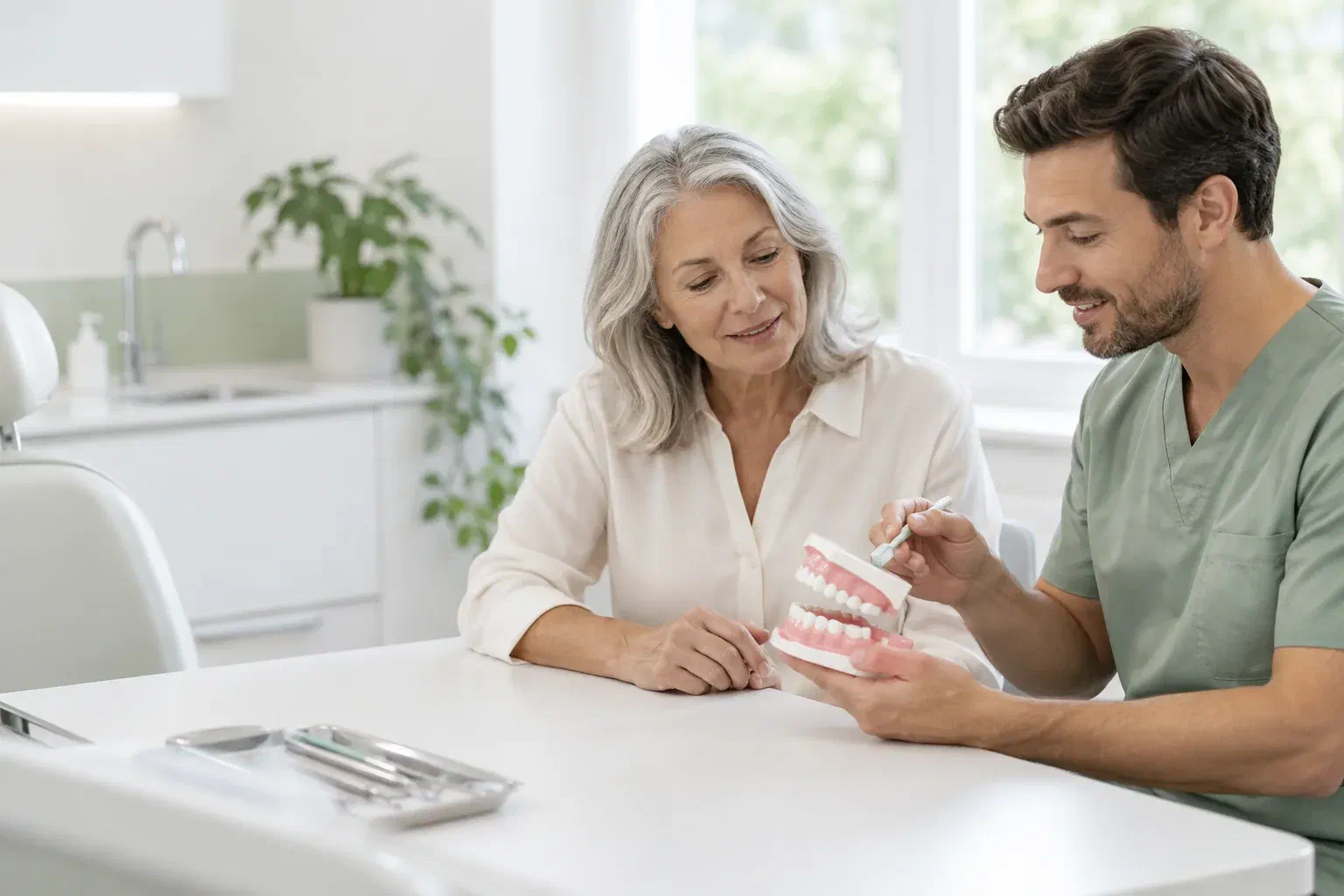
Illustrative conversation about caring for exposed root surfaces
General & Family Dentistry

Root-Cavity Prevention in Old Milton

Years of fillings, crowns, and gentle gum changes can leave root surfaces exposed around older dental work. We help people in Old Milton see where those surfaces are and how to look after them.

Old Milton smiles, roots and restorations

What happens where old dental work meets the gum?

A mouth with decades of history often has fillings and crowns whose edges once sat neatly under the gum. As gums recede, a strip of root can appear beside that work. Root surface is softer than enamel and can decay more readily, yet seeing it is not proof of a cavity. It simply tells us where extra care may be useful.

For long-time households in Milton’s historic downtown and newcomers on the same streets, our Bronte Street practice starts by looking. We check margins, root surfaces, and any area that catches floss or food. You tell us about twinges, dryness, and the places you find hard to reach, and together we sort prevention from repair.

The plan that follows should be specific. Perhaps a narrower brush for the edge of an old crown, a fluoride product chosen for your risk, or a talk about medicines that dry the mouth. Nothing can guarantee protection, so the advice is revisited when your health, prescriptions, or dexterity change.

Plan care around older dental work
Illustrative soft toothbrush and interdental brush for a preventive routine
Signs to bring up

The edges tell us a lot.

Risk on a root reflects the exposed surface, the restorations beside it, and your saliva and habits. Describe what you notice; the examination decides whether decay is present.

Recession beside a filling or crown

You might feel a ledge with your tongue, or notice a sensitive spot just above an older restoration. Tell us when you first noticed it. Several things can cause sensitivity, so we examine the area before suggesting a toothpaste or assuming recession explains everything.

A mouth that feels parched

Waking with a dry tongue, needing sips while talking, or noticing dryness since a prescription changed are all relevant. Bring your medicine list. Please continue prescribed treatment; we can discuss whether to raise the dryness with your physician or pharmacist.

Floss that shreds or catches

A rough margin, a gap under a bridge, or stiff fingers can make one area hard to clean. Point to the exact place. A short demonstration with an interdental brush or threader often helps more than scrubbing harder or buying a stronger rinse.

A brown line along a filling edge is not, by itself, a diagnosis of root decay. Avoid poking at it with a pick. Ask for an assessment if the edge seems to be changing, food packs in, or the tooth aches.

Why it is worth the effort

Fewer surprises at the margin.

Prevention pulls together several things: how the surface is cleaned, fluoride contact, how often sugar is around, and how much saliva you have. The right mix depends on you. A person with dry mouth and earlier root decay usually needs more support than someone with a little recession and no cavity history.

It cannot replace lost structure, and it does not promise that an exposed root will stay healthy. Neither does it mean every root needs a filling. When we recommend something, feel free to ask whether the goal is preventing a new lesion, managing an early one, or treating established damage.

Patient information: ADA — aging, exposed roots, and caries risk

Cleaning aimed at the right spot

Once you know which edges and surfaces matter, home care stops feeling vague. We can show you in a mirror and guide the brush to the right angle. Practising it in the chair helps the technique carry over to your own bathroom.

Products you understand

Fluoride advice should say what the product is for, how to use it, and whether a prescription is needed. Let us know what you use already. A longer shelf of products is not better if the directions become hard to follow.

Advice that keeps pace with you

New dental work, rising dryness, or a family member starting to help with brushing can all change what works. Share those changes at reviews. We would rather adjust the routine than have you keep an instruction that no longer suits.

From conversation to review

Here is how we approach it.

An assessment separates an exposed but healthy surface from active decay. Recommendations follow the findings and what you can manage between appointments.

  1. Go over your dental past

    Many mouths in Old Milton carry a long record of care. We discuss old cavities, crowns and fillings, recession, dryness, medicines, and day-to-day eating and cleaning. Let us know if someone helps with your care. Describe what really happens at home; that is what helps us find workable changes.

  2. Check roots and restoration edges

    The dentist examines the exposed roots, the margins of existing work, and the gums, and decides whether more records would help. Ask which areas are sound, which to watch, and whether anything needs treating. A mirror or photo can show the spot clearly.

  3. Choose measures for home and chair

    We talk through suitable brushes and aids, fluoride, and ways to handle dryness or frequent sweets. If a prescription or in-office application is suggested, make sure the directions and follow-up are clear. Any treatment for existing decay is explained separately, with its benefits and limits.

  4. Agree when to look again

    Set a review date and know what will be compared. If the routine is a struggle before then, call. Root-surface prevention works best as an ongoing discussion shaped by findings and your experience, not a one-off recommendation.

Looking after it at home

Gentle at the gum, steady through the week.

Follow the advice given for your own mouth. A prescribed product should be used exactly as directed and kept out of children’s reach.

Ease off the pressure

Use the brush and motion we demonstrated rather than bearing down on an exposed area. Ask how to clean around crown edges and between teeth without hurting the gum. If discomfort gets in the way of cleaning, tell us so both the cause and the method can be reviewed.

Mind the sips and lozenges

Mention the drinks, mints, or lozenges you use for a dry mouth. Frequent sugary or acidic exposure can work against the plan. Ask about better choices and about assessment of lasting dryness instead of adding products on your own.

Watch, then report

Let us know about new pain, a changed surface, or food packing in, rather than testing the tooth with cold drinks or a sharp tool. Keep your review appointments even when nothing hurts. How it feels cannot confirm the root surface is stable.

Three possible paths

The finding decides the response.

Ask what the exam showed first. A healthy exposed root, an early lesion, and a cavity that has lost structure each need different care.

Surfaces that need protecting

Prevention fitted to your mouth

Cleaning guidance, suitable fluoride, and attention to relevant habits make up the base. The plan should name the areas of concern and the follow-up. Choosing prevention does not mean leaving a known problem unreviewed.

Higher risk or an early lesion

Additional fluoride or lesion care

The dentist may propose an extra fluoride measure or another appropriate way to manage an early lesion. Ask about its purpose, its limits, any effect on appearance, and how it will be monitored. Confirm it suits you rather than assuming from a general description.

When prevention is not enough

Restoring a cavity

A cavity may need repair depending on its depth, position, access, and the tooth’s condition. Older restorations nearby can affect the options, and the dentist will explain them. Prevention still matters afterward, since one repair does not remove the causes of decay.

Patient information: ADA — fluoride and caries prevention

Old Milton root-care questions

Your history shapes the answers.

Bring your questions about recession, older dental work, fluoride, and dryness. Advice should rest on an examination rather than appearance alone.

(905) 876-4488
Is decay at the edge of an old filling the same as a root cavity?
They can overlap. Decay can start at a restoration margin, and if that margin sits on root surface, the two concerns meet. The dentist examines the edge and the surrounding root to see what is happening and explains whether monitoring, prevention, or a repair fits.
Should a filling be replaced just because the gum has moved away from it?
Not automatically. An exposed margin may be sound and simply need careful cleaning and review. Replacement is considered when there is a specific problem, such as decay, a gap, or a fracture. Ask what was found and why a particular option is suggested.
Do I need a prescription toothpaste for my exposed roots?
It depends on your risk. Some people benefit from a stronger fluoride product, and others do well with their regular toothpaste and better technique. Bring the tube you use now. If something is prescribed, it comes with its own directions.
My hands are stiffer than they used to be. Can the routine change?
Yes. A thicker handle, a powered brush, or a different interdental aid may be easier to control. Show us what is difficult and we can try options in the chair. The routine should work for your hands, not the other way round.
Why do you ask about the mints I keep in my pocket?
What they contain and how often you have them can affect root-surface risk, especially with a dry mouth. Tell us about drinks and lozenges as well. We can talk about alternatives and about having the dryness itself looked at.
What does monitoring an early root lesion actually involve?
The dentist records the area and compares it at later visits to see whether it is stable or changing. Ask what will be checked and when. Feeling comfortable is helpful information, but it does not replace that planned review.
Near Milton’s historic downtown

Bring your dental history; we’ll read it together.

Call our Bronte Street practice about recession, dryness, or a worry near an older filling or crown. We will examine the surfaces, explain what we find, and walk you through the preventive or treatment options that suit you.

Visible root surface is not automatically decay. New pain or a changing area should be examined rather than managed only with prevention products.

Visit Milton Dental Clinic
Unit 1, 342 Bronte St. S, Milton, ON L9T 5B7
Get directions Clinic hours
Monday–Thursday
11am–7pm
Friday–Sunday
By appointment only

Areas we serve

  • Milton
  • Oakville
  • Mississauga
  • Georgetown
  • Halton Hills
  • Acton
  • Campbellville
  • Brampton
  • Burlington
  • Puslinch
  • Rockwood
  • Erin
  • Caledon
  • Etobicoke
  • Old Milton
  • Bronte Meadows
  • Timberlea
  • Dorset Park
  • Dempsey
  • Clarke
  • Beaty
  • Coates
  • Harrison
  • Scott
  • Willmott
  • Ford
  • Bowes
  • Cobden
  • Walker
  • Mountain View
  • Milton Heights
  • Hawthorne Village
  • Valley View
  • Fallingbrook
  • Nassagaweya
  • Trafalgar
  • Esquesing
  • Nelson
  • Brookville
  • Moffat
  • Glen Williams
  • Norval
  • Limehouse
  • Stewarttown
  • Ashgrove
  • Hornby
  • Silver Creek
  • Speyside
  • Scotch Block
  • North Oakville
  • River Oaks
  • Glen Abbey
  • West Oak Trails
  • Palermo
  • Bronte Creek
  • College Park
  • Joshua Creek
  • Uptown Core
  • Preserve
  • Iroquois Ridge
  • Lisgar
  • Meadowvale
  • Meadowvale Village
  • Churchill Meadows
  • Erin Mills
  • Central Erin Mills
  • Streetsville
  • East Credit
  • Creditview
  • Heartland
  • Sheridan
  • Mount Pleasant
  • Credit Valley
  • Huttonville
  • Churchville
  • Springbrook
  • Northwest Brampton
  • Bram West
  • Fletcher's Meadow
  • Fletcher's Creek South
  • Alton Village
  • Orchard
  • Millcroft
  • Headon Forest
  • Tansley
  • Brant Hills
  • Tyandaga
  • Kilbride
  • Lowville
  • Aberfoyle
  • Morriston
  • Arkell
  • Hillsburgh
  • Freelton
  • Carlisle
  • Waterdown
  • Flamborough
  • Mountsberg

How can we help?

Milton Dental Clinic

Have a question about your smile? Choose the option that works best for you.

For urgent dental concerns, please call.
Messages are reviewed during clinic hours.