
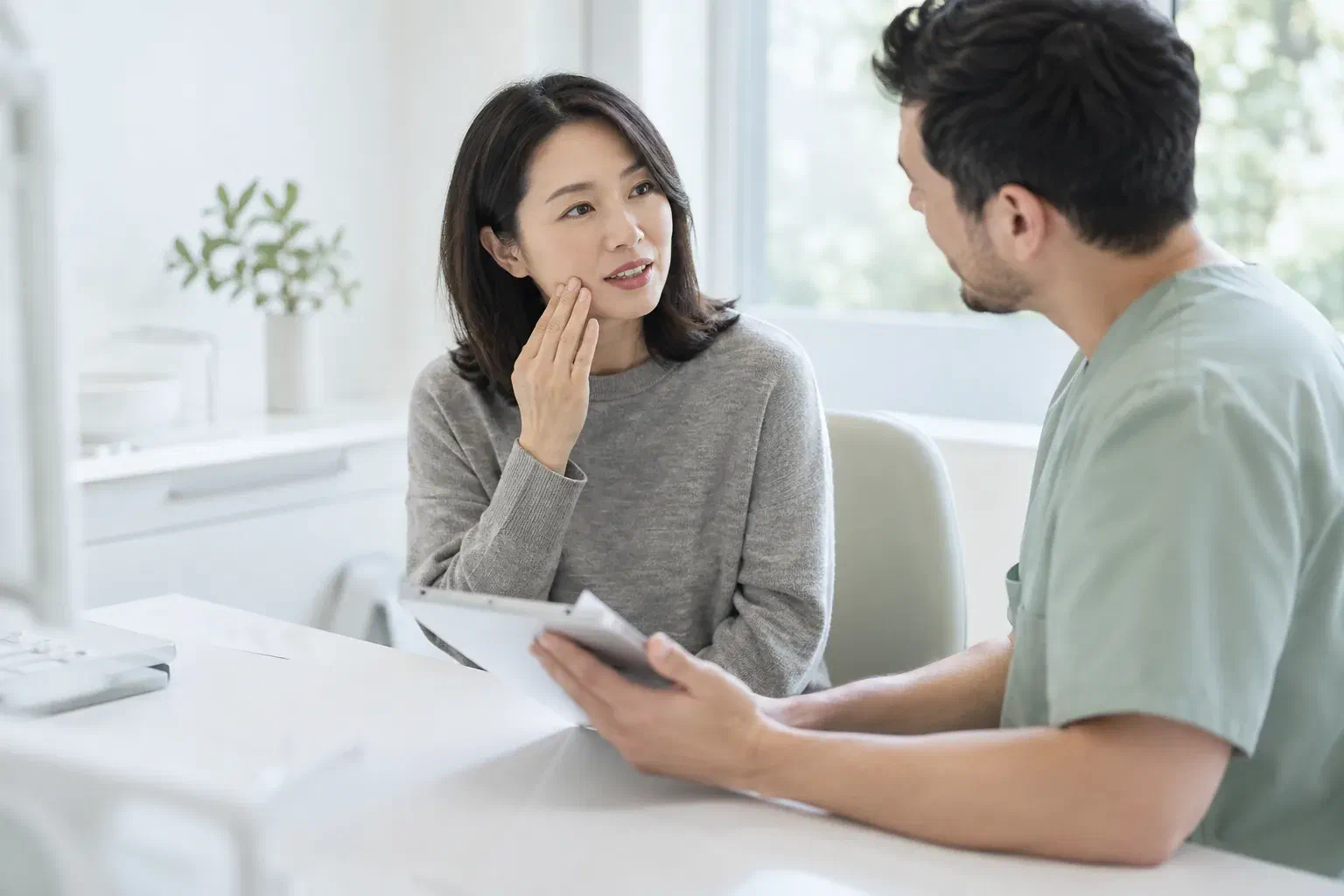
Illustrative patient describing tooth sensitivity during a dental conversation
General & Family Dentistry

Treatment for Sensitive Teeth in Milton

That jolt from a glass of iced water is easy to shrug off until it keeps happening. Our Milton team looks at when, where, and how long your teeth react, then finds the cause before suggesting any treatment.

Is it worth booking?

A twinge you keep noticing is a reason to ask.

Most people wait. The sharp feeling comes with the first sip of something cold, fades in a moment, and gets filed away as nothing. When it returns week after week, or starts showing up while you brush, it is telling you something worth hearing, even though the word sensitivity on its own does not say what is wrong.

Exposed dentin is one common reason teeth react, yet decay, a cracked or worn tooth, an ageing filling, or gum changes can feel much the same. That is why our Bronte Street team starts with your description and a careful examination instead of a product recommendation. A toothpaste chosen by guesswork can quiet the signal while the real problem carries on.

You will not be asked to prove the pain. Tell us what ordinary moments set it off, whether it is getting better or worse, and how long each episode lasts. From there, the dentist can explain what was found, suggest care that suits it, and tell you what progress should look like over the coming weeks.

Ask about your sensitive teeth
Illustrative soft toothbrush, toothpaste, and drinking water for gentle daily care
What to tell us

Three patterns that point in different directions

You do not need to name the condition. Notice the trigger, the spot, and the length of each episode, and describe them as plainly as you can.

A quick sting from cold, air, or the brush

Note whether the reaction is repeatable and whether it involves one area or several teeth. Even a short sting is worth an assessment when it is new, seems to be spreading, or has you skipping part of your brushing routine.

An ache that stays, or arrives unprovoked

Pain that outlasts the cold drink, wakes you at night, or starts with no trigger at all may call for a different investigation and a quicker appointment. A stronger toothpaste is not the obvious answer once the pattern has shifted like this.

Sensitivity that began after something changed

Mention any recent filling, whitening, new toothpaste or rinse, knock to the mouth, or change in how your bite feels. The timing gives useful context, but it is only a clue, and the tooth still needs to be examined properly.

Phone us soon about swelling, a broken tooth, real pain when biting, or symptoms that are getting worse. Already booked for a checkup? Let us know about the new problem so we can decide whether you should come in sooner or for a different visit.

Diagnosis before products

Care that answers the actual finding

Dentin sits beneath enamel and gum tissue, and when part of it becomes exposed, cold or touch can travel through to the nerve. Several other dental problems produce a similar sensation, so the examination is what tells them apart. The right care might be a home product, a treatment applied in the chair, or a repair of one specific tooth.

No approach can promise instant or lasting relief. Before you start, ask what the treatment is meant to change, how you should use it, and when the team will check how you are doing. A sound plan also tells you what to do if the discomfort lingers or begins to behave differently.

Patient information: ADA MouthHealthy — sensitive teeth and possible causes

Fewer products tried at random

Bring the names of any toothpaste, rinse, or whitening kit you have already used and say how each one went. That history keeps you from cycling through more of the same, and lets the dentist explain why a new suggestion might work differently.

Treatment aimed at the cause

When the examination finds decay, a worn restoration, or another issue, that problem can be discussed directly. Covering up the feeling may leave it in place. Ask the dentist to link every recommendation to the finding it is meant to treat.

Brushing you can keep up

If cleaning one area hurts, it is natural to skip it, and that makes daily care harder. Tell us where your routine slips so technique and tools can be adjusted. The aim is cleaning that feels manageable while the cause and your response are reviewed.

Your visit in Milton

From your description to a clear next step

Which tests are used depends on what the dentist finds. If you are nervous about a test bringing on discomfort, say so, and each step can be explained before it begins.

  1. Talk through the history

    Share when you first noticed the feeling, what usually sets it off, where it seems to be, and how long it lasts. Mention night pain or recent dental work. Not sure which tooth it is? That is fine, and you can still ask for help.

  2. Look closely at teeth and gums

    The dentist checks the relevant surfaces, fillings, and gum areas. Tests or X-rays may be suggested to narrow down the source. Ask what each one is meant to show, and raise a hand whenever you need to stop.

  3. Hear the findings and the choices

    You will hear what is known and what is still uncertain. If a conservative approach suits the findings, the team explains how to use it and how it will be followed. If a tooth needs treatment, ask about the options, their limits, and the timing.

  4. Leave with a routine and a check-in date

    Confirm the home care, any treatment given in the chair, and when to report back. Ask which changes should bring an earlier call. A trial of a product should have a purpose and an end point, not run on while the cause stays unexplained.

At home, between visits

Gentle, consistent care works better than hard scrubbing.

Follow the instructions for your own diagnosis and the product or procedure you actually received. Care after a new filling can be quite different from using a desensitizing toothpaste.

Leave the ice cube test alone

Touching the tooth with something cold to see if it has improved only keeps irritating it. Use a soft brush and the technique you were shown, and avoid pressing harder on the sore spot. Tell us if that area is still hard to clean.

Stick to the product directions

Desensitizing toothpaste often needs regular use over a period before anyone can judge whether it helps. Use it as directed instead of stacking several treatments or applying them more often. Check with us before continuing whitening that seems connected to the problem.

Watch for changes that matter

A short note can help: what sets the tooth off, how long it lasts, and whether eating or brushing feels easier. There is no need to provoke it on purpose. Call if the pain gets worse, starts without a trigger, or does not improve as expected.

Possible paths

The source decides the treatment.

Ask what each option is designed to do. Exposed dentin, a damaged tooth, and a problem inside the tooth lead to quite different conversations.

When conservative care suits the findings

Desensitizing care

For a suitable sensitive surface, the dentist may suggest a product to use at home or a treatment applied at the clinic. Ask how it is used, what it cannot do, and when it will be reviewed. It should come after an assessment, not replace one.

When a tooth or filling needs attention

Repairing or protecting one area

Decay, a damaged tooth, or a failing filling may need a repair or another protective step. What is suitable depends on the problem and how much healthy tooth remains. Ask why a treatment is recommended and which alternatives are reasonable.

When the diagnosis needs more care

Gum care or treatment inside the tooth

Some findings lead to a separate discussion about gum treatment or care for the inside of the tooth, and a referral may be suggested. Root canal treatment is not the standard answer to sensitivity; it depends entirely on the diagnosis and the options available.

Common questions

What people in Milton ask about sensitive teeth

Bring questions about what sets your teeth off, the products you have tried, and how progress will be judged. One word can cover several different problems.

(905) 876-4488
The twinge only lasts a second. Is it really worth an appointment?
A brief reaction can still be worth checking, especially if it is new, happening more often, or changing how you eat or brush. Mention it at your next visit or call to ask whether an earlier assessment makes sense. Lingering or worsening pain should not wait.
Can sensitivity come and go over a few weeks?
Yes, symptoms can vary from day to day, and that pattern is useful to describe. A quiet spell does not prove the cause has gone away. Tell the dentist how often it happens and whether the episodes are becoming longer or stronger.
Could my gums have something to do with it?
They may. When gum tissue pulls back, part of the root surface can be exposed and react to cold or touch. Gum changes are only one possibility, though, so the dentist will examine both the teeth and the gums before suggesting care.
Does a good result from a sensitivity toothpaste mean no cavity is there?
No. Feeling better does not rule out decay or another problem. Have new or unexplained sensitivity assessed, and tell the dentist which toothpaste you used and how much it helped. The examination decides whether more care is needed.
Should I keep using my whitening strips until my visit?
If the strips seem to bring on the discomfort, pause them and ask for advice before going back. Bring the product name and how often you used it. Adding more desensitizing products while continuing the same whitening is not a substitute for an assessment.
Is a root canal the likely outcome for a sensitive tooth?
Not usually on sensitivity alone. Whether it is ever needed depends on the history, the examination, and any tests. Ask what the diagnosis is and why a particular treatment fits your tooth before agreeing to a plan.
Sensitive teeth care in Milton

Tell us what you feel, and we will look for why.

Call our Bronte Street practice to describe what is happening and book a suitable assessment. Let us know if the pain lingers, appears without a trigger, or began after recent treatment, so the right next step can be arranged.

Treatment depends on the cause. Report new swelling or strong, worsening pain promptly instead of relying on products alone.

Visit Milton Dental Clinic
Unit 1, 342 Bronte St. S, Milton, ON L9T 5B7
Get directions Clinic hours
Monday–Thursday
11am–7pm
Friday–Sunday
By appointment only

Areas we serve

  • Milton
  • Oakville
  • Mississauga
  • Georgetown
  • Halton Hills
  • Acton
  • Campbellville
  • Brampton
  • Burlington
  • Puslinch
  • Rockwood
  • Erin
  • Caledon
  • Etobicoke
  • Old Milton
  • Bronte Meadows
  • Timberlea
  • Dorset Park
  • Dempsey
  • Clarke
  • Beaty
  • Coates
  • Harrison
  • Scott
  • Willmott
  • Ford
  • Bowes
  • Cobden
  • Walker
  • Mountain View
  • Milton Heights
  • Hawthorne Village
  • Valley View
  • Fallingbrook
  • Nassagaweya
  • Trafalgar
  • Esquesing
  • Nelson
  • Brookville
  • Moffat
  • Glen Williams
  • Norval
  • Limehouse
  • Stewarttown
  • Ashgrove
  • Hornby
  • Silver Creek
  • Speyside
  • Scotch Block
  • North Oakville
  • River Oaks
  • Glen Abbey
  • West Oak Trails
  • Palermo
  • Bronte Creek
  • College Park
  • Joshua Creek
  • Uptown Core
  • Preserve
  • Iroquois Ridge
  • Lisgar
  • Meadowvale
  • Meadowvale Village
  • Churchill Meadows
  • Erin Mills
  • Central Erin Mills
  • Streetsville
  • East Credit
  • Creditview
  • Heartland
  • Sheridan
  • Mount Pleasant
  • Credit Valley
  • Huttonville
  • Churchville
  • Springbrook
  • Northwest Brampton
  • Bram West
  • Fletcher's Meadow
  • Fletcher's Creek South
  • Alton Village
  • Orchard
  • Millcroft
  • Headon Forest
  • Tansley
  • Brant Hills
  • Tyandaga
  • Kilbride
  • Lowville
  • Aberfoyle
  • Morriston
  • Arkell
  • Hillsburgh
  • Freelton
  • Carlisle
  • Waterdown
  • Flamborough
  • Mountsberg

How can we help?

Milton Dental Clinic

Have a question about your smile? Choose the option that works best for you.

For urgent dental concerns, please call.
Messages are reviewed during clinic hours.