

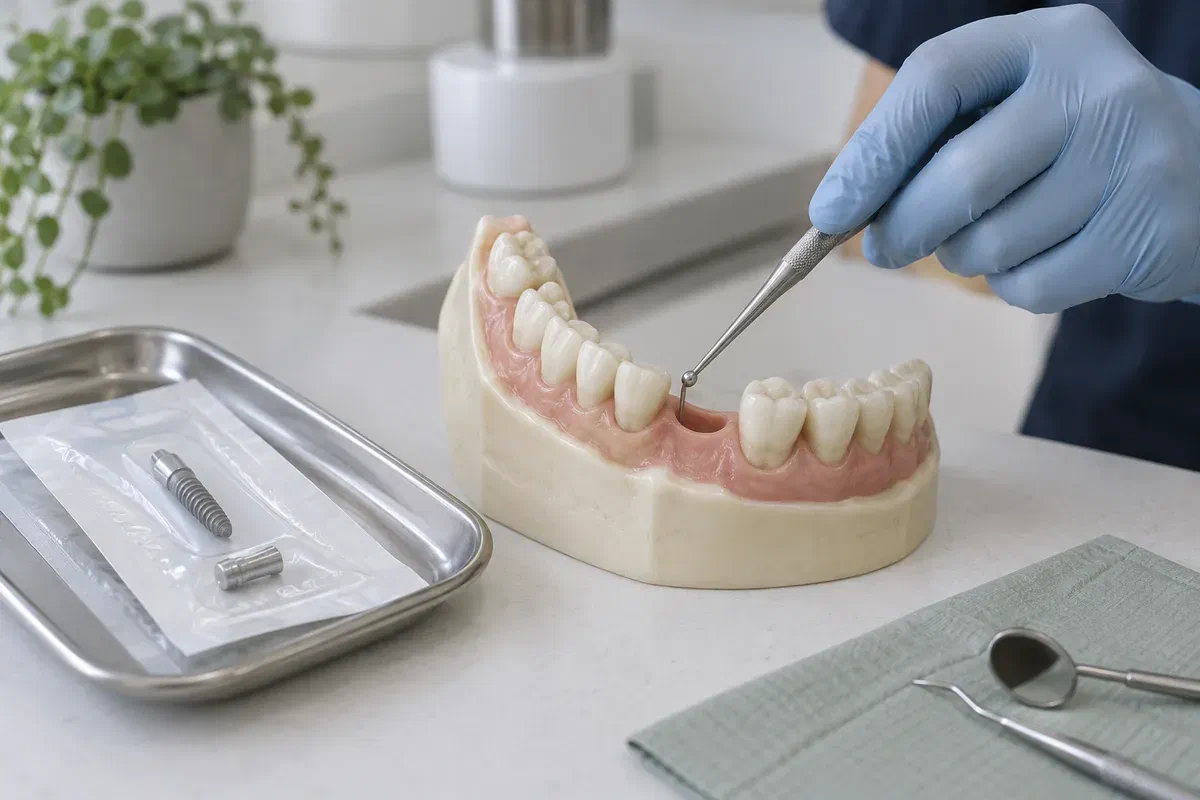
Illustrative discussion of tooth extraction and future replacement planning
Restorative Dentistry

Alveolar Ridge Preservation in Burlington

A front tooth that needs removing raises a visible question: what happens to the gum line? From Burlington, learn how ridge preservation may help protect the shape of the site.

When the tooth shows in your smile

Keep the outline you see in the mirror.

Losing a tooth near the front of your mouth is not only about chewing. People notice the gum line, and a dip or hollow above a replacement tooth can be hard to disguise. That hollow often begins after extraction, when the bony ridge that held the root shrinks back as the socket heals.

Ridge preservation places graft material into the empty socket with the aim of limiting some of that shrinkage. It is not right for every case. The thickness of the bone at the front, the condition of the gum, your general health and the replacement you have in mind all shape the advice.

If a visible tooth is cracked, loose or failing, raise the question of appearance early. For people coming from Burlington, a single visit can cover how the space might look over time, which replacements could suit it, and whether preserving the site is likely to help.

Ask about a front-tooth extraction
Dental study model showing a missing molar space for a ridge-preservation discussion
Moments to bring it up

Is the tooth in your smile line?

Preservation is normally done as the tooth is removed, so the right time to ask is beforehand. Your dentist can explain whether the site suits grafting and whether a periodontist or surgeon should also assess it.

An implant crown could be the goal

An implant needs adequate bone and healthy gum to sit in the right position. Preserving the site may help that later assessment, though it cannot ensure an implant will be suitable or remove every need for further grafting.

Gum height between teeth

When the ridge collapses, the gum over the gap can recede and leave a replacement looking longer than its neighbours. Where the tooth sits and how much of it shows when you smile affect how much this matters.

Undecided between a bridge and an implant

You can take care of a failing tooth before settling on its replacement. Talking first lets you understand what preservation may add for either choice, its limits, and how it fits a step-by-step plan.

If the tooth is already gone, the site can still be evaluated. A healed ridge that needs rebuilding is generally treated with a different procedure from fresh-socket preservation.

Why it can matter at the front

Bone supports the gum you see.

The goal is to keep more of the ridge's width and height than an untreated socket tends to hold on to. The graft serves as a scaffold for healing. It is not a replacement tooth, and some natural change in the bone still takes place.

There are drawbacks to weigh as well: an added fee, surgical care and healing time, with a chance of graft exposure, infection or less bone forming than planned. A useful recommendation explains why the expected benefit for your front tooth justifies them.

Patient information: AAP — ridge modification

Appearance planned from the start

Considering the replacement before removal means the socket is treated with the final look in mind, not as an afterthought.

Gum contour support

Maintaining bone and soft-tissue form may help a future crown or bridge tooth blend with its neighbours. Your anatomy and healing still set the limits.

Reassessment after healing

Once the site has healed, it is checked again so you know what imaging, treatment or referral is needed before a replacement is made.

Step by step

From assessment to a healed, reviewed site.

Front-tooth techniques vary with the bone and gum involved. Ask who will place the graft, what material is planned and how a temporary tooth fits between the extraction and the final replacement.

  1. Examine and image

    We look at why the tooth is failing, check the gum around it and review the X-rays. Your medical history, medications, smoking and past healing are part of deciding whether a graft is appropriate.

  2. Weigh the options together

    The material, expected benefits, alternatives, fees and recovery are explained before you give consent. Thin bone, infection or gum loss may call for specialist input or a different sequence of care.

  3. Place the graft

    Where suitable, the tooth is gently removed and graft material is placed in the socket while the area is numbed. A membrane, covering or stitches may be used, depending on the method and tissues.

  4. Monitor and confirm

    Review visits follow how the gum is healing. The site is reassessed before an implant or bridge is finalized, as a neat-looking gum surface does not show whether the bone is ready.

Back home in Burlington

Protect the site, especially when you eat and smile.

Your written instructions take priority, because grafting methods differ. Ask before leaving if anything is unclear about brushing, rinsing, food or wearing a temporary tooth.

Avoid biting into the area

Cut food into small pieces and chew away from the site. Keep your tongue and fingers off the graft, and confirm whether a temporary appliance needs adjusting so it does not press down.

Clean gently around it

Keep brushing other teeth and use any prescribed rinse as directed. Ask when to resume cleaning right beside the healing area rather than going back to normal brushing there straight away.

Attend each review

Check-ups let the clinician look at the gum and discuss progress. Mention any new discomfort, unusual discharge or difficulty with the instructions before the next stage.

Comparing approaches

What happens to the socket shapes what is possible.

Ask how each option could affect a front tooth in particular, including letting the socket heal without a graft. A clear answer covers both the first weeks and any later stages.

No preservation procedure

Socket heals naturally

The site can heal without graft material if that is the agreed plan. Some change to the ridge is expected, so ask how it could affect the look and fit of a replacement here.

When the fresh socket allows

Graft during extraction

Grafting at the removal visit may help reduce shrinkage. Suitability depends on the site and plan, and an implant still requires its own assessment before placement.

For a ridge that has already thinned

Rebuild later

If the healed ridge is not enough for the planned restoration, a bone-augmentation procedure may be considered later. It can involve more surgery and its own healing time.

Front-tooth questions

What to ask when appearance is part of the decision.

These questions often come up when the tooth being removed is visible. They can help you plan for both healing and how your smile will look along the way.

(905) 876-4488
Will I have a visible gap while the site heals?
Not necessarily. Options such as a temporary removable tooth or other interim solutions may be possible, depending on the site and graft. Ask what is suitable before the extraction so you can plan around work and social commitments.
Does gum shape matter more for front teeth than back teeth?
Often, yes, because the gum line at the front is easy to see. Bone changes after extraction can affect how natural a replacement looks. At the back, function and space for a replacement may matter more than appearance.
Is preservation useful if I choose a bridge instead of an implant?
It can be. Keeping the ridge fuller may help a bridge tooth sit against the gum more naturally. Whether it is worth doing depends on the site, so ask how preservation would affect the specific replacement you prefer.
Does ridge preservation make the extraction appointment longer?
Usually somewhat, since the socket is prepared and grafted after the tooth is removed. Ask for an estimate of the appointment length and recovery so you can plan your day.
Can ridge preservation stop all bone loss after removal?
No. Some change is expected even with a graft, and some sites still need more treatment before an implant. The aim is a better starting point for planning, not a promised amount of bone.
What should I know about graft material before I agree?
Grafts may come from a human donor, an animal source, synthetic materials or your own bone. Ask which is proposed and why, and discuss any medical, personal or religious concerns before giving consent.
Planning from Burlington

Talk about the look of the site before it changes.

Book a consultation at our Bronte Street practice ahead of a planned extraction, or bring an existing recommendation for us to review. We will examine the site, discuss how it may look as it heals and say whether specialist care is advisable.

After surgery, contact your treating clinician with any concern. For urgent problems, please call instead of making an online request.

Visit Milton Dental Clinic
Unit 1, 342 Bronte St. S, Milton, ON L9T 5B7
Get directions Clinic hours
Monday–Thursday
11am–7pm
Friday–Sunday
By appointment only

Areas we serve

  • Milton
  • Oakville
  • Mississauga
  • Georgetown
  • Halton Hills
  • Acton
  • Campbellville
  • Brampton
  • Burlington
  • Puslinch
  • Rockwood
  • Erin
  • Caledon
  • Etobicoke
  • Old Milton
  • Bronte Meadows
  • Timberlea
  • Dorset Park
  • Dempsey
  • Clarke
  • Beaty
  • Coates
  • Harrison
  • Scott
  • Willmott
  • Ford
  • Bowes
  • Cobden
  • Walker
  • Mountain View
  • Milton Heights
  • Hawthorne Village
  • Valley View
  • Fallingbrook
  • Nassagaweya
  • Trafalgar
  • Esquesing
  • Nelson
  • Brookville
  • Moffat
  • Glen Williams
  • Norval
  • Limehouse
  • Stewarttown
  • Ashgrove
  • Hornby
  • Silver Creek
  • Speyside
  • Scotch Block
  • North Oakville
  • River Oaks
  • Glen Abbey
  • West Oak Trails
  • Palermo
  • Bronte Creek
  • College Park
  • Joshua Creek
  • Uptown Core
  • Preserve
  • Iroquois Ridge
  • Lisgar
  • Meadowvale
  • Meadowvale Village
  • Churchill Meadows
  • Erin Mills
  • Central Erin Mills
  • Streetsville
  • East Credit
  • Creditview
  • Heartland
  • Sheridan
  • Mount Pleasant
  • Credit Valley
  • Huttonville
  • Churchville
  • Springbrook
  • Northwest Brampton
  • Bram West
  • Fletcher's Meadow
  • Fletcher's Creek South
  • Alton Village
  • Orchard
  • Millcroft
  • Headon Forest
  • Tansley
  • Brant Hills
  • Tyandaga
  • Kilbride
  • Lowville
  • Aberfoyle
  • Morriston
  • Arkell
  • Hillsburgh
  • Freelton
  • Carlisle
  • Waterdown
  • Flamborough
  • Mountsberg

How can we help?

Milton Dental Clinic

Have a question about your smile? Choose the option that works best for you.

For urgent dental concerns, please call.
Messages are reviewed during clinic hours.