A knock at any age
Even a blow that left only a small chip can affect the pulp. Mention falls, sports bumps and dental accidents, including those from childhood that never seemed to cause trouble.


Worried a front tooth will look different once it is treated? Appearance belongs in the conversation from day one. Visiting from Brampton, plan root canal care with shade, shape and the final restoration discussed up front.
A front tooth is part of every conversation, photo and video call, so it is natural to think about looks as well as comfort. Incisors and canines each contain pulp, a soft centre of nerves and blood vessels. Should that pulp become infected or irreversibly inflamed, root canal treatment may let you keep a tooth that can still be restored.
Deep decay, a crack or an injury, whether recent or years old, can each set this in motion. Often the enamel looks fine while the tissue inside has changed. Testing, your description of symptoms and appropriate imaging tell the dentist far more than a glance in the mirror.
When you come from Brampton to our Bronte Street practice, we start with the diagnosis and keep the visible result in the same discussion. Ask about colour, the access filling, the amount of tooth left and whether a further restoration is likely, so nothing about the finish comes as a surprise.
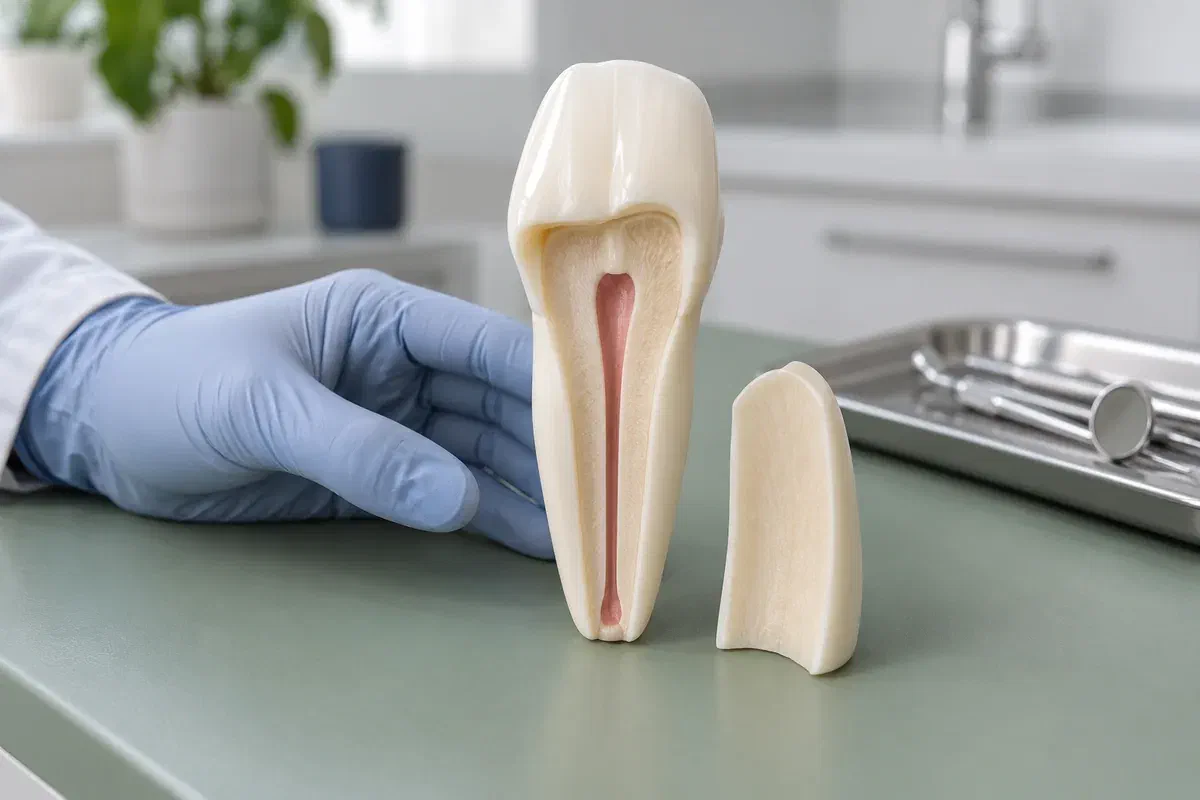
Discomfort sends many people to the dentist, but a troubled pulp can also be painless. Examination tells us if the nerve tissue is involved at all, and if it is, which treatment truly fits.
Even a blow that left only a small chip can affect the pulp. Mention falls, sports bumps and dental accidents, including those from childhood that never seemed to cause trouble.
Pain that lingers after something cold or hot, aching that begins on its own or soreness when biting all warrant a look. Timing and triggers help, because different conditions can overlap.
Gradual loss of brightness in an incisor, or a small swelling near the root that keeps returning, should be assessed. Neither proves the diagnosis, and a quiet tooth is not necessarily a healthy one.
Call straight away if an adult tooth has been knocked out of the mouth. Fresh injuries need prompt advice by phone rather than a routine consultation.
Root canal treatment takes out the affected pulp, disinfects and shapes the inside of the root and seals it. Done in a restorable tooth, it aims to let that tooth continue to function and look natural once a suitable final restoration is placed.
Several factors influence success: the diagnosis, how the root is shaped, any cracks, the remaining structure and how well the restoration seals. Trauma, calcified canals or previous treatment can make an anterior tooth more complex, and a specialist referral may be advised when that would improve planning.
Patient information: AAE — root canal treatment
Saving a suitable tooth avoids creating a gap and keeps the work centred on restoring the tooth already in your smile.
The access opening, earlier damage, shade and shape are considered together, linking the work inside the root with how the tooth will look.
Testing helps separate a pulp problem from a crack, gum disease or pain from elsewhere, so treatment responds to findings rather than sensitivity alone.
Ask early about the number of visits, any temporary filling you might leave with and who places the final restoration. Seeing the complete plan helps make sure the tooth is never left unprotected.
The dentist reviews your symptoms and history, examines the tooth and gums and carries out relevant tests. Imaging is used to assess the root and nearby tissue, and restorability is considered before beginning.
Local anaesthetic is given as needed and a dental dam isolates the tooth, which also keeps saliva out of the treatment area. Ask for a pause whenever you need one.
Access is usually made through the back of the tooth, so the front surface is not the entry point. The canal is cleaned, shaped and sealed, with a temporary filling between stages if required.
The opening and any damaged areas are restored with the appearance in mind. Follow-up checks healing, and the dentist explains why a filling, a crown or another option suits the tooth that remains.
Follow the instructions your dentist or endodontist provides. The tooth may feel unfamiliar for a while, and a temporary restoration should be protected until the final one is placed.
Avoid very hard foods and never use a temporarily restored front tooth to open packaging. Ask what you can eat and when normal chewing is fine.
Stick with the routine you were given and be gentle around any tender gum. Let us know if the temporary chips, loosens or comes out.
Root canal care and the restoration that follows are distinct steps. Keep the appointments for both the restoration and review, so the opening is sealed and the tooth is monitored.
Bring every question, cosmetic or practical. The root, the visible tooth and any past injury all influence what we recommend.
Bring a front tooth that is aching, injured or changing colour to our Bronte Street practice. We will explain what testing shows, whether root canal care makes sense for you, and the restoration or referral that would complete it.
Phone the clinic promptly about a recent injury, severe pain or swelling. Online booking requests are for concerns that can wait.
