A knock you almost forgot
Front teeth take the brunt of falls, elbows and stray balls. Tell us about any blow to the tooth, even one from childhood that seemed to settle, because the pulp can be affected without an obvious break.


Sometimes the first sign is a family photo where one front tooth looks a shade greyer than the rest. Talk through front-tooth root canal care in Milton, from testing what is happening inside to restoring how it looks.
Your incisors and canines sit right where everyone notices them, so a change in one of them tends to get attention quickly. Deep inside every tooth is the pulp, a soft core of nerves and blood vessels. If that core becomes infected or inflamed beyond recovery, a root canal can be a way to keep a tooth that is still worth restoring.
What leads there varies. Decay that reached too far, a crack, or a bump from a playground tumble or hockey practice, whether last month or a decade ago, can all affect the pulp. A tooth can look fairly normal on the outside while the tissue within has changed, so the decision rests on symptoms, tests and suitable imaging rather than the mirror.
For anyone in Milton, the appointment is a short trip to our Bronte Street practice, which makes it easier to ask everything you want to know. Front teeth raise particular questions: will the colour change, where does the opening go, how much natural tooth is left, and will it need more than a filling once treatment is done.
Discomfort brings many people in, yet some pulp problems cause very little of it. An exam is how we work out whether the pulp is involved at all, and whether a root canal or something else fits the findings.
Front teeth take the brunt of falls, elbows and stray balls. Tell us about any blow to the tooth, even one from childhood that seemed to settle, because the pulp can be affected without an obvious break.
Notice whether pain fades right after a cold drink or lingers, whether it starts on its own, and whether biting hurts. Those details help, since several different conditions can feel much alike.
A tooth turning grey or a pimple-like spot near the root that keeps returning should be examined. Neither one settles the diagnosis by itself, and feeling no pain is not proof that everything underneath is fine.
If a permanent tooth has been knocked right out, call us straight away for advice. A recent injury needs prompt guidance, not a routine consultation request.
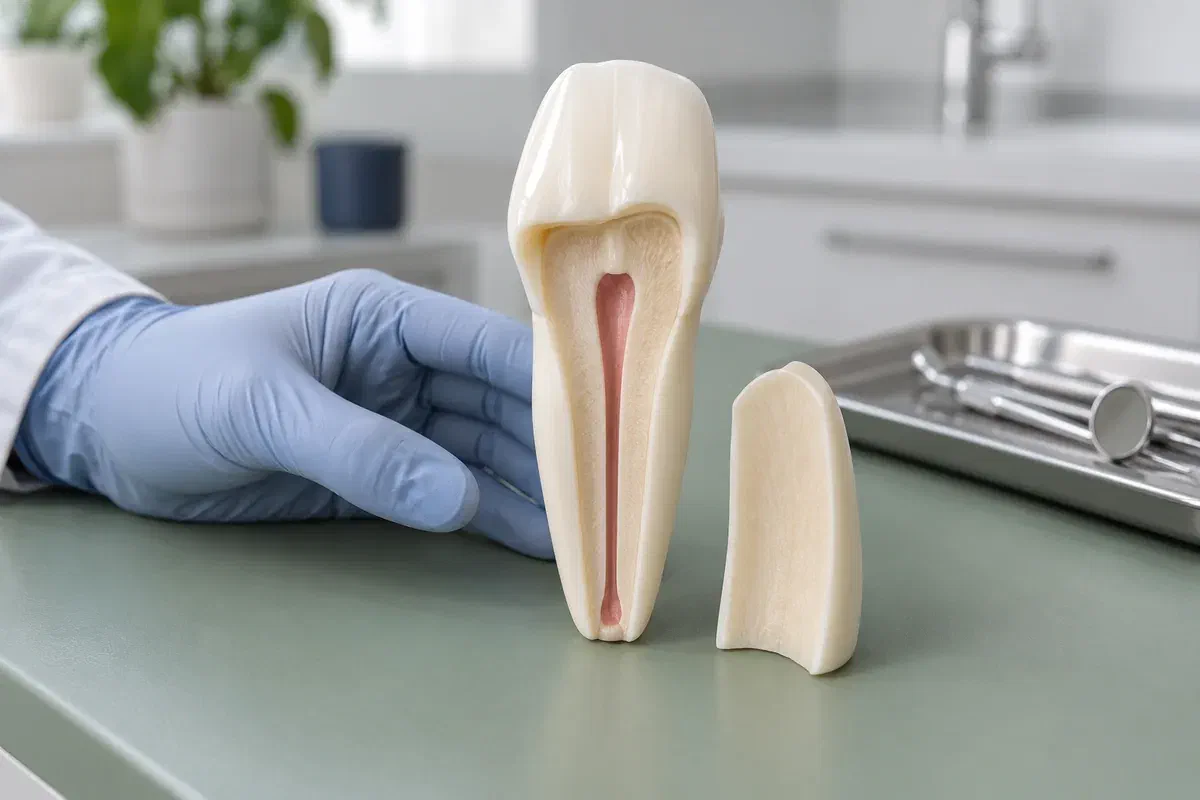
During a root canal, the dentist removes the affected pulp, cleans and shapes the space it occupied, then fills and seals that space. The goal is to resolve the problem within a restorable tooth so it can keep working once it has the right final restoration.
How well it works depends on an accurate diagnosis, the shape of the root, any cracks, how much tooth remains and how well the final seal holds. Old injuries, narrowed canals or earlier treatment can make a front tooth harder to treat, and a referral to an endodontist may be suggested when a specialist would help.
Patient information: AAE — root canal treatment
Holding on to a suitable tooth means no new gap to manage, and the work can focus on restoring the tooth that is already part of your smile.
Colour, shape, the access opening and any existing damage are weighed together, so the inside treatment and the visible finish are planned as one.
Tests help tell a pulp problem apart from a crack, gum trouble or pain coming from elsewhere, so the decision rests on findings and not on sensitivity alone.
It helps to ask early how many visits to expect, whether you will leave with a temporary filling, and who places the final restoration. Knowing the full path keeps a treated tooth from being left without protection.
We go over your symptoms and any past injuries, examine the tooth and gums and run suitable tests. Imaging shows the root and surrounding bone, and we consider whether the tooth can be restored before anything starts.
Local anaesthetic is given as needed, and a thin rubber dam keeps the tooth isolated and clean. Raise a hand if you feel anything or simply want a break.
A small opening, usually on the back of a front tooth, gives access to the pulp space. The canal is cleaned, shaped and filled, and a temporary seal may be placed if treatment happens in stages.
The opening and any damaged areas are then restored. A follow-up visit checks healing and comfort, and the dentist explains whether a filling, a crown or another option suits what remains of the tooth.
Your dentist or endodontist will give instructions for your case. The tooth can feel a little unfamiliar for a while, and a temporary filling needs gentle handling until the permanent work is complete.
Avoid biting into very hard foods or opening packages with a temporarily restored front tooth. Ask what is safe to eat and when you can use the tooth normally again.
Keep up the brushing and cleaning routine you were given, taking care around sore gum tissue. Tell us if the temporary filling cracks, falls out or starts to feel loose.
The root canal and the final restoration are two separate pieces of work. Schedule the recommended restoration and review so the opening is properly sealed and the tooth can be watched over time.
Ask about comfort, about appearance, or about anything else on your mind. The condition inside the root, the visible part of the tooth and any earlier injury all feed into what we recommend.
Bring a sore, injured or darkening front tooth to our Bronte Street practice and we will walk through what we find. Together we can decide whether root canal care makes sense, and what restoration or referral would finish the job.
For a fresh dental injury, severe pain or swelling, phone us promptly. Online requests are best for appointments that are not urgent.
