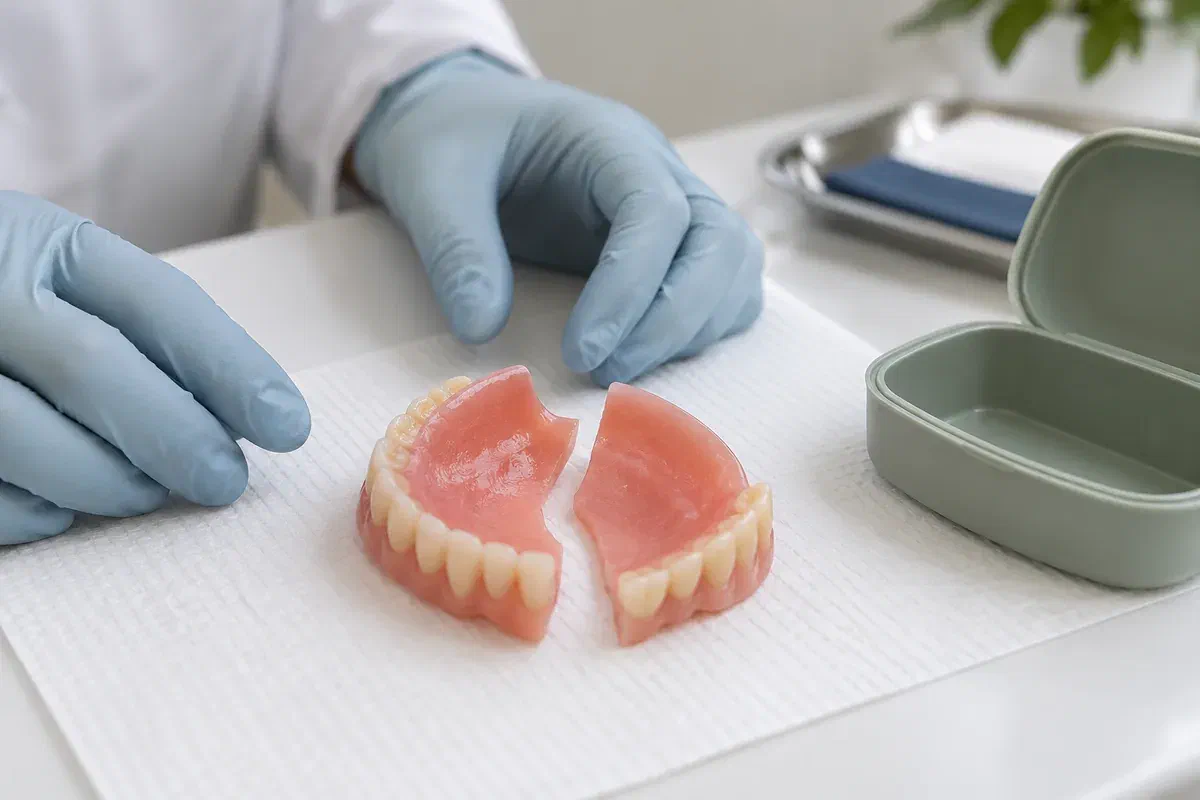
Acrylic that has cracked
A broken acrylic base, on a full or partial denture, may be repairable when the pieces fit together accurately. The clinician also asks whether an accident or a long-standing fit problem caused it.


A partial denture that suddenly shifts, clicks or won’t stay put may have a broken clasp or cracked frame. From Brampton, call our team to have the damage, your natural teeth and the fit assessed before anything is decided.
Partial dentures rely on small metal arms and a framework to hold on to your natural teeth. When one of those parts bends or breaks, the appliance can lift as you speak or tip when you chew. Full dentures fail differently: a plate splits after a drop, or a tooth breaks free during a meal.
In every case, the cause shapes the solution. A partial that was stepped on is not the same problem as one whose clasp has been flexing loose for months. Fit, worn teeth, changes in the supporting gums and bone, and how your upper and lower teeth meet may all affect whether a simple repair will last.
Before wearing it again or trying to bend anything back, phone us from Brampton and describe what you noticed. Keep every piece, including a loose tooth or a snapped clasp, together in one container. The originals show the clinician exactly what failed and make it easier to compare repair with replacement.
The type of denture, the material involved and how much is damaged all guide the advice. The clinician also judges whether the appliance still fits well enough for a repair to be worthwhile.
A broken acrylic base, on a full or partial denture, may be repairable when the pieces fit together accurately. The clinician also asks whether an accident or a long-standing fit problem caused it.
One tooth can detach while the rest of the appliance remains intact. Its position and condition, and the acrylic around it, help determine whether to reattach it or use a new tooth.
Metal parts give a partial its grip and stability. Repairing them is a different process from fixing acrylic and may need a dental lab or a broader look at how the partial is designed.
Never bend a clasp back with pliers or your fingers, glue loose parts, or file sharp edges. These attempts can affect fit, strain your natural teeth and complicate a professional repair.
If the rest of the denture is still in good working order, a repair can correct the specific fault and spare you the process of making a whole new appliance. The clinician considers how precisely the components can be restored and whether the result will grip and function as it should.
Some problems run deeper than a single break. Worn teeth, a loose fit or a frame that keeps failing may suggest a reline, a redesign or a new denture. It is worth asking not only whether this part can be fixed, but whether the repaired appliance will serve your mouth well.
Patient information: ADA — caring for partial dentures
For a partial, the teeth it clasps matter as much as the appliance. Examining them, along with your gums and bite, helps catch issues that a repair alone would miss.
You’ll understand which problems the repair resolves and which limitations will remain, so comparing it with a new denture is straightforward.
Tips on handling, inserting, removing and storing the appliance can prevent future damage. If it broke during chewing, the review also looks at other possible causes.
Timing depends on what broke, the material, whether a lab is required and appointment availability. If going without the denture affects eating or work, tell us so it can be factored into the plan.
Bring the denture, every loose part and any repair history. The clinician inspects the material and the break and asks whether it was dropped, stepped on or gave way during use.
Gums, the natural teeth a partial relies on and your opposing bite are examined. An impression or other record may be taken so the repair fits accurately.
The work may rejoin acrylic, replace a tooth or address a clasp or framework. Metal repairs commonly involve a dental lab, and the team will explain when to expect the appliance back.
With the appliance back in your mouth, we test how firmly it holds, how your teeth meet and whether any edge is rough. Tightness, pressure or movement are worth mentioning; a follow-up beats adjusting it yourself.
Use and clean the repaired denture as advised for its design and material. If it feels loose or sore after the first days, let us know instead of waiting for it to settle.
Lift a partial out by its base rather than pulling on the clasps, and clean it over a towel or water-filled basin. Choose cleaners and water temperatures suited to its materials.
Clean your remaining teeth carefully, especially those the partial clasps, along with your gums. Ask about overnight removal and how the appliance should be stored.
A repaired denture that presses in one spot or shifts when you bite should be checked. Adhesive is not a substitute for assessing an appliance that no longer fits.
Let us know which part has broken and whether you can safely go without the denture for now. The assessment sorts out what is urgent and what kind of repair is realistic.
A snapped clasp, a split base or a tooth that has gone missing can all be looked at by our Bronte Street practice. Pack the appliance with each piece you found; we’ll work out what is repairable, how it sits and roughly how long it will take.
Is the denture hurting you, or is life without it unmanageable? Phone instead of waiting for a booking. Timing for any repair rests on the assessment and our openings.
