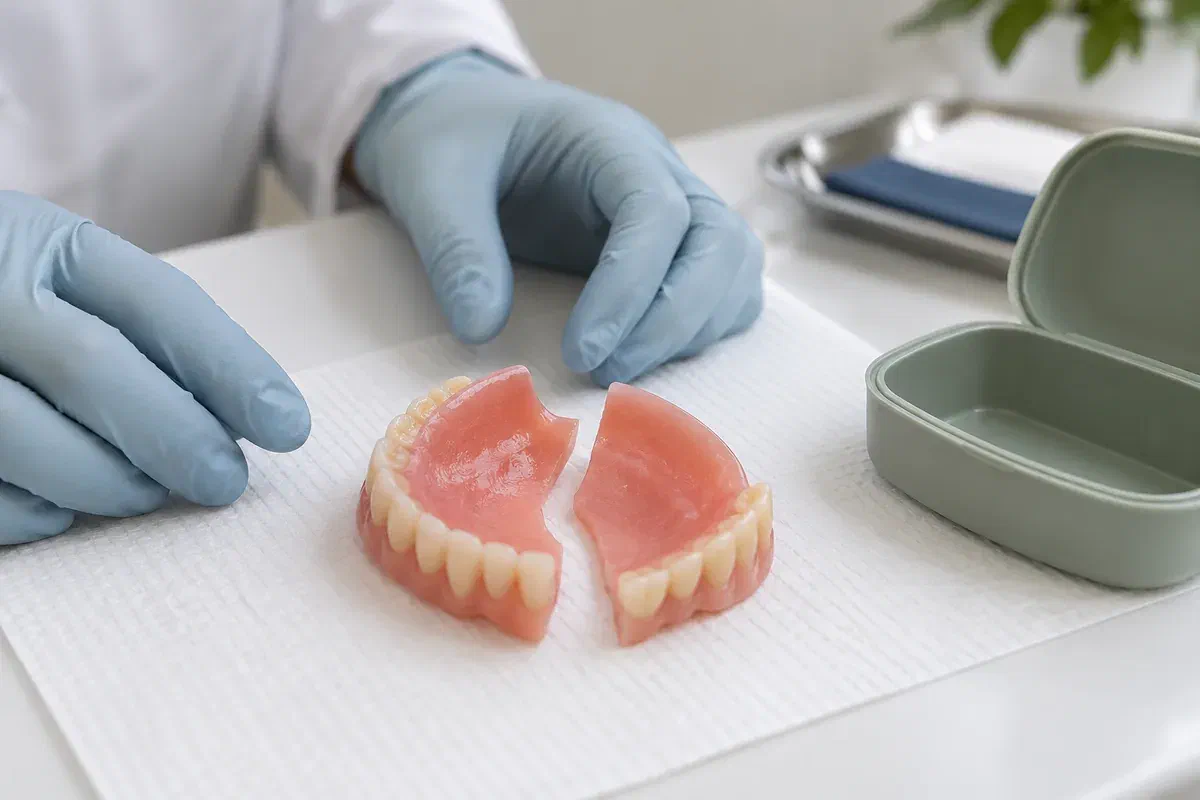
The base has split
An acrylic base that has cracked in two can often be repaired if the pieces line up accurately. The clinician also asks whether an accident caused it or whether an ongoing fit or pressure problem is to blame.


When a denture snaps, chips or loses a tooth, the first hour matters more than any quick fix. Our Milton team can look at the damage, check how the appliance still fits, and talk through whether repair makes sense.
Most denture breaks happen at ordinary moments: rinsing it over a hard sink, biting into a crusty roll, or knocking it off the bathroom counter. Afterwards there may be a clean split through the base, a hairline crack, or an empty gap where a tooth used to sit. You may feel no pain at all, yet eating and speaking can suddenly feel awkward.
What caused the break shapes the next step. An appliance that cracked once after a fall raises a different question from one that keeps splitting along the same line while you chew. Fit, worn teeth, changes in the gums and bone underneath, and the way your bite comes together can all play a part.
Before you try to wear it or fix it, call our Milton office and describe what happened. Gather every fragment you can find, including any loose tooth, and keep them together. Having the original parts lets the clinician see how the damage occurred and discuss honest repair and replacement options with you.
How a denture is made, how far the damage reaches and the general state of the appliance all shape what we suggest. We also look at whether it still sits well enough in your mouth for a repair to be worthwhile.
An acrylic base that has cracked in two can often be repaired if the pieces line up accurately. The clinician also asks whether an accident caused it or whether an ongoing fit or pressure problem is to blame.
Sometimes one artificial tooth lets go while the rest of the denture stays whole. Where it sat, its condition and the material around the gap help decide between reattaching it and fitting a new tooth.
A bent or broken clasp or framework on a partial denture can leave it loose or wobbly. This type of repair is different from fixing acrylic and may need lab work or a closer look at the overall design.
Please avoid superglue, bending metal clasps or smoothing rough edges with a nail file. Home fixes can change the fit, weaken the material and make a proper repair harder.
If the rest of the appliance is in good shape, a repair can deal with one specific break without the time involved in making a whole new denture. The clinician weighs how precisely the parts can be rejoined and whether the finished result will fit and work acceptably.
A repair can't undo every change in an older denture, though. Worn-down teeth, a loose fit or a pattern of repeated cracks may point toward a reline, a rebase or a replacement. The real question is not just whether the pieces can be joined, but whether the result will suit your mouth.
Patient information: ADA — caring for partial dentures
Looking at your gums and bite as well as the denture helps uncover sore spots or rocking that could keep causing trouble once the crack is fixed.
You'll know which part of the problem a repair will solve and what limits will remain, so comparing a repair with a new denture is easier.
Advice on handling, storing and cleaning can protect the appliance. When a denture broke while you were chewing, the review can also look for causes beyond a simple drop.
How long a repair takes depends on the damage, the material, any lab work and our schedule. Let us know if you're struggling to eat or manage without the denture so we can plan for that in the meantime.
Bring the denture, all loose pieces and anything you know about earlier repairs. The clinician examines the material and the shape of the break and asks whether it was dropped or gave way while in your mouth.
Your gums, any natural teeth and the opposite bite are checked. An impression or similar record may be taken so the repair lines up accurately with your mouth.
Depending on the damage, this may mean joining the base, replacing a tooth or fixing a component. Some repairs go to a dental lab, and the team will tell you when to expect the denture back.
The repaired denture is checked for fit, grip, bite and rough edges. Mention any pressure or movement, and book any recommended follow-up instead of trimming a sore spot yourself.
Use your repaired denture as instructed for its material and condition. If discomfort or looseness lingers, tell us rather than assuming it's just part of settling in.
Hold the denture over a folded towel or a sink with some water in it, so a slip is less likely to cause damage. Choose cleaners and water temperatures that suit its material, since hot water can warp some appliances.
Clean both the denture and the tissues that support it as advised, along with any natural teeth. Ask whether you should take it out overnight and how to store it.
If the repaired denture presses in one place or rocks, give us a call. Extra adhesive can’t replace an assessment when a denture no longer fits properly.
Let us know what's damaged and whether you can manage safely without the denture for now. The assessment sorts out what is urgent from the kind of repair your appliance can handle.
Reach out to our Bronte Street practice about a split base, a lost tooth or a broken clasp. Bring the denture and every piece you have so we can assess what can be repaired, check the fit and give you a realistic timeline.
Please phone if the denture is hurting your mouth or you can’t manage without it. Timing for repairs depends on the assessment and availability.
