Decay in grooves and gaps
Deep grooves on molars and tight spaces between teeth trap food easily. A cavity there may need restoring before it causes any discomfort.


A child’s first cavity or a parent’s cracked filling can land in the same busy month. Households in Brampton can plan tooth-coloured repairs together, with each tooth assessed on its own and every step explained.
It is common for one checkup to turn up a small cavity in a teenager, while a parent mentions a filling that feels sharp at the edge. The same word, filling, covers both, but the details for each tooth can be quite different.
Composite is a tooth-coloured resin that bonds to a prepared tooth and is shaped in place to rebuild what decay or damage took away. Whether it is the right repair depends on the size and location of the problem, how much sound tooth remains, and how that tooth is used when chewing. The exam comes first for everyone.
Parents arranging care from Brampton often want to line up appointments for several people. Tell us who needs to be seen and we can talk about what is practical.
The cause matters as much as the repair. Examining the tooth shows what happened, how far it goes, and whether a filling has enough healthy tooth around it to last.
Deep grooves on molars and tight spaces between teeth trap food easily. A cavity there may need restoring before it causes any discomfort.
Sports, falls or biting something hard can break off a piece. Composite may restore a limited chip, depending on its position, the bite and whether a crack runs further.
Older fillings can roughen or develop changes at the edge. That does not automatically mean replacement; the exam decides whether to repair, redo or simply keep an eye on it.
Sensitive teeth have more than one possible cause. Ask each family member to describe what sets theirs off and how long it lasts before assuming it is a cavity.
A composite filling can be colour-matched, which is why it is often used on visible teeth. It is also placed in suitable back-tooth cavities, with attention to how large the restoration is and the pressure it will take.
The material has requirements. It must be placed on a tooth that stays dry during bonding, which can take patience with younger mouths, and a large or heavily loaded area may suit another option better. The choice is made tooth by tooth.
Patient information: ADA — tooth-coloured fillings · FDA — filling materials
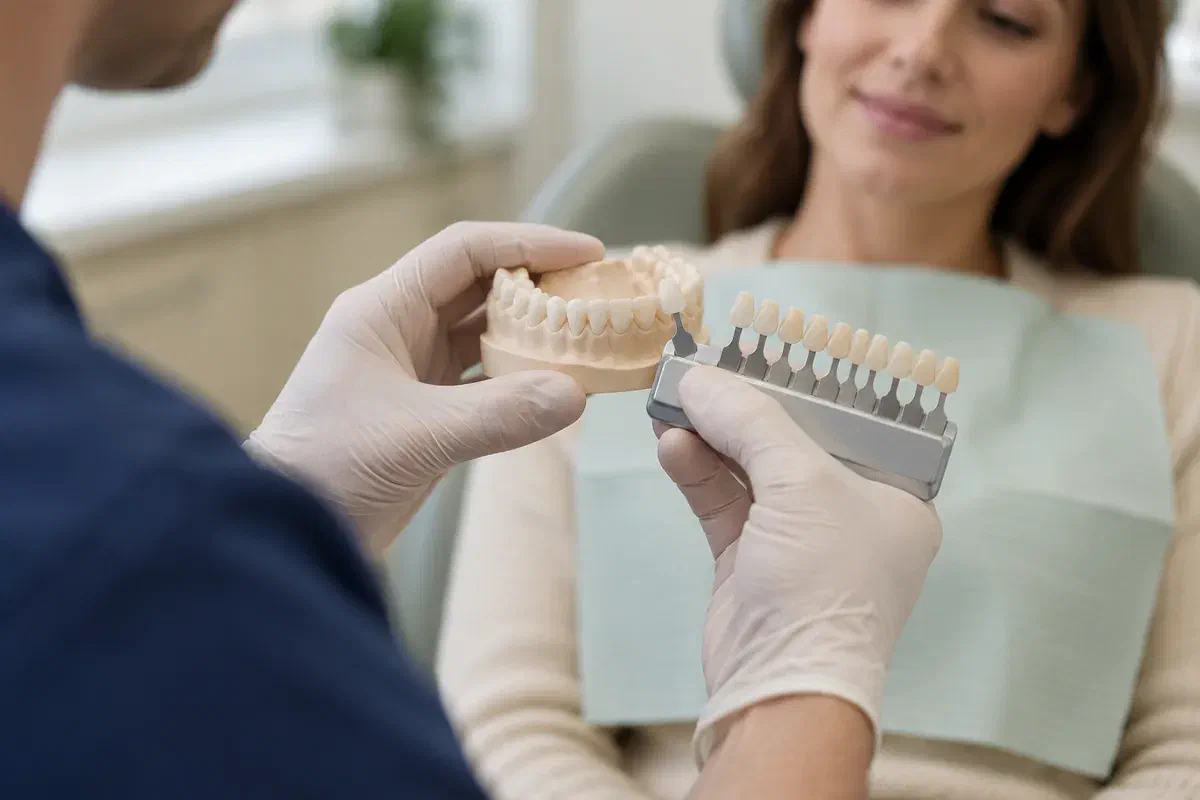
Each repair gets a shade selected to sit comfortably beside the person’s own enamel.
Because it bonds, composite may allow more healthy tooth to be kept, if the tooth’s condition permits.
Many fillings are done in a single treatment visit, although the assessment or additional care may need separate time.
Children and adults alike tend to feel calmer when they know what is next. Anyone can ask for a pause, and questions are always welcome.
We talk about what was noticed and examine the tooth. X-rays may be suggested if they would help assess decay or nearby structures. The planned repair, other choices and the estimated fee are discussed before treatment.
Local anaesthetic may be used so the area feels numb. The dentist removes the damaged portion and keeps the tooth clean and dry, which the bond relies on.
Composite is placed and formed, often in layers, each set with a curing light. Careful contouring restores the tooth’s surface and how it touches the one beside it.
The filling is polished, and the bite is checked. Before leaving, there is time to ask about eating, brushing or anything that feels strange.
Follow the instructions given for each person’s treatment. If something seems off, call us rather than waiting for the next checkup.
Children especially may bite or chew a numb lip or cheek without realising. Wait until feeling returns before meals, and keep hot drinks for later.
A little sensitivity may occur for a short time. Contact us if pain grows, sensitivity does not settle, or the treated tooth seems to meet first.
Brushing twice daily with fluoride toothpaste and cleaning between teeth helps protect every tooth, including the one with a new filling, which can still decay at its edges.
Patient information: Cleveland Clinic — dental fillings
Ask on behalf of yourself or your child. If you are unsure how to describe the problem, we can start from what you have seen.
Patient information: CDA — tooth-coloured fillings · FDA — existing amalgam fillings
Bring your questions about a cavity, a chipped tooth or an older filling to our Bronte Street practice. Each person is assessed first, so everyone understands what their own tooth needs.
Please call for significant pain or swelling. Online requests are intended for non-urgent appointments.
