
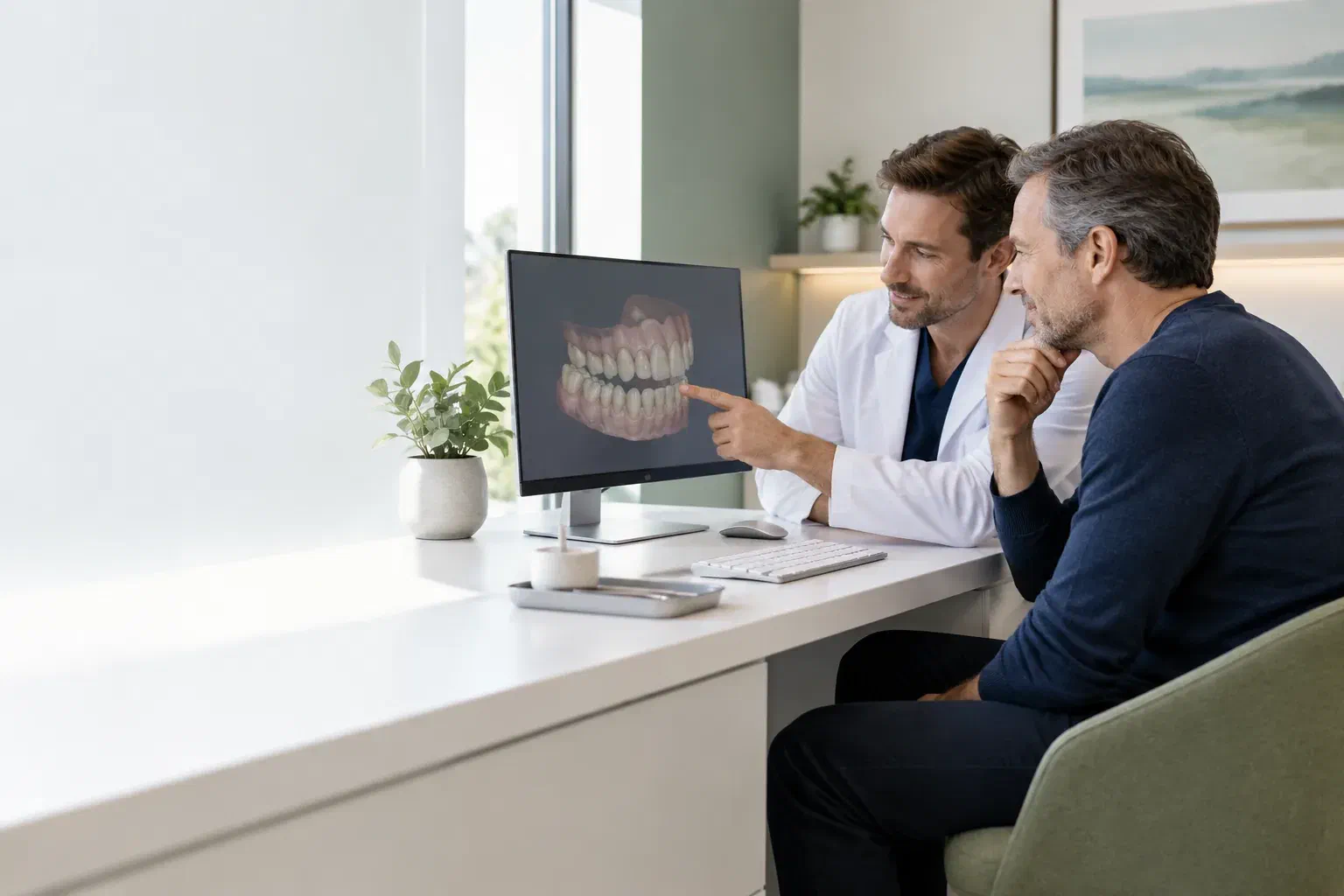
Illustrative consultation about digital planning for a dental implant
Restorative Dentistry

Computer-Planned Implant Placement

Discuss computer-planned implant placement in Milton and understand how digital records can support a carefully considered treatment plan. Start with an assessment of your mouth, your replacement options, and the stages involved.

A closer look at implant planning

Plan the position with the finished tooth in mind.

Computer-planned implant placement uses digital information to help a clinician consider where an implant could be positioned. The plan needs to account for the replacement tooth, the available bone, surrounding structures, and access for future cleaning. A convincing image on a screen is only one part of that assessment.

You may hear about three-dimensional scans, virtual planning, or a surgical guide. These terms describe different parts of a possible workflow, and they are not interchangeable. Ask which methods are being proposed for your case, why they are useful, and who will provide each part of the treatment.

At Milton Dental Clinic, you can begin by discussing the gap you want to replace and the options worth assessing. The conversation should establish whether implant care is appropriate before focusing on a particular planning technique. Any imaging, specialist involvement, surgery, and restorative stages should be explained as part of the proposed pathway.

Discuss an implant treatment plan
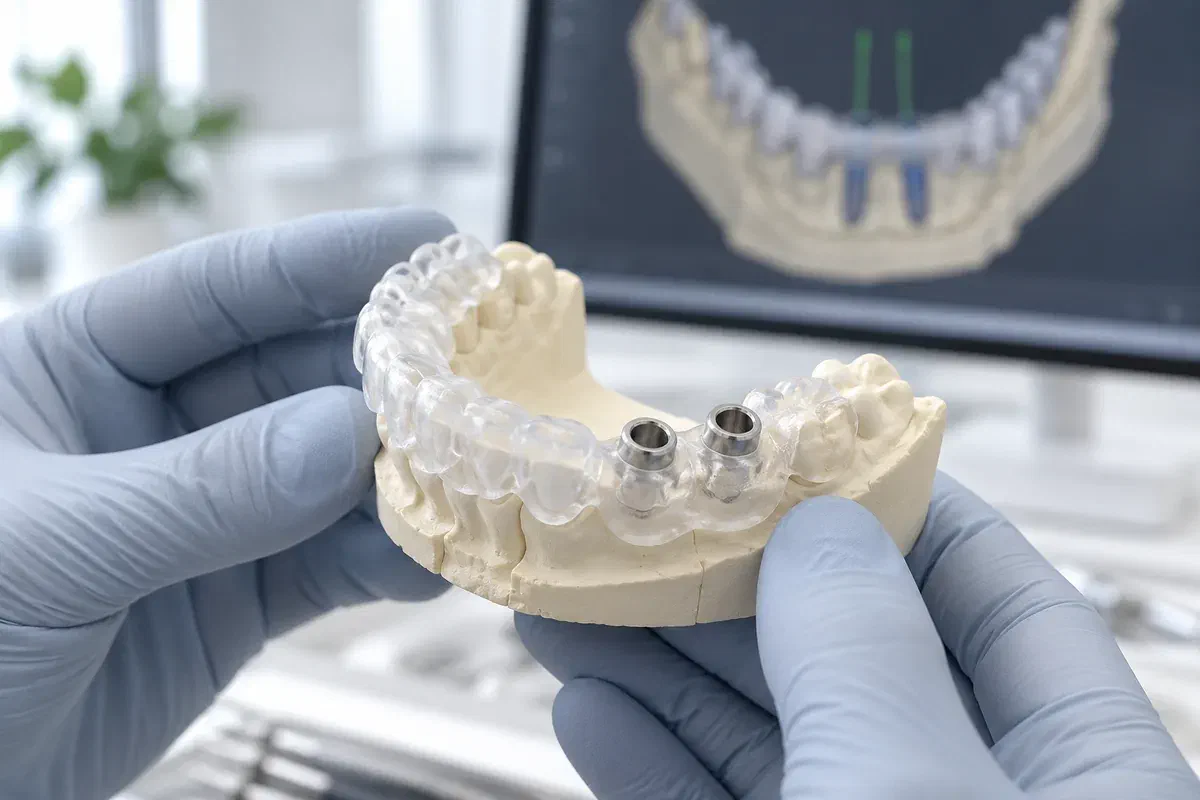
Dental implant planning model and illustrative surgical guide
Questions worth exploring first

Understand the site before choosing the technique.

An implant is part of a larger restoration. Planning needs to connect the condition of your mouth with the tooth you hope to use, rather than focus only on where a small fixture could fit.

A gap near important structures

The position of neighbouring roots and other anatomical structures can influence the assessment. The clinician decides which records are justified and explains how the information affects the proposed implant position or whether another approach should be considered.

A tooth replacement with limited space

The visible gap and the space beneath the gum are both relevant. A plan should consider the shape of the final tooth, its relationship to adjacent teeth, and whether the area can be maintained comfortably after treatment.

Several stages that need coordination

When treatment involves more than one clinician or location, ask how records and responsibilities are shared. Knowing who plans, places, restores, and reviews the implant helps you understand the sequence and where to direct questions.

Digital planning does not establish suitability by itself. Your health history, oral examination, expectations, and ability to maintain the restoration remain part of the decision.

What digital planning can contribute

A clearer plan can support a better conversation.

Digital records may help the treating clinician assess the proposed implant in relation to the final restoration and surrounding anatomy. In suitable cases, the plan can inform a guide used during placement. The chosen method depends on the clinical situation and the treating team’s assessment.

Planning tools support professional judgement; they do not remove surgical risk or guarantee the final result. Records must be accurate, the proposed position must be clinically appropriate, and the team still needs to respond to findings encountered during treatment.

Patient information: ITI — computer-guided implant surgery

Consider the restoration from the outset

The intended tooth or appliance gives the discussion a practical focus. Ask how its shape, bite, and cleaning access influence the proposed location of the implant supporting it.

Explain the reasons behind the sequence

Reviewing the available records can help the team explain why additional preparation, healing, or another opinion may be recommended before surgery. It can also clarify why an advertised rapid treatment may not suit your circumstances.

Compare the plan with other choices

A detailed implant discussion should still make space for a bridge, removable appliance, or another appropriate option. You should understand what the proposed technology adds to the decision and what it cannot resolve.

Understanding the planning pathway

Move from records to a treatment you can explain.

The number of appointments and the tools involved vary. Before proceeding, ask for a clear outline of assessment, any additional preparation, placement, restoration, and maintenance, including where each stage will take place.

  1. Review the replacement goal

    Discuss the missing tooth or teeth, your medical history, previous dental care, and practical priorities. The examination helps determine which replacement options deserve further assessment and whether any existing dental problems need attention first.

  2. Gather the records that are needed

    The clinician may recommend photographs, impressions or scans, and appropriate radiographic imaging. Ask what each record is intended to show, whether existing records are useful, and how any additional imaging contributes to your care.

  3. Discuss the proposed position and sequence

    The plan considers the future restoration alongside the implant site. Review the benefits, limitations, costs, and alternatives, including whether a guide, grafting procedure, referral, or temporary tooth is part of the proposal.

  4. Proceed with agreed care and reviews

    If you choose treatment, the treating team confirms the surgical arrangements and follow-up. The final restoration is planned around healing and clinical findings, with instructions for cleaning and continuing review after it is fitted.

The plan continues after placement

Healing and maintenance deserve their own attention.

A digital plan does not replace individualized postoperative instructions. Follow the guidance from the clinician who performs the procedure, and make sure you know whom to contact if the recovery differs from what was explained.

Follow the specific recovery instructions

Your directions may address cleaning, eating, activity, and any prescribed medicines. These depend on the treatment actually performed, including additional procedures. Ask for clarification before leaving rather than relying on a general description of guided surgery.

Protect the temporary arrangement

If a temporary tooth or appliance is provided, ask how it should be used and cleaned. Report looseness, a bite that feels different, or damage so the team can assess it before you continue using it normally.

Keep the restoration under review

Once the final tooth is fitted, ask for a demonstration of cleaning around it and agree on a review schedule. Bring concerns about comfort, access for cleaning, or changes in the surrounding gum to the team’s attention.

Choosing the appropriate pathway

Technology is one part of a suitable replacement.

The most useful comparison is between complete treatment plans. Ask about the expected appointments, preparation, restoration, and long-term care, rather than comparing techniques by name alone.

When a guide is appropriate

Computer planning with a surgical guide

A guide may help transfer a planned position to the surgical procedure. Its suitability depends on the records, support, access, and clinical circumstances. The treating clinician should explain its role and limitations in your case.

A different placement method

Another clinically suitable implant approach

Not every implant plan uses the same workflow. Ask why the clinician recommends a particular method, how the site is assessed, and whether additional preparation or specialist care changes the sequence.

Considering the alternatives

A replacement without implant surgery

A suitable bridge or removable appliance may be worth comparing. The condition of neighbouring teeth, the size of the gap, your preferences, and maintenance requirements help shape that discussion.

Questions about computer-planned implants

Understand the tools before committing to the treatment.

Technical terminology can make a consultation feel more complicated than it needs to be. Ask the team to connect each proposed step to your mouth and the replacement tooth you are considering.

(905) 876-4488
Does computer-planned placement mean a robot performs the surgery?
No. Computer planning describes the use of digital information to prepare a treatment plan. A clinician remains responsible for the procedure. If a particular navigation system or other technology is proposed, ask exactly how it is used rather than assuming the term describes robotic treatment.
Is a three-dimensional scan the same thing as a surgical guide?
No. A scan supplies information that may support assessment and planning. A surgical guide is a separate device that may be produced to assist placement in a suitable case. Having a scan does not automatically mean a guide will be recommended or used.
Can computer planning remove the need for a bone graft?
It cannot create bone that is not present. Planning can help assess the site and possible approaches, but the available support still matters. Ask whether grafting is recommended, what it is intended to achieve, and how alternatives compare for your particular replacement.
Does a guided implant always mean a tooth is fitted on the same day?
No. The planning method and the timing of the restoration are separate decisions. Healing, the condition of the site, and findings during placement can affect when a temporary or final tooth is appropriate. Ask which timeline is proposed and what could change it.
Can the implant plan change after the digital records are reviewed?
Yes. Records can reveal information that changes the proposed position, preparation, or overall suitability. A plan may also need revision if your mouth changes before treatment. Ask when the final recommendation will be confirmed and how any changes will be discussed with you.
What should an estimate for computer-planned implant care include?
Ask which assessments, imaging, planning steps, surgical guides, procedures, temporary teeth, and final restorations are included. Clarify any specialist fees and maintenance arrangements. An estimate is easier to compare when it describes the full pathway and identifies costs that depend on additional findings.
Computer-planned implant placement in Milton

Start with the questions that matter to your replacement.

Arrange a consultation at our Bronte Street clinic to discuss the missing tooth, your expectations, and the assessment needed. We can help you understand the proposed pathway and the questions to ask about planning, treatment responsibilities, and continuing care.

Bring details of previous implant consultations or available imaging so the team can discuss which records may be relevant to the assessment.

Visit Milton Dental Clinic
Unit 1, 342 Bronte St. S, Milton, ON L9T 5B7
Get directions Clinic hours
Monday–Thursday
11am–7pm
Friday–Sunday
By appointment only

How can we help?

Milton Dental Clinic

Have a question about your smile? Choose the option that works best for you.

For urgent dental concerns, please call.
Messages are reviewed during clinic hours.