
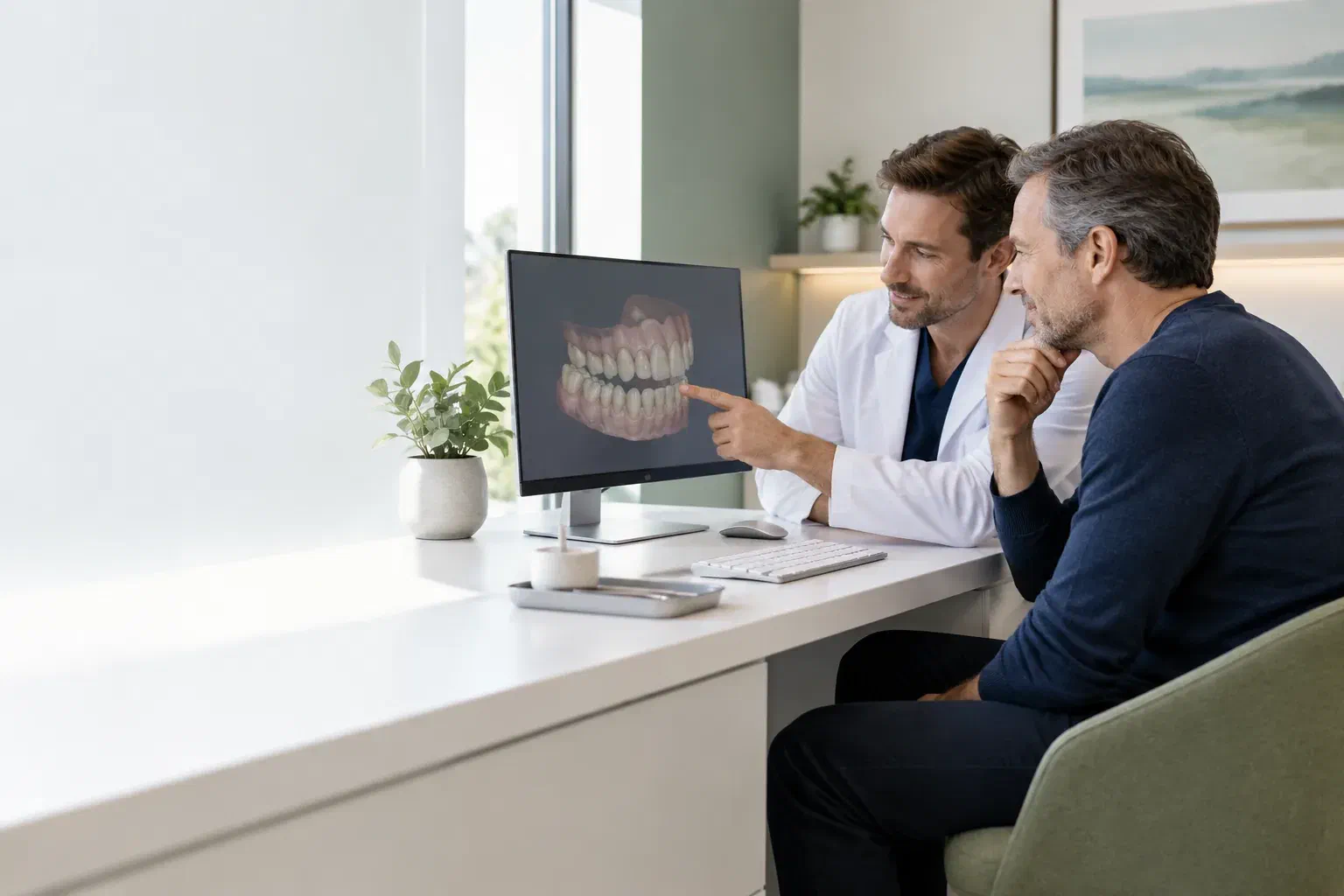
Illustrative consultation about digital planning for a dental implant
Restorative Dentistry

Computer-Planned Implant Placement in Brampton

A missing tooth near the front of your smile brings its own worries about how the replacement will look. Visiting from Brampton, you can learn how digital planning helps us think about the visible tooth first and the implant beneath it second.

When the gap shows in your smile

The tooth people see sets the plan.

With a front tooth, small differences in angle or depth can affect how a crown and the gum around it look. Computer-planned placement uses digital images to study where an implant might go, working backward from the tooth you want to see in the mirror. Bone volume, neighbouring roots, your bite and how you will clean the area all have to fit that picture. A screen image starts the discussion; it does not finish it.

Three-dimensional imaging, virtual planning and a surgical guide each play a separate part. Your case might call for some of them or a different approach. Ask which ones are proposed, what each brings, and which clinician is responsible for each stage.

For people travelling from Brampton, the first visit centres on the gap, how it affects you, and the realistic ways to restore it. We establish whether an implant is suitable before any talk of technique. Imaging, any referral, surgery and the steps to the final crown are then explained together.

Discuss a front tooth implant plan
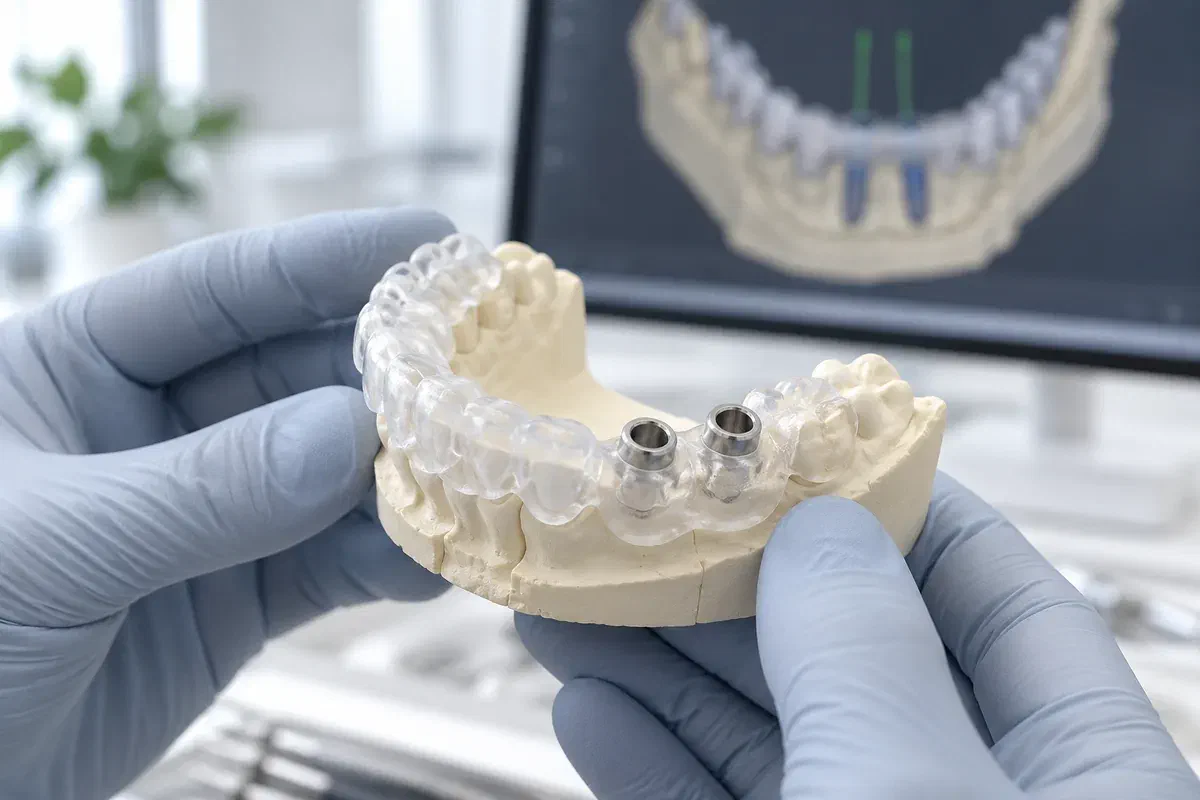
Dental implant planning model and illustrative surgical guide
What matters for a visible tooth

Bone, gum and spacing all show.

An implant in the smile zone supports something people notice. Planning must connect the site with the appearance and function of that crown, not simply locate somewhere a post would fit.

Thin bone near neighbouring roots

Front teeth often sit in narrow bone close to adjacent roots and other structures. The clinician chooses the records that are justified and explains how they influence the planned position or suggest a different route.

Matching the gap to the crown

The width of the space, the height of the gum and the shape of nearby teeth all affect how a new crown will look. A good plan also considers how you will reach the area with a brush and floss.

Coordinating the surgical and cosmetic stages

Placement and the final crown may be handled by different clinicians. Ask how photos, records and shade information are shared, and who to approach with questions about appearance versus healing.

A digital plan cannot confirm suitability on its own. Your medical history, the examination, your expectations and your ability to maintain the restoration remain central.

How planning supports appearance

Design the smile, then plan the support.

Digital records can help the clinician weigh a proposed implant against the planned crown and the anatomy around it. Where it suits the case, the plan can be used to make a guide for the surgical appointment. Whether a guide is appropriate depends on your situation and the treating team’s view.

Planning helps; it does not guarantee an aesthetic outcome or remove surgical risk. Records must be accurate, the position must be clinically sensible, and the team still responds to what they find during the procedure.

Patient information: ITI — computer-guided implant surgery

A preview of proportions

Starting from the intended crown helps the team talk about size, shape and the way it meets your lower teeth. Ask how those factors guided the proposed implant angle.

Reasons for staging the work

Records can explain why gum or bone preparation, a healing period or a specialist view is recommended first. They can also show why a rushed approach may not serve a visible site.

Options beyond an implant

A bridge or removable tooth may still deserve consideration. You should understand what the technology adds for your front tooth and what it cannot change.

The road to a finished front tooth

What happens, and in what order?

Visits and tools differ between cases. Ask for a clear outline of assessment, preparation, placement, the final crown and maintenance, including where each will take place, before you decide.

  1. Discuss looks, comfort and health

    We talk about the missing tooth, what you dislike about the gap, your medical history and earlier dental work. The exam shows which options are worth exploring and whether other dental problems need treatment first.

  2. Capture the smile and the bone

    Photographs, scans or impressions and suitable radiographs may be suggested. Ask what each shows, whether existing records can be used, and how any further imaging helps plan a visible tooth.

  3. Review the planned tooth and position

    You see the proposed implant site with the future crown in mind. Go over benefits, limitations, costs and alternatives, and whether a guide, graft, referral or temporary tooth is included.

  4. Heal, restore and review

    If you proceed, the treating team confirms surgery and follow-up. The final crown is made once healing allows, with shade and shape checked, and you receive cleaning instructions and review dates.

Protecting the result

Healing shapes how the tooth will look.

No digital plan replaces your personal recovery instructions. Follow the clinician who performed the surgery, and make sure you know whom to contact if healing feels different from what was described.

Follow the advice for your procedure

Instructions may cover cleaning near the site, food choices, activity and any medicines prescribed. They reflect what was actually done, including grafting, so ask questions before you leave instead of relying on generic descriptions.

Look after the temporary front tooth

A temporary crown or removable tooth helps you through healing. Ask how to wear and clean it, and report looseness, a changed bite or damage so it can be checked.

Keep the gum line under review

After the final crown is fitted, ask to be shown how to clean around it and agree on regular visits. Mention discomfort, cleaning difficulty or changes in the gum’s appearance.

Ways to replace a front tooth

Several routes lead to a complete smile.

Compare complete plans, not technique names. Look at the visits, preparation, final restoration and long-term care each option involves for a visible tooth.

If a guide fits the case

Digitally planned, guide-assisted implant

A guide may help transfer the planned position into surgery. Whether it suits you depends on records, support, access and clinical factors, and its role and limits should be explained.

A different method

An implant placed another way

Front tooth implants do not all follow the same workflow. Ask why a particular method is recommended and whether grafting or specialist care changes the order of treatment.

Without implant surgery

Bridge or removable tooth

Comparing a fixed bridge or a removable replacement is often worthwhile. The health of the neighbouring teeth, the size of the gap, your preferences and the upkeep each one needs all shape the discussion.

Front tooth questions from Brampton

Appearance, healing and the in-between.

A visible gap raises very practical questions. Ask us to tie each step to your own smile and the tooth you hope to replace.

(905) 876-4488
Will the implant crown match my other front teeth?
The aim is a crown that blends with your natural teeth, using photos, shade selection and careful design. Exact matching depends on your teeth and gum, so ask how shade and shape will be checked before the final crown is made.
What will fill the gap while the implant heals?
Options can include a removable temporary tooth, a bonded temporary or sometimes a temporary crown on the implant. Which is suitable depends on the site and healing, so ask what is planned for you.
Should I whiten my teeth before the crown is made?
Crowns do not change colour with whitening, so if you are considering it, mention it early. The team can advise on timing so the crown shade is chosen to suit your teeth.
Is a front tooth harder to plan than a back tooth?
It brings different challenges. Front teeth often sit in thinner bone and are highly visible, so the gum line and crown shape need extra attention. Ask how these factors affect your plan.
Does an intraoral scan show the bone under my gum?
No. A surface scan records your teeth and gums. Information about the bone usually comes from appropriate X-ray imaging, which the clinician recommends only when it helps the assessment.
Could my plan change after the records are reviewed?
Yes. Imaging may reveal details that change the proposed position, preparation or suitability, and your mouth may change before treatment. Ask when the plan will be confirmed and how changes are discussed.
From Brampton to our clinic

Talk about your smile first.

Come and see us on Bronte Street to discuss the missing tooth, how it affects you and the assessment that would come next. We will explain the possible pathway and help you form questions about planning, appearance and continuing care.

Photos of your smile before the tooth was lost, previous consultation notes or existing imaging can all help the discussion.

Visit Milton Dental Clinic
Unit 1, 342 Bronte St. S, Milton, ON L9T 5B7
Get directions Clinic hours
Monday–Thursday
11am–7pm
Friday–Sunday
By appointment only

Areas we serve

  • Milton
  • Oakville
  • Mississauga
  • Georgetown
  • Halton Hills
  • Acton
  • Campbellville
  • Brampton
  • Burlington
  • Puslinch
  • Rockwood
  • Erin
  • Caledon
  • Etobicoke
  • Old Milton
  • Bronte Meadows
  • Timberlea
  • Dorset Park
  • Dempsey
  • Clarke
  • Beaty
  • Coates
  • Harrison
  • Scott
  • Willmott
  • Ford
  • Bowes
  • Cobden
  • Walker
  • Mountain View
  • Milton Heights
  • Hawthorne Village
  • Valley View
  • Fallingbrook
  • Nassagaweya
  • Trafalgar
  • Esquesing
  • Nelson
  • Brookville
  • Moffat
  • Glen Williams
  • Norval
  • Limehouse
  • Stewarttown
  • Ashgrove
  • Hornby
  • Silver Creek
  • Speyside
  • Scotch Block
  • North Oakville
  • River Oaks
  • Glen Abbey
  • West Oak Trails
  • Palermo
  • Bronte Creek
  • College Park
  • Joshua Creek
  • Uptown Core
  • Preserve
  • Iroquois Ridge
  • Lisgar
  • Meadowvale
  • Meadowvale Village
  • Churchill Meadows
  • Erin Mills
  • Central Erin Mills
  • Streetsville
  • East Credit
  • Creditview
  • Heartland
  • Sheridan
  • Mount Pleasant
  • Credit Valley
  • Huttonville
  • Churchville
  • Springbrook
  • Northwest Brampton
  • Bram West
  • Fletcher's Meadow
  • Fletcher's Creek South
  • Alton Village
  • Orchard
  • Millcroft
  • Headon Forest
  • Tansley
  • Brant Hills
  • Tyandaga
  • Kilbride
  • Lowville
  • Aberfoyle
  • Morriston
  • Arkell
  • Hillsburgh
  • Freelton
  • Carlisle
  • Waterdown
  • Flamborough
  • Mountsberg

How can we help?

Milton Dental Clinic

Have a question about your smile? Choose the option that works best for you.

For urgent dental concerns, please call.
Messages are reviewed during clinic hours.