
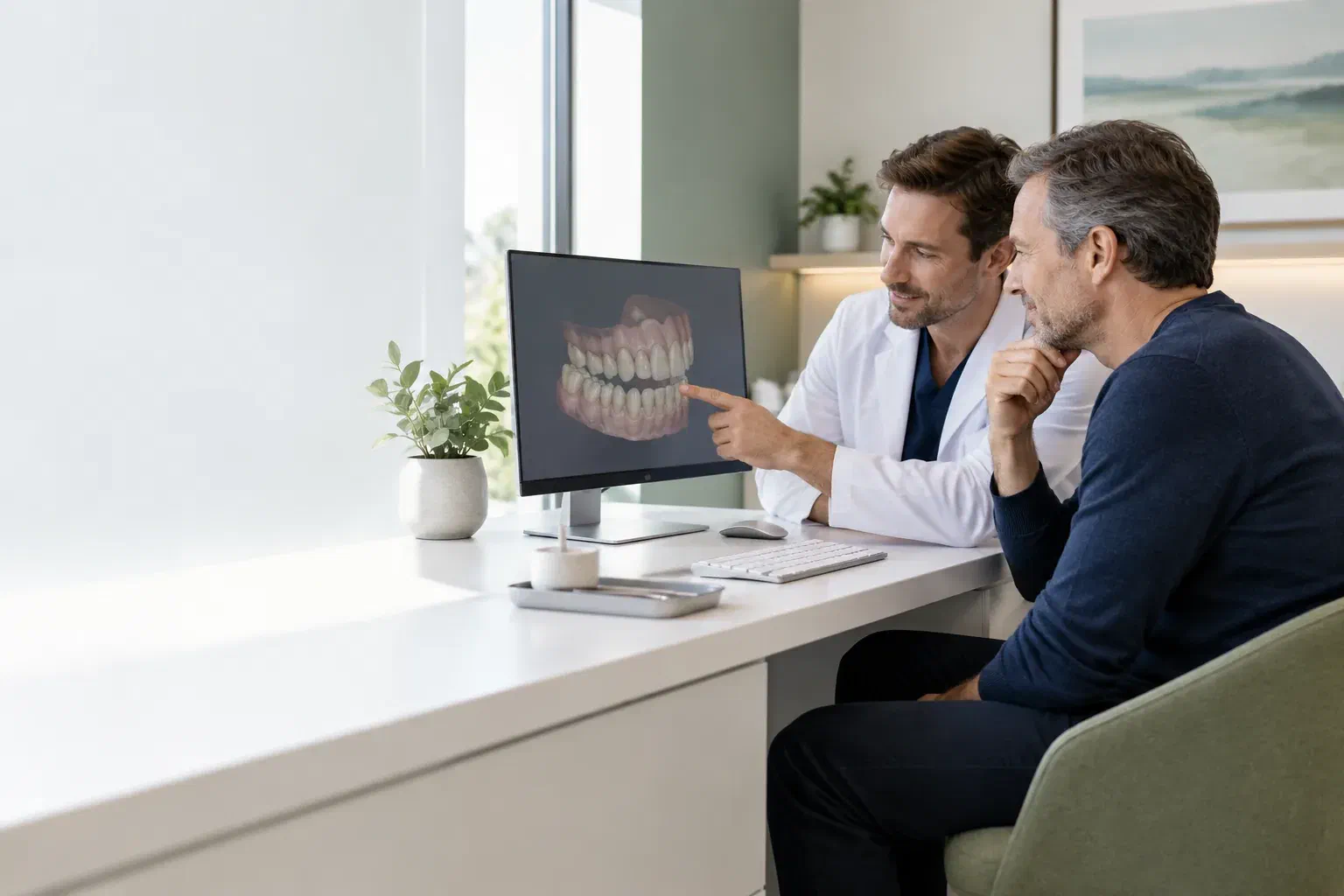
Illustrative consultation about digital planning for a dental implant
Restorative Dentistry

Computer-Planned Implant Placement in Campbellville

Many people hope a planned implant means leaving with a tooth the same day. From Campbellville, come and talk about how digital planning and the timing of your new tooth are separate decisions, and what shapes each one.

Timing, temporaries and digital plans

A clock that runs on healing.

It is natural to want the gap gone quickly. Yet how an implant is planned and when a tooth is attached to it are two different questions. With computer planning, the clinician studies digital records to work out a position that suits the eventual crown, the bone, neighbouring roots and nerves, and your cleaning routine. When a tooth can go on depends largely on what the bone and gum do after surgery.

A scan, planning software and a surgical guide are each separate steps. Some cases use all three; many use only one or two, or a different approach. Ask which are part of your plan, what they add and which clinician carries out each stage.

Households around Campbellville often like to group appointments where they can. Our first conversation looks at the gap, your timing hopes and the replacements worth exploring. We settle whether an implant suits you before discussing method, then lay out imaging, any referral, surgery and the restorative visits in sequence.

Ask about implant timing
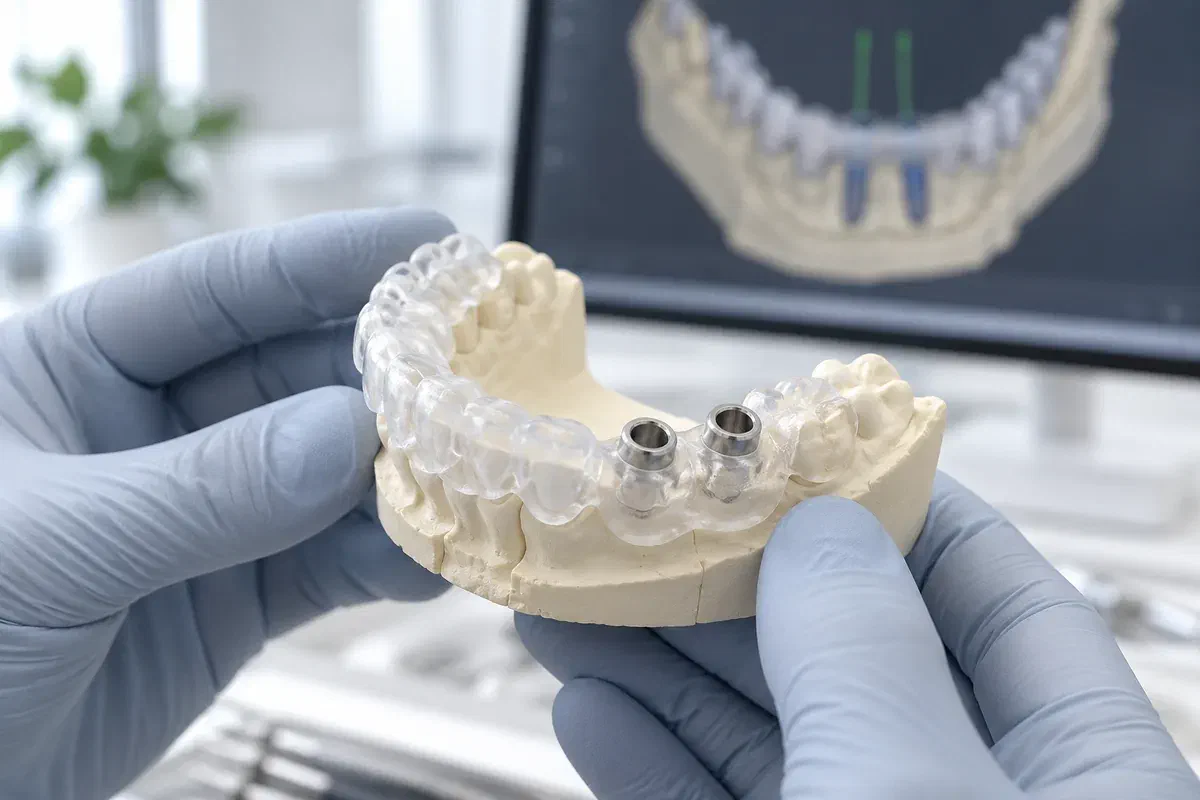
Dental implant planning model and illustrative surgical guide
What affects how soon

Three things that set the pace.

The implant holds up a tooth that must last. Planning connects your site’s condition to that tooth, which is why timing cannot be promised before the assessment.

Proximity to nerves, sinus or roots

Delicate anatomy near the site may call for more caution or a staged approach. Your clinician decides which records are warranted and explains how they affect the position, the timeline or the choice of another option.

Bone strength and space

Whether an implant is stable enough to carry a tooth early depends partly on the bone. The plan also considers the crown’s shape, how it meets nearby teeth and whether it can be kept clean.

Stages shared between clinicians

If one clinician places the implant and another makes the tooth, scheduling depends on both. Ask how they share records and who decides when the site is ready for the next step.

Planning tools alone cannot say you are suitable, or how quickly. Your health history, exam findings, goals and ability to look after the restoration all play their part.

What planning brings to timing

Realistic expectations from the start.

Digital records can let the clinician consider the implant position alongside the future tooth and nearby anatomy, which helps when discussing whether an early temporary might be possible. In suitable cases, the plan may also be used to create a guide for placement, depending on the clinical picture and the treating team.

Precise planning still leaves surgical risk in place and cannot guarantee a timeline. Accurate records and a sensible position are needed, and the team may change course based on what they find during surgery.

Patient information: ITI — computer-guided implant surgery

A tooth designed in advance

Planning the crown early can make it easier to prepare a temporary. Ask how the intended shape and bite influence both the temporary and the final tooth.

Reasons for waiting, explained

Records can show why grafting, a longer healing period or another opinion is advised before a tooth is attached, and why a same-day offer may not apply to you.

Other ways to fill the gap

A bridge or removable partial might give you a tooth on a different timeline. Ask what the technology adds and what it cannot speed up.

Mapping the timeline

Each stage waits for the one before.

Visit numbers and tools vary between cases. Before going ahead, ask for an outline that covers assessment, preparation, placement, any temporary, the final tooth and maintenance, plus where each happens.

  1. Share your goals and health

    We talk about the missing tooth, your medical history, previous treatment and how soon you hope to have a tooth. The exam shows which options are realistic and whether other issues come first.

  2. Take the records the plan depends on

    You may need photos, a digital scan or impressions and suitable X-ray imaging. Ask what each will show and whether existing records can be used, which may save a visit.

  3. Agree on position and timing

    The proposed implant site is reviewed with the future tooth in mind. We discuss benefits, limits, costs and alternatives, and when a temporary or final tooth might realistically be fitted.

  4. Place, heal and restore

    If you decide to proceed, the treating team confirms surgery and follow-up. The final tooth is made when healing and findings allow, and you receive cleaning instructions and review dates.

While you wait for the final tooth

Healing time is working time.

Personal recovery instructions still apply, however detailed the plan. Follow the clinician who performed the surgery, and know whom to call if things do not go as described.

Follow your recovery plan closely

Instructions may cover cleaning, diet, activity and prescribed medicines, tailored to the work done. Clarify anything uncertain before leaving rather than relying on general accounts of guided surgery.

Treat a temporary tooth with care

An early temporary often needs gentle use, especially when chewing. Ask what to avoid, how to clean it, and call if it loosens, cracks or your bite changes.

Stay on track after the final tooth

Once the permanent tooth is fitted, ask for a cleaning demonstration and agree on regular reviews. Mention discomfort, cleaning difficulty or changes in the gum.

Comparing approaches and timelines

Faster is not always better.

Comparing full treatment plans shows more than comparing method names. Look at the number of visits, preparation, the restoration and long-term care involved.

Where a guide is suitable

Computer-planned surgery with a guide

A guide may help carry the planned position into surgery. Whether it suits you depends on the records, guide support, access and clinical factors, and its role should be explained.

A different placement approach

Another implant workflow

Not all implants are placed the same way, and a guide is only one possibility. Ask why a particular method is advised for your site, what the assessment showed, and whether grafting or a specialist visit would add weeks to the overall plan.

Non-implant replacement

Bridge or removable partial

These may offer a tooth on a different schedule, sometimes without a long healing wait. The health of neighbouring teeth, the gap’s size, your preferences and the upkeep each one needs all shape the comparison.

Campbellville timing questions

When will I have a tooth again?

Timing is often the first thing people ask about. We will relate each answer to your mouth and the replacement you are considering.

(905) 876-4488
What decides whether I can have a temporary tooth on the implant right away?
Mainly how stable the implant is when placed, the bone around it and the bite forces in that area. The clinician confirms this during surgery, so plans may change on the day.
Is a same-day tooth the same as the final crown?
Usually not. An early tooth is typically a temporary, with the final crown made after healing. Ask what is planned and how long the temporary is meant to last.
Can I chew normally on an early temporary?
Often you will be advised to be gentle while the implant heals, since pressure on a new implant can disturb the bone settling around it. Softer foods and chewing on the other side are common suggestions. Follow the specific instructions you are given, and ask how long the precautions should last.
Does digital planning shorten the overall treatment time?
Not necessarily. It can make the planning conversation clearer and may help a guide be prepared in advance, but healing still sets the pace. Ask how the method being proposed affects your timeline, if at all, and which stages are fixed regardless of the technology used.
What fills the gap if an early tooth is not possible?
A removable temporary tooth or one bonded to the neighbouring teeth may be options, depending on the site and your bite. For some back teeth, the space is simply left to heal. Ask what will be provided while the implant settles and how to look after it.
Can several appointments be booked together to reduce trips?
Sometimes steps can be grouped, but each depends on healing and clinical findings. Ask which visits are fixed and which can be arranged to suit your schedule.
From Campbellville to Bronte Street

Start with a realistic timeline.

Arrange an appointment with our team on Bronte Street to talk about the missing tooth, your timing hopes and the assessment needed. We can outline the likely pathway and suggest what to ask about planning, temporaries and long-term care.

If you have had implant consultations before or have imaging held elsewhere, mention it so we can consider which records are relevant.

Visit Milton Dental Clinic
Unit 1, 342 Bronte St. S, Milton, ON L9T 5B7
Get directions Clinic hours
Monday–Thursday
11am–7pm
Friday–Sunday
By appointment only

Areas we serve

  • Milton
  • Oakville
  • Mississauga
  • Georgetown
  • Halton Hills
  • Acton
  • Campbellville
  • Brampton
  • Burlington
  • Puslinch
  • Rockwood
  • Erin
  • Caledon
  • Etobicoke
  • Old Milton
  • Bronte Meadows
  • Timberlea
  • Dorset Park
  • Dempsey
  • Clarke
  • Beaty
  • Coates
  • Harrison
  • Scott
  • Willmott
  • Ford
  • Bowes
  • Cobden
  • Walker
  • Mountain View
  • Milton Heights
  • Hawthorne Village
  • Valley View
  • Fallingbrook
  • Nassagaweya
  • Trafalgar
  • Esquesing
  • Nelson
  • Brookville
  • Moffat
  • Glen Williams
  • Norval
  • Limehouse
  • Stewarttown
  • Ashgrove
  • Hornby
  • Silver Creek
  • Speyside
  • Scotch Block
  • North Oakville
  • River Oaks
  • Glen Abbey
  • West Oak Trails
  • Palermo
  • Bronte Creek
  • College Park
  • Joshua Creek
  • Uptown Core
  • Preserve
  • Iroquois Ridge
  • Lisgar
  • Meadowvale
  • Meadowvale Village
  • Churchill Meadows
  • Erin Mills
  • Central Erin Mills
  • Streetsville
  • East Credit
  • Creditview
  • Heartland
  • Sheridan
  • Mount Pleasant
  • Credit Valley
  • Huttonville
  • Churchville
  • Springbrook
  • Northwest Brampton
  • Bram West
  • Fletcher's Meadow
  • Fletcher's Creek South
  • Alton Village
  • Orchard
  • Millcroft
  • Headon Forest
  • Tansley
  • Brant Hills
  • Tyandaga
  • Kilbride
  • Lowville
  • Aberfoyle
  • Morriston
  • Arkell
  • Hillsburgh
  • Freelton
  • Carlisle
  • Waterdown
  • Flamborough
  • Mountsberg

How can we help?

Milton Dental Clinic

Have a question about your smile? Choose the option that works best for you.

For urgent dental concerns, please call.
Messages are reviewed during clinic hours.