
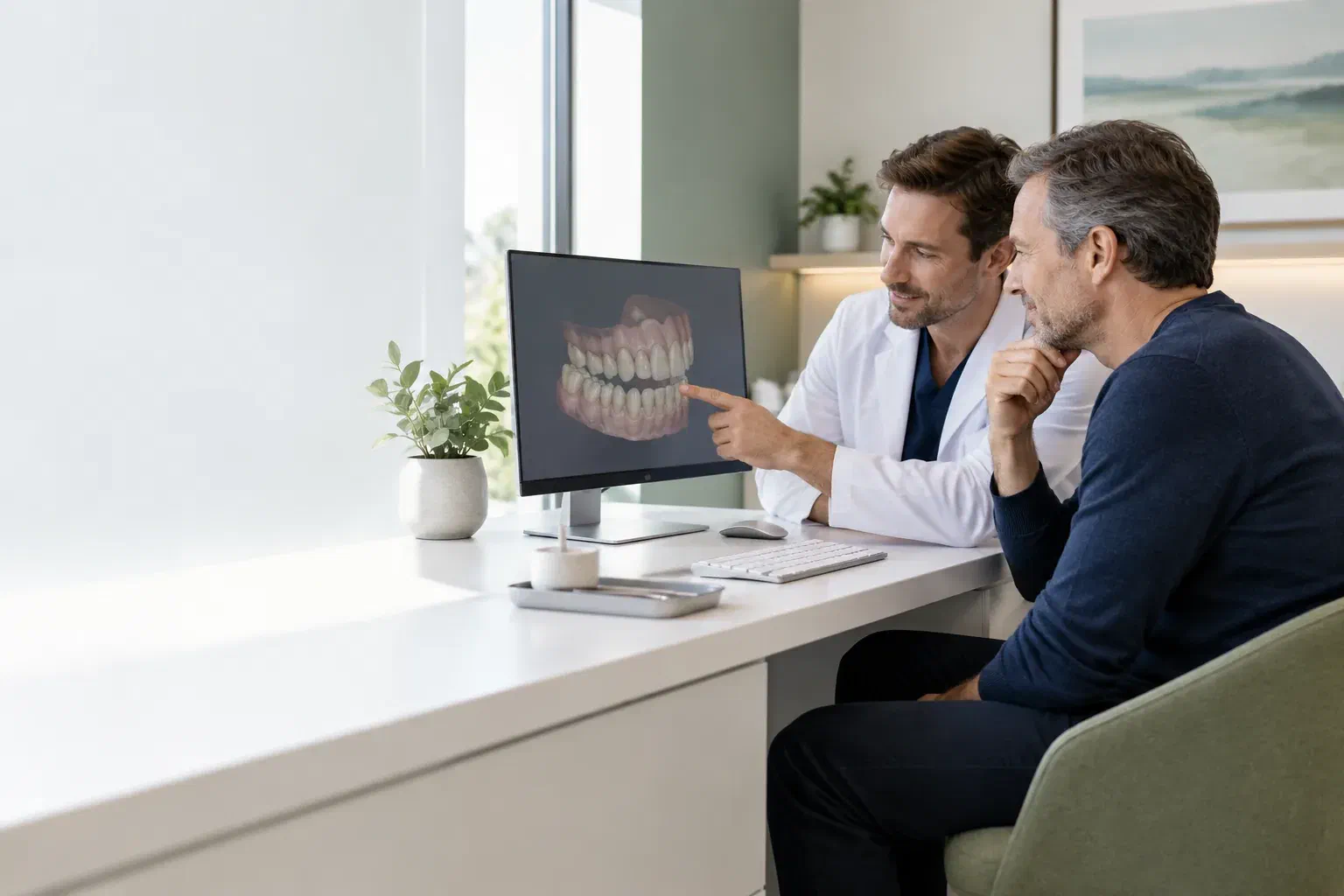
Illustrative consultation about digital planning for a dental implant
Restorative Dentistry

Computer-Planned Implant Placement in Halton Hills

Chewing on one side because a back tooth is gone? From anywhere in Halton Hills, you can book a consultation about how digital planning helps assess an implant for a molar gap and what the treatment would involve.

Back teeth and digital planning

Chewing comfortably again starts with a plan.

A missing molar is easy to hide but hard to ignore at dinner. Many people start favouring the other side without noticing. Computer-planned placement uses digital records to explore where an implant could support a new chewing tooth, taking into account the bite forces it will face, the bone available, nearby nerves or sinus, and whether you can clean around it. The digital view guides that thinking without replacing it.

Imaging, planning software and a surgical guide each have their own job, and they are not one bundled package. Ask which of them are suggested for your molar, why, and which clinician takes care of each stage.

From Georgetown, Acton, Glen Williams or a smaller hamlet in Halton Hills, the conversation starts with the gap and how it affects eating. We check that an implant is suitable before choosing a planning method. Any imaging, referral, surgery and restorative steps are then explained in order.

Ask about a molar implant plan
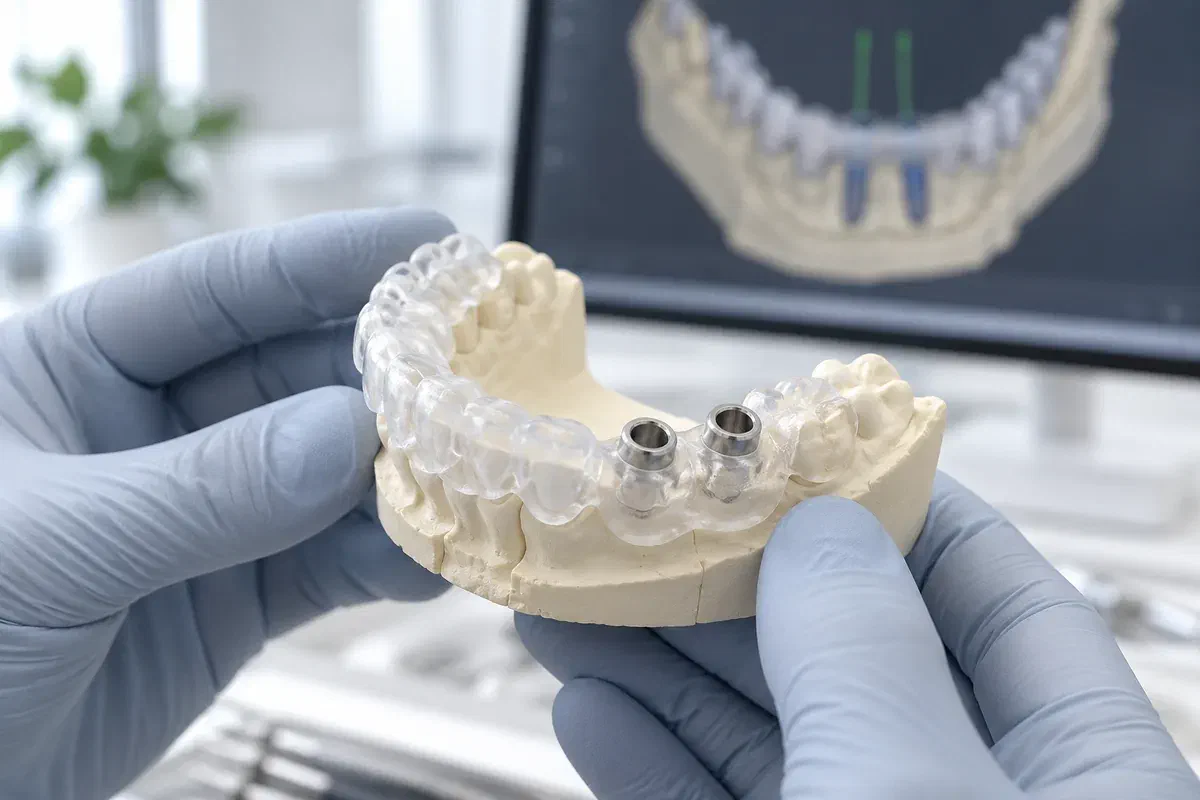
Dental implant planning model and illustrative surgical guide
What a molar site involves

Bite, bone and the nerve below.

An implant in the back of the mouth carries a tooth that does heavy work. The assessment links the site to that working tooth, not simply to the first place a post might fit.

A lower nerve or upper sinus nearby

Lower molars sit above a nerve canal, and upper molars often sit beneath the sinus. The clinician selects records that are justified for your case and explains how they affect the planned position or suggest another approach.

A space that has narrowed

Teeth on either side may tip into an old molar gap, and the opposing tooth may drift toward it. The plan considers the crown’s size, your bite and whether brushes and floss can reach the area.

Treatment spread across providers

Sometimes a specialist places the implant and your own dentist completes the crown. Ask how information passes between them and who to call with questions during each phase.

Planning software does not decide suitability. Your health history, examination, chewing habits, expectations and ability to maintain the tooth all count.

Where digital planning helps a molar

Plan for chewing, not just for filling a space.

Digital records can help the clinician weigh an implant position against the planned crown and nearby anatomy at the same time. For suitable cases, the plan may be turned into a guide for the surgical visit. Whether that is appropriate depends on your mouth and the team’s clinical assessment.

No planning method takes away surgical risk or guarantees a result. Accurate records and a sound position are essential, and the clinician must still respond to findings during the procedure.

Patient information: ITI — computer-guided implant surgery

Aligning the root with the bite

A molar crown needs to meet the opposing teeth properly. Ask how the planned angle allows for chewing forces and room for cleaning.

Explaining any extra steps

Records can show why a sinus or bone procedure, extra healing time or a specialist opinion may be recommended first, and why a rapid option may not suit a back tooth.

Comparing a bridge or partial

A fixed bridge or removable partial may still be a reasonable answer. You should understand what the technology adds to the decision and what it cannot change.

How it usually proceeds

Exam, images, proposal, treatment.

The number of visits and tools varies. Ask for an outline covering assessment, any preparation, placement, the final crown and maintenance, including where each takes place, before you agree.

  1. Talk about eating and health

    We discuss the missing tooth, how chewing has changed, your medical history and earlier dental work. The exam shows whether an implant is worth exploring and whether other problems should be addressed first.

  2. Take the images your site needs

    Photos, scans or impressions and appropriate radiographs may be suggested. Ask what each will reveal, whether existing records are usable and why any new imaging is worthwhile for a back tooth.

  3. Look at the plan side by side

    We review the implant site next to the future crown, along with benefits, limitations, costs and alternatives. You will learn whether sinus or bone preparation, a surgical guide or a referral is proposed.

  4. Place, restore and keep reviewing

    If you go ahead, the treating team confirms surgery and follow-up. The final crown is made around healing and findings, and you leave with cleaning advice and a plan for regular checks.

Caring for a back tooth implant

Recovery deserves the same care as planning.

Personal recovery guidance is still needed, however detailed the digital plan. Follow the clinician who performed the surgery, and know whom to contact if healing differs from what you were told.

Follow the instructions for your procedure

These may cover cleaning near the site, soft food choices, activity and prescribed medicines. They depend on the work done, including any sinus or bone procedure, so ask before leaving if anything is unclear.

Go easy on a temporary

Back-tooth temporaries are not always provided, since a molar gap is less visible. When one is, ask how to wear and clean it, and avoid biting hard on it. If it feels loose, cracked or high when you close, call so it can be looked at before you chew on it normally.

Reach the back of your mouth

Molars are harder to clean. Once the final crown is fitted, ask for a demonstration with the right brushes or floss and agree on review visits. Raise any discomfort or gum changes.

Replacing a chewing tooth

Three ways to restore a back tooth.

Compare complete treatment plans, not technique names. Ask about visits, preparation, the final tooth and long-term care for each option.

If a guide suits the site

Guide-assisted molar implant

A guide may help transfer the planned position into surgery. It depends on records, support, mouth opening and other factors, and its role and limits should be explained. Opening wide enough at the back can matter.

A different workflow

An implant placed by another method

Molar implants do not all follow the same route. Some sites are planned with conventional imaging and placed without a guide, while others need bone added first. Your clinician should explain the reasoning for your tooth and how any extra procedure would reshape the timeline.

Without implant surgery

Bridge or removable partial

These can still restore chewing in suitable cases. A bridge relies on the teeth either side, while a partial clips in and out. Their condition, the gap’s size, your preferences and the daily care each requires guide the comparison.

Halton Hills molar questions

Chewing, bone and back-tooth planning.

Molar gaps raise their own practical questions. Ask us to connect each step to your mouth and the tooth you would like to replace.

(905) 876-4488
Is it a problem to leave a back tooth gap unfilled?
Not always urgently, but neighbouring and opposing teeth can shift over time, and chewing may change. An assessment can explain what is happening in your mouth and whether replacement is advisable.
What is a sinus lift, and might I need one?
It is a procedure that adds bone beneath the sinus floor where upper back teeth were lost. Not everyone needs one. Imaging helps the clinician judge the bone height, and the reason for any such step should be explained.
Can an implant handle heavy chewing?
Implant crowns are designed to function as chewing teeth, but the plan has to consider your bite, any grinding and the bone around the implant. Ask whether a night guard or other protection is suggested.
Will a guide fit if I cannot open very wide?
Mouth opening can affect whether a guide is practical for back teeth. The clinician considers this during planning and may recommend another approach if access is limited.
Do I need a 3D scan for a molar implant?
Often some form of three-dimensional imaging is used to assess the bone and nearby structures, but the decision is made case by case. Ask why it is recommended and what it will show.
Will my estimate include the crown as well as the implant?
Ask for every stage to be listed: assessment, imaging, planning, any guide or graft, surgery, temporary teeth and the final crown. Clarify specialist fees and which costs depend on later findings.
Halton Hills to Bronte Street

Tell us how the gap affects your meals.

Arrange a consultation with our Bronte Street team to discuss the missing tooth, how you are chewing now and the assessment needed. You will leave knowing the likely next steps, who would handle each one and what to keep asking as the plan for your back tooth takes shape.

If you have had a previous implant consultation or have imaging on file, mention it so we can consider which records may help.

Visit Milton Dental Clinic
Unit 1, 342 Bronte St. S, Milton, ON L9T 5B7
Get directions Clinic hours
Monday–Thursday
11am–7pm
Friday–Sunday
By appointment only

Areas we serve

  • Milton
  • Oakville
  • Mississauga
  • Georgetown
  • Halton Hills
  • Acton
  • Campbellville
  • Brampton
  • Burlington
  • Puslinch
  • Rockwood
  • Erin
  • Caledon
  • Etobicoke
  • Old Milton
  • Bronte Meadows
  • Timberlea
  • Dorset Park
  • Dempsey
  • Clarke
  • Beaty
  • Coates
  • Harrison
  • Scott
  • Willmott
  • Ford
  • Bowes
  • Cobden
  • Walker
  • Mountain View
  • Milton Heights
  • Hawthorne Village
  • Valley View
  • Fallingbrook
  • Nassagaweya
  • Trafalgar
  • Esquesing
  • Nelson
  • Brookville
  • Moffat
  • Glen Williams
  • Norval
  • Limehouse
  • Stewarttown
  • Ashgrove
  • Hornby
  • Silver Creek
  • Speyside
  • Scotch Block
  • North Oakville
  • River Oaks
  • Glen Abbey
  • West Oak Trails
  • Palermo
  • Bronte Creek
  • College Park
  • Joshua Creek
  • Uptown Core
  • Preserve
  • Iroquois Ridge
  • Lisgar
  • Meadowvale
  • Meadowvale Village
  • Churchill Meadows
  • Erin Mills
  • Central Erin Mills
  • Streetsville
  • East Credit
  • Creditview
  • Heartland
  • Sheridan
  • Mount Pleasant
  • Credit Valley
  • Huttonville
  • Churchville
  • Springbrook
  • Northwest Brampton
  • Bram West
  • Fletcher's Meadow
  • Fletcher's Creek South
  • Alton Village
  • Orchard
  • Millcroft
  • Headon Forest
  • Tansley
  • Brant Hills
  • Tyandaga
  • Kilbride
  • Lowville
  • Aberfoyle
  • Morriston
  • Arkell
  • Hillsburgh
  • Freelton
  • Carlisle
  • Waterdown
  • Flamborough
  • Mountsberg

How can we help?

Milton Dental Clinic

Have a question about your smile? Choose the option that works best for you.

For urgent dental concerns, please call.
Messages are reviewed during clinic hours.