
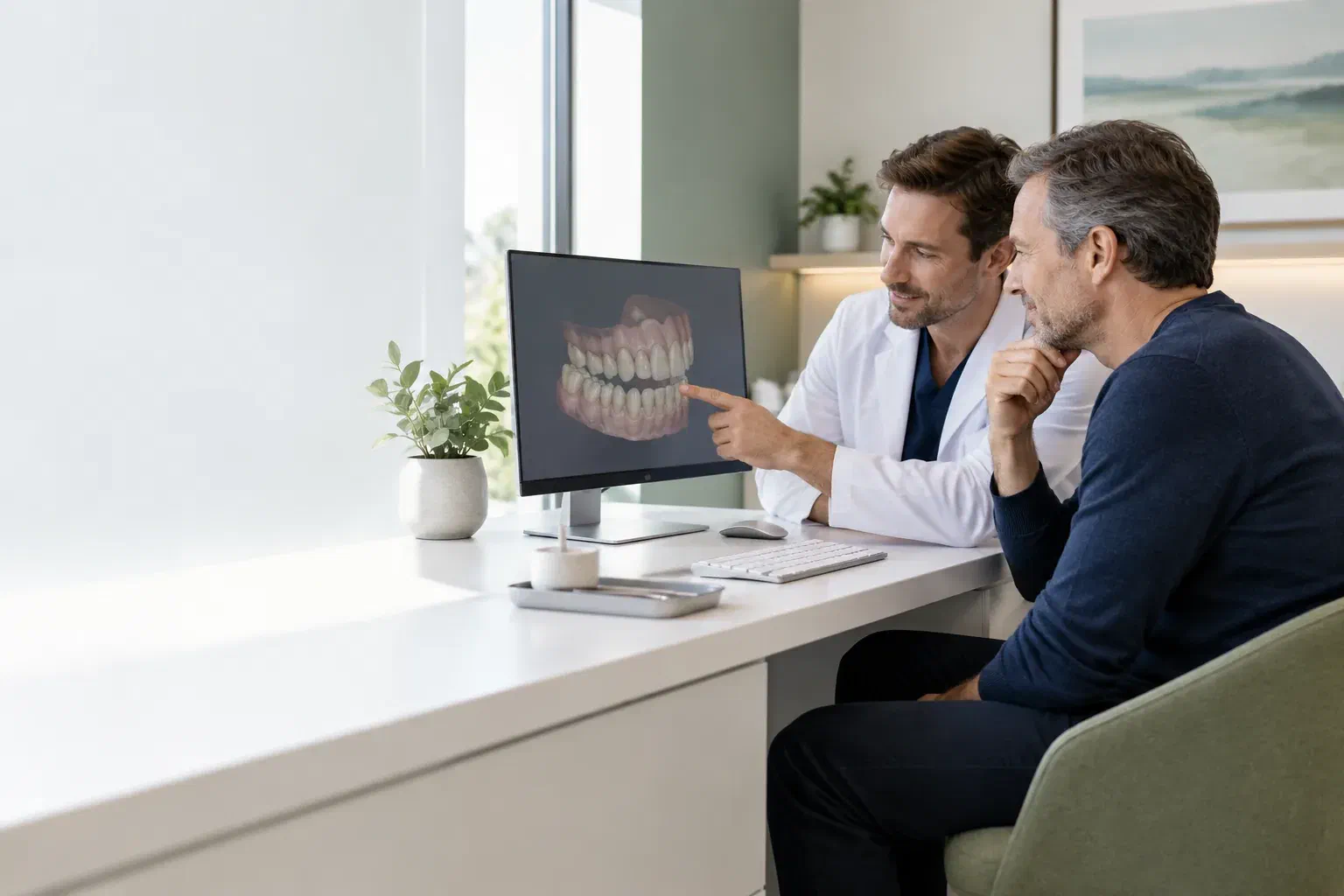
Illustrative consultation about digital planning for a dental implant
Restorative Dentistry

Computer-Planned Implant Placement in Oakville

Seen an ad for guided implants and wondering what it really involves? Coming from Oakville, you can sit down with us to separate the marketing from the method and learn what an assessment of your gap would cover.

Beyond the brochure

Precision is a tool, not a promise.

Adverts tend to lead with words like guided, digital and fast. Underneath, computer-planned placement is a way of using scans and software to think through where an implant might go. A sound plan weighs the final tooth, the bone available, nearby roots and nerves, and whether you can reach the area to clean it. Polished renderings help, but they only ever represent part of the evaluation.

Three ideas often get bundled together: three-dimensional imaging, virtual planning and a printed surgical guide. Each plays a separate role, and a given case may use some or none of them. Ask which are being offered to you, the reason for each, and who is responsible at every stage.

For anyone weighing offers from different clinics around Oakville, our consultation begins with the gap itself and the replacements worth considering. Whether an implant suits you is settled before we discuss a planning method. If imaging, specialist input, surgery and restorative visits are needed, we set them out as one connected pathway.

Get a clear view of your options
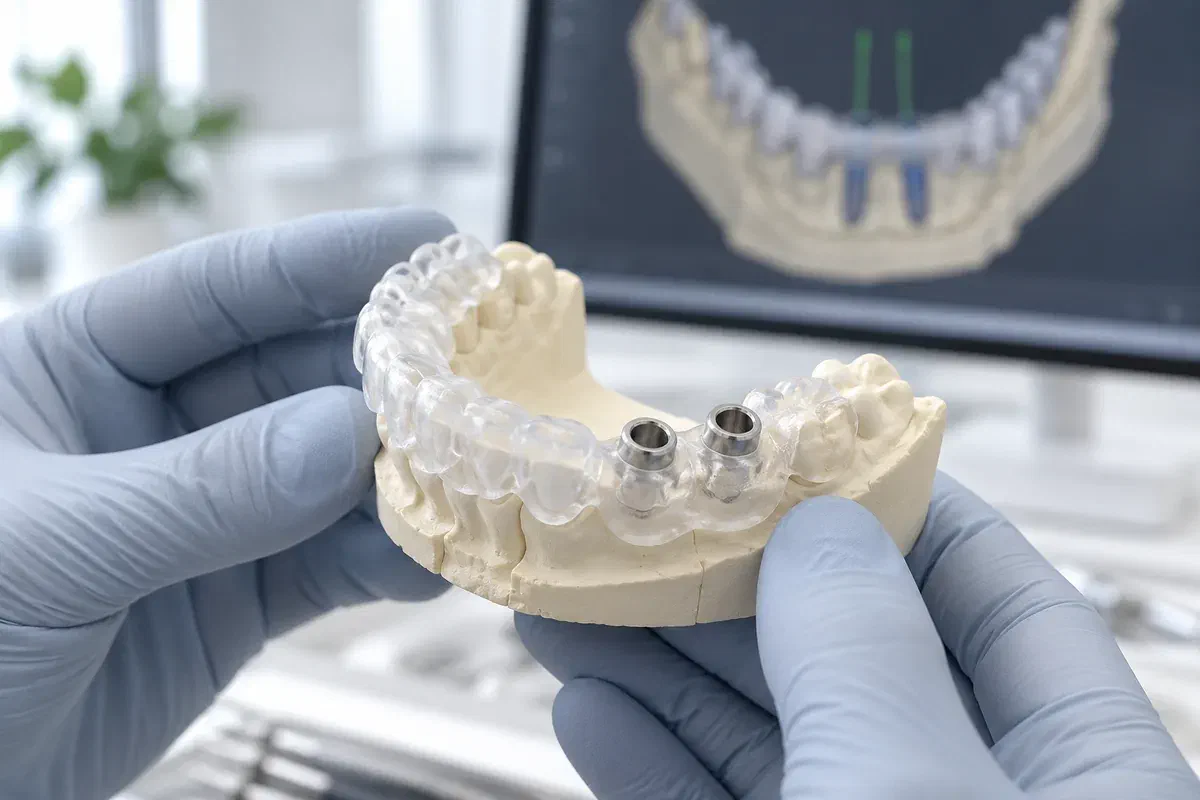
Dental implant planning model and illustrative surgical guide
Questions to ask before any technique

What does your site actually need?

The implant is only the hidden support for a visible tooth. Planning should join your mouth’s condition to that replacement rather than treat the job as fitting a post into any available space.

Sensitive anatomy close by

Roots of neighbouring teeth, nerves and the sinus can all sit near a gap. The clinician selects records that are warranted for your case and explains how they influence the proposed position or suggest a different approach.

Limited room for the new tooth

Space matters both in the visible gap and in the bone beneath. The plan looks at the crown’s shape, how it lines up with nearby teeth and whether you will be able to keep it clean comfortably.

Care spread across several offices

Promotional offers sometimes involve a surgeon in one place and a restoring dentist in another. Ask how records are passed along, who is accountable for what, and where to direct concerns between visits.

Technology does not decide whether you are a candidate. Your medical history, exam findings, goals and ability to maintain the result are part of that judgement every time.

What planning genuinely offers

More clarity in the conversation.

Good records can help a clinician study a proposed implant beside the planned crown and the anatomy around it. Where it is suitable, the digital plan may be used to produce a guide for placement. That choice rests on your clinical picture and the treating team’s view.

Planning supports skill and judgement rather than replacing them. It does not erase surgical risk or guarantee how things turn out. The records need to be accurate, the position must make clinical sense, and the team still adapts to what they encounter during the procedure.

Patient information: ITI — computer-guided implant surgery

Starting from the finished tooth

Beginning with the intended crown or appliance keeps everyone focused. Ask how its shape, your bite and the space you need for cleaning influence where the implant is placed.

Explaining the timeline honestly

Reviewing records together can show why preparation, healing time or another opinion may be advised first. It can also make clear why a rapid offer seen online might not match your situation.

Keeping alternatives on the table

A thorough implant discussion should still compare a bridge, a removable option or another suitable route. You should leave knowing what the technology adds for you and what it cannot change.

What the pathway looks like

Assess, record, plan, then treat.

Appointment counts and equipment differ between cases. Before going ahead, request a clear outline covering assessment, any preparatory work, placement, the final restoration and maintenance, including where each happens.

  1. Clarify what you want to replace

    We discuss the missing tooth or teeth, your health history, earlier dental treatment and what you care about most. The exam helps decide which options merit more investigation and whether existing problems should be treated first.

  2. Choose the records worth taking

    Photos, scans or impressions and appropriate radiographs may be suggested. You are welcome to ask what each will show, whether images you already have are suitable, and why anything further is needed.

  3. Go over the proposal together

    The plan considers the future crown along with the implant site. Review benefits, limits, costs and alternatives, including whether a guide, graft, referral or temporary tooth is involved.

  4. Proceed and keep checking in

    If you choose to go ahead, the surgical arrangements and follow-ups are confirmed. The final tooth is planned around healing and findings, and you receive cleaning instructions and a review schedule after it is fitted.

Once placement is done

Recovery has its own checklist.

Postoperative care is personal and cannot be printed from a plan. Follow the instructions of whoever performed your procedure, and know exactly whom to contact if recovery strays from what was described.

Follow directions written for you

Guidance may include how to clean, what to eat, how active to be and how to take any prescribed medicine. It depends on what was actually done, so ask before leaving if something is unclear rather than relying on a generic overview.

Take care with a temporary

If you have a provisional tooth or appliance, learn how to wear and clean it. Report movement, a change in how your teeth meet or any damage, so the team can assess it before you go on using it.

Schedule ongoing reviews

After the permanent tooth is in, ask for a hands-on cleaning demonstration and agree on how often you will be seen. Raise discomfort, difficulty reaching the area or changes in the surrounding gum promptly.

Comparing like with like

Judge the whole plan, not the label.

Comparing full treatment plans tells you far more than comparing technique names. Ask about appointments, preparation, the restoration and long-term care for each option.

Where a guide makes sense

Guide-assisted implant surgery

A guide may help carry a planned position over to surgery. Whether it suits you depends on records, support for the guide, access in your mouth and other clinical factors, all of which should be explained.

An alternative method

Implants placed using another workflow

Implant care is not one-size-fits-all. Ask why a specific approach is recommended, how the site was evaluated and whether grafting or specialist treatment changes the sequence.

Non-surgical routes

Tooth replacement without an implant

A bridge or removable partial may be worth comparing directly. Neighbouring teeth, the size of the space, your preferences and upkeep needs all shape that decision.

Oakville questions answered

Sorting fact from sales pitch.

Promotional language can make implants sound simpler or more complicated than they are. Ask us to link each step back to your mouth and the tooth you want to replace.

(905) 876-4488
Is guided surgery always more accurate than other methods?
Not in every situation. A guide can help transfer a plan, but its usefulness depends on the quality of the records, how well the guide is supported and the clinical circumstances. Ask why it is or is not recommended for your site.
An ad promised new teeth in one day. Is that realistic for me?
It depends on your case. Same-day teeth are a separate decision from how the implant is planned, and healing, bone condition and findings during surgery all play a part. Ask what timeline is being proposed and what might change it.
How do I compare two implant quotes from different clinics?
Check whether each one includes the consultation, imaging, planning, any guide, the surgery, temporary teeth and the final crown or appliance. Note specialist fees, follow-up care and which costs depend on later findings, so you are comparing the same pathway.
Who owns my scan, and can I take it elsewhere?
You can ask for copies of your dental records, including imaging, to share with another clinician. Ask how they will be provided and whether the receiving office can use the format.
Is a scan enough to tell whether I can have an implant?
No. A scan provides information, but suitability also depends on your examination, medical history, gum health and goals. The full assessment comes from putting all of these together.
Can my plan still change after I agree to it?
It can. Records or changes in your mouth before treatment may lead to a revised position or sequence, and surgery itself can reveal new information. Ask how such changes are communicated and when the plan is considered final.
Planning a visit from Oakville

Get answers before you sign anything.

Book a consultation at our Bronte Street practice to discuss the missing tooth, any offers you have been considering, and the assessment that makes sense. We will help you understand the pathway and the right questions about planning, responsibilities and aftercare.

Quotes, treatment plans or imaging from another office are worth bringing along so we can talk through what they include.

Visit Milton Dental Clinic
Unit 1, 342 Bronte St. S, Milton, ON L9T 5B7
Get directions Clinic hours
Monday–Thursday
11am–7pm
Friday–Sunday
By appointment only

Areas we serve

  • Milton
  • Oakville
  • Mississauga
  • Georgetown
  • Halton Hills
  • Acton
  • Campbellville
  • Brampton
  • Burlington
  • Puslinch
  • Rockwood
  • Erin
  • Caledon
  • Etobicoke
  • Old Milton
  • Bronte Meadows
  • Timberlea
  • Dorset Park
  • Dempsey
  • Clarke
  • Beaty
  • Coates
  • Harrison
  • Scott
  • Willmott
  • Ford
  • Bowes
  • Cobden
  • Walker
  • Mountain View
  • Milton Heights
  • Hawthorne Village
  • Valley View
  • Fallingbrook
  • Nassagaweya
  • Trafalgar
  • Esquesing
  • Nelson
  • Brookville
  • Moffat
  • Glen Williams
  • Norval
  • Limehouse
  • Stewarttown
  • Ashgrove
  • Hornby
  • Silver Creek
  • Speyside
  • Scotch Block
  • North Oakville
  • River Oaks
  • Glen Abbey
  • West Oak Trails
  • Palermo
  • Bronte Creek
  • College Park
  • Joshua Creek
  • Uptown Core
  • Preserve
  • Iroquois Ridge
  • Lisgar
  • Meadowvale
  • Meadowvale Village
  • Churchill Meadows
  • Erin Mills
  • Central Erin Mills
  • Streetsville
  • East Credit
  • Creditview
  • Heartland
  • Sheridan
  • Mount Pleasant
  • Credit Valley
  • Huttonville
  • Churchville
  • Springbrook
  • Northwest Brampton
  • Bram West
  • Fletcher's Meadow
  • Fletcher's Creek South
  • Alton Village
  • Orchard
  • Millcroft
  • Headon Forest
  • Tansley
  • Brant Hills
  • Tyandaga
  • Kilbride
  • Lowville
  • Aberfoyle
  • Morriston
  • Arkell
  • Hillsburgh
  • Freelton
  • Carlisle
  • Waterdown
  • Flamborough
  • Mountsberg

How can we help?

Milton Dental Clinic

Have a question about your smile? Choose the option that works best for you.

For urgent dental concerns, please call.
Messages are reviewed during clinic hours.