
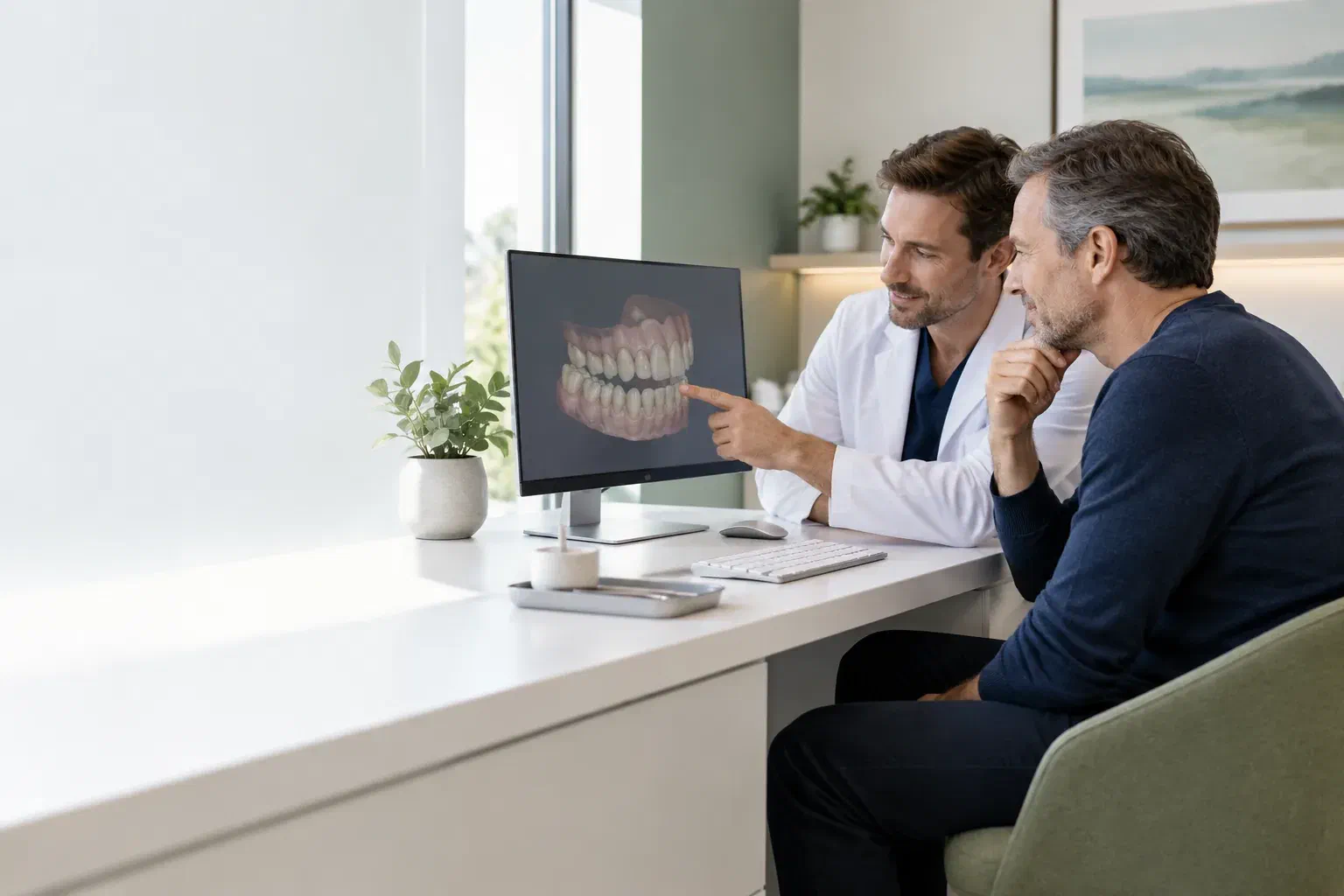
Illustrative consultation about digital planning for a dental implant
Restorative Dentistry

Computer-Planned Implant Placement in Old Milton

A tooth lost years ago, or an old bridge that is wearing out, can raise new questions. From Old Milton, book a consultation to learn how digital records may help us assess an implant and the steps it would involve.

Revisiting a long-standing gap

Is an implant still possible after all these years?

When a tooth has been missing for a long time, the jaw underneath can slowly change shape and neighbouring teeth may drift or tilt. That is one reason a planner wants a detailed view before suggesting anything. Computer-planned placement uses digital records to study where an implant could go, measured against the tooth it would eventually carry, the bone that remains, and the anatomy nearby.

The vocabulary can be confusing. A cone beam scan, planning software and a surgical guide each do a different job, and not every case needs all three. Feel free to ask what is being suggested in your situation and what each item contributes.

Many people on the established streets of Old Milton, Milton’s historic downtown, have lived with an old bridge or partial for decades. Our first discussion looks at that history and asks whether an implant is suitable before any technique is chosen. Referrals, surgery and the restorative visits that follow should all be laid out for you.

Ask about replacing an older gap
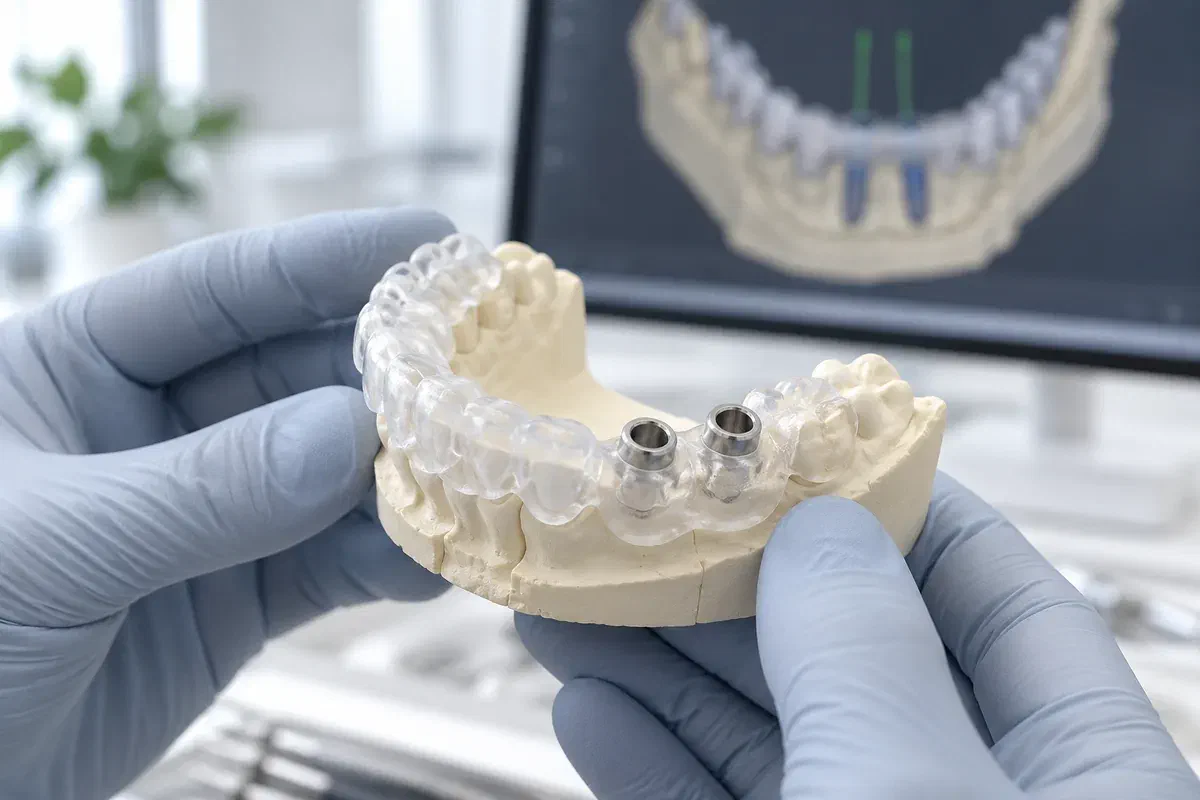
Dental implant planning model and illustrative surgical guide
Things the records may reveal

Time changes a gap. Planning has to catch up.

An implant only makes sense as part of the tooth it will hold. The assessment ties what is happening in your jaw today to the replacement you want, rather than simply looking for room.

Bone that has narrowed

After years without a root to stimulate it, bone can thin out. Imaging chosen for your case helps show how much support there is and how close sensitive structures sit, which may shift the proposed site or point toward another option.

Teeth that have moved into the space

Neighbouring teeth sometimes lean into a gap or the opposing tooth grows down toward it. That can shrink the room for a new crown and affect your bite, so the plan has to consider the finished shape as much as the root.

Old work that needs a decision

An ageing bridge may be anchored to teeth that also need attention. Sorting out which restorations stay, which are replaced, and who handles each step keeps the sequence understandable and your questions pointed at the right person.

No scan settles suitability on its own. Your general health, an exam of your mouth, realistic expectations and your ability to look after the result are all weighed together.

Why plan digitally

Seeing the whole site before anyone begins.

With good digital records, the treating clinician can compare the intended crown, the implant position and the surrounding structures in one view. In suitable cases, that work may be used to make a guide for the placement appointment. Whether a guide is used is a clinical call that depends on your mouth.

None of this makes surgery risk-free or promises a particular outcome. Planning relies on accurate records and sound decisions, and the team must still respond to what they find once treatment is under way.

Patient information: ITI — computer-guided implant surgery

Designing backward from the crown

Knowing what the replacement should look like and how it should bite keeps planning practical. Ask how cleaning access and your existing teeth shaped the suggested angle.

Clearer reasons for extra steps

Records can explain why a graft, a healing period or a second opinion might come before the implant. They may also show why a fast-track offer you have seen elsewhere would not suit an older gap.

Honest comparison with your current setup

Replacing an old bridge with a new bridge, or adjusting a partial, can still be reasonable. A useful consultation explains what an implant would add for you and where it would not help.

How the steps usually unfold

From your dental history to a clear proposal.

No two cases need the same number of visits or the same tools. Ask for an outline of assessment, preparation, placement, the final tooth and maintenance, and where each part takes place, before you commit.

  1. Look back at what has been done

    We talk about when the tooth was lost, past bridges or partials, your health and what bothers you most now. The examination shows whether gum disease, decay or worn restorations should be dealt with before any implant is discussed in detail.

  2. Take the images that answer real questions

    Photographs, a digital scan or impressions and suitable X-ray imaging may be recommended. You can ask what each record is for and whether earlier X-rays from your dental file are still useful.

  3. Walk through the proposed plan

    The implant site is shown with the future crown in mind. Discuss the advantages, drawbacks, fees and alternatives, and whether grafting, a guide, a referral or a temporary tooth forms part of it.

  4. Treat, heal and review

    If you decide to proceed, surgical details and check-up dates are confirmed. The permanent crown is made once healing allows, and you receive guidance on cleaning and a plan for ongoing visits.

Looking after the new tooth

Healing well takes attention of its own.

Your recovery instructions come from the clinician who did the surgery, not from the planning software. Keep those directions handy and make sure you know who to reach if healing feels different from what you were told.

Stick to your personal directions

Instructions may cover rinsing, diet, exercise and any medicines prescribed. Because they reflect the exact work done, including grafts, clear up anything uncertain before you head home rather than going by what a friend experienced.

Treat the temporary gently

A temporary crown, flipper or partial needs its own care routine. If it loosens, chips or your bite starts to feel odd, let the team know so they can look at it before you keep using it as normal.

Plan for the long run

Once the final crown is fitted, ask to be shown the brushes or floss that reach around it, and set a review schedule. Speak up about soreness, food trapping or changes in the gum nearby.

Weighing the routes

Compare complete plans, not buzzwords.

A long-standing gap can be handled several ways. Look at the visits, preparation, final restoration and ongoing care each route would need instead of judging techniques by their names.

When a guide suits the site

Guided surgery from a digital plan

A guide can help translate the planned position to the surgery itself. It depends on good records, stable support, enough mouth opening and the wider clinical picture, and its limits should be explained to you.

A different workflow

Implant placement by another method

Some cases are planned and placed in other ways. Ask why a given method is preferred for your site and whether grafting or a specialist referral would change the order of treatment.

Non-surgical choices

A bridge or partial instead

Replacing or adjusting what you already have may be worth considering. The state of neighbouring teeth, the gap’s size, your wishes and the upkeep involved all feed into that comparison.

Questions from Old Milton

What people ask about older gaps and digital planning.

It is easy to feel lost in technical language. Ask us to explain how each suggested step relates to your mouth and to the tooth you are hoping to replace.

(905) 876-4488
Can an implant replace a tooth that was pulled decades ago?
Sometimes. It depends on how much bone remains, how the surrounding teeth have shifted and your overall health. Imaging and an exam help the clinician judge whether an implant is reasonable or whether another approach would serve you better.
My bridge still works. Should I replace it with an implant now?
Not automatically. If a bridge is comfortable and the supporting teeth are healthy, keeping it may be sensible. If it is failing or the anchor teeth have problems, an assessment can compare the options so you can decide with the facts in front of you.
Does planning software let the computer place the implant?
No. The software helps the clinician prepare and review a plan. A person performs the procedure and stays responsible for it. If any navigation or robotic system is mentioned, ask precisely what role it plays.
Will I need a graft because the gap is so old?
Possibly, though not always. Planning cannot add bone that is missing, but it can show how much is there. Ask whether a graft is suggested, what it is meant to accomplish and how alternatives compare.
Do health conditions or medications affect implant planning?
They can. Tell the team about conditions such as diabetes, medicines you take and whether you smoke, because these may influence healing and the timing of treatment. Your physician may sometimes be consulted as part of the assessment.
Could the recommendation change once the records are reviewed?
Yes. Imaging can uncover details that alter the planned position, the preparation needed or whether an implant suits you at all. Ask when the plan becomes final and how you will hear about any changes.
Visit us from Old Milton

Bring the history of your gap with you.

Our Bronte Street practice is a short way from Milton’s historic core. Book a consultation to talk about the missing tooth, any older work in that area and what you would like to achieve, and we will explain the assessment and questions that come next.

Details of old bridges, partials or earlier implant consultations, and any imaging you have, can help us decide which records matter.

Visit Milton Dental Clinic
Unit 1, 342 Bronte St. S, Milton, ON L9T 5B7
Get directions Clinic hours
Monday–Thursday
11am–7pm
Friday–Sunday
By appointment only

Areas we serve

  • Milton
  • Oakville
  • Mississauga
  • Georgetown
  • Halton Hills
  • Acton
  • Campbellville
  • Brampton
  • Burlington
  • Puslinch
  • Rockwood
  • Erin
  • Caledon
  • Etobicoke
  • Old Milton
  • Bronte Meadows
  • Timberlea
  • Dorset Park
  • Dempsey
  • Clarke
  • Beaty
  • Coates
  • Harrison
  • Scott
  • Willmott
  • Ford
  • Bowes
  • Cobden
  • Walker
  • Mountain View
  • Milton Heights
  • Hawthorne Village
  • Valley View
  • Fallingbrook
  • Nassagaweya
  • Trafalgar
  • Esquesing
  • Nelson
  • Brookville
  • Moffat
  • Glen Williams
  • Norval
  • Limehouse
  • Stewarttown
  • Ashgrove
  • Hornby
  • Silver Creek
  • Speyside
  • Scotch Block
  • North Oakville
  • River Oaks
  • Glen Abbey
  • West Oak Trails
  • Palermo
  • Bronte Creek
  • College Park
  • Joshua Creek
  • Uptown Core
  • Preserve
  • Iroquois Ridge
  • Lisgar
  • Meadowvale
  • Meadowvale Village
  • Churchill Meadows
  • Erin Mills
  • Central Erin Mills
  • Streetsville
  • East Credit
  • Creditview
  • Heartland
  • Sheridan
  • Mount Pleasant
  • Credit Valley
  • Huttonville
  • Churchville
  • Springbrook
  • Northwest Brampton
  • Bram West
  • Fletcher's Meadow
  • Fletcher's Creek South
  • Alton Village
  • Orchard
  • Millcroft
  • Headon Forest
  • Tansley
  • Brant Hills
  • Tyandaga
  • Kilbride
  • Lowville
  • Aberfoyle
  • Morriston
  • Arkell
  • Hillsburgh
  • Freelton
  • Carlisle
  • Waterdown
  • Flamborough
  • Mountsberg

How can we help?

Milton Dental Clinic

Have a question about your smile? Choose the option that works best for you.

For urgent dental concerns, please call.
Messages are reviewed during clinic hours.