

Illustrative dentist and patient consultation about a suspected cracked tooth
Restorative Dentistry

Cracked Tooth Assessment in Milton

A zap of pain as you let go of a bite, then nothing for days. That on-and-off pattern is worth having checked. In Milton, we can examine the tooth, listen to how it behaves, and explain what the findings point to.

When a bite stings on release

The tooth that hurts for a second, then hides

Many people describe the same odd moment: chewing feels fine until they let go, and a quick, sharp jolt shoots through one side. By the next meal it may not happen at all. A cracked-tooth assessment looks into whether that tooth has structural damage, or whether something else explains the sensation.

Pinpointing the source is often harder than people expect. Upper and lower teeth can feel alike, and discomfort may seem to wander. What helps most is your description: which foods set it off, how long it lingers, and whether it is becoming more frequent. There is no need to bite down hard to prove it before you come in.

Being here in Milton means you can book while the pattern is still fresh in your mind. Our role is to match your account to what the examination shows, then explain plainly what is clear and what is still open. If another test or a specialist’s view would help, we will tell you why.

Book a check for a sore bite
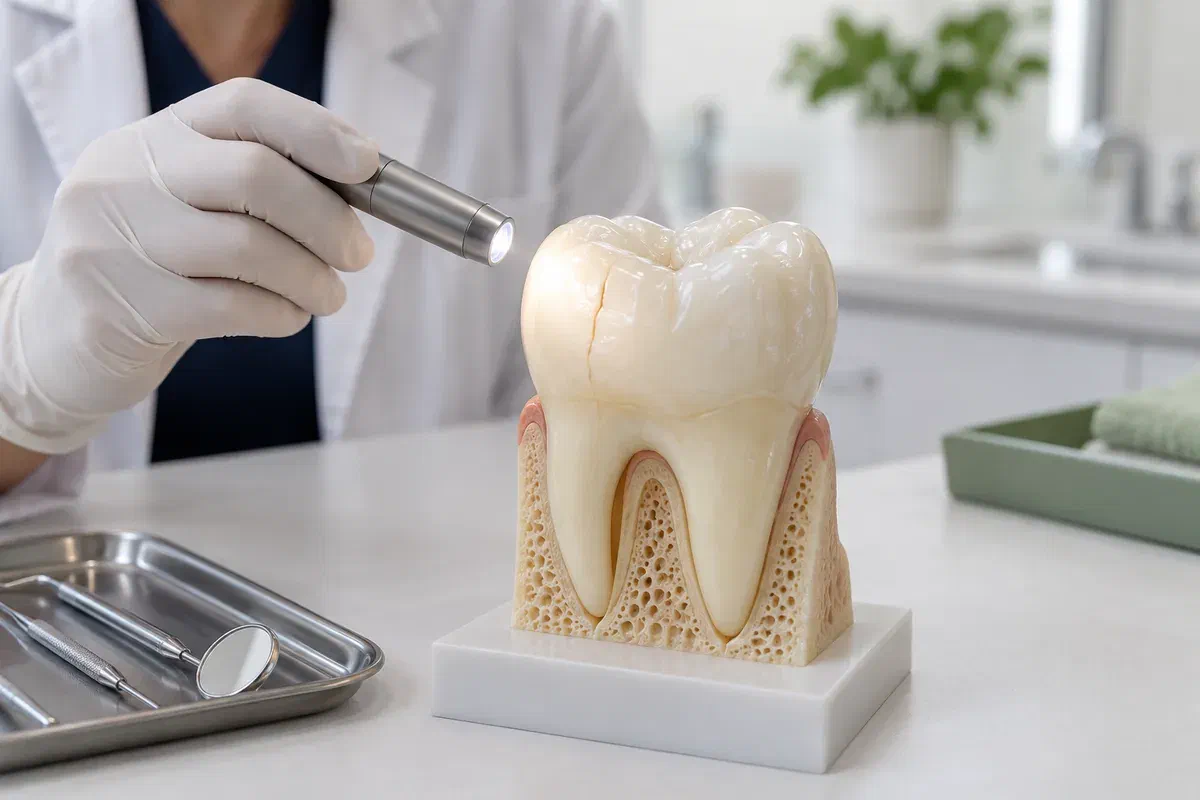
Illustrative tooth examination model with a fine visible crack
Details worth mentioning

What did you notice, and when?

Your own words are a good starting point. How a twinge starts, how it ends and how often it returns can say as much as how strong it feels, especially when it only shows up now and then.

A jolt with certain foods

Say whether the pain arrives as you press down, as you release, or only with grainy or chewy foods. Note roughly when it began and whether you have started chewing on the other side. More than one problem can produce a similar feeling.

A dark or fine line on the surface

Lines in enamel are common and many are shallow. A deeper fracture is a different matter, and the two cannot be told apart reliably by looking in a mirror. The dentist judges the line alongside the tooth and how it behaves.

Trouble near an existing filling

Older fillings, crowns and past repairs all belong in the story. Mention if an edge has felt sharp, a fragment has come away, or the area has become touchy lately. Any notes on earlier work are useful to bring.

Please phone our Milton team first if there is swelling, strong or worsening pain, a recent knock to the mouth, or a tooth that moves. That lets the team talk through how soon you should be seen.

Why it is worth investigating

Clear findings make the choice easier.

Spotting a crack is only part of it. The assessment tries to work out which tooth or surrounding tissue is behind the symptom, whether the tooth looks repairable, and what is still unknown before any treatment is suggested.

Sometimes one visit is enough to settle the question. Other times the answer needs more testing or a review later. Either way, you should hear about those limits honestly. An open account of what remains uncertain serves you better than an early promise about keeping the tooth.

A symptom is not yet a diagnosis

Pain on biting can have several causes besides a crack. Weighing those possibilities keeps the conversation grounded in what is found, rather than jumping to a treatment because the description sounds familiar.

Each test has a reason

You are welcome to ask what a particular check is meant to show and how it could change the plan. Knowing the purpose can make the visit feel less mysterious and help you describe any discomfort as it happens.

A plan you both agree on

The result might be watching the tooth, protecting it, testing further or treating it. Before you go, confirm the next step, its timing, and which changes mean you should call sooner than planned.

How the visit unfolds

Four parts, guided by what we find

Not every check suits every tooth, so the steps follow your symptoms. If you are nervous about setting the pain off, say so at the start and agree on a signal to stop.

  1. Talk through the history

    We ask about timing, triggers, earlier fillings or crowns, and any accident. Let us know if the ache carries on after the trigger has gone, and whether you have seen swelling or felt your bite change. Please skip testing the tooth at home.

  2. Look at the tooth and its neighbours

    The dentist checks the surface, any restorations, the gums and nearby teeth. Depending on what turns up, this may include looking at how the tooth responds to biting or temperature and how healthy its supporting tissues are.

  3. Add images or tests if useful

    X-rays or other investigations can reveal related issues, though a hairline crack often does not appear on them directly. You can ask what the images show and whether a second opinion would help narrow things down.

  4. Go over the findings together

    We explain the likely cause, what is still uncertain and the realistic options. If a further procedure is proposed to look more closely, we discuss why, what it might reveal and what it could mean, before you agree.

Between appointments

Go easy on the tooth while the plan takes shape

What to do after the visit depends on the findings and on any temporary care provided. Ask for guidance that fits your tooth, particularly if more tests or a specialist visit are being organised.

Stop testing it with hard bites

Checking again and again which food causes the jolt can add strain to a tooth that may already be weak. Share what you have noticed and ask how best to eat while you wait for the next stage.

Jot down real changes

A quick note about new swelling, an ache that lasts longer, or pain that has gone from occasional to constant is helpful. If things are getting worse, contact us straight away instead of building a detailed log.

Keep the follow-up in place

Feeling better is good news, but check with us before cancelling a planned review. Fewer twinges do not, on their own, reveal what is happening inside the tooth or replace the plan you agreed.

Where things may go next

Different findings, different paths

An assessment can lead in quite different directions. Ask what supports the suggested approach, what is still unclear and what each alternative would mean for the tooth.

When repair is not needed yet

Watching with a set review

A shallow finding is handled differently from a structural one. If monitoring is the advice, find out what will be checked, when you should return and which symptoms mean coming back earlier.

When the tooth needs reinforcing

Support or repair for the tooth

If the tooth seems damaged but restorable, a suitable repair can be discussed. How much healthy structure remains and where the problem sits both affect whether a filling or a larger restoration makes more sense.

When the picture is incomplete

More investigation or a referral

A hard-to-pin-down case, or one that involves the nerve or root, may call for further assessment. Ask what question the next step should answer and how the answer will shape treatment.

Common questions

Unsure what is going on? Ask anyway.

You do not need to know the cause before getting in touch. These answers may help you prepare, without trying to work out the problem on your own.

(905) 876-4488
Why does it hurt when I let go of a bite rather than when I press down?
Pain on release is one pattern people describe with cracked teeth, but it is not proof of one. Other problems can feel similar. Tell the dentist exactly when the sensation occurs; that detail helps guide which checks make sense for your tooth.
Can a cracked tooth heal by itself?
Enamel and the layers beneath it do not knit back together the way bone can. Symptoms may quiet down for a while, though, which can be misleading. An assessment helps show what is happening and whether the tooth needs protection or simply monitoring.
Is it fine to take a pain reliever before my appointment?
Many people use an over-the-counter pain reliever as directed on the label, provided it suits their health and other medicines. Mention what you took and when, because it can affect how the tooth responds during the examination. Ask a pharmacist if unsure.
Do I need to locate the sore tooth before I book?
No. Point out the general area and describe what sets it off. Narrowing down the source is part of the dentist’s job. Biting on hard things to find it can put extra stress on the tooth, so it is better not to try.
Could grinding or clenching play a part?
Heavy clenching or grinding can add stress to teeth, and some people do it without realising, often at night. Mention any jaw tiredness, morning headaches or comments from a partner. The dentist can consider it as one factor among several.
If my X-ray looked normal, could there still be a crack?
Yes, a very fine crack may not appear on an image. That is why the dentist combines X-rays with your history and the examination. Ask what the image was meant to check, rather than treating a clear picture as a final answer.
Suspected crack in Milton

Come in and let us take a look.

Visit our Bronte Street practice to talk about a twinge on biting, a line you have spotted, or a tooth that just feels wrong. We will examine it, explain the findings and help you weigh the next step.

If the pain is severe or getting worse, or there is swelling or a recent injury, phone the clinic rather than booking online so we can discuss what you need first.

Visit Milton Dental Clinic
Unit 1, 342 Bronte St. S, Milton, ON L9T 5B7
Get directions Clinic hours
Monday–Thursday
11am–7pm
Friday–Sunday
By appointment only

Areas we serve

  • Milton
  • Oakville
  • Mississauga
  • Georgetown
  • Halton Hills
  • Acton
  • Campbellville
  • Brampton
  • Burlington
  • Puslinch
  • Rockwood
  • Erin
  • Caledon
  • Etobicoke
  • Old Milton
  • Bronte Meadows
  • Timberlea
  • Dorset Park
  • Dempsey
  • Clarke
  • Beaty
  • Coates
  • Harrison
  • Scott
  • Willmott
  • Ford
  • Bowes
  • Cobden
  • Walker
  • Mountain View
  • Milton Heights
  • Hawthorne Village
  • Valley View
  • Fallingbrook
  • Nassagaweya
  • Trafalgar
  • Esquesing
  • Nelson
  • Brookville
  • Moffat
  • Glen Williams
  • Norval
  • Limehouse
  • Stewarttown
  • Ashgrove
  • Hornby
  • Silver Creek
  • Speyside
  • Scotch Block
  • North Oakville
  • River Oaks
  • Glen Abbey
  • West Oak Trails
  • Palermo
  • Bronte Creek
  • College Park
  • Joshua Creek
  • Uptown Core
  • Preserve
  • Iroquois Ridge
  • Lisgar
  • Meadowvale
  • Meadowvale Village
  • Churchill Meadows
  • Erin Mills
  • Central Erin Mills
  • Streetsville
  • East Credit
  • Creditview
  • Heartland
  • Sheridan
  • Mount Pleasant
  • Credit Valley
  • Huttonville
  • Churchville
  • Springbrook
  • Northwest Brampton
  • Bram West
  • Fletcher's Meadow
  • Fletcher's Creek South
  • Alton Village
  • Orchard
  • Millcroft
  • Headon Forest
  • Tansley
  • Brant Hills
  • Tyandaga
  • Kilbride
  • Lowville
  • Aberfoyle
  • Morriston
  • Arkell
  • Hillsburgh
  • Freelton
  • Carlisle
  • Waterdown
  • Flamborough
  • Mountsberg

How can we help?

Milton Dental Clinic

Have a question about your smile? Choose the option that works best for you.

For urgent dental concerns, please call.
Messages are reviewed during clinic hours.