

Illustrative dentist and patient consultation about a suspected cracked tooth
Restorative Dentistry

Cracked Tooth Assessment in Oakville

Sore when you chew, but is it really a crack? From Oakville, you can arrange an examination that weighs a fracture against other likely causes, so any recommendation rests on findings rather than a hunch.

Crack or something else?

Sorting out what is behind a sore bite

Plenty of things can make a tooth hurt on biting. A crack is one of them, but so are decay, an irritated gum, a filling sitting slightly high, heavy clenching and even congestion near the upper back teeth. An assessment is how we tell these apart for the tooth that is bothering you.

That is why your description carries so much weight. Explain what starts the sensation, whether it is sharp or dull, and how quickly it fades. Mention if it began after a particular meal or dental visit. It does not matter if the tooth is quiet on the day; the earlier pattern is still useful.

For people coming from Oakville, the goal of the visit is simple: connect your story with what the examination shows, and say clearly which parts are settled and which are not. When an extra test or a specialist view would genuinely help, you will hear the reason for it.

Find out what is causing the pain
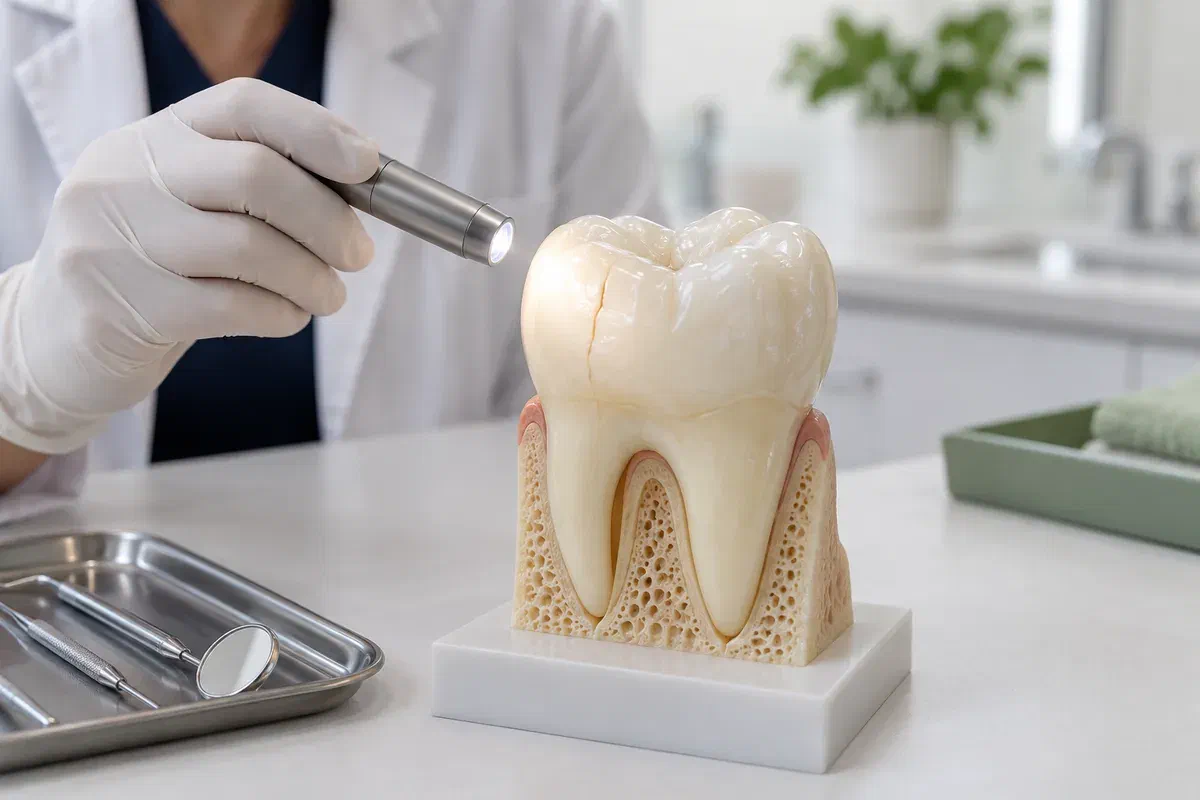
Illustrative tooth examination model with a fine visible crack
Useful observations

Which of these sounds familiar?

None of these confirms a crack by itself, yet each one helps narrow the search. Describe them as you experienced them, including any that come and go rather than appearing every time you eat.

A sharp moment on one side

Note whether it comes as your teeth meet, as they part, or only with seeds, nuts or tough foods. Say when you first felt it and whether you now steer food elsewhere. A crack is only one of several things that can cause this.

A line you can see

Many people have shallow lines in their enamel that never cause trouble. What you see in the mirror cannot tell you how deep a line runs. The dentist considers it alongside the rest of the tooth and your symptoms.

Changes near past dental work

Tell us if an old filling or crown has started to feel rough, sensitive or chipped. Earlier work is part of the history, and dates or notes from previous treatment can help if you have them.

Swelling, strong pain, a tooth that moves, or a recent knock all deserve a phone call first. The team can then discuss how urgently you should be seen before anything is booked.

The value of ruling things out

Better decisions start with the right cause.

Finding a line on a tooth is not the whole job. The assessment tries to identify which tooth or tissue explains the symptom, whether the tooth appears restorable, and what still needs clarifying before a recommendation is made.

Some causes reveal themselves in a single visit; others need more testing or another look later on. You should be told about those limits openly. Admitting what is not yet known is more useful than promising that the tooth will be saved before anyone understands its condition.

Avoiding the wrong treatment

Treating a crack that is not there, or missing a different cause, helps no one. Weighing the alternatives keeps attention on the evidence rather than on what the symptom seems to suggest.

Knowing why each test is done

Ask what a check is for and how its result could shift the recommendation. Once the logic is clear, it is easier to stay with each step and to say exactly what you feel in the moment.

Leaving with a clear plan

The next step could be monitoring, protection, further investigation or treatment. Make sure you know which it is, when it should happen and what would mean contacting the clinic before then.

How we narrow it down

History first, then a targeted examination

The checks used depend on the tooth and on your symptoms. If you are worried about the pain being triggered, tell us beforehand so each step is explained and you can agree on a way to stop.

  1. Listen to the full story

    We ask about timing, triggers, past fillings and crowns, recent illness or congestion, and any injury. Let us know whether pain lingers after the trigger ends, and if you have noticed swelling or a change in how your teeth meet.

  2. Examine more than one tooth

    Because pain can be referred, the dentist looks at the suspect tooth, its neighbours, the opposing teeth and the gums. Checks of biting, temperature response or supporting tissue are chosen according to what is found.

  3. Use imaging where it adds something

    X-rays can help reveal decay, infection or other related problems, even though a fine crack may not show on them directly. Ask what the images do and do not tell us, and whether another opinion would help.

  4. Explain the likely cause and options

    We go through the most likely explanation, what remains uncertain and which approaches are available. If a further procedure is suggested to look closer, we discuss its purpose and implications before you agree.

After the assessment

Waiting for answers? Treat the tooth gently.

Advice after your visit depends on what was found and whether anything temporary was placed. Ask for instructions that apply to your tooth, particularly if more tests or a referral are in progress.

Resist re-testing the tooth

Chewing deliberately on the sore side to see if it still hurts can stress a tooth that may already be compromised. Describe what you have noticed and ask how to eat comfortably until the next step.

Track what matters

It helps to note new swelling, an ache that stays longer or pain that has become constant. If the tooth is clearly getting worse, call rather than waiting to build a detailed record first.

Hold on to the follow-up

If things calm down, check with the clinic before cancelling a planned review. Easing symptoms do not explain the tooth’s condition by themselves, and they do not replace the plan you agreed on.

Once the cause is clearer

What might be recommended?

Findings can point in quite different directions. Ask what supports the suggested approach, what is still open, and what the alternatives would mean for the tooth over time.

When no repair is needed now

Watching and reviewing

A surface-level finding calls for a different response than a structural one. If monitoring is advised, ask what will be rechecked, when, and what change should bring you back sooner.

When strength needs restoring

Repairing or protecting the tooth

If the tooth seems damaged but restorable, an appropriate repair can be discussed. The amount of sound tooth left and the location of the damage influence whether a filling or a larger restoration is considered.

When the answer is still uncertain

Additional tests or a referral

A complicated case or a concern involving the nerve or root may need further assessment. Ask what question the next step is meant to settle and how its answer will affect the treatment plan.

Before you book from Oakville

Questions about biting pain

You do not need to know whether it is a crack before you call. These answers may help you prepare without trying to reach a diagnosis at home.

(905) 876-4488
Can sinus congestion make an upper tooth feel cracked?
It can. The roots of upper back teeth sit close to the sinuses, so congestion sometimes causes aching or pressure that feels like a dental problem. Mention any recent cold or allergies. The dentist will still check the tooth to make sure nothing is missed.
How is a crack different from a cavity?
A cavity is damage caused by decay, while a crack is a structural break in the tooth. They can feel similar and can even occur together. The examination looks for signs of both so the recommendation matches what is actually present.
My new filling feels high and sore. Is that a crack?
A filling that sits slightly high can make a tooth tender on biting. It is a common and often simple thing to check. Let the clinic know when the filling was placed and how the bite feels, so the cause can be examined.
Should I wait to see if the soreness goes away?
If the pain is mild and occasional, booking an assessment rather than waiting indefinitely is sensible, because symptoms can come and go. Swelling, worsening pain or an injury should prompt a call to discuss urgency.
Will the dentist need to test the tooth in a way that hurts?
Some checks aim to reproduce the symptom briefly, since that helps locate the source. You can ask for each step to be explained first and agree on a signal to pause. Tell the dentist if you feel anxious beforehand.
Is one X-ray enough to rule out a crack?
Not always. Fine cracks can be invisible on images, so X-rays are combined with your history and the examination. Ask what the image was taken to assess rather than reading a normal result as the final word.
From Oakville to our clinic

Let’s find the real cause.

Book a visit at our Bronte Street practice to talk about pain on chewing, a worrying line or a tooth that feels off. We will examine the area, explain what we find and help you decide what to do next.

Call rather than booking online if you have swelling, a recent injury, or pain that is severe or getting worse, so your immediate needs can be talked through first.

Visit Milton Dental Clinic
Unit 1, 342 Bronte St. S, Milton, ON L9T 5B7
Get directions Clinic hours
Monday–Thursday
11am–7pm
Friday–Sunday
By appointment only

Areas we serve

  • Milton
  • Oakville
  • Mississauga
  • Georgetown
  • Halton Hills
  • Acton
  • Campbellville
  • Brampton
  • Burlington
  • Puslinch
  • Rockwood
  • Erin
  • Caledon
  • Etobicoke
  • Old Milton
  • Bronte Meadows
  • Timberlea
  • Dorset Park
  • Dempsey
  • Clarke
  • Beaty
  • Coates
  • Harrison
  • Scott
  • Willmott
  • Ford
  • Bowes
  • Cobden
  • Walker
  • Mountain View
  • Milton Heights
  • Hawthorne Village
  • Valley View
  • Fallingbrook
  • Nassagaweya
  • Trafalgar
  • Esquesing
  • Nelson
  • Brookville
  • Moffat
  • Glen Williams
  • Norval
  • Limehouse
  • Stewarttown
  • Ashgrove
  • Hornby
  • Silver Creek
  • Speyside
  • Scotch Block
  • North Oakville
  • River Oaks
  • Glen Abbey
  • West Oak Trails
  • Palermo
  • Bronte Creek
  • College Park
  • Joshua Creek
  • Uptown Core
  • Preserve
  • Iroquois Ridge
  • Lisgar
  • Meadowvale
  • Meadowvale Village
  • Churchill Meadows
  • Erin Mills
  • Central Erin Mills
  • Streetsville
  • East Credit
  • Creditview
  • Heartland
  • Sheridan
  • Mount Pleasant
  • Credit Valley
  • Huttonville
  • Churchville
  • Springbrook
  • Northwest Brampton
  • Bram West
  • Fletcher's Meadow
  • Fletcher's Creek South
  • Alton Village
  • Orchard
  • Millcroft
  • Headon Forest
  • Tansley
  • Brant Hills
  • Tyandaga
  • Kilbride
  • Lowville
  • Aberfoyle
  • Morriston
  • Arkell
  • Hillsburgh
  • Freelton
  • Carlisle
  • Waterdown
  • Flamborough
  • Mountsberg

How can we help?

Milton Dental Clinic

Have a question about your smile? Choose the option that works best for you.

For urgent dental concerns, please call.
Messages are reviewed during clinic hours.