

Illustrative dentist and patient consultation about a suspected cracked tooth
Restorative Dentistry

Cracked Tooth Assessment in Old Milton

Big fillings placed years ago can leave a tooth with less natural structure to lean on. If an older repair has started to feel different, an assessment near Old Milton can check the tooth and explain what is going on.

Older repairs, new symptoms

When a filling you have had for years starts to complain

Teeth that have carried a large filling for a long time sometimes start to behave differently. Chewing on that side may bring a brief sharp feeling, or the edge may suddenly feel rough. A cracked-tooth assessment investigates whether the tooth itself, the restoration, or something nearby is responsible.

The history matters here more than usual. Tell us roughly how old the repair is, whether it has ever been redone, and when the new sensation first appeared. Mention what tends to trigger it and how long it lasts. You do not have to make it hurt on purpose for the visit to be worthwhile.

Our Bronte Street practice sits close to Milton’s historic downtown, so a check is easy to fit around an ordinary day in Old Milton. During the visit, we link what you describe to what the examination shows and separate firm findings from open questions. If a further test or a specialist would add something, the reason will be explained.

Have an older repair checked
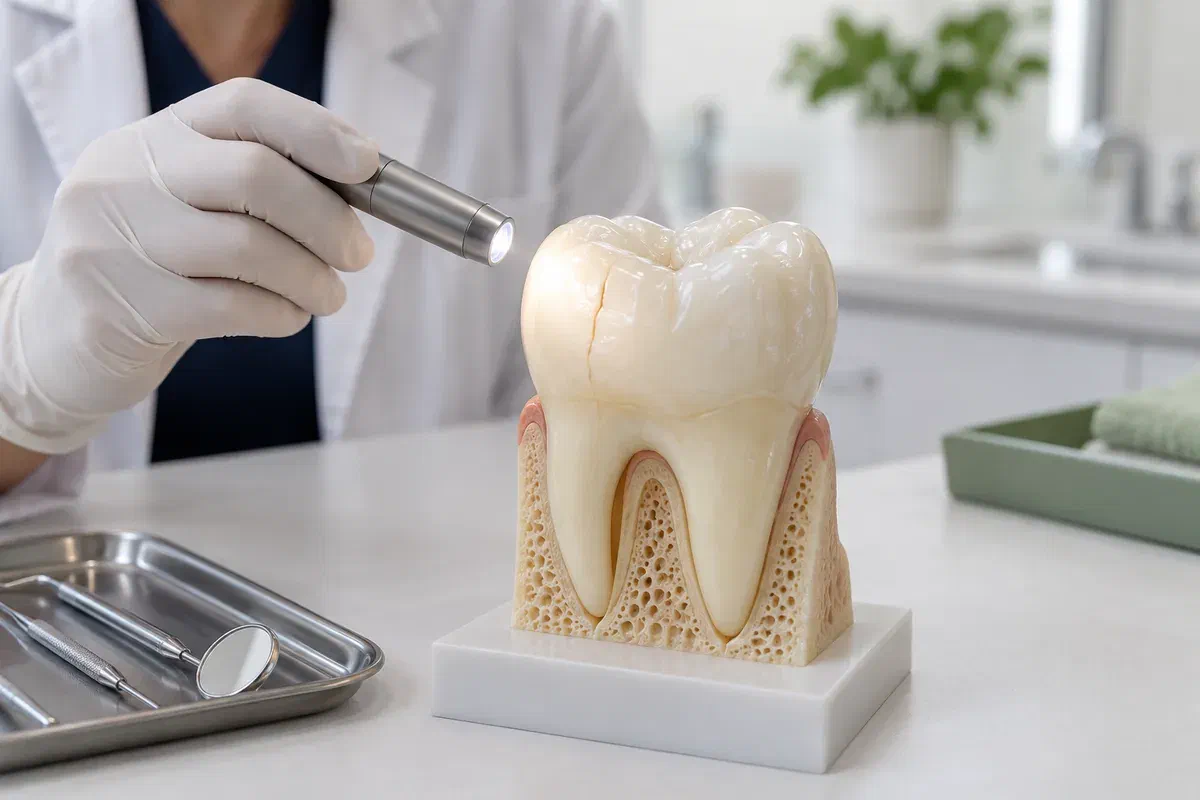
Illustrative tooth examination model with a fine visible crack
Signs around a restored tooth

Small changes in a familiar tooth

You know how your teeth normally feel, which makes your observations valuable. Describe what has shifted, even if it only happens with some foods or on some days.

Discomfort with one kind of chewing

Explain whether the twinge comes as you clamp down, as you open again, or only with crusty bread, nuts or similar foods. Note when it started and whether you now favour the other side. Several conditions can feel much the same.

A visible line near the filling

Fine lines often appear in enamel over the years and may be superficial. Their colour or length does not reveal how deep they go. The dentist looks at the line together with the restoration and any symptoms you report.

A chipped edge or lost fragment

If a piece has broken off, the edge feels sharp, or the area has grown sensitive, say so. Previous crowns, root treatment or repairs are part of the picture, and any records you can point us towards are useful.

If there is swelling, pain that is strong or building, a recent fall or blow, or a tooth that feels loose, call first. The team can then talk through how quickly you should come in.

What you gain from a proper look

Knowing where the problem sits

With a heavily restored tooth, the question is rarely just whether a crack exists. The assessment aims to show which part of the tooth, filling or gum is involved, whether the tooth still looks restorable, and what information is missing before care is recommended.

Some answers arrive on the day. Others need more investigation or a later review, and you should be told so directly. Being honest about uncertainty is more helpful than assuring you that a long-standing tooth can be kept before its condition is understood.

Looking past the obvious explanation

Soreness near an old filling may point to a crack, but it might also come from decay, the gum, or the bite. Considering each possibility keeps the recommendation tied to evidence rather than assumption.

Following the reasoning

Feel free to ask what each check is looking for and how its result could change the advice. Understanding the purpose makes the visit easier to follow and helps you report what you feel.

Clarity about what comes next

You may be advised to monitor, protect, investigate further or treat. Make sure you know the next step, the timeframe and which developments should prompt a call before the planned date.

Step by step

What happens in the chair?

Checks are chosen to suit the tooth and the symptom. If you worry about the pain being set off, mention it early so each step can be explained and you can agree how to pause.

  1. Your account of the tooth

    We go over when it started, what triggers it, the age of past restorations and any injury. Tell us whether the ache fades as soon as the trigger stops, and whether you have seen swelling or noticed your bite change.

  2. A careful examination

    The dentist inspects the tooth, the edges of any filling or crown, the gums and the teeth beside it. Further checks of biting, temperature response or the supporting tissues are chosen according to what is found.

  3. Extra information if it helps

    X-rays or other tests may be useful for related problems, although a hairline crack may not show on an image. Ask what any records reveal and whether a specialist opinion could resolve what remains unclear.

  4. A plain explanation of the results

    We set out the likely diagnosis, the open questions and the options available. If investigating under an old restoration is suggested, we explain why, what could be found and what it may mean, before you decide.

In the meantime

Protect the tooth and watch for change.

Guidance after the visit depends on the findings and on any temporary measure placed. Ask for advice specific to your tooth, especially while further tests or a referral are being arranged.

Spare it the hard foods

Biting on things just to see whether they hurt can strain a weakened tooth further. Let the dentist know what you already suspect, and ask how to manage meals until the next stage happens.

Note anything new

A short record of fresh swelling, an ache that lingers, or a shift from now-and-then to all the time is worth keeping. When symptoms clearly worsen, get in touch promptly rather than waiting to gather more detail.

Keep the review appointment

If the tooth settles down, ask whether the planned visit is still needed before you cancel. Feeling better does not tell us the tooth’s condition, and it does not replace the follow-up you agreed.

Possible outcomes

A restored tooth may need one of three routes.

The recommendation follows the findings. Ask what supports it, what is still unknown and how each alternative would affect the tooth and the restoration it already has.

When repair can safely wait

Monitoring with a planned check

A shallow line is managed differently from a crack that weakens the tooth. If watching is advised, ask what will be reviewed, when to come back and what should bring you in earlier.

When the tooth needs more support

Replacing or reinforcing the restoration

Where damage appears restorable, a new repair can be discussed. The remaining tooth structure and the position of the problem guide whether a filling or a fuller restoration such as a crown is considered.

When questions remain

Further tests or a specialist

Concerns reaching the nerve or root, or a diagnosis that stays unclear, may warrant extra assessment. Ask what the next clinician or test is meant to answer and how that will shape the plan.

Questions we hear

Asking early is always reasonable.

Noticing that a tooth feels different is reason enough to have it examined. These answers may help you get ready, without needing to diagnose anything yourself.

(905) 876-4488
Are teeth with large fillings more likely to crack?
A tooth with a big filling has less of its own structure left, which can make it more vulnerable under heavy biting forces. That does not mean every restored tooth will crack. The examination looks at your particular tooth and how it is behaving.
My filling is decades old. Does it need replacing just because of its age?
Age alone is not the deciding factor. What matters is the condition of the filling and the tooth around it. If replacement is suggested, ask what was found that supports it and what would happen if it were left for now.
Could the problem be the gum instead of the tooth?
It could. Gum inflammation or a problem in the supporting tissues can cause tenderness on biting that feels similar. The dentist checks the gums and surrounding area as well as the tooth itself so other explanations are not overlooked.
Is it worth mentioning that I chew ice or hard candy?
Yes. Habits such as chewing ice, pens or hard sweets add stress to teeth, and they are useful background for the dentist. Mentioning them is not about blame; it simply helps explain how the symptom might have developed.
The tooth has a crown. Can it still be cracked underneath?
It is possible for the tooth beneath a crown to have problems, though crowns can make some signs harder to see. Tell the dentist when the crown was placed and what has changed. Additional checks may be suggested if the cause is unclear.
What should I bring if earlier work was done at another office?
Any notes you have, the approximate date of the treatment and the name of the office are helpful. With your permission, the clinic can discuss requesting relevant records. The tooth will still be examined as it is today.
Old Milton cracked-tooth visits

Bring us the tooth that has changed.

From anywhere in Old Milton, book at our Bronte Street practice to discuss a sore bite, a rough edge on an old filling or a line you have noticed. We will look closely and explain what we find.

Where there is a recent injury, swelling, or pain that is severe or getting worse, please call instead of booking online so we can talk through your situation first.

Visit Milton Dental Clinic
Unit 1, 342 Bronte St. S, Milton, ON L9T 5B7
Get directions Clinic hours
Monday–Thursday
11am–7pm
Friday–Sunday
By appointment only

Areas we serve

  • Milton
  • Oakville
  • Mississauga
  • Georgetown
  • Halton Hills
  • Acton
  • Campbellville
  • Brampton
  • Burlington
  • Puslinch
  • Rockwood
  • Erin
  • Caledon
  • Etobicoke
  • Old Milton
  • Bronte Meadows
  • Timberlea
  • Dorset Park
  • Dempsey
  • Clarke
  • Beaty
  • Coates
  • Harrison
  • Scott
  • Willmott
  • Ford
  • Bowes
  • Cobden
  • Walker
  • Mountain View
  • Milton Heights
  • Hawthorne Village
  • Valley View
  • Fallingbrook
  • Nassagaweya
  • Trafalgar
  • Esquesing
  • Nelson
  • Brookville
  • Moffat
  • Glen Williams
  • Norval
  • Limehouse
  • Stewarttown
  • Ashgrove
  • Hornby
  • Silver Creek
  • Speyside
  • Scotch Block
  • North Oakville
  • River Oaks
  • Glen Abbey
  • West Oak Trails
  • Palermo
  • Bronte Creek
  • College Park
  • Joshua Creek
  • Uptown Core
  • Preserve
  • Iroquois Ridge
  • Lisgar
  • Meadowvale
  • Meadowvale Village
  • Churchill Meadows
  • Erin Mills
  • Central Erin Mills
  • Streetsville
  • East Credit
  • Creditview
  • Heartland
  • Sheridan
  • Mount Pleasant
  • Credit Valley
  • Huttonville
  • Churchville
  • Springbrook
  • Northwest Brampton
  • Bram West
  • Fletcher's Meadow
  • Fletcher's Creek South
  • Alton Village
  • Orchard
  • Millcroft
  • Headon Forest
  • Tansley
  • Brant Hills
  • Tyandaga
  • Kilbride
  • Lowville
  • Aberfoyle
  • Morriston
  • Arkell
  • Hillsburgh
  • Freelton
  • Carlisle
  • Waterdown
  • Flamborough
  • Mountsberg

How can we help?

Milton Dental Clinic

Have a question about your smile? Choose the option that works best for you.

For urgent dental concerns, please call.
Messages are reviewed during clinic hours.