

Illustrative conversation about treatment options for a cracked tooth
Restorative Dentistry

Cracked Tooth Treatment

Explore cracked-tooth treatment in Milton with a clear explanation of the findings and realistic repair options. The position of the crack, the remaining tooth, and the health of the pulp guide the next step.

A closer look at cracked-tooth treatment

Choose the repair around the tooth that remains.

Treating a cracked tooth begins with understanding the damage. A small fractured area, a deeper crack through the tooth, and a fracture involving the root can have very different implications. The treatment recommendation needs to reflect those differences rather than treat every crack as the same problem.

A suitable plan may aim to restore a damaged area, protect vulnerable tooth structure, address a problem inside the tooth, or discuss removal when the tooth cannot be predictably restored. Sometimes the full extent becomes clearer only during further investigation. That possibility should be part of the conversation before care begins.

At Milton Dental Clinic, we want you to understand what a proposed treatment is intended to accomplish and what it cannot guarantee. Bring your questions about comfort, timing, cost, and alternatives. A decision about a cracked tooth is easier to make when the findings and the limits of treatment are explained together.

Discuss treatment for a cracked tooth
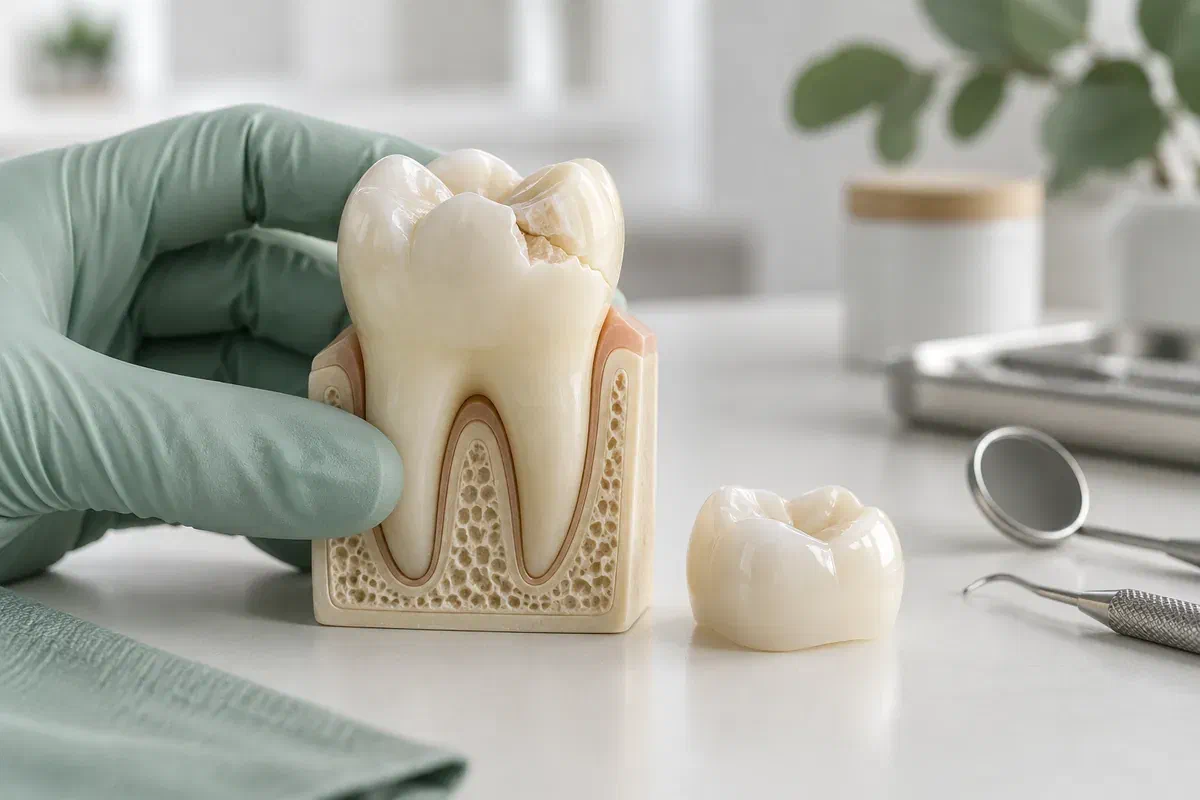
Illustrative tooth model and crown showing a restorative treatment concept
What shapes the recommendation

The location and depth matter more than the label.

The word crack can describe several different findings. Your dentist considers the remaining structure, the supporting tissues, and the condition of the inside of the tooth before discussing a suitable approach.

A weakened section of the chewing surface

Damage around a cusp or an existing restoration may leave part of the tooth vulnerable. The discussion should address whether a localized repair can work or whether broader support is needed for the tooth to function.

Symptoms involving the inside of the tooth

Pain, sensitivity, and clinical tests help assess the pulp, which contains the tooth’s nerves and blood vessels. If that tissue needs treatment, simply covering the outer surface may not address the whole problem.

Damage that limits restorability

Some fractures leave too little suitable structure or extend into areas that make a lasting repair unlikely. Ask the dentist to explain which findings affect the outlook and whether another opinion would be useful before a major decision.

A tooth can remain uncertain even after a careful assessment. Ask how new findings during treatment would change the plan and when you would be consulted before further care.

What treatment is trying to achieve

Protect useful structure and set realistic expectations.

When a tooth can be retained, treatment may rebuild a damaged area and provide support appropriate to the remaining structure. If the pulp is affected, the plan may also include treatment inside the tooth. These are related goals, but they are not the same procedure.

A crack does not mend in the way a broken bone can. Even a carefully selected restoration cannot promise that a crack will never progress. Understanding that limitation helps you weigh the expected benefit against the uncertainty and the possible need for future care.

Patient information: American Association of Endodontists — cracked teeth

A reason for each treatment stage

Ask which part of the problem each recommendation addresses. You should be able to distinguish a temporary measure, treatment of the pulp, and the final restoration rather than seeing them as interchangeable repairs.

An opportunity to retain a suitable tooth

Where the findings support restoration, preserving the tooth may be worth considering. The recommendation should also explain why retention is reasonable and which factors make the outcome less certain.

A plan for changes after treatment

Review appointments and clear contact instructions help you respond if symptoms return or the bite changes. Knowing what to report is part of the care plan, even when the tooth initially feels comfortable.

From findings to treatment

Agree on the sequence before moving ahead.

Some teeth need a straightforward restorative appointment; others need staged care or specialist input. Ask how the proposed sequence relates to the diagnosis and what the tooth will need between appointments.

  1. Confirm the findings and discuss the outlook

    Review the assessment, symptoms, and available records. The dentist explains what is known about the crack, whether the tooth appears restorable, and any uncertainty that may affect the recommendation.

  2. Compare suitable options and give consent

    Discuss the purpose, limitations, expected stages, and costs of the available approaches. If additional findings might change the plan, clarify how that would be handled and which decisions may need to be revisited.

  3. Provide the agreed treatment

    Care may involve a repair, a protective restoration, treatment of the pulp, or another clinically appropriate step. The team explains comfort measures and how the tooth will be managed if a temporary restoration is needed.

  4. Check function and arrange review

    The completed or temporary restoration is assessed, and you receive instructions for the next stage. Ask when normal use is appropriate, what symptoms need a call, and whether further restorative or specialist appointments remain.

Looking after a treated crack

Comfort is useful feedback, but follow-up still matters.

Your instructions depend on the treatment performed and whether the final restoration is complete. Keep the written advice and contact details available, particularly when care involves more than one appointment or clinician.

Respect the temporary stage

If the tooth has a temporary repair, ask about chewing and cleaning around it. A temporary arrangement may not provide the same function as the final restoration. Report looseness or breakage instead of waiting silently for the next scheduled visit.

Report a bite that feels different

Tell the team if the treated tooth seems to contact first, feels uncomfortable during ordinary chewing, or develops new symptoms. Do not try to wear down a high-feeling area by repeatedly biting on it.

Discuss habits that load the tooth

Mention grinding, clenching, or repeated chewing on hard objects. The dentist can discuss whether a protective appliance or another measure is appropriate, while explaining that protection cannot guarantee a crack will never worsen.

Choosing an appropriate repair

The tooth’s condition sets the limits of the choice.

A recommendation should explain both what can be achieved and what remains uncertain. Ask how each option fits the location of the damage, the remaining structure, and the health of the pulp.

When the damaged tooth can be restored

A filling or protective restoration

A localized defect may suit a filling, while a weakened tooth may need a crown or partial-coverage restoration. The design should reflect the support required and the amount of useful tooth that remains.

When the inside also needs care

Pulp treatment and a final restoration

Root canal treatment may be considered when the pulp diagnosis warrants it and the tooth remains restorable. It addresses the tissue inside the tooth; an appropriate final restoration still needs to be planned separately.

When retention is not a suitable choice

Removal and replacement planning

A tooth with an unfavourable fracture may need extraction. Ask why repair is unlikely to be useful and discuss the consequences of the gap, replacement choices, and any timing considerations before proceeding where circumstances allow.

Questions about treating a crack

Understand the benefit and the uncertainty together.

The best questions are often about what happens after the immediate repair. Discuss the expected sequence, the possible changes to the plan, and how the tooth will be reviewed over time.

(905) 876-4488
Does placing a crown guarantee that a crack will stop spreading?
No. A crown may provide useful protection for a suitable tooth, but it cannot guarantee that an existing crack will remain unchanged. Ask why the tooth is considered worth restoring, what affects its outlook, and which symptoms should prompt a review after the crown is fitted.
Why might root canal treatment be discussed for a cracked tooth?
The crack may be associated with a pulp problem that needs treatment inside the tooth. That decision depends on the diagnosis, not simply the presence of a line. The dentist also needs to assess whether enough suitable structure remains to restore the tooth afterwards.
Can treatment begin before the full depth of a crack is known?
In some cases, further investigation or an initial protective step may be proposed while uncertainty remains. Ask what is known, what the next step may reveal, and how an unfavourable finding would change the plan. You should understand those possibilities before agreeing to staged care.
Why is a temporary restoration sometimes used during cracked-tooth care?
A temporary restoration may be part of an investigation or staged treatment sequence. Its purpose varies, so ask what it is doing in your case and how long it is intended to remain. Also clarify eating precautions and what to do if it loosens or breaks.
If a cracked tooth cannot be saved, do I have to choose an implant?
No. Replacement decisions are separate from the decision to remove an unrestorable tooth. Depending on the location and your mouth, a bridge, removable appliance, implant, or another approach may be discussed. Ask about suitability, timing, maintenance, and the implications of leaving the space.
Can I request a specialist opinion before committing to cracked-tooth treatment?
Yes. Discuss whether a specialist assessment could help clarify the diagnosis or options, particularly when the outlook is uncertain. Ask how urgent the concern is and what to do while waiting. A further opinion may provide useful information, although it cannot remove every uncertainty.
Cracked tooth treatment in Milton

Let’s discuss a plan that fits the findings.

Visit our Bronte Street clinic to review the condition of the tooth and the available approaches. We can explain the purpose of the recommended care, discuss alternatives, and help you understand the next stage before treatment proceeds.

Call for advice about appointment availability if you have significant pain, swelling, or a new break. Online enquiries are intended for non-urgent requests.

Visit Milton Dental Clinic
Unit 1, 342 Bronte St. S, Milton, ON L9T 5B7
Get directions Clinic hours
Monday–Thursday
11am–7pm
Friday–Sunday
By appointment only

How can we help?

Milton Dental Clinic

Have a question about your smile? Choose the option that works best for you.

For urgent dental concerns, please call.
Messages are reviewed during clinic hours.