

Illustrative conversation about treatment options for a cracked tooth
Restorative Dentistry

Cracked Tooth Treatment in Campbellville

One unpopped kernel or a crunch on ice can be enough to crack a tooth. From Campbellville, you can have the damage assessed, hear what repair is realistic and learn how to lower the risk of another crack.

One hard bite

The popcorn kernel that found a weak spot

Movie night, a bowl of popcorn and one kernel that refused to pop. Biting on it produces a jolt, and from then on a particular back tooth protests every so often. Ice cubes, hard candy, olive pits and the occasional bone in a meal can do the same thing, especially to a tooth already weakened by a filling or by years of heavy chewing.

What a single hard bite leaves behind varies. The damage may be a small crack in one cusp, a fracture extending toward the middle of the tooth, or, less often, something reaching the root. Those situations lead to different treatment discussions, and the full depth may not be obvious until the tooth is examined closely or partly prepared.

Our job is to show you what we find, explain what is still uncertain and describe what each option is designed to achieve. Ask anything about comfort, timing, fees or alternatives. Afterwards, we can talk about the habits that put teeth at risk, because preventing the next crack matters too.

Book a check after a hard bite
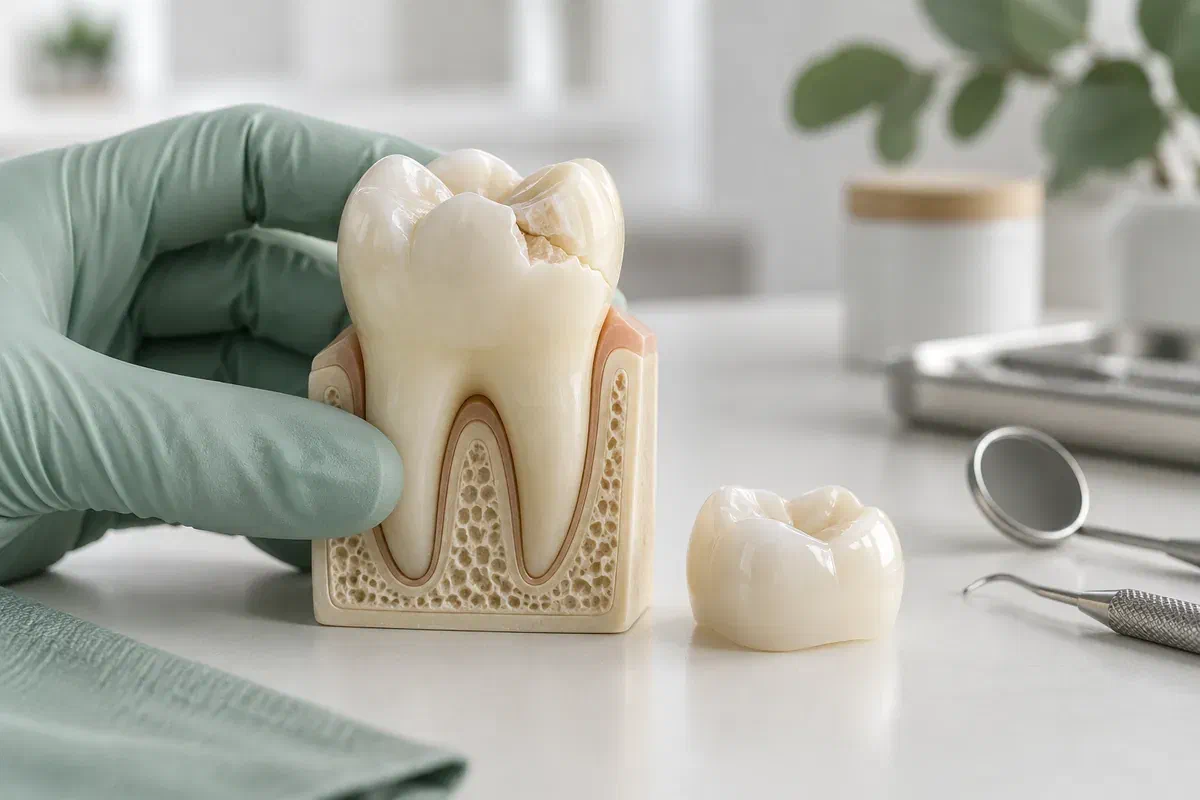
Illustrative tooth model and crown showing a restorative treatment concept
Looking at a Campbellville tooth

Not every crack carries the same risk

A crack can be trivial or serious. The dentist considers how much healthy tooth surrounds the damage, whether the pulp has been affected and how deep the fracture runs, then suggests a sensible approach.

A cusp weakened by the impact

Biting on something hard often cracks the pointed corner of a back tooth. The dentist decides whether that area can be repaired on its own or whether the tooth needs a restoration covering its chewing surface for support.

Irritation deeper inside

Pain that lingers, sensitivity to temperature and simple tests help show whether the pulp, the soft core of the tooth, has been affected. If so, patching the outer surface would not deal with the whole issue.

A fracture that may not be fixable

Occasionally the crack splits the tooth or runs below the gum and bone, which makes a lasting repair unlikely. Ask what leads to that conclusion and whether a specialist’s assessment would help you decide.

Some findings only become clear partway through treatment. Ask how the plan would adjust if more damage appears, and at what point we would pause to talk it over with you.

Goals of repair

Restore the bite and reduce the next risk

If the tooth can be kept, treatment rebuilds the cracked section and supports the rest according to how strong it is. Where the pulp is involved, root canal treatment may be part of the plan. Prevention is the third piece: understanding what caused the crack helps protect this tooth and its neighbours.

A tooth will not grow back together after cracking. A well-planned restoration can protect it, but cannot guarantee the crack won’t creep further, particularly if the same hard-biting habits continue. That limitation is worth weighing alongside the benefit of keeping the tooth.

Patient information: American Association of Endodontists — cracked teeth

Knowing what each step does

Ask which part of the problem each appointment tackles. A temporary, care inside the tooth and the final restoration are separate jobs, even when they happen close together.

A tooth kept in working order

When the findings are positive, retaining the tooth may be well worth it. The dentist should explain why and which factors leave the long-term result uncertain.

Practical prevention advice

Alongside review visits and clear contact instructions, you’ll hear which foods and habits tend to crack teeth. That knowledge helps protect the repair and the rest of your smile.

The steps involved

Examine, plan, repair, review

Some cracks are fixed in one visit; others need stages or a referral. Ask how the order fits the diagnosis, whether visits can be grouped with other household appointments, and how to treat the tooth in between.

  1. Find the crack and explain it

    We review what happened, examine the tooth and take any images that would help. The dentist explains where the damage seems to run, whether the tooth looks repairable and what isn’t yet known.

  2. Talk through options and agree

    Each reasonable approach is described with its purpose, limits, stages and fees. We also discuss how a surprise finding would change things and which choices might need to be made again later.

  3. Repair the tooth

    The work may be a bonded filling, an onlay or crown, root canal care, or a combination. We explain how you’ll be kept comfortable and, if a temporary is used, what it can and can’t handle.

  4. Confirm comfort and plan ahead

    We check how the tooth meets its neighbours and outline the next steps. Ask when you can eat normally, what symptoms should prompt a call and whether more visits are planned.

Protecting the repair

A comfortable tooth, still worth checking

Aftercare depends on what was done and whether the final restoration is in place. Keep the written instructions and the clinic’s number on hand, especially if treatment spans several visits.

Spare the temporary

Temporary restorations are not built for hard or sticky food. Chew on the opposite side, avoid popcorn, nuts and toffee for now, and clean gently around it. Phone us if it loosens or chips.

Notice a bite that feels off

Tell the team if the tooth meets the others first, aches with ordinary food or begins to feel different. Please don’t bite down hard on it repeatedly to try to level a high spot.

Rethink the hard-biting habits

Chewing ice, cracking nuts or pits with your teeth, and clenching all strain teeth. The dentist can suggest simple changes or a night guard, while being clear that protection lowers the risk but can’t eliminate it.

Choosing a repair

Options set by the damage, not by habit

Each choice brings benefits and limits. Ask how it suits the position of the crack, the amount of strong tooth left and the pulp’s health before deciding.

When rebuilding can work

Bonded filling, onlay or crown

A small, contained crack may be rebuilt with a bonded filling. A tooth with a cracked or weakened cusp may need an onlay or crown that caps the biting surface and distributes force.

Where the pulp has been affected

Root canal care with a final restoration

Root canal treatment may be advised when testing shows the pulp needs it and enough tooth remains to rebuild. It treats the inside; a protective final restoration is still planned separately.

When saving it isn’t sensible

Extraction with replacement planning

Some fractures leave a tooth that cannot be reliably kept. Ask why a repair is unlikely to hold up, what a gap could mean for chewing and nearby teeth, and which replacement paths and timings are open to you.

Campbellville questions

Hard foods, cracked teeth and prevention

People often want to know what caused the crack as much as how to fix it. These answers are general; your examination will shape the details for your tooth.

(905) 876-4488
Which everyday habits are most likely to crack a tooth?
Chewing ice, biting on unpopped popcorn kernels, hard candy, pits or bones, opening packages with your teeth, and clenching or grinding are common culprits. Teeth with large fillings are especially vulnerable to these forces.
How can I lower the chance of cracking another tooth?
Avoid using your teeth as tools, cut back on chewing ice and very hard foods, and mention any grinding to the dentist. Regular checkups help spot weakened teeth early. A night guard or sports mouthguard may be suggested where appropriate.
Can other family members’ checkups be booked around my visits?
Often, yes. Ask the front desk whether appointments for others in your household can be scheduled on the same day as your treatment or review, which can reduce the number of separate trips.
Why do back teeth crack more often than front teeth?
Molars and premolars take most of the force when you chew and grind, and their cusps can be wedged apart by hard food. They also tend to have larger fillings, which can leave thinner walls.
Does an onlay protect a cracked tooth as well as a crown?
An onlay covers and supports the cusps while keeping more natural tooth than a full crown. Whether it is suitable depends on where the crack runs and how much tooth is affected. Ask why one design is suggested over the other.
What makes a cracked tooth impossible to save?
A crack that splits the tooth into separate parts, runs deep into the root, or leaves too little sound structure may rule out a lasting repair. The dentist should explain the specific findings and discuss replacement options.
Booking from Campbellville

Let us check the tooth that took the hit

Visit our Bronte Street practice and we’ll examine the cracked tooth, explain what we find and go through the realistic options. We can also talk about simple ways to protect your teeth from the next hard bite.

Please call the clinic if you have severe pain, swelling or a piece of tooth has broken away, and we’ll advise on timing. Online forms suit non-urgent requests.

Visit Milton Dental Clinic
Unit 1, 342 Bronte St. S, Milton, ON L9T 5B7
Get directions Clinic hours
Monday–Thursday
11am–7pm
Friday–Sunday
By appointment only

Areas we serve

  • Milton
  • Oakville
  • Mississauga
  • Georgetown
  • Halton Hills
  • Acton
  • Campbellville
  • Brampton
  • Burlington
  • Puslinch
  • Rockwood
  • Erin
  • Caledon
  • Etobicoke
  • Old Milton
  • Bronte Meadows
  • Timberlea
  • Dorset Park
  • Dempsey
  • Clarke
  • Beaty
  • Coates
  • Harrison
  • Scott
  • Willmott
  • Ford
  • Bowes
  • Cobden
  • Walker
  • Mountain View
  • Milton Heights
  • Hawthorne Village
  • Valley View
  • Fallingbrook
  • Nassagaweya
  • Trafalgar
  • Esquesing
  • Nelson
  • Brookville
  • Moffat
  • Glen Williams
  • Norval
  • Limehouse
  • Stewarttown
  • Ashgrove
  • Hornby
  • Silver Creek
  • Speyside
  • Scotch Block
  • North Oakville
  • River Oaks
  • Glen Abbey
  • West Oak Trails
  • Palermo
  • Bronte Creek
  • College Park
  • Joshua Creek
  • Uptown Core
  • Preserve
  • Iroquois Ridge
  • Lisgar
  • Meadowvale
  • Meadowvale Village
  • Churchill Meadows
  • Erin Mills
  • Central Erin Mills
  • Streetsville
  • East Credit
  • Creditview
  • Heartland
  • Sheridan
  • Mount Pleasant
  • Credit Valley
  • Huttonville
  • Churchville
  • Springbrook
  • Northwest Brampton
  • Bram West
  • Fletcher's Meadow
  • Fletcher's Creek South
  • Alton Village
  • Orchard
  • Millcroft
  • Headon Forest
  • Tansley
  • Brant Hills
  • Tyandaga
  • Kilbride
  • Lowville
  • Aberfoyle
  • Morriston
  • Arkell
  • Hillsburgh
  • Freelton
  • Carlisle
  • Waterdown
  • Flamborough
  • Mountsberg

How can we help?

Milton Dental Clinic

Have a question about your smile? Choose the option that works best for you.

For urgent dental concerns, please call.
Messages are reviewed during clinic hours.