

Illustrative conversation about treatment options for a cracked tooth
Restorative Dentistry

Cracked Tooth Treatment in Milton

A sharp zing when you bite, then nothing once you let go, is a common sign of a cracked tooth. In Milton, we look closely at where the crack runs and how the tooth is coping before suggesting any repair.

When biting brings a jolt

That sharp, fleeting pain deserves a proper look

Many people describe the same moment: chewing a crust of bread or a handful of nuts, a quick electric pain, then calm again as soon as the jaw relaxes. Pain on release like this often comes from a crack flexing under pressure. It is easy to dismiss because it comes and goes, yet the tooth is telling you something.

A crack is not one single diagnosis. It might affect only a corner of the chewing surface, run deeper toward the centre of the tooth, or reach the root. Each of those calls for a different conversation, and sometimes the true extent only becomes clear once an old filling is removed or the tooth is examined more closely.

Our aim in Milton is to explain what we can see, what remains uncertain and what each option is meant to do. Ask about comfort, timing, fees and alternatives as we go. You should leave knowing why a repair is suggested and where its limits lie, not just what it is called.

Ask about a tooth that hurts on biting
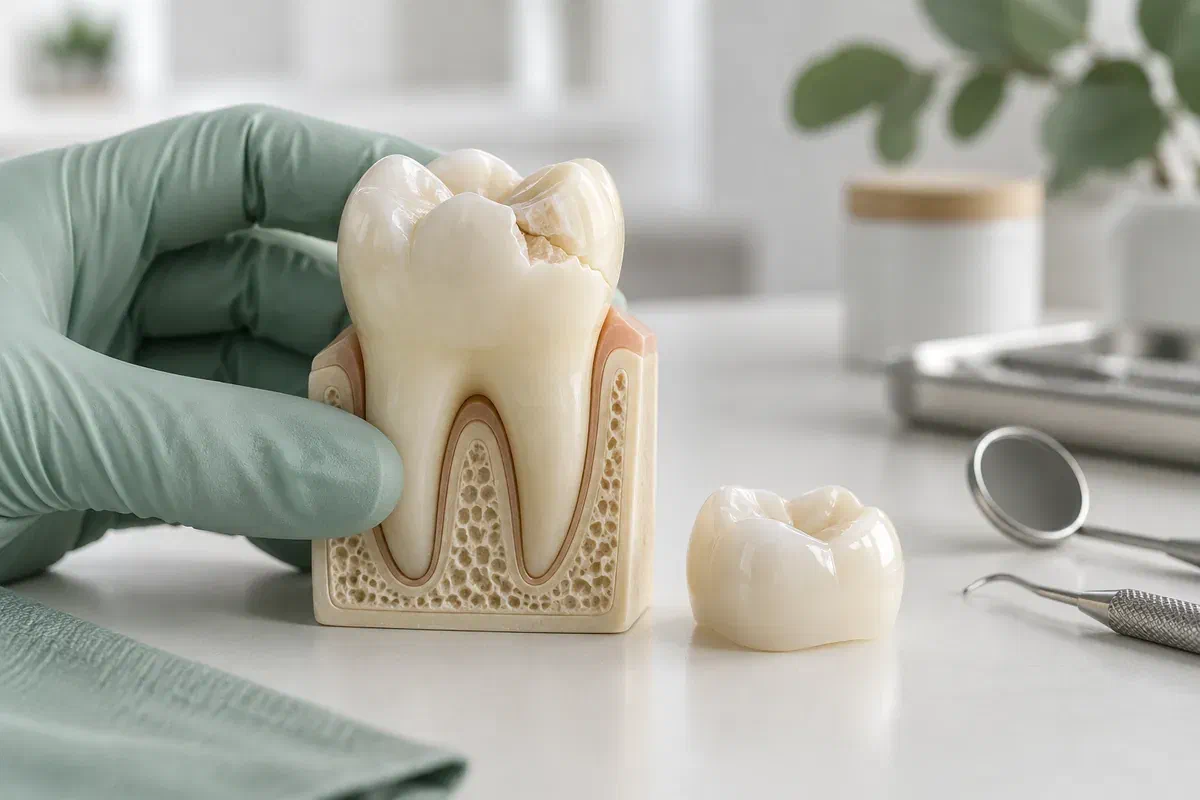
Illustrative tooth model and crown showing a restorative treatment concept
Reading the crack

Three findings steer the plan

Two cracked teeth can look alike and need very different care. Before recommending anything, the dentist weighs how much sound tooth is left, whether the nerve and blood supply are affected and how far the damage has travelled.

A cusp that has been weakened

The pointed corners of back teeth take heavy loads, especially next to large fillings. When one is cracked, the question is whether a contained repair can hold or whether the whole biting surface needs to be covered and supported.

Signs that the pulp is involved

Lingering ache, sensitivity to hot or cold, and the results of simple tests help show whether the soft tissue inside the tooth is irritated or damaged. If it is, sealing the outside alone may leave the real source of discomfort untreated.

A crack that runs too far

Occasionally a fracture splits the tooth or extends below the gum and bone, where a reliable repair is unlikely. The dentist should explain which findings point that way, and you are welcome to ask whether a specialist view would help.

Even after careful testing, some cracks keep their secrets. Ask how the plan would change if something new appears during treatment, and when we would stop to check with you first.

What a good repair can do

Keep the sound tooth working, without overpromising

If the tooth can be kept, treatment usually rebuilds the damaged part and adds the amount of support the remaining structure needs. Where the pulp is inflamed or infected, care inside the tooth may come first. Both goals can belong to one plan, but they are separate steps with separate purposes.

Unlike a broken bone, a cracked tooth does not knit back together. A well-chosen filling or crown can reduce flexing and protect the tooth, but nothing can guarantee the crack will never travel further. Keeping that in mind makes it easier to judge whether a given treatment is worth it for you.

Patient information: American Association of Endodontists — cracked teeth

Clarity about each step

You should be able to tell which appointment deals with the crack, which deals with the pulp and which places the final restoration. Ask whenever two steps start to sound like the same thing.

A fair chance to keep a useful tooth

When the findings are favourable, saving your own tooth may be a sensible choice. The dentist should explain why retention seems reasonable and which factors make the outlook less predictable.

A plan for what comes after

Review visits and clear instructions mean you know what to watch for if pain returns or your bite shifts. Feeling fine right after treatment is welcome, but it does not replace follow-up.

How care unfolds

Each step, agreed in order

Some cracks are repaired in a single visit. Others need staged treatment or a referral. Before starting, ask how the sequence fits the diagnosis and how the tooth should be treated in between appointments.

  1. Review what has been found

    We go over the examination, your symptoms and any images taken. The dentist explains where the crack seems to run, whether the tooth looks restorable and what is still uncertain.

  2. Weigh the options together

    You hear the aim, limits, likely stages and fees of each reasonable approach. We also agree how an unexpected finding would be handled and which decisions might need to be made again.

  3. Carry out the chosen treatment

    Depending on the tooth, this may be a filling, a crown or partial crown, care for the pulp, or another appropriate step. The team explains how you will be kept comfortable and how any temporary will be looked after.

  4. Check the bite and plan review

    We check how the tooth meets its neighbours and explain the next stage. Ask when you can chew normally again, which symptoms mean you should call and whether more appointments are still to come.

After the repair

Feeling better is good news, and follow-up still counts

Aftercare depends on what was done and whether the final restoration is already in place. Keep your written instructions and our number handy, especially if more than one appointment or clinician is involved.

Treat a temporary gently

A temporary filling or crown is not built to handle the same forces as the final one. Ask what to avoid chewing and how to floss around it. If it loosens or chips, call us instead of waiting for the next booked visit.

Notice how the tooth meets the others

Let us know if the treated tooth hits first, aches when you chew ordinary food or starts to feel different. Please don’t try to grind a high spot down yourself by biting on it over and over.

Talk about grinding and hard foods

Clenching, night grinding, chewing ice or cracking hard candy all load teeth heavily. The dentist can discuss whether a night guard or other step makes sense, while being honest that protection lowers risk rather than removing it.

Matching the repair to the tooth

What is possible depends on what remains

Every option comes with benefits and limits. Ask how each one fits the position of the crack, the amount of healthy tooth left and the condition of the pulp before you decide.

When the tooth can be rebuilt

Filling, onlay or crown

A small, contained defect may be managed with a filling. A tooth with weakened walls may do better with an onlay or full crown that covers and braces the biting surface, depending on how much support it needs.

Where the pulp is affected

Root canal treatment, then a restoration

When testing shows the pulp needs care and the tooth can still be restored, root canal treatment may be suggested. It treats the inside of the tooth, so a suitable final restoration is still planned as its own step.

If keeping it won’t work

Extraction and a replacement plan

If the fracture is unfavourable, removing the tooth may be the sensible choice. Ask why a repair is unlikely to last, what happens if the space is left and which replacement options and timings are worth considering.

Common questions in Milton

Straight answers about cracked teeth

People often wonder about the signs, the timing and what happens after the first repair. These answers cover the basics, and your own findings will shape the details.

(905) 876-4488
Why does my tooth only hurt when I stop biting?
Pain on release is a typical pattern with cracks. Biting can push the two sides of the crack apart slightly, and letting go allows them to snap back, which irritates the inside of the tooth. Other problems can feel similar, so an examination is the way to find out.
Will an X-ray show the crack?
Not always. Many cracks run in a direction that X-rays cannot capture clearly. The dentist may also use magnification, a bite test, a special light or a dye, and look at any existing filling. Sometimes the crack is only fully visible once treatment begins.
Is a crown a promise that the crack won’t get worse?
No. A crown can brace a suitable tooth and reduce flexing, but it cannot guarantee that an existing crack will stay where it is. Ask why the tooth seems worth restoring and which signs after the crown should bring you back.
Should I chew on the other side until my appointment?
Favouring the other side and avoiding very hard or sticky foods can reduce strain on a suspected crack while you wait. It is a short-term measure, though, not a fix. Call sooner if pain becomes constant, swelling appears or a piece breaks away.
Does a cracked tooth always need a root canal?
No. Root canal treatment is considered when the pulp is diagnosed as needing it, not simply because a crack is present. Many cracked teeth are restored without it. The dentist will also check that enough tooth remains to rebuild afterwards.
Should the tooth need removing, what are my choices?
Removing the tooth and replacing it are separate decisions. Depending on the area, a bridge, a removable option, an implant or leaving the space may be discussed. Ask about suitability, timing, upkeep and what an empty space could mean for neighbouring teeth.
Book in Milton

Bring us the tooth that’s been bothering you

Come to our Bronte Street practice and we’ll examine the tooth, explain what we find and walk through the reasonable options. You’ll know the purpose of each step and what comes next before any treatment begins.

If you have strong pain, swelling or a fresh break, please phone the clinic so we can advise on availability. Online requests are best for non-urgent concerns.

Visit Milton Dental Clinic
Unit 1, 342 Bronte St. S, Milton, ON L9T 5B7
Get directions Clinic hours
Monday–Thursday
11am–7pm
Friday–Sunday
By appointment only

Areas we serve

  • Milton
  • Oakville
  • Mississauga
  • Georgetown
  • Halton Hills
  • Acton
  • Campbellville
  • Brampton
  • Burlington
  • Puslinch
  • Rockwood
  • Erin
  • Caledon
  • Etobicoke
  • Old Milton
  • Bronte Meadows
  • Timberlea
  • Dorset Park
  • Dempsey
  • Clarke
  • Beaty
  • Coates
  • Harrison
  • Scott
  • Willmott
  • Ford
  • Bowes
  • Cobden
  • Walker
  • Mountain View
  • Milton Heights
  • Hawthorne Village
  • Valley View
  • Fallingbrook
  • Nassagaweya
  • Trafalgar
  • Esquesing
  • Nelson
  • Brookville
  • Moffat
  • Glen Williams
  • Norval
  • Limehouse
  • Stewarttown
  • Ashgrove
  • Hornby
  • Silver Creek
  • Speyside
  • Scotch Block
  • North Oakville
  • River Oaks
  • Glen Abbey
  • West Oak Trails
  • Palermo
  • Bronte Creek
  • College Park
  • Joshua Creek
  • Uptown Core
  • Preserve
  • Iroquois Ridge
  • Lisgar
  • Meadowvale
  • Meadowvale Village
  • Churchill Meadows
  • Erin Mills
  • Central Erin Mills
  • Streetsville
  • East Credit
  • Creditview
  • Heartland
  • Sheridan
  • Mount Pleasant
  • Credit Valley
  • Huttonville
  • Churchville
  • Springbrook
  • Northwest Brampton
  • Bram West
  • Fletcher's Meadow
  • Fletcher's Creek South
  • Alton Village
  • Orchard
  • Millcroft
  • Headon Forest
  • Tansley
  • Brant Hills
  • Tyandaga
  • Kilbride
  • Lowville
  • Aberfoyle
  • Morriston
  • Arkell
  • Hillsburgh
  • Freelton
  • Carlisle
  • Waterdown
  • Flamborough
  • Mountsberg

How can we help?

Milton Dental Clinic

Have a question about your smile? Choose the option that works best for you.

For urgent dental concerns, please call.
Messages are reviewed during clinic hours.