

Illustrative conversation about treatment options for a cracked tooth
Restorative Dentistry

Cracked Tooth Treatment in Oakville

A tooth that only hurts now and then is easy to put off. For people coming from Oakville, we help you decide whether to act now or monitor, based on where the crack runs and how the tooth is responding.

Treat now or wait?

An on-and-off ache, and a decision to make

Intermittent pain is one of the hardest symptoms to act on. The tooth feels fine for days, then a certain bite or a cold drink brings a brief, sharp reminder. People often wonder whether it is worth treating something that barely bothers them, or whether waiting could make the eventual repair bigger.

The honest answer depends on the crack itself. A shallow fracture near one cusp behaves very differently from one heading toward the pulp or the root. Some cracks can reasonably be watched; others are more likely to progress with continued chewing. Part of the picture may stay hidden until the tooth is opened up or examined under magnification.

We would rather you make that call with clear information than under pressure. Ask us about comfort, timing, costs and the alternatives, including monitoring. Our job is to explain what each option is meant to do, what it cannot promise, and what signs would change the advice.

Talk through a tooth that hurts sometimes
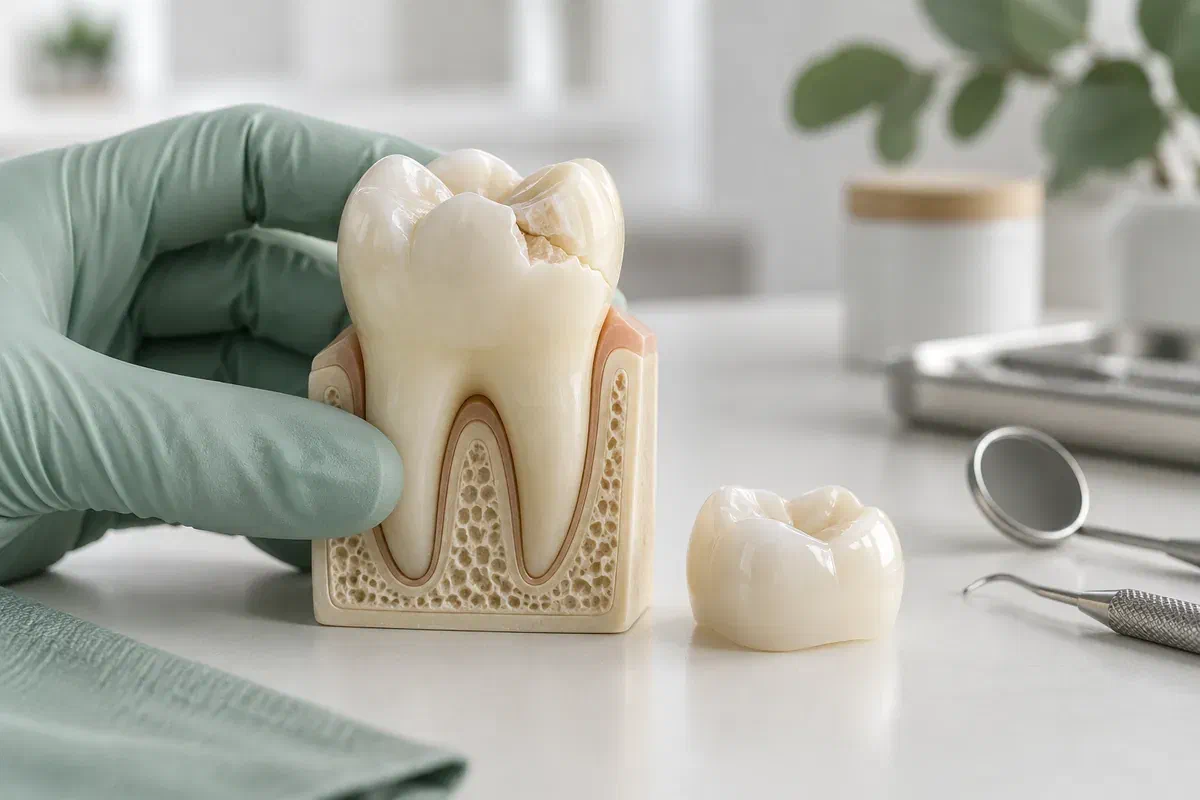
Illustrative tooth model and crown showing a restorative treatment concept
What tips the balance

Where the crack sits changes everything

Before suggesting treatment or a wait-and-see approach, the dentist considers how much strong tooth surrounds the crack, the health of the pulp and how deep the damage appears to reach.

A cusp that may be about to break

A cracked corner on a back tooth, especially one beside a large filling, may eventually snap off. Covering it early with a suitable restoration can sometimes keep the damage smaller than waiting for it to fracture on its own.

A pulp that is starting to react

Pain that lingers after hot or cold, or aching that arrives without a trigger, can suggest the inner tissue is involved. Test results help show whether an outer repair would be enough or whether care inside the tooth is needed too.

Findings that change the outlook

A fracture that reaches below the gumline or splits the tooth may leave little to work with. The dentist should explain which findings lower the chance of a lasting repair and whether a specialist assessment could clarify things.

Monitoring is a plan too, not a dismissal. Ask what you should watch for, how often the tooth should be reviewed and which changes mean it is time to revisit treatment.

Why treatment is offered

Limit the damage while the tooth is still repairable

When a cracked tooth is worth keeping, treatment generally restores the damaged area and provides support matched to the remaining structure. If the pulp has been affected, the plan may include root canal treatment as well. Those are linked aims, yet they address different parts of the problem.

No restoration can make a crack disappear, because teeth do not repair fractures the way bone does. Treatment can reduce flexing and protect what remains, but it cannot guarantee the crack will never extend. Weighing that limit against the possible benefit is the core of the decision.

Patient information: American Association of Endodontists — cracked teeth

A rationale you can follow

For each proposed step, ask what it is meant to solve. A temporary measure, pulp treatment and a final crown or onlay each play their own role and are not simply different versions of one fix.

A realistic chance to keep the tooth

Where the evidence supports it, saving the tooth may well be worthwhile. The dentist should explain what makes retention sensible in your case and which factors leave the result less certain.

Guidance for after the visit

Follow-up appointments and clear contact advice help you respond quickly if pain returns or the bite changes. Knowing what to report is part of treatment, even when everything feels comfortable at first.

Steps from assessment to repair

Map out the sequence, then begin

Some cracked teeth are treated in one appointment, while others need several stages or a referral. Ask how the proposed order fits the diagnosis and how to look after the tooth between visits.

  1. Discuss the examination results

    The dentist goes through your symptoms, the clinical findings and any images. You will hear what is known about the crack, whether the tooth appears restorable and which questions are still open.

  2. Compare treatment with monitoring

    Each reasonable path, including watching the tooth, is explained with its purpose, limits, stages and costs. We also agree how an unexpected finding would be handled once work begins.

  3. Proceed with the agreed care

    Treatment might be a filling, an onlay or crown, root canal treatment or another suitable step. The team explains how comfort will be managed and how any temporary restoration should be treated.

  4. Review the bite and the plan

    We check how the tooth now meets the others and explain what happens next. Ask when ordinary chewing is fine, which symptoms deserve a call and whether further appointments are expected.

Once the tooth is treated

Keep an eye on it, even when it feels fine

Aftercare instructions vary with the treatment and with whether the final restoration is in place. Keep the written guidance and our contact details close, particularly when care spans more than one visit.

Protect a temporary restoration

A temporary crown or filling is designed for short-term use. Ask which foods to avoid and how to clean around it. If it feels loose or breaks, contact the clinic instead of waiting quietly for your next appointment.

Speak up about bite changes

Tell us if the tooth feels high, hurts during normal chewing or develops a new sensation. Biting hard on it repeatedly to wear down a high spot can do more harm than good.

Mention clenching and grinding

Daytime clenching, night grinding and chewing hard objects place real strain on cracked and restored teeth. The dentist can discuss a night guard or other measures, while being clear that none of them makes a tooth crack-proof.

Treatment paths

Three directions, set by the tooth itself

Each option has its own aims and limits. Before agreeing to a plan, ask how each one suits the crack’s position, how much tooth is left and what the pulp tests suggest.

If enough structure remains

Restoring and protecting the tooth

A contained crack may be managed with a filling or bonding. A tooth with weakened cusps may need an onlay or a crown that covers the biting surface and holds the walls together under load.

Where the pulp needs care

Root canal treatment with a final restoration

When the pulp diagnosis calls for it and the tooth is still restorable, root canal treatment may be recommended. It treats the inner tissue; the crown or other restoration that follows is planned separately.

When repair is unlikely to last

Extraction followed by replacement planning

A tooth with an unfavourable fracture may be better removed. Ask why repair is not expected to succeed, what leaving a gap could mean and which replacement options are worth discussing before going ahead.

Questions from Oakville

Waiting, watching and repairing

Most questions about cracks come down to timing and what treatment can realistically achieve. These answers are general; your examination will shape the advice for your own tooth.

(905) 876-4488
Is it reasonable to wait and see whether the pain settles?
Sometimes. If the crack appears shallow and symptoms are mild, monitoring may be discussed. Waiting carries the risk that a crack deepens or a cusp breaks, so ask what signs would mean the tooth should be treated sooner.
What can happen to a cracked tooth that is left untreated?
Some cracks stay stable for a long time. Others gradually extend, which can lead to a broken cusp, pulp problems or, in some cases, a tooth that can no longer be saved. The dentist can explain how your crack looks and how it might behave.
Could bonding be enough for a small crack?
For a minor, contained defect, a bonded tooth-coloured filling may be suitable. If the crack weakens a larger part of the tooth, more coverage may be advised. Ask why a particular material or design has been chosen.
Why is it hard to tell which tooth is cracked?
Crack pain can be vague and may feel as though it comes from a neighbouring tooth, or even the opposite jaw. Bite tests, magnification and a careful look at each tooth help narrow it down, though it can take more than one visit.
Can I be sure a crown will hold the crack before I agree to one?
No one can promise that. A crown can protect a suitable tooth and reduce flexing, but an existing crack may still progress. Ask what makes your tooth a reasonable candidate and how the outlook would be reviewed afterwards.
Can treatment start while the crack’s depth is still unclear?
In some cases, yes. An initial protective step or further investigation may be proposed first. Ask what that step may reveal and how an unfavourable finding would change the plan, so you understand the possibilities beforehand.
Booking from Oakville

Find out where the crack stands

Visit our Bronte Street practice for an examination of the tooth. We’ll explain the findings, set out treatment and monitoring options side by side and help you decide on a next step that fits the tooth and your priorities.

If the pain becomes severe, the area swells or part of the tooth breaks off, please phone us for advice on availability. Online booking is meant for non-urgent requests.

Visit Milton Dental Clinic
Unit 1, 342 Bronte St. S, Milton, ON L9T 5B7
Get directions Clinic hours
Monday–Thursday
11am–7pm
Friday–Sunday
By appointment only

Areas we serve

  • Milton
  • Oakville
  • Mississauga
  • Georgetown
  • Halton Hills
  • Acton
  • Campbellville
  • Brampton
  • Burlington
  • Puslinch
  • Rockwood
  • Erin
  • Caledon
  • Etobicoke
  • Old Milton
  • Bronte Meadows
  • Timberlea
  • Dorset Park
  • Dempsey
  • Clarke
  • Beaty
  • Coates
  • Harrison
  • Scott
  • Willmott
  • Ford
  • Bowes
  • Cobden
  • Walker
  • Mountain View
  • Milton Heights
  • Hawthorne Village
  • Valley View
  • Fallingbrook
  • Nassagaweya
  • Trafalgar
  • Esquesing
  • Nelson
  • Brookville
  • Moffat
  • Glen Williams
  • Norval
  • Limehouse
  • Stewarttown
  • Ashgrove
  • Hornby
  • Silver Creek
  • Speyside
  • Scotch Block
  • North Oakville
  • River Oaks
  • Glen Abbey
  • West Oak Trails
  • Palermo
  • Bronte Creek
  • College Park
  • Joshua Creek
  • Uptown Core
  • Preserve
  • Iroquois Ridge
  • Lisgar
  • Meadowvale
  • Meadowvale Village
  • Churchill Meadows
  • Erin Mills
  • Central Erin Mills
  • Streetsville
  • East Credit
  • Creditview
  • Heartland
  • Sheridan
  • Mount Pleasant
  • Credit Valley
  • Huttonville
  • Churchville
  • Springbrook
  • Northwest Brampton
  • Bram West
  • Fletcher's Meadow
  • Fletcher's Creek South
  • Alton Village
  • Orchard
  • Millcroft
  • Headon Forest
  • Tansley
  • Brant Hills
  • Tyandaga
  • Kilbride
  • Lowville
  • Aberfoyle
  • Morriston
  • Arkell
  • Hillsburgh
  • Freelton
  • Carlisle
  • Waterdown
  • Flamborough
  • Mountsberg

How can we help?

Milton Dental Clinic

Have a question about your smile? Choose the option that works best for you.

For urgent dental concerns, please call.
Messages are reviewed during clinic hours.