

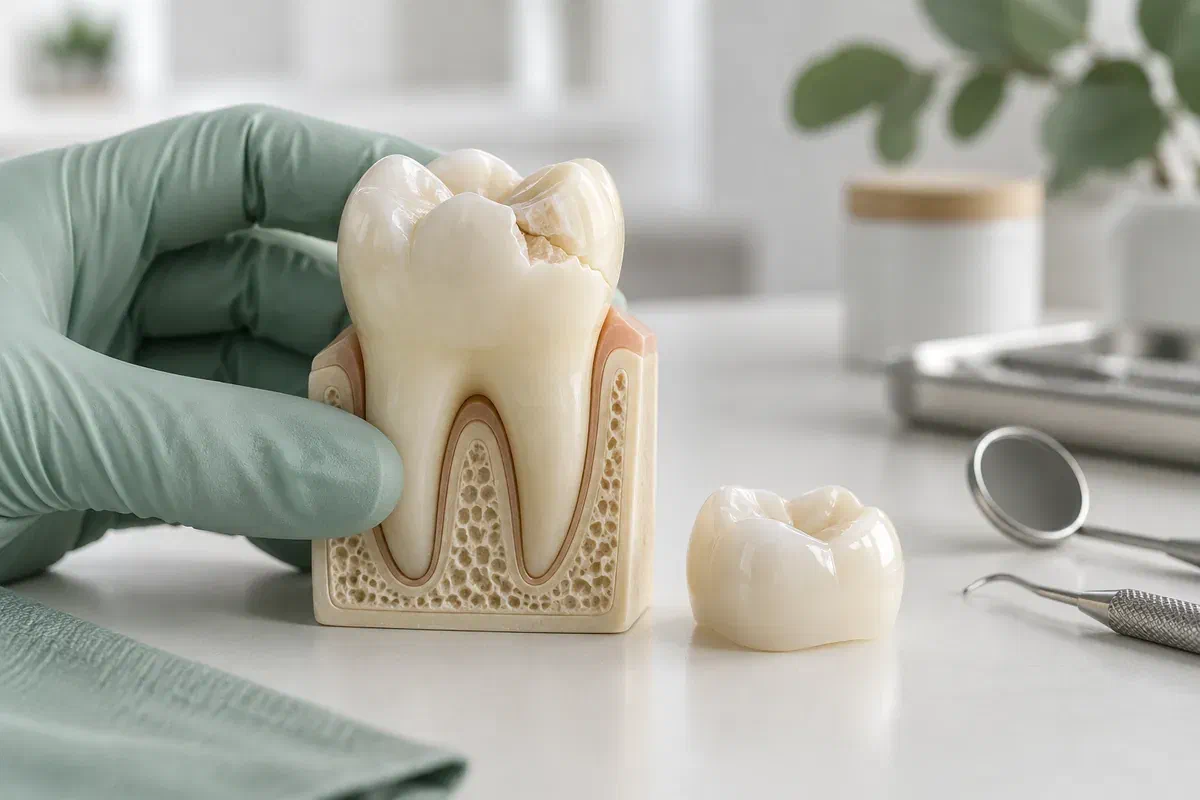
Illustrative conversation about treatment options for a cracked tooth
Restorative Dentistry

Cracked Tooth Treatment in Puslinch

A cracked tooth can bring a big decision: invest in saving it or plan to replace it. From Puslinch, you can review the findings with us, take time to weigh the options and seek a specialist view if it would help.

A decision worth taking slowly

Saving the tooth is a choice, and you can take time to make it

Hearing that a tooth is cracked often comes with a list of possibilities: a crown, maybe root canal treatment, perhaps removal. For a tooth with an uncertain outlook, that can feel like a lot to decide on the spot. Unless the situation is urgent, it is reasonable to go home, think it over and come back with questions.

Part of the uncertainty lies in the crack itself. A fracture confined to one cusp tends to have a better outlook than one moving toward the pulp, and one reaching the root may leave little to work with. Some details are hard to confirm until treatment is underway, which is exactly why the options deserve a careful explanation.

We will tell you what we know, what we can only estimate and what each approach is intended to achieve. Ask about comfort, scheduling, fees and every alternative, including a second opinion. A choice made with the benefits and the limits in view is one you are less likely to second-guess later.

Review your options for a cracked tooth
Illustrative tooth model and crown showing a restorative treatment concept
What affects the outlook

The findings behind a recommendation

Recommendations for a cracked tooth rest on a few key observations. The dentist considers how much sound tooth is left, the condition of the pulp and how far the fracture extends, and should be able to explain each one.

How much the chewing surface can bear

A crack under a cusp or beside a large filling can weaken part of the tooth. The dentist explains whether a limited repair is likely to hold or whether coverage of the whole biting surface would be more appropriate.

What is happening in the pulp

Symptoms and tests help gauge whether the pulp is healthy, inflamed or failing. If it needs treatment, an outer restoration alone would leave the main problem in place, and the plan becomes more involved.

How restorable the tooth really is

Fractures extending deep below the gum or into the root can make a durable repair unlikely. Ask which findings point that way, how confident the assessment is and whether an endodontist’s view would add clarity.

Uncertainty is normal with cracked teeth. Ask how a new finding during treatment would change the plan, and make sure you know when you would be asked before anything further is done.

What a repair offers

A chance to keep the tooth, with honest limits

If retention is reasonable, treatment rebuilds the damaged area and gives the remaining tooth suitable support. Where the pulp is affected, root canal treatment may come first. Each step has a defined purpose, and knowing those purposes helps you judge whether the whole plan is worthwhile.

Cracks don’t knit together the way bone fractures can. A crown or onlay may protect the tooth for many years, or a crack may still progress despite good care. Weighing that uncertainty against the benefit of keeping your own tooth is a personal decision, and you are entitled to the information to make it.

Patient information: American Association of Endodontists — cracked teeth

An explanation for every stage

Ask what each proposed procedure addresses. You should be able to tell a temporary step, pulp treatment and the final restoration apart, and know why each is included.

Retention where it makes sense

When findings are favourable, keeping your natural tooth may be worth the investment. The dentist should explain the reasoning and the factors that could weaken the outlook.

Support after treatment

Review visits and contact instructions help you respond if discomfort returns or the bite shifts. Knowing what to report is part of the plan, even when everything feels settled.

From findings to a decision

A process that leaves room for questions

Some cracked teeth are restored in a single visit; others need staged care or a specialist. Ask how the proposed sequence follows the diagnosis and how the tooth should be managed while you decide.

  1. Go over the evidence

    We review your symptoms, the examination and any images with you. The dentist explains what is known about the crack, how restorable the tooth appears and where the uncertainty lies.

  2. Compare paths and take your time

    Each reasonable option, including removal and replacement, is explained with its purpose, limits, stages and costs. If you would like a specialist opinion first, we can discuss a referral.

  3. Proceed once you are ready

    Treatment may involve a filling, an onlay or crown, root canal care, or another appropriate step. We explain comfort measures and how to care for any temporary placed during the process.

  4. Review the result

    The restoration is checked against your bite, and the next steps are explained. Ask when normal chewing can resume, which symptoms deserve a call and what follow-up is planned.

After treatment

Keep the review appointment, even if the tooth feels great

What you’re told to do will reflect the work carried out and whether you’re still wearing a temporary. Keep the written advice and our number nearby, especially if more than one clinician is involved.

Respect a temporary restoration

A temporary won’t withstand the forces a final restoration can. Ask what to avoid and how to clean around it, and phone us if it loosens or breaks instead of waiting for your next visit.

Mention bite changes promptly

Let us know if the treated tooth contacts first, aches with ordinary chewing or develops new sensations. Avoid trying to wear down a high area by biting on it.

Talk about forces on your teeth

Grinding, clenching and chewing hard objects can strain a cracked or restored tooth. The dentist may discuss a night guard or other protection, while being clear that it reduces risk rather than ruling out problems.

Comparing the choices

Repair, treat inside or replace

Each option has benefits and limits. Ask how each matches the crack’s position, the tooth that’s left and the state of the pulp, and how they compare over the longer term.

When enough tooth remains

A filling or a covering restoration

A small defect may be repaired with a filling. A weakened tooth may need a crown or onlay that covers the cusps, chosen to match the support the tooth requires.

Where the pulp needs care

Root canal treatment plus a restoration

If the pulp diagnosis supports it and the tooth is still restorable, root canal treatment may be advised. A protective final restoration is planned as a further stage.

When keeping it isn’t advisable

Removal and a replacement plan

An unfavourable fracture may make extraction the better choice. Ask why repair isn’t expected to last, what leaving a gap could mean and how replacement options compare in timing and upkeep.

Puslinch questions

Getting the information you need to decide

When the outlook is uncertain, questions often turn to second opinions and comparisons. These answers are general; your own findings will guide the specifics.

(905) 876-4488
Is it all right to ask for a second opinion on a cracked tooth?
Yes. Asking for another view on a significant decision is reasonable, and a good clinician won’t take offence. Ask how urgent the situation is so that waiting for a second appointment doesn’t put the tooth at extra risk.
Can my X-rays and notes be shared with a specialist?
With your consent, records can usually be sent to another dentist or specialist. That can avoid repeating images and give the second clinician a fuller picture. Ask us how to arrange it.
Is it safe to wait for a specialist appointment?
It depends on your symptoms and the crack. Ask how to protect the tooth meanwhile, such as avoiding hard foods on that side, and which changes, like swelling or worsening pain, mean you should call sooner.
Why might two dentists suggest different treatments for the same crack?
Cracked teeth involve judgement, and clinicians may weigh the uncertainty differently. Ask each to explain their reasoning and the risks they see. Differences in opinion are useful information rather than a sign that one is wrong.
How should I compare saving the tooth with replacing it?
Consider the outlook for the tooth, the number of visits, the cost, the maintenance involved and what you value. Ask for an itemised explanation of each path so you can compare them fairly.
What should I ask before agreeing to a crown on a cracked tooth?
Ask why a crown is suggested, what the outlook for the tooth is, whether root canal treatment might be needed later and what symptoms should bring you back. A crown can protect the tooth but cannot guarantee the crack won’t progress.
Coming in from Puslinch

Review the findings at your own pace

Visit our Bronte Street practice to go through the condition of the cracked tooth and every reasonable option. We’ll explain what each approach is meant to achieve, answer your questions and discuss a referral if you would like one.

Call the clinic if you have significant pain, swelling or a new break so we can advise on timing. Online requests are meant for non-urgent concerns.

Visit Milton Dental Clinic
Unit 1, 342 Bronte St. S, Milton, ON L9T 5B7
Get directions Clinic hours
Monday–Thursday
11am–7pm
Friday–Sunday
By appointment only

Areas we serve

  • Milton
  • Oakville
  • Mississauga
  • Georgetown
  • Halton Hills
  • Acton
  • Campbellville
  • Brampton
  • Burlington
  • Puslinch
  • Rockwood
  • Erin
  • Caledon
  • Etobicoke
  • Old Milton
  • Bronte Meadows
  • Timberlea
  • Dorset Park
  • Dempsey
  • Clarke
  • Beaty
  • Coates
  • Harrison
  • Scott
  • Willmott
  • Ford
  • Bowes
  • Cobden
  • Walker
  • Mountain View
  • Milton Heights
  • Hawthorne Village
  • Valley View
  • Fallingbrook
  • Nassagaweya
  • Trafalgar
  • Esquesing
  • Nelson
  • Brookville
  • Moffat
  • Glen Williams
  • Norval
  • Limehouse
  • Stewarttown
  • Ashgrove
  • Hornby
  • Silver Creek
  • Speyside
  • Scotch Block
  • North Oakville
  • River Oaks
  • Glen Abbey
  • West Oak Trails
  • Palermo
  • Bronte Creek
  • College Park
  • Joshua Creek
  • Uptown Core
  • Preserve
  • Iroquois Ridge
  • Lisgar
  • Meadowvale
  • Meadowvale Village
  • Churchill Meadows
  • Erin Mills
  • Central Erin Mills
  • Streetsville
  • East Credit
  • Creditview
  • Heartland
  • Sheridan
  • Mount Pleasant
  • Credit Valley
  • Huttonville
  • Churchville
  • Springbrook
  • Northwest Brampton
  • Bram West
  • Fletcher's Meadow
  • Fletcher's Creek South
  • Alton Village
  • Orchard
  • Millcroft
  • Headon Forest
  • Tansley
  • Brant Hills
  • Tyandaga
  • Kilbride
  • Lowville
  • Aberfoyle
  • Morriston
  • Arkell
  • Hillsburgh
  • Freelton
  • Carlisle
  • Waterdown
  • Flamborough
  • Mountsberg

How can we help?

Milton Dental Clinic

Have a question about your smile? Choose the option that works best for you.

For urgent dental concerns, please call.
Messages are reviewed during clinic hours.