

Illustrative consultation about replacing an existing dental bridge
Restorative Dentistry

Dental Bridge Replacement in Brampton

Replacing a bridge means planning around work shifts, school runs and family events. From Brampton, you can have the old bridge and its supports assessed, then map out timing, temporaries and choices with no rush.

Timing it right

Busy calendar, ageing bridge

The question many people bring is not only whether to replace a bridge, but when. There is a cousin’s wedding next month, a heavy work season, children’s activities every evening. A bridge connects replacement teeth to anchoring teeth or implants, so replacing it can mean several stages, and knowing that in advance helps.

Before any calendar talk, the dentist needs to know what is actually wrong. Slight movement, food trapping, a chip or a sore anchor all lead to different plans, and some of them are more urgent than others. A comfortable, stable older bridge may be fine to monitor; one sitting on a failing support usually is not.

Share both what has changed and what is coming up in your life. We can examine the bridge, explain whether it can be kept, repaired or replaced, and discuss realistic timing. If the supports can only be judged after removal, you will know that before committing to dates. For many people coming from Brampton, that early clarity is what makes the rest of the planning manageable.

Plan a bridge assessment
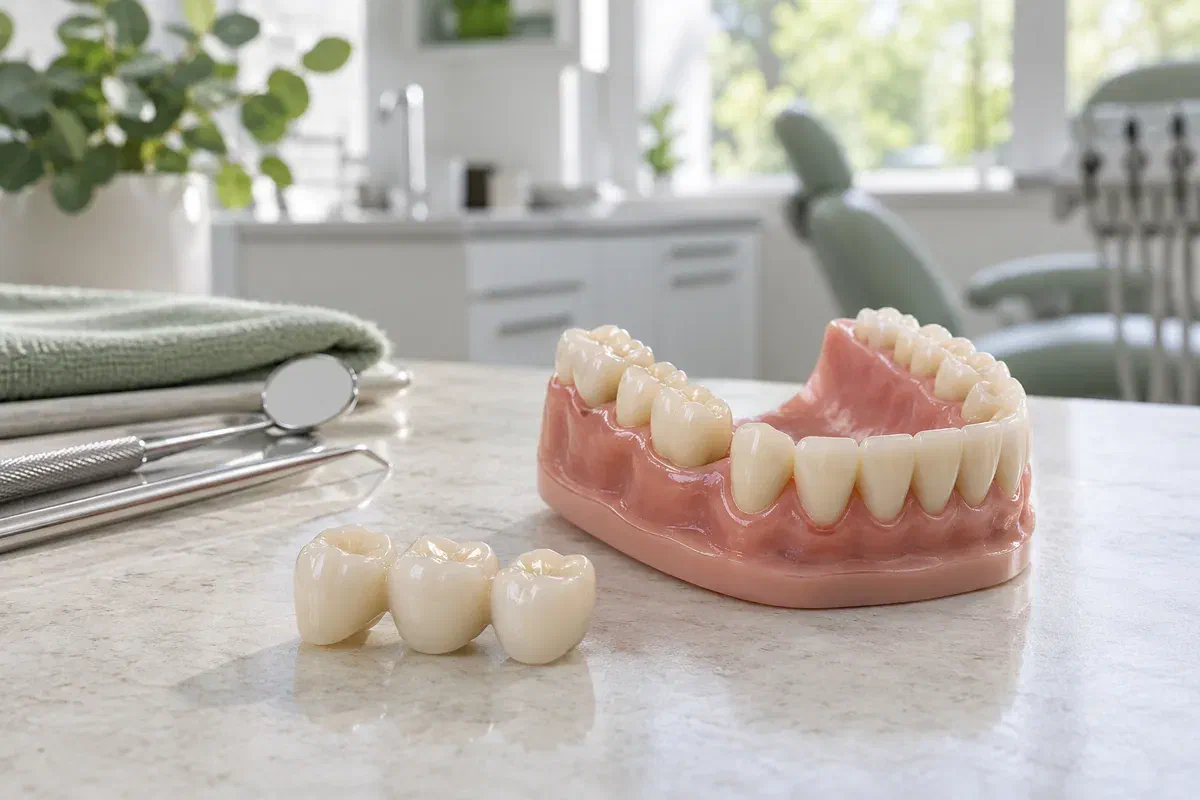
Ceramic three-unit bridge beside a dental teaching model
What can’t wait and what can

Sorting urgent signs from ones to watch

Some changes call for prompt attention; others can be monitored and scheduled sensibly. An examination helps match both the advice and its timing to the actual findings.

Movement or a repeat repair

A bridge that has loosened or broken before, or is moving now, deserves an earlier visit. Bring what you know about past repairs so the dentist can judge whether fit, design, supports or bite forces are the underlying issue.

Pain or swelling at a support

Tenderness, sensitivity or gum swelling near an anchor tooth may need treatment of its own and should not be put off for long. Its condition will also influence whether a similar bridge is a reasonable choice.

Trouble cleaning underneath

Describe where floss catches or food lodges. This is often something to plan for rather than rush, but it helps the dentist understand the current design and think about access in any future one.

Call promptly if the bridge is shifting, sore or has broken and left a sharp spot. Do not try to remove or reattach it at home while you wait for advice.

Why planning pays off

A well-timed replacement can address more than one issue

When the bridge is renewed, the dentist can revisit its outline, the way it meets your bite and how easily it can be cleaned. Those improvements depend on the supports and gums being suitable, which is why the assessment comes before any scheduling.

One limit is worth knowing early: replacing the bridge does not by itself resolve decay or gum disease beneath it. Those require their own diagnosis and care, which can add appointments. Ask how the anchors were assessed and what that means for the plan.

Informed by daily life with the old one

Your experience of chewing, speaking and cleaning around the bridge can shape the next design. Some features may be worth keeping; others may be better changed.

A plan based on the foundation

Reviewing the supports explains why a similar bridge still fits your mouth or why an alternative is being raised. Ask which findings drove the recommendation.

Maintenance agreed up front

Expect clear guidance on looking after the new bridge, plus a review schedule that fits your life. Discuss which cleaning tools you will realistically use each day.

A stage-by-stage outline

Know the appointments before you book them

How many visits you need depends on your bridge and its supports. Ask about the temporary, what removal might uncover and how the schedule would change if extra treatment were needed.

  1. Consultation and records

    The dentist reviews your symptoms, earlier repairs, bite and gums, and takes suitable X-rays. You will also hear what cannot be confirmed until the existing bridge is off.

  2. Options, costs and timing

    Keeping, repairing or recementing the bridge are compared with replacement. If a new bridge is advised, go through the design, alternatives, stages, fees and uncertainties, and talk about dates that work for you.

  3. Removal and preparation

    Once you decide to go ahead, the old bridge is removed and any needed treatment completed with suitable comfort measures. The supports are reassessed, records are taken and the temporary is explained.

  4. Fitting and follow-up plan

    Before cementation, the dentist confirms that the new bridge seats well, touches its neighbours properly, meets your bite evenly and looks right. Ask to be shown how to clean beneath it, and confirm your review date and the signs that should prompt a call.

Fitting care into your day

A routine short enough to keep

Two minutes a day, aimed at the right places, does most of the work: beneath the artificial teeth and along each support. Ask for steps that suit this specific bridge, as the method for your previous one may not carry over.

Get a demonstration

The team can recommend aids and show you exactly where to use them. Say so if grip or limited access makes a technique hard, so a practical routine can be worked out.

Flag discomfort or food traps

Let us know about an uneven bite, soreness that persists or a new place where food collects. An unfamiliar feeling is normal for a short while, but ongoing discomfort should be checked.

Put reviews in the calendar

The bridge and its supporting teeth or implants need regular monitoring. Bring cleaning questions, gum changes or any looseness to each review, and call sooner if a new problem appears.

Patient information: Cleveland Clinic — dental bridges

Possible next steps for the gap

Choose the plan, then the schedule

Suitable options depend on the gap, the remaining teeth or implants and what matters most to you. Compare whole plans, including preparation, temporaries, maintenance and the time each one involves.

Suitable supports remain

Another bridge on natural teeth

Existing anchors may carry a new bridge after any necessary treatment. Ask what they need first, how many extra visits that might mean, and what their health suggests about the new bridge’s outlook.

A new foundation is being considered

Implant-based teeth

Implants may suit some mouths after a dedicated assessment, and usually involve surgery and a healing period, so timelines are longer. Bridges already on implants need compatible parts and an implant check.

Fixed work is less suitable

A partial denture or something else

If the gap or the remaining support no longer favours a fixed bridge, a removable option or a different approach may be suggested. Compare comfort, handling, appearance and daily care.

Scheduling and practical questions

Plan the changeover with confidence

These answers deal with timing, the in-between stage and what the dentist must confirm before the final bridge is made.

(905) 876-4488
How long does a bridge replacement usually take from start to finish?
It depends on the bridge, the supports and whether extra treatment is needed. A straightforward case may take a few visits, while implant work takes considerably longer. Ask for an outline at your consultation.
Can I postpone replacement until after a big event?
Sometimes, if the bridge is stable and there are no urgent findings. If there is pain, infection or significant movement, waiting may not be wise. Tell the dentist your dates so the risks of delay can be explained.
Will my temporary look natural enough for photos?
Temporaries are designed to fill the space, but they are not identical to the final bridge. Mention any important occasions so the team can discuss what is realistic for your situation.
Can I eat normally with a temporary bridge?
You will usually be advised to avoid very hard or sticky foods and to chew carefully on that side, which can take some getting used to at family meals. Follow the specific instructions you are given, and call if the temporary loosens or feels rough.
Is the dentist able to see everything before the bridge comes off?
Examination and X-rays reveal a lot, but some details only become clear after removal. Ask what remains uncertain and how the plan, and the schedule, would change if more treatment were needed.
Can appointments be grouped to reduce trips from Brampton?
Where clinically sensible, we can try to combine steps. Mention this when booking, and ask at the consultation which stages need separate visits so you can plan ahead.
Bridge planning for Brampton households

Start with an assessment, then set the dates

Bring your bridge concerns and your calendar to our Bronte Street practice. The dentist will examine the restoration and what holds it, explain what can be kept and outline replacement options that take your comfort, daily care and schedule into account.

Loose or painful bridges are best discussed on the phone first, before you settle on a routine online booking.

Visit Milton Dental Clinic
Unit 1, 342 Bronte St. S, Milton, ON L9T 5B7
Get directions Clinic hours
Monday–Thursday
11am–7pm
Friday–Sunday
By appointment only

Areas we serve

  • Milton
  • Oakville
  • Mississauga
  • Georgetown
  • Halton Hills
  • Acton
  • Campbellville
  • Brampton
  • Burlington
  • Puslinch
  • Rockwood
  • Erin
  • Caledon
  • Etobicoke
  • Old Milton
  • Bronte Meadows
  • Timberlea
  • Dorset Park
  • Dempsey
  • Clarke
  • Beaty
  • Coates
  • Harrison
  • Scott
  • Willmott
  • Ford
  • Bowes
  • Cobden
  • Walker
  • Mountain View
  • Milton Heights
  • Hawthorne Village
  • Valley View
  • Fallingbrook
  • Nassagaweya
  • Trafalgar
  • Esquesing
  • Nelson
  • Brookville
  • Moffat
  • Glen Williams
  • Norval
  • Limehouse
  • Stewarttown
  • Ashgrove
  • Hornby
  • Silver Creek
  • Speyside
  • Scotch Block
  • North Oakville
  • River Oaks
  • Glen Abbey
  • West Oak Trails
  • Palermo
  • Bronte Creek
  • College Park
  • Joshua Creek
  • Uptown Core
  • Preserve
  • Iroquois Ridge
  • Lisgar
  • Meadowvale
  • Meadowvale Village
  • Churchill Meadows
  • Erin Mills
  • Central Erin Mills
  • Streetsville
  • East Credit
  • Creditview
  • Heartland
  • Sheridan
  • Mount Pleasant
  • Credit Valley
  • Huttonville
  • Churchville
  • Springbrook
  • Northwest Brampton
  • Bram West
  • Fletcher's Meadow
  • Fletcher's Creek South
  • Alton Village
  • Orchard
  • Millcroft
  • Headon Forest
  • Tansley
  • Brant Hills
  • Tyandaga
  • Kilbride
  • Lowville
  • Aberfoyle
  • Morriston
  • Arkell
  • Hillsburgh
  • Freelton
  • Carlisle
  • Waterdown
  • Flamborough
  • Mountsberg

How can we help?

Milton Dental Clinic

Have a question about your smile? Choose the option that works best for you.

For urgent dental concerns, please call.
Messages are reviewed during clinic hours.