

Illustrative patient consultation about damage to a dental crown
Restorative Dentistry

Dental Crown Repair in Acton

Floss that shreds on one back tooth, or food that suddenly packs in beside a crown, can be the first clue that something has chipped. From Acton, an exam can find out what changed, what the crown is made of and how the tooth below is doing.

Clues from the back of the mouth

Why does the floss keep catching on that one crown?

Back crowns are out of sight, so damage tends to announce itself indirectly. Floss frays in the same spot every night. A strand of meat wedges in where it never used to. These small changes can mean the crown has chipped or worn, and a limited defect may sometimes be repaired while the rest of the crown stays.

They can also mean something else. A rough edge where the crown meets the tooth could be a chipped margin, but it could equally be a gap, decay starting underneath or a crown that has shifted. Any of those needs proper attention, and a surface repair is not a way around them.

For households in Acton who like to make each trip count, it helps to note when the catching began, which foods trap and whether the tooth feels sensitive. During the visit we examine the crown and tooth together, then explain whether polishing, a localized repair, a new crown or other care makes sense and what each can achieve.

Find out what is catching
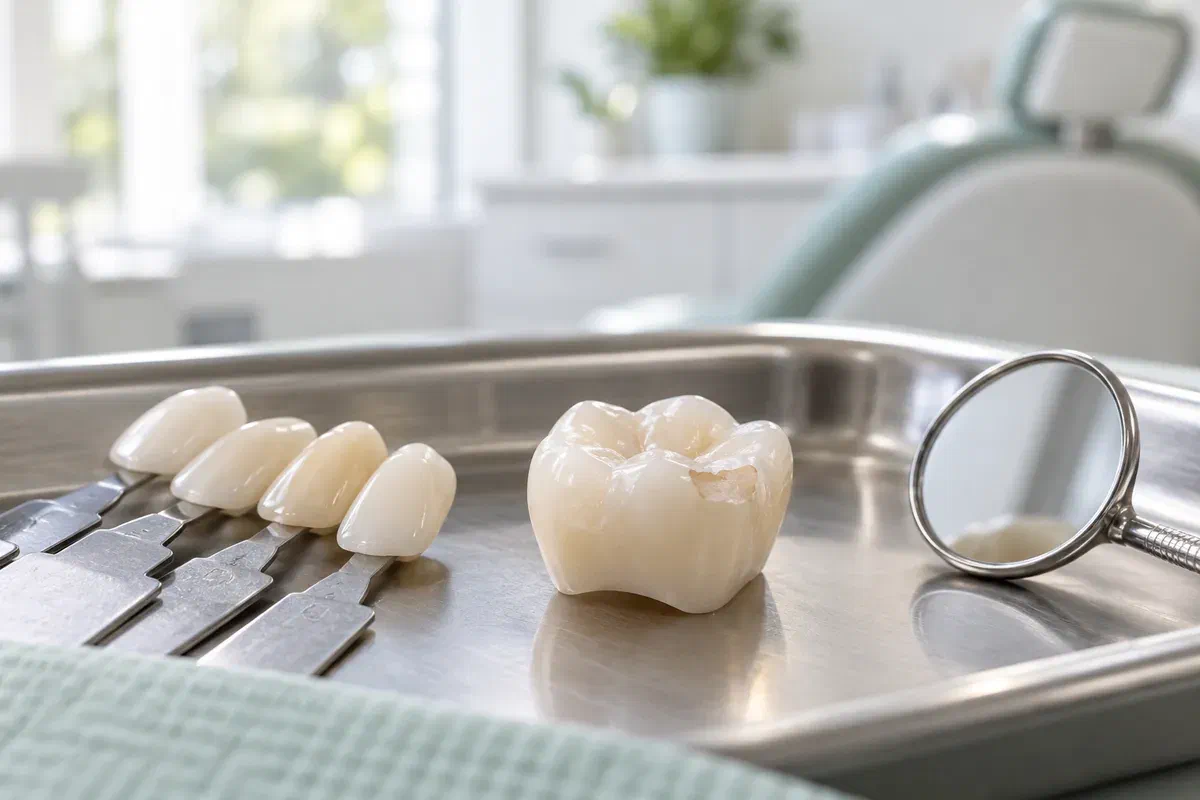
Ceramic crown with a small chipped area beside a shade guide
Everyday signs on a hidden crown

Small irritations, worth a closer look

Describe the pattern you notice, since back-tooth damage is rarely seen in a mirror. A tiny flaw can still be significant if it traps food, irritates the gum, alters your bite or turns out to be part of a bigger break.

A rough ridge your floss or tongue finds

A roughened edge can tear floss and bother your tongue. The dentist checks whether polishing would safely solve it, or whether it would remove too much of the crown, change its outline or leave a gap or crack in place.

A chip that shows when you laugh

Some back crowns are visible in a wide smile. If the chipped area bothers you, mention it, and ask how closely a repair might match the surrounding crown material now and as time passes.

A broken cusp on your chewing side

Molar crowns take much of the work when you chew. The dentist examines how the opposing teeth strike the damaged area, since steady chewing force affects whether a small repair would last there.

Tell us about any looseness, a bad taste around the crown, pain, swelling or a recent injury. A chipped surface and a problem in the tooth underneath can occur together.

If the problem is small

A smooth edge can make daily care easier again.

Where the defect is limited and the crown still sits firmly, a repair may let you keep a restoration that otherwise works well, while restoring a surface you can clean properly. This is worth discussing as long as the tooth underneath is healthy enough that it would not soon need work of its own.

Bonded repair material may age or look slightly different from the crown around it. Its lifespan and appearance vary from one mouth to the next, and sometimes a repair is meant only to hold until a replacement can be planned. Ask which kind yours would be.

The smallest fix that solves the problem

A rough margin or a small chip is not automatically a reason to remove a crown. The exam sorts out which flaws can be handled in place and which are too wide, or sit too far under the gum, to fix that way.

Easier cleaning and greater comfort

Often the goal on a back tooth is simply a surface that stops catching floss and food. Ask how the proposed repair improves that, and whether any change in feel or finish may remain.

Finding out why food keeps packing

Food trapping can stem from a chip, a gap between teeth or a change in the crown’s contact with its neighbour. The dentist looks at all of these so the fix targets the actual cause.

Inside the appointment

Locate the flaw, then choose the fix.

The method depends on the crown and the defect. Your visit begins with an examination, sometimes with images if needed, and an explanation of the choices, including whether replacing the crown would serve you better.

  1. Find exactly where the crown has changed

    The dentist examines the crown surface, its edges and its contact with neighbouring teeth, checks the gum and asks about sensitivity or trapping. Records of the crown material help, but the examination steers the advice.

  2. Talk about the extent of treatment

    Polishing, a bonded repair and a new restoration are weighed for your situation. Ask how each would feel, what the repair is expected to do, how to keep it clean and what would happen if it chipped again.

  3. Smooth or rebuild the area

    When repair is suitable, the damaged area is prepared in a way that suits that crown material, then rebuilt and finished. If the edge simply needs refining, the dentist polishes it without adding material.

  4. Test the bite and the contacts

    Your bite and the contacts with neighbouring teeth are checked, and floss may be used to confirm nothing catches. Ask about short-term precautions and any planned review, particularly if the repair is temporary.

Keeping the area healthy

Floss it, watch it, go gently on it.

Follow instructions that match the treatment you received. A polished edge, a bonded build-up and a temporary repair may each need different precautions at first, so check with the team before going back to your usual routine.

Limit very hard or sticky foods at first

Hard nuts, ice and very sticky candy can strain or pull at a small repaired area. Grinding at night is another quiet source of stress, and the dentist may suggest a guard or a closer look if it applies to you.

Clean between the teeth every day

Keep flossing or using interdental brushes around the crown, gently sliding floss out sideways if it still feels snug. The crown margin and the gum need daily care after a repair. Ask for help if cleaning remains difficult.

Notice if catching comes back

Contact the clinic if floss starts shredding again, food traps in the same place or the repair breaks. Do not try to smooth it yourself. The team will check whether the original approach is still suitable.

Patient information: Cleveland Clinic — dental crowns

Possible approaches

From a quick polish to a new crown

Each approach answers a different problem. Ask the dentist how sound the crown is overall, what each option would change, and what it would leave untouched, before deciding.

For minor roughness only

Polishing a rough margin or ridge

A small irregularity may be polished smooth if enough material remains and the crown keeps a cleanable shape. The dentist makes sure this will not leave a ledge or hide a gap that needs a different solution.

For a limited chip

A contained bonded repair

Some chips on back crowns can be filled in with tooth-coloured or other bonded material. The crown type, the surface left to bond to, its position near the gum and your chewing forces all shape the recommendation and its limits.

For gaps, decay or larger breaks

Replacing the crown or treating beneath it

A broken margin, a poor seal, recurring damage or decay under the crown may make replacement more suitable. Decay or other trouble in the tooth is dealt with first, so the new crown goes onto a sound foundation.

Hidden crown questions

Answers about damage you can feel but not see

These questions connect everyday clues with what may be happening to the crown. They can help you describe the problem clearly at your appointment.

(905) 876-4488
Why does my floss shred around one crowned tooth?
Floss can catch on a chipped or rough crown edge, a gap at the margin, tartar or decay. The cause cannot be confirmed without an examination. If shredding starts suddenly or keeps happening, it is worth having the crown checked.
Can food trapping beside a crown mean it is damaged?
It can, but there are other possibilities, such as a change in the contact between teeth or gum changes. The dentist checks the crown surface, its fit and the neighbouring teeth to work out why food is packing in.
Is a chip on a back crown less urgent than one at the front?
Not necessarily. Back crowns take heavy chewing forces and can hide decay or cracks where you cannot see them. Urgency depends on symptoms such as pain, swelling or looseness rather than which tooth is affected.
Can every type of crown be repaired the same way?
No. A porcelain surface, a metal one and a layered crown each call for their own technique, and a chip near the gum is harder to work on than one on top. Old records can hint at the material, but the current examination settles it.
Why would a temporary repair be suggested for a back crown?
A temporary measure might protect the tooth while another concern is investigated or a replacement is planned. Ask what it is designed to do, how carefully to chew on that side and when the next step should happen.
Can I book my crown visit alongside errands or other appointments from Acton?
Yes. Tell the team which days you will be in town and they can look for a time that fits. The clinic keeps late-morning to early-evening hours from Monday through Thursday and books weekend and Friday visits by arrangement. Mention pain, swelling or looseness up front.
Crown checks for Acton

Stop guessing about that back tooth.

A crown that snags floss or collects food has a reason, and finding it is simpler in the chair than in the mirror. Come to our Bronte Street clinic and we will track down the cause, check the tooth underneath and explain what a repair could do.

Bring any fragment that came away in a sealed container. Call about significant pain, swelling or a crown that moves so we can discuss how soon to see you.

Visit Milton Dental Clinic
Unit 1, 342 Bronte St. S, Milton, ON L9T 5B7
Get directions Clinic hours
Monday–Thursday
11am–7pm
Friday–Sunday
By appointment only

Areas we serve

  • Milton
  • Oakville
  • Mississauga
  • Georgetown
  • Halton Hills
  • Acton
  • Campbellville
  • Brampton
  • Burlington
  • Puslinch
  • Rockwood
  • Erin
  • Caledon
  • Etobicoke
  • Old Milton
  • Bronte Meadows
  • Timberlea
  • Dorset Park
  • Dempsey
  • Clarke
  • Beaty
  • Coates
  • Harrison
  • Scott
  • Willmott
  • Ford
  • Bowes
  • Cobden
  • Walker
  • Mountain View
  • Milton Heights
  • Hawthorne Village
  • Valley View
  • Fallingbrook
  • Nassagaweya
  • Trafalgar
  • Esquesing
  • Nelson
  • Brookville
  • Moffat
  • Glen Williams
  • Norval
  • Limehouse
  • Stewarttown
  • Ashgrove
  • Hornby
  • Silver Creek
  • Speyside
  • Scotch Block
  • North Oakville
  • River Oaks
  • Glen Abbey
  • West Oak Trails
  • Palermo
  • Bronte Creek
  • College Park
  • Joshua Creek
  • Uptown Core
  • Preserve
  • Iroquois Ridge
  • Lisgar
  • Meadowvale
  • Meadowvale Village
  • Churchill Meadows
  • Erin Mills
  • Central Erin Mills
  • Streetsville
  • East Credit
  • Creditview
  • Heartland
  • Sheridan
  • Mount Pleasant
  • Credit Valley
  • Huttonville
  • Churchville
  • Springbrook
  • Northwest Brampton
  • Bram West
  • Fletcher's Meadow
  • Fletcher's Creek South
  • Alton Village
  • Orchard
  • Millcroft
  • Headon Forest
  • Tansley
  • Brant Hills
  • Tyandaga
  • Kilbride
  • Lowville
  • Aberfoyle
  • Morriston
  • Arkell
  • Hillsburgh
  • Freelton
  • Carlisle
  • Waterdown
  • Flamborough
  • Mountsberg

How can we help?

Milton Dental Clinic

Have a question about your smile? Choose the option that works best for you.

For urgent dental concerns, please call.
Messages are reviewed during clinic hours.