

Illustrative patient consultation about damage to a dental crown
Restorative Dentistry

Dental Crown Repair in Old Milton

An older crown that has started to chip or roughen is not automatically due for replacement. Talk with our team near Old Milton about what the material, the extent of the wear and the health of the tooth beneath suggest.

Older crowns in Old Milton

Is a crown that has served for years still worth keeping?

Crowns placed a long time ago often keep working quietly until one day a corner flakes off or the edge turns rough. Age alone does not decide whether a repair is reasonable. What matters is whether the damage is confined to a small area and the remainder of the crown still fits and functions properly.

There is a real difference between a worn spot on a crown that otherwise sits firmly and a fracture across the restoration, or one with a concern hidden at its margin. Patching the surface should not cover up looseness, decay or another problem that calls for separate care. The full crown and the tooth supporting it both need a look.

In Milton’s historic downtown and the streets around it, many people have dental work that dates back decades. Tell us roughly how old the crown is, when the change appeared and whether it affects eating, comfort or appearance. We can then compare polishing, a local repair, replacement or another option, with honest limits for each.

Ask about an older crown
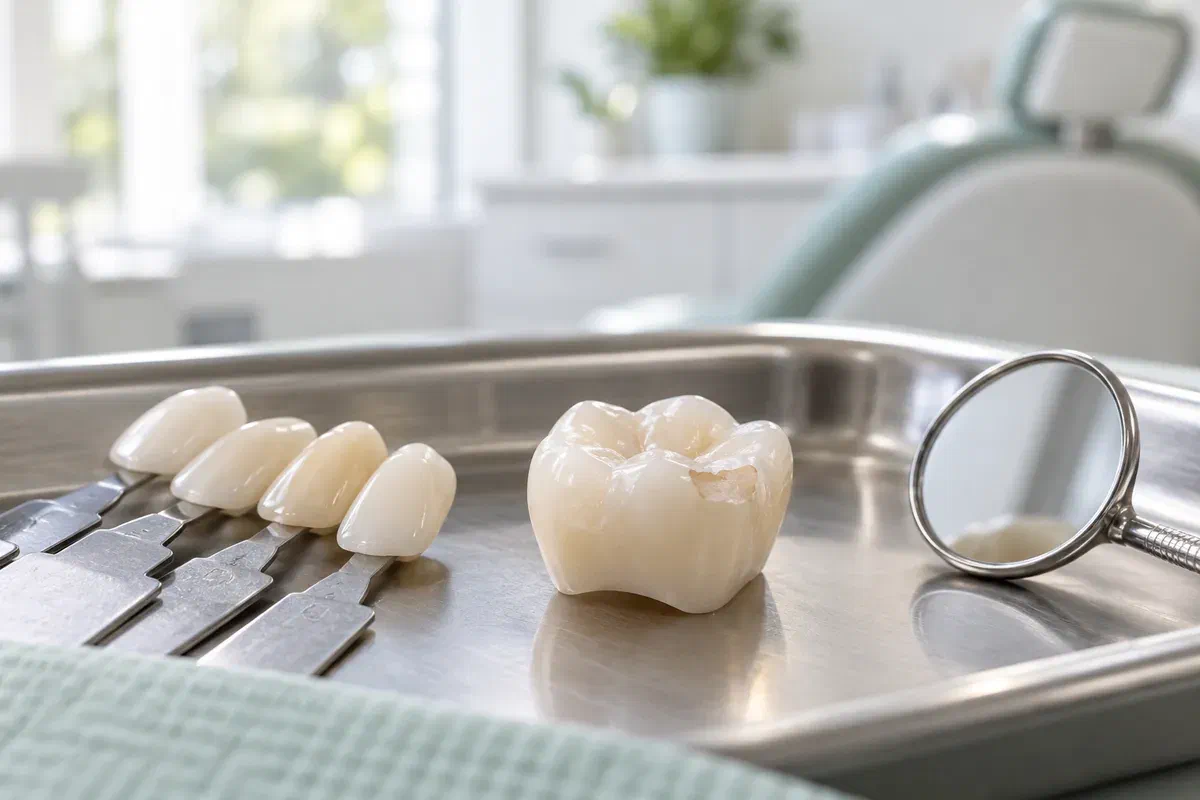
Ceramic crown with a small chipped area beside a shade guide
Changes in a long-standing crown

Wear shows up in more than one way.

Describe what feels or looks different and when you notice it. A modest defect can still be significant if it rubs your tongue, shifts the way you bite, or is the visible edge of damage that reaches further.

A once-smooth surface now feels coarse

Roughness that appears without warning is a reason to book a check. The dentist can tell whether careful smoothing is safe, or whether it would take away too much material, alter the contour or leave an underlying issue untouched.

A chip has exposed a different shade

On a visible tooth, a broken outer layer can be noticeable, especially in photographs. Say what concerns you about the look, and ask how well added material is likely to blend with an older crown and how that blend may change.

The worn spot takes the force of chewing

Damage on a surface that meets the opposite teeth works harder than a chip off to the side. The dentist studies where your bite lands on the crown and whether a localized repair is practical in that position.

Please mention looseness, aching, swelling or any recent fall or blow to the face. A damaged crown surface and a problem in the supporting tooth may be present together.

The case for a measured repair

Hold on to sound work, and be clear about the rest.

When the defect is limited and well located, repairing it can extend the useful life of a crown you are otherwise happy with. That is most worth discussing when the crown is still secure and the tooth below it does not need care that would make repair the wrong choice.

Repair material may wear or reflect light differently from an older crown. How long it lasts and how closely the colour matches vary from case to case, and some repairs are intended only as an interim step. It is fair to ask whether the plan is a lasting fix or a bridge to replacement.

Care proportioned to the flaw

A small imperfection rarely means the entire crown has to come off. Assessment shows when a modest approach is sensible and when the damage is too broad, or awkwardly placed, for a repair to be worthwhile.

Both function and appearance discussed

Your goal might be a smoother margin, a more natural outline or a rebuilt surface. Ask how the proposed work answers your particular concern and what visible differences in finish or shade could remain.

A closer look at repeated breakage

When the same crown has chipped before, the reasons deserve attention. Repair is more useful when the surrounding conditions are reviewed as well, rather than treating each new chip as unrelated.

How the visit unfolds

From examination to a bite check, step by step.

The technique used depends on the crown and the type of damage. Every visit begins with an examination and a plain explanation of your choices, which may include the view that a new crown would serve you better.

  1. Assess the crown and what supports it

    The dentist looks at the crown’s condition and stability, the nearby gum and tissues, and the symptoms you describe. Older records about the material help, though the present examination carries the most weight.

  2. Settle on the right extent of care

    You discuss whether smoothing, a bonded repair or a replacement fits best. Ask about the look you can expect, the role the repair is meant to play, upkeep, and the plan should it chip again.

  3. Treat the affected surface

    If a repair is appropriate, the area is prepared using a method suited to the crown material. The dentist builds up and finishes the repair, or gently refines the edge where no added material is required.

  4. Confirm comfort and arrange follow-up

    The repaired surface and your bite are checked, and you can describe how it feels. Ask what to avoid at first and whether a review is planned, particularly when the repair is temporary or replacement is still being weighed.

Caring for a repaired crown

Small habits help a repair last.

Aftercare should reflect what was done. A smoothed edge, a bonded build-up and a temporary repair may each need different precautions in the first days, so ask the team before resuming your usual routine.

Spare the tooth from heavy, focused pressure

Chewing ice, biting hard shells or opening packages with your teeth places strain on a small repaired area. If you clench or grind, raise it so the dentist can consider whether further assessment or a protective appliance would help.

Keep the margins and gum healthy

Carry on with the brushing and interdental cleaning you have been shown. A repair does not change the need to keep the crown edges and the gum around them clean. If the new contour traps food, ask for guidance.

Watch for roughness or wear returning

Get in touch if the repaired spot turns rough, changes in look or breaks again. Avoid filing or sanding it at home. The team should check whether the first approach is still the right one.

Patient information: Cleveland Clinic — dental crowns

Weighing your choices

Three levels of care, matched to the damage.

Look at what each choice would correct and what it would leave alone. A sound recommendation describes the condition of the entire crown, not only the simplest way to conceal the chip.

When no material needs adding

Polishing a minor irregularity

A slight surface flaw may be polished if the outline and remaining thickness stay appropriate. The dentist confirms that this will not create an unhelpful shape or mask damage that needs another kind of treatment.

When a small section can be rebuilt

A targeted bonded repair

Certain defects can be restored with a suitable repair material. The type of crown, the surface available for bonding, appearance and bite forces all guide the advice and the limits you should hear about.

When the issue runs deeper

Replacing the crown or treating the tooth

A wide fracture, a poor fit, repeated failures or a problem beneath the crown can point toward replacement. If the tooth also needs treatment, that becomes part of the plan before any new crown is made.

Common questions

What people ask about repairing older crowns

A good conversation ties the size and location of the damage to what you want from treatment. These questions can help you decide whether a limited repair suits your crown.

(905) 876-4488
My crown is many years old. Is repairing it still worth considering?
It can be. The age of a crown matters less than how well it fits, whether the tooth beneath is healthy and how much of the restoration is damaged. The dentist assesses those factors before suggesting repair, replacement or simply keeping an eye on it.
Does a grey or dark line near my gum mean the crown is breaking?
Not necessarily. A dark edge can have several causes, including the crown’s design or changes in the gum. It does not by itself mean the crown has failed. An examination helps sort out whether it needs attention or is a cosmetic matter only.
Can a chip that reveals another colour underneath be fixed without replacing the crown?
Sometimes. Layered crowns can show an inner material when the outer surface breaks. Whether a repair is suitable depends on the size and position of the chip and how much sound material remains, which the dentist checks first.
Is there a risk that smoothing my crown will alter my bite?
There can be if the chipped area is part of where your teeth meet. That is why refinement is done carefully and the contacts are checked afterwards. Please do not try to smooth the crown yourself with a nail file or sandpaper.
I’m in Old Milton already. Can I just drop by when a crown chips?
Please call first. Hours from Monday to Thursday are 11am to 7pm, with Friday to Sunday by appointment only. A quick phone conversation lets the team judge urgency and set aside time to examine the crown properly.
Can an old crown be replaced without the tooth needing other work?
That depends on what the dentist finds when the tooth is assessed. Some teeth need only a new crown, while others need treatment first. Ask how any additional care would be sequenced so you understand the plan before it starts.
Visiting from Old Milton

An honest look at an old friend.

Our Bronte Street practice is close to Milton’s historic downtown. Book a visit to have a worn, chipped or rough crown examined, along with the tooth beneath it, and leave with a clear comparison of the options that make sense.

If a piece has broken off, store it in a small sealed container. Call about severe pain, swelling or a crown that feels loose so the timing can be discussed.

Visit Milton Dental Clinic
Unit 1, 342 Bronte St. S, Milton, ON L9T 5B7
Get directions Clinic hours
Monday–Thursday
11am–7pm
Friday–Sunday
By appointment only

Areas we serve

  • Milton
  • Oakville
  • Mississauga
  • Georgetown
  • Halton Hills
  • Acton
  • Campbellville
  • Brampton
  • Burlington
  • Puslinch
  • Rockwood
  • Erin
  • Caledon
  • Etobicoke
  • Old Milton
  • Bronte Meadows
  • Timberlea
  • Dorset Park
  • Dempsey
  • Clarke
  • Beaty
  • Coates
  • Harrison
  • Scott
  • Willmott
  • Ford
  • Bowes
  • Cobden
  • Walker
  • Mountain View
  • Milton Heights
  • Hawthorne Village
  • Valley View
  • Fallingbrook
  • Nassagaweya
  • Trafalgar
  • Esquesing
  • Nelson
  • Brookville
  • Moffat
  • Glen Williams
  • Norval
  • Limehouse
  • Stewarttown
  • Ashgrove
  • Hornby
  • Silver Creek
  • Speyside
  • Scotch Block
  • North Oakville
  • River Oaks
  • Glen Abbey
  • West Oak Trails
  • Palermo
  • Bronte Creek
  • College Park
  • Joshua Creek
  • Uptown Core
  • Preserve
  • Iroquois Ridge
  • Lisgar
  • Meadowvale
  • Meadowvale Village
  • Churchill Meadows
  • Erin Mills
  • Central Erin Mills
  • Streetsville
  • East Credit
  • Creditview
  • Heartland
  • Sheridan
  • Mount Pleasant
  • Credit Valley
  • Huttonville
  • Churchville
  • Springbrook
  • Northwest Brampton
  • Bram West
  • Fletcher's Meadow
  • Fletcher's Creek South
  • Alton Village
  • Orchard
  • Millcroft
  • Headon Forest
  • Tansley
  • Brant Hills
  • Tyandaga
  • Kilbride
  • Lowville
  • Aberfoyle
  • Morriston
  • Arkell
  • Hillsburgh
  • Freelton
  • Carlisle
  • Waterdown
  • Flamborough
  • Mountsberg

How can we help?

Milton Dental Clinic

Have a question about your smile? Choose the option that works best for you.

For urgent dental concerns, please call.
Messages are reviewed during clinic hours.