

Illustrative patient and dentist discussion about replacing an older crown
Restorative Dentistry

Dental Crown Replacement in Erin

Between the visit that removes an old crown and the one that fits the new crown, there is a stretch of everyday life with a temporary. For homes in Erin and Hillsburgh, knowing how to manage those weeks makes the whole process smoother.

Life with a temporary

The weeks in between

Most of the attention in crown replacement goes to the appointments, yet much of the experience happens at home. You eat, brush and sleep with a temporary crown while the permanent one is made. A little preparation for that stage saves worry and, sometimes, an extra trip.

The replacement itself means taking off the current crown and having a new one made, provided the tooth can support it. It is worth doing when the current crown is damaged, fits poorly, hides a problem that needs treatment underneath, or simply no longer looks right to you. The reason should be clear before the old crown comes off.

Once it is off, the tooth beneath can be seen properly. The examination before and during treatment weighs remaining structure, the gum, symptoms and what has been done before. Let us know about your routine at home, along with any concerns about colour or comfort, so the advice you take away fits how you live.

Plan a crown replacement
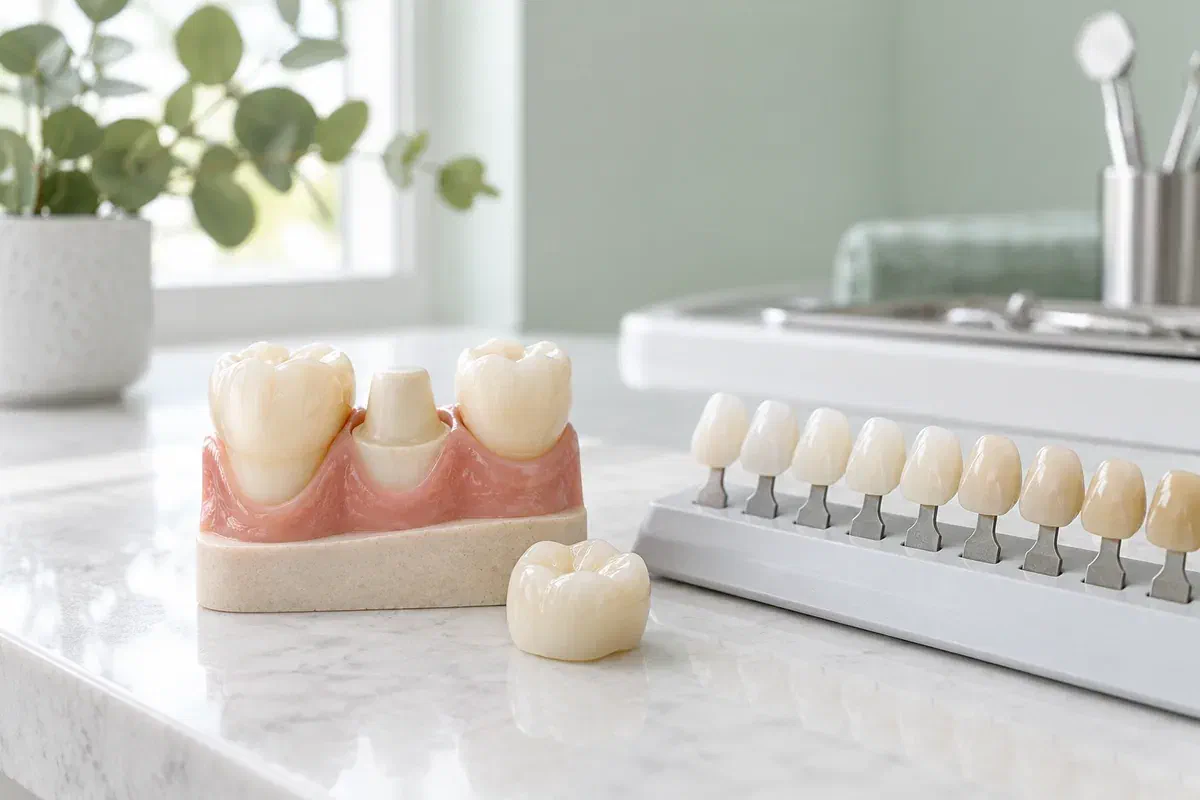
Prepared-tooth teaching model with a ceramic crown and shade guide
Before deciding to replace

Is there a real reason to start?

Going through the temporary stage only makes sense if a new crown is worthwhile. Assessment separates a crown that can stay in service from one where a replacement plan is justified.

A crown that is broken or keeps failing

A major fracture or a series of failed repairs may make another patch a poor investment. The dentist weighs how much of the crown is intact and whether a repair could still offer the shape and function the tooth needs.

A suspected problem at the margin

Decay or a poor seal where crown meets tooth often needs direct access. Examination helps establish what is going on there and whether removing the crown is the right way to treat it.

Looks that no longer suit your smile

Colour or contour that stands out is a fair concern. It is discussed alongside the crown’s condition, because replacing a working crown has both rewards and costs, including time spent with a temporary.

Mention pain, swelling or looseness even if your main concern is appearance. Those symptoms can change both the assessment and the timing.

Why the effort can pay off

A crown made for the tooth as it is now

When replacement is the right step, the new crown is designed around the tooth’s present condition and your current bite. Material, contour and appearance are planned together with how much supporting tooth remains and how readily you can keep the area clean.

No replacement crown guarantees that a tooth will need nothing more. The amount of natural structure, the health of the nerve or an earlier root canal, the gum and other factors still affect its outlook. Ask which ones apply here.

Fix what made the old crown unsuitable

If decay or a weak build-up is found, ask how it will be treated before the final crown is cemented. The temporary stage is the time when that groundwork is completed.

Understand the material choice

Each crown material has its own blend of appearance and durability. The tooth’s position and the load it carries should guide the recommendation, explained for you rather than as a single best.

Note what the temporary teaches you

Living with the temporary can reveal how you want the final crown to feel. Mention anything about its shape, bite or cleaning that you notice, so the permanent crown can be refined.

The sequence, start to finish

What happens at each stage

How many visits are needed depends on the tooth. Before starting, ask how long the temporary is likely to be in place, what comfort options are available, what the fees will be and what would change if the tooth needs more work.

  1. Assess and agree on a plan

    The dentist examines the crown, the gum and the bite, listens to your symptoms and reviews X-rays or other records. You will hear the reason for replacement and what can only be confirmed once the crown is off.

  2. Remove the crown and look closely

    With your consent and comfort measures in place, the old crown is removed. The tooth is examined, and any finding that would change the plan is explained before going further.

  3. Prepare the tooth and fit the temporary

    Supporting treatment is done or arranged, impressions or scans are taken, and shade is discussed if needed. A temporary is fitted, and you leave with clear instructions for eating and cleaning around it.

  4. Swap the temporary for the final crown

    The temporary is removed, the new crown is tried in and its fit and bite are confirmed, and you can say how it looks and feels. After placement, the team explains care and any follow-up.

Caring for temporary and final crowns

Simple habits for both stages

Temporary and permanent crowns need slightly different care. Ask for instructions for each stage, and for any extra treatment completed during the process.

Eat thoughtfully with the temporary

Avoid sticky foods like caramel and gum, and very hard foods, on that side. After the final crown is placed, ask before leaving when normal chewing can resume and protect your cheek and tongue while numb.

Clean without dislodging

Brush the temporary gently. When flossing, slide the floss out sideways rather than pulling up, so the temporary is not lifted. With the final crown, return to your usual routine and mention any spot that catches.

Notice anything that persists

Sensitivity under a temporary can be normal for a short time, but strong or lasting pain, or a final crown that feels high, should be checked. Avoid testing it on hard foods.

Patient information: ADA MouthHealthy — dental crowns

Do you need to go through it?

Options before committing to a temporary

Which path is realistic comes down to the state of the crown and of the tooth it covers. Look at what each option offers and what it cannot do before starting.

When the crown is still doing its job

Keep, repair or recement the crown

A sound crown may be monitored, polished, repaired or refitted, avoiding a temporary altogether. Ask why that approach does or does not fit your concern.

When the tooth can support one

Go ahead with a new crown

A replacement may be the best choice once underlying problems are treated. Discuss material, preparation, the temporary period and the tooth’s condition together.

When the outlook is less certain

Rethink the plan for the tooth

A deep fracture or other unfavourable finding may leave a new crown with little to work with. Ask whether further care could keep the tooth, or which options for removing and replacing it might be considered.

Temporary crown questions

Getting through the in-between stage

These questions focus on daily life with a temporary crown. Bring your own about materials, appearance or scheduling.

(905) 876-4488
What can I eat with a temporary crown?
Softer foods are easiest. Avoid sticky treats, chewing gum and very hard foods like nuts or ice on that side. Chewing mainly on the other side helps keep the temporary in place.
Is it normal for a tooth to feel sensitive under a temporary?
Some sensitivity to cold or pressure can occur because the temporary does not seal as tightly as a final crown. If it becomes strong, lasts or wakes you at night, call the clinic.
How should I floss around a temporary crown?
Gently guide the floss down, then pull it out sideways rather than lifting it back up through the contact. This lowers the chance of loosening the temporary.
Will the temporary look like my final crown?
It is made to cover and protect the tooth and to look reasonable, but its shade and shape are usually simpler. The final crown is made with more attention to colour and contour.
Can the removal of the old crown damage it?
It often needs to be cut or altered to come off safely, so it is rarely kept as a spare. The temporary takes its place until the new crown is ready.
What if my temporary comes off on a weekend in Erin?
Rinse it, store it in a small clean container and phone us once we are open. Leave the glue in the drawer. Should severe pain or facial swelling develop over the weekend, find urgent care in or near Erin instead of waiting.
Crown replacement for Erin

Start with a plan you can live with

Come in to our Bronte Street practice for a consultation. We will review your crown and the tooth beneath, explain the stages, and make sure you know how to manage the temporary period between visits.

If the crown is loose or you have swelling or strong pain, tell the team when you contact the clinic so appropriate timing can be arranged.

Visit Milton Dental Clinic
Unit 1, 342 Bronte St. S, Milton, ON L9T 5B7
Get directions Clinic hours
Monday–Thursday
11am–7pm
Friday–Sunday
By appointment only

Areas we serve

  • Milton
  • Oakville
  • Mississauga
  • Georgetown
  • Halton Hills
  • Acton
  • Campbellville
  • Brampton
  • Burlington
  • Puslinch
  • Rockwood
  • Erin
  • Caledon
  • Etobicoke
  • Old Milton
  • Bronte Meadows
  • Timberlea
  • Dorset Park
  • Dempsey
  • Clarke
  • Beaty
  • Coates
  • Harrison
  • Scott
  • Willmott
  • Ford
  • Bowes
  • Cobden
  • Walker
  • Mountain View
  • Milton Heights
  • Hawthorne Village
  • Valley View
  • Fallingbrook
  • Nassagaweya
  • Trafalgar
  • Esquesing
  • Nelson
  • Brookville
  • Moffat
  • Glen Williams
  • Norval
  • Limehouse
  • Stewarttown
  • Ashgrove
  • Hornby
  • Silver Creek
  • Speyside
  • Scotch Block
  • North Oakville
  • River Oaks
  • Glen Abbey
  • West Oak Trails
  • Palermo
  • Bronte Creek
  • College Park
  • Joshua Creek
  • Uptown Core
  • Preserve
  • Iroquois Ridge
  • Lisgar
  • Meadowvale
  • Meadowvale Village
  • Churchill Meadows
  • Erin Mills
  • Central Erin Mills
  • Streetsville
  • East Credit
  • Creditview
  • Heartland
  • Sheridan
  • Mount Pleasant
  • Credit Valley
  • Huttonville
  • Churchville
  • Springbrook
  • Northwest Brampton
  • Bram West
  • Fletcher's Meadow
  • Fletcher's Creek South
  • Alton Village
  • Orchard
  • Millcroft
  • Headon Forest
  • Tansley
  • Brant Hills
  • Tyandaga
  • Kilbride
  • Lowville
  • Aberfoyle
  • Morriston
  • Arkell
  • Hillsburgh
  • Freelton
  • Carlisle
  • Waterdown
  • Flamborough
  • Mountsberg

How can we help?

Milton Dental Clinic

Have a question about your smile? Choose the option that works best for you.

For urgent dental concerns, please call.
Messages are reviewed during clinic hours.