

Illustrative patient and dentist discussion about replacing an older crown
Restorative Dentistry

Dental Crown Replacement in Etobicoke

Replacing a crown usually takes more than one visit, and a temporary has to see you through in between. Coming from Etobicoke, it helps to know the sequence early so each trip counts.

Planning a replacement from a distance

Fewer trips, clearer steps

For anyone making a longer journey, the shape of the treatment matters almost as much as the treatment itself. How many appointments? What happens between them? What if the temporary comes off on a weekday evening? Those are fair things to settle before the old crown is touched.

Crown replacement is the removal of an existing crown and the making of a new one where the tooth is suited to it. Typical reasons include damage, a poor fit, a problem under the crown that has to be reached, or a look you would like to improve. Knowing which reason applies shapes how many visits are likely.

Whatever brought you in, the tooth beneath gets as much attention as the crown. Its remaining structure, the gum, any symptoms and its treatment history are all reviewed. Tell us what concerns you and how your week in Etobicoke is structured, and the plan can be laid out with both in mind.

Plan a crown replacement with us
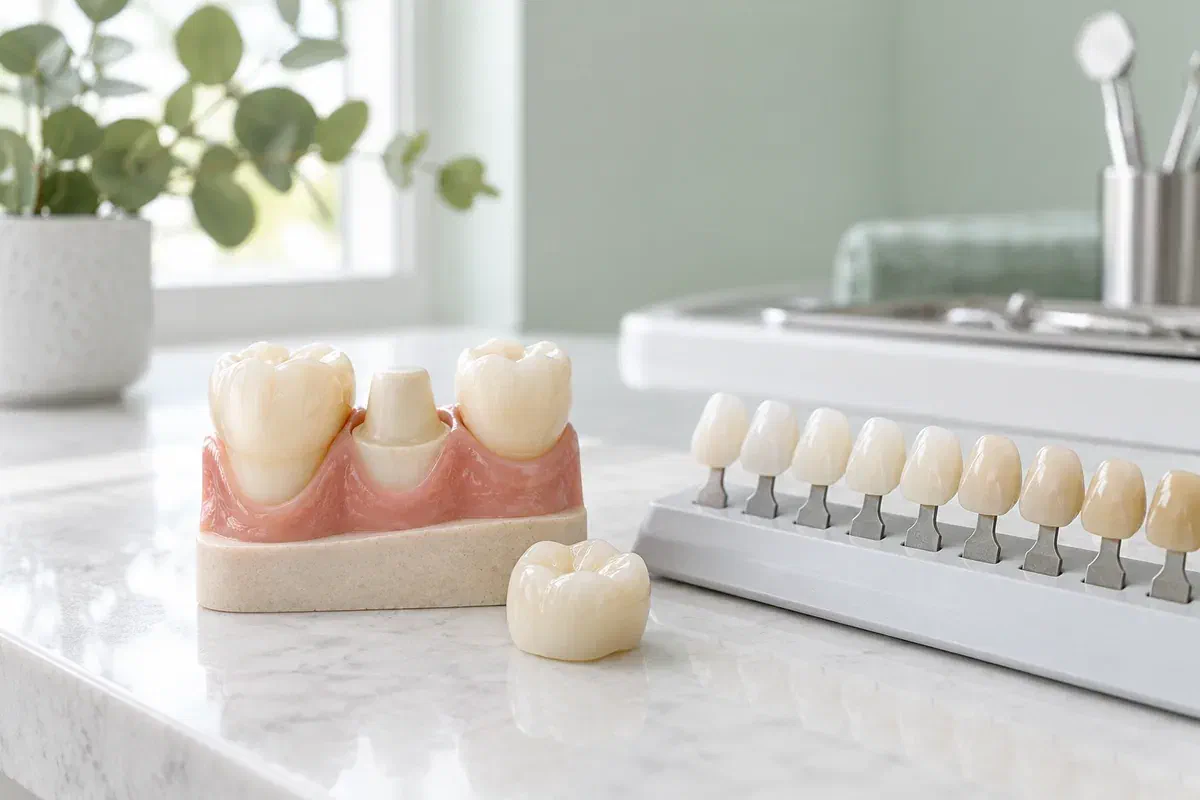
Prepared-tooth teaching model with a ceramic crown and shade guide
Is the trip worth it yet?

Reasons that justify a new crown

A crown is not replaced because of its age. The assessment looks for a genuine concern so that a restoration with good service left in it is not removed unnecessarily.

A crown too damaged to patch

Extensive fractures or repairs that keep failing can make another fix a poor use of your time. The dentist considers how much of the crown remains sound and whether a repair could give the tooth proper shape and function.

Trouble along the margin

Decay or a suspected gap where the crown meets the tooth needs proper investigation. Examination helps establish the cause and whether the crown has to come off for the area to be treated well.

Appearance you would like to change

Shade or shape differences next to natural teeth can be bothersome. Your preferences are discussed along with the crown’s condition, because replacing a working crown carries both benefits and drawbacks.

Pain, swelling or a loose crown change the picture. Mention them when you call, even if appearance is your main reason for booking.

What replacement can achieve

A crown built for the tooth, not the past

When a new crown is appropriate, it is designed for the tooth’s present condition and your current bite. Material, contour and appearance are considered together with the remaining supporting structure and how readily you can clean around it.

There is no guarantee that a replaced crown means no further care for that tooth. Remaining structure, the pulp or an earlier root canal, gum health and other factors still influence its future. Ask which of these matter most for you.

Tackle the original problem

Treatment should connect to whatever made the old crown unsuitable. If decay or a damaged build-up is discovered, ask how it will be managed before the permanent crown is completed.

Understand your material options

Each material involves its own balance of looks and durability. The tooth’s position and the forces on it should guide the recommendation, explained for your situation instead of as one best material.

Raise the small annoyances

A crown that caught floss, trapped food or felt bulky is worth describing. Shape, contacts and cleaning access can be taken into account while the new crown is designed.

How the visits can be organised

Making every appointment count

The number of visits depends on what the tooth needs. Ask before starting about the temporary, comfort, fees and what would change if the tooth needs extra work, so you can plan travel with fewer surprises.

  1. A thorough first assessment

    The dentist examines the crown, gums and bite, asks about symptoms and uses appropriate records. You will learn the reason for replacement, what cannot be confirmed until removal and roughly how many appointments to expect.

  2. Removal and direct examination

    With consent and comfort measures in place, the old crown is removed using a suitable technique. The tooth is examined directly, and anything that would change the agreed plan is discussed before work continues.

  3. Preparation and a well-fitted temporary

    Supporting treatment is completed or scheduled, and impressions or scans are made for the new crown. Shade and shape are discussed, and the temporary is fitted with clear instructions for the time in between.

  4. Fitting the final crown

    The dentist confirms how the crown seats, touches its neighbours and meets your bite, while you comment on appearance and comfort. Once it is placed, the team explains early care, cleaning and whether any follow-up visit is needed.

Back home with the new crown

Care that travels with you

Once you are home, the tooth and gum around the crown still need daily attention. Ask for clear written or verbal instructions that cover any extra treatment done during the process.

Plan your meal after the fitting

Eating right away may or may not be fine, depending on the cement and on numbness. Ask before leaving, and be careful not to bite your cheek or tongue on the way home while sensation returns.

Keep the gumline clean

Continue the recommended brushing and between-teeth cleaning. If floss repeatedly catches or a spot is difficult to reach, mention it at your next visit or call so the contour can be checked.

Call before travelling about discomfort

Ongoing sensitivity, pain when biting or a crown that seems high should be assessed. Phone first so the team can advise whether a visit is needed, rather than testing the crown with hard food.

Patient information: ADA MouthHealthy — dental crowns

Weighing up the choices

Sometimes less treatment is the answer

Realistic options hinge on how both the restoration and its foundation are holding up. Compare what each is designed to do, and its limits, before committing to the travel and time involved.

When the crown is still serviceable

Monitor or repair the existing crown

A sound crown may be polished, repaired, recemented or simply watched in some cases. Ask why a smaller step is or is not reasonable for your concern.

When the tooth can support one

Commit to a new crown

A replacement may be right once any underlying problem is treated. Discuss material, preparation, the temporary stage and the supporting tooth together as one plan.

When the tooth’s outlook is uncertain

Discuss a wider approach

A significant fracture or other poor finding may cap what any crown could offer. You will hear whether more treatment could retain the tooth, or whether it may be time to talk about removal and replacement options.

Travel and timing questions

Practical answers for a longer trip

These questions focus on organising treatment around the journey. Add your own about materials, appearance or anything specific to your tooth.

(905) 876-4488
How many visits does a crown replacement usually take?
Often two, one to remove the old crown and prepare the tooth and one to fit the new crown. More may be needed if the tooth requires a new core, root canal care or other treatment. You will get an estimate at the first visit.
Can the assessment and removal happen on the same day?
Sometimes, if the reason for replacement is clear and you have agreed to the plan. In other cases, a separate visit is better so you have time to consider options and costs. Ask when booking whether a combined visit might be possible.
What should I do if the temporary crown comes off at night?
Keep it safe, avoid household glues and call the clinic in the morning for advice. If you have severe pain or swelling, seek urgent dental or medical care near you rather than waiting.
Will I be numb for the drive home?
Often, if local anaesthetic is used. Feeling usually returns within a few hours. Avoid hot drinks and chewing until it does, and let the team know if you have any concerns about the journey afterward.
Can a new crown be a different material from my old one?
Often, yes, depending on the tooth, the space available, your bite and other findings. Explain what you would like to improve, and ask how the alternatives compare for that tooth.
Is coming from Etobicoke practical for crown work?
Many people make it work by planning ahead. Ask for a clear outline of the visits, book them in advance, and know where you would go for urgent care closer to home if a problem arises between appointments.
From Etobicoke to our practice

A crown plan that respects your travel time

Arrange a consultation at our Bronte Street practice. We will review the crown, examine the supporting tooth and lay out the steps, visit by visit, so you can plan the trips that a replacement involves.

If a crown is loose or you have swelling or significant pain, please phone before setting out so the team can advise on timing.

Visit Milton Dental Clinic
Unit 1, 342 Bronte St. S, Milton, ON L9T 5B7
Get directions Clinic hours
Monday–Thursday
11am–7pm
Friday–Sunday
By appointment only

Areas we serve

  • Milton
  • Oakville
  • Mississauga
  • Georgetown
  • Halton Hills
  • Acton
  • Campbellville
  • Brampton
  • Burlington
  • Puslinch
  • Rockwood
  • Erin
  • Caledon
  • Etobicoke
  • Old Milton
  • Bronte Meadows
  • Timberlea
  • Dorset Park
  • Dempsey
  • Clarke
  • Beaty
  • Coates
  • Harrison
  • Scott
  • Willmott
  • Ford
  • Bowes
  • Cobden
  • Walker
  • Mountain View
  • Milton Heights
  • Hawthorne Village
  • Valley View
  • Fallingbrook
  • Nassagaweya
  • Trafalgar
  • Esquesing
  • Nelson
  • Brookville
  • Moffat
  • Glen Williams
  • Norval
  • Limehouse
  • Stewarttown
  • Ashgrove
  • Hornby
  • Silver Creek
  • Speyside
  • Scotch Block
  • North Oakville
  • River Oaks
  • Glen Abbey
  • West Oak Trails
  • Palermo
  • Bronte Creek
  • College Park
  • Joshua Creek
  • Uptown Core
  • Preserve
  • Iroquois Ridge
  • Lisgar
  • Meadowvale
  • Meadowvale Village
  • Churchill Meadows
  • Erin Mills
  • Central Erin Mills
  • Streetsville
  • East Credit
  • Creditview
  • Heartland
  • Sheridan
  • Mount Pleasant
  • Credit Valley
  • Huttonville
  • Churchville
  • Springbrook
  • Northwest Brampton
  • Bram West
  • Fletcher's Meadow
  • Fletcher's Creek South
  • Alton Village
  • Orchard
  • Millcroft
  • Headon Forest
  • Tansley
  • Brant Hills
  • Tyandaga
  • Kilbride
  • Lowville
  • Aberfoyle
  • Morriston
  • Arkell
  • Hillsburgh
  • Freelton
  • Carlisle
  • Waterdown
  • Flamborough
  • Mountsberg

How can we help?

Milton Dental Clinic

Have a question about your smile? Choose the option that works best for you.

For urgent dental concerns, please call.
Messages are reviewed during clinic hours.