

Illustrative patient and dentist discussion about replacing an older crown
Restorative Dentistry

Dental Crown Replacement in Halton Hills

Nobody can see through a crown. Until the old one is off, part of the story stays hidden, so households across Halton Hills deserve a plan that explains what is known, what is not, and how surprises are handled.

The part you cannot see

What lies beneath an old crown

X-rays and a careful examination reveal a lot, but a crown still covers most of the tooth it protects. That is why a replacement plan often comes with an honest caveat: some details can only be confirmed once the old restoration is removed and the tooth is in view.

Taking off an existing crown and making a new one is worthwhile when there is a reason. The crown may be damaged or loose-fitting, there may be decay or another problem that has to be reached, or its appearance may no longer suit you. Each reason carries a different likelihood of finding something extra underneath.

Over the years, the supporting tooth can lose structure, the gum can change and old fillings beneath the crown can break down. The assessment draws together what can be seen, your symptoms and past treatment. From Georgetown, Acton, Glen Williams or a smaller hamlet, bring your questions and we will be clear about the unknowns.

Talk through an old crown
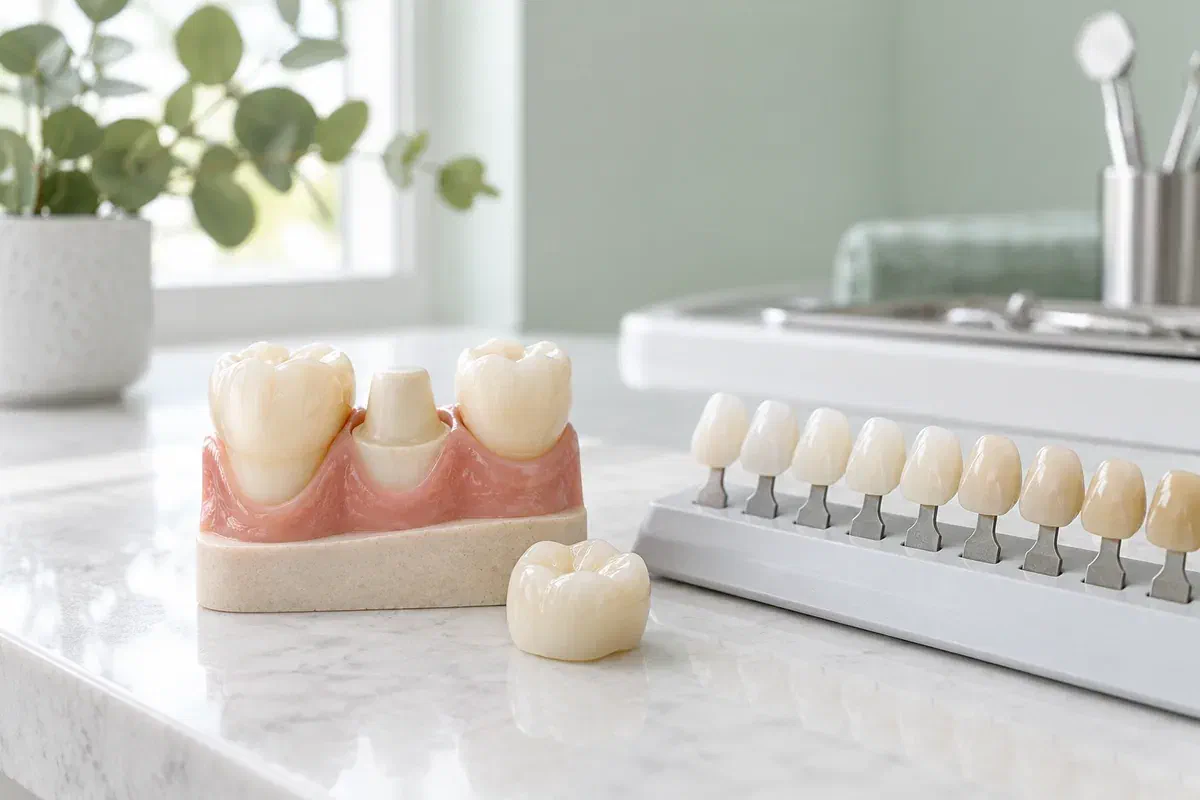
Prepared-tooth teaching model with a ceramic crown and shade guide
Grounds for replacement

A reason first, then a plan

The age of a crown says little on its own. Assessment looks for a particular concern, so a crown that still works is not replaced simply because it has been there a long time.

Damage beyond what a repair can manage

When a crown is badly fractured or earlier patches have not lasted, another limited fix may not help much. The dentist weighs how much of the restoration is intact and whether any repair could restore the needed form and function.

Suspected decay or a gap at the edge

Problems at the margin are among the most common reasons for removal. Examination helps clarify what is going on there, but the full extent of decay may only be clear once the crown is off.

A look that no longer fits your smile

If the crown stands out in colour or shape, that is a legitimate concern. It is weighed with the crown’s condition, because replacing a functioning restoration has both upsides and downsides.

Let us know about pain, swelling or a crown that moves, even if appearance is your main concern. These may change the timing of care.

What a careful replacement offers

A chance to fix what was hidden

Removing an old crown can expose problems that have been developing quietly. When replacement is appropriate, those can be treated and the new crown designed around the tooth as it really is, with material, contour and appearance chosen alongside the remaining structure and your cleaning routine.

Even so, no new crown makes a tooth immune to future problems. How much sound tooth remains, the condition of the nerve or any prior root canal treatment, the health of the surrounding gum and more all play a part. Ask which ones apply here.

Treat what removal uncovers

If decay, a cracked build-up or another issue is found, it should be addressed before the final crown is made. Ask how such findings would be managed and how you would be kept informed.

Get an explanation of materials

Crown materials differ in appearance and how they handle chewing forces. The tooth’s location and workload should guide the choice, and the reasoning should be explained for your mouth.

Correct the old crown’s quirks

If the old crown trapped food, felt bulky or made cleaning awkward, describe it. Contour, contacts and access for cleaning can be planned with those problems in mind.

Step by step, with check-ins

Where decisions happen along the way

Visit numbers depend on the tooth and what is found. Ask before you begin about the temporary crown, comfort options, costs and the point at which you would be consulted if the plan needs to change.

  1. Assess what can be seen beforehand

    The dentist examines the crown, the gum and the surrounding teeth, listens to your symptoms and reviews suitable X-rays or other records. The unknowns that can only be resolved after removal are named clearly.

  2. Remove the crown and pause to review

    After consent and comfort measures, the crown is removed. The tooth is examined directly, and if anything changes the agreed plan, the dentist explains it to you before going further.

  3. Treat, rebuild and capture the tooth’s shape

    Any decay or weakened structure is dealt with, a core is placed if needed, and impressions or scans are made. You will discuss colour and form where relevant and receive a temporary crown with care instructions.

  4. Place and check the finished crown

    Margins, contacts and bite are assessed and you can give feedback on look and feel. After placement, you will hear how to care for it and whether any follow-up is needed.

Settling in with the new crown

Protecting the work that was done

A crown fits into your routine, but the tooth and gum around it still need care. If extra treatment such as decay removal or a new core was needed, ask whether that changes the advice.

Take care on fitting day

Eating advice may depend on the cement and on whether you are still numb. Ask before leaving when normal chewing can resume, and avoid biting your cheek or tongue while feeling returns.

Keep the margin clean

Brush along the gumline and clean between teeth as shown. If floss catches or one area is awkward to reach, let us know so the contour can be checked and a better cleaning aid suggested.

Speak up about lasting discomfort

Sensitivity that continues, pain on biting or a crown that seems to hit first deserves assessment. Hard food is not a good test, and not every symptom is simply a normal adjustment.

Patient information: ADA MouthHealthy — dental crowns

Possible paths

Decisions that depend on findings

What is realistic depends on both the crown and the tooth beneath it, and sometimes on what is discovered during removal. Compare each option’s aims and limits.

When replacement is not warranted

Keep or repair the current crown

A crown in good overall condition may be monitored, polished, repaired or recemented in certain cases. Ask why that approach does or does not suit the concern being assessed.

When the tooth is restorable

Proceed with a new crown

Once underlying problems are treated, a replacement may be appropriate. Material, preparation, temporary care and the tooth’s condition should be planned together.

When findings change the outlook

Revisit the plan for the tooth

Extensive decay or a deep fracture discovered during removal may limit what a new crown can do. The dentist will explain whether further treatment could still save the tooth, and if not, which replacement options you could consider.

Questions about the unknowns

Understanding what removal might show

These questions help prepare you for findings that are not visible beforehand. Add your own about appearance, timing and the temporary stage.

(905) 876-4488
Can X-rays show everything under a crown?
Not always. Metal and some ceramic materials can block parts of the image, and early decay can be hard to see. X-rays are useful, but the dentist may only be able to confirm certain details after the crown is removed.
Will I be asked before extra treatment is done?
You should be. If removal reveals something that changes the agreed plan, the dentist should explain the finding, the options and any change in cost before going further, except where a brief step is needed to protect the tooth.
What if the tooth turns out to be unrestorable?
It is uncommon but possible. If too little sound tooth remains or a fracture extends too far, the dentist will discuss options such as removal and tooth replacement, and you will have time to consider them.
Could an old filling under the crown be the problem?
Yes. Crowns are often placed over a core or old filling, which can break down or develop decay along its edges. This is one of the things the dentist checks directly once the crown is off.
Is it possible to keep the old crown for later?
Usually not. Removal often involves cutting or altering the crown, so it is rarely reusable. The approach is chosen to protect the tooth, and the temporary plan will be explained before removal.
How do I plan visits from Halton Hills if the plan changes?
Ask at your first visit which extra steps are possible and how many appointments each might add. Building some flexibility into your schedule makes it easier to adjust without rushing a decision.
Halton Hills crown replacement

A clear plan, including what we can’t yet see

Our Bronte Street practice can review your crown, examine the supporting tooth and explain what is known and what may only be confirmed during removal. You will leave with the likely steps and the choices ahead.

A loose crown, swelling or strong pain is worth mentioning when you contact us so appointment timing can be adjusted.

Visit Milton Dental Clinic
Unit 1, 342 Bronte St. S, Milton, ON L9T 5B7
Get directions Clinic hours
Monday–Thursday
11am–7pm
Friday–Sunday
By appointment only

Areas we serve

  • Milton
  • Oakville
  • Mississauga
  • Georgetown
  • Halton Hills
  • Acton
  • Campbellville
  • Brampton
  • Burlington
  • Puslinch
  • Rockwood
  • Erin
  • Caledon
  • Etobicoke
  • Old Milton
  • Bronte Meadows
  • Timberlea
  • Dorset Park
  • Dempsey
  • Clarke
  • Beaty
  • Coates
  • Harrison
  • Scott
  • Willmott
  • Ford
  • Bowes
  • Cobden
  • Walker
  • Mountain View
  • Milton Heights
  • Hawthorne Village
  • Valley View
  • Fallingbrook
  • Nassagaweya
  • Trafalgar
  • Esquesing
  • Nelson
  • Brookville
  • Moffat
  • Glen Williams
  • Norval
  • Limehouse
  • Stewarttown
  • Ashgrove
  • Hornby
  • Silver Creek
  • Speyside
  • Scotch Block
  • North Oakville
  • River Oaks
  • Glen Abbey
  • West Oak Trails
  • Palermo
  • Bronte Creek
  • College Park
  • Joshua Creek
  • Uptown Core
  • Preserve
  • Iroquois Ridge
  • Lisgar
  • Meadowvale
  • Meadowvale Village
  • Churchill Meadows
  • Erin Mills
  • Central Erin Mills
  • Streetsville
  • East Credit
  • Creditview
  • Heartland
  • Sheridan
  • Mount Pleasant
  • Credit Valley
  • Huttonville
  • Churchville
  • Springbrook
  • Northwest Brampton
  • Bram West
  • Fletcher's Meadow
  • Fletcher's Creek South
  • Alton Village
  • Orchard
  • Millcroft
  • Headon Forest
  • Tansley
  • Brant Hills
  • Tyandaga
  • Kilbride
  • Lowville
  • Aberfoyle
  • Morriston
  • Arkell
  • Hillsburgh
  • Freelton
  • Carlisle
  • Waterdown
  • Flamborough
  • Mountsberg

How can we help?

Milton Dental Clinic

Have a question about your smile? Choose the option that works best for you.

For urgent dental concerns, please call.
Messages are reviewed during clinic hours.