

Illustrative consultation about suitability for a dental implant
Restorative Dentistry

Dental Implant Assessment in Milton

Told a tooth may need to come out, or already living with a gap? An implant assessment close to home in Milton lets you talk through the site, your health and every realistic way to replace the tooth before anything is decided.

Planning a replacement in Milton

The first step is a conversation, not a procedure.

Many people first hear the word implant on the day a dentist says a cracked or badly decayed tooth may not be worth saving. That is a hard moment to make a long-term choice. An assessment slows things down: it looks at the tooth or gap, the gums and neighbouring teeth, and what would have to be in place before any replacement could be planned.

It helps to picture an implant as a pathway rather than a single tooth. There is support placed in the jaw, a restoration fixed on top, a period of healing in between, and cleaning and check-ups for years afterward. Seeing all of those parts makes it easier to weigh against a bridge or a removable option on fair terms.

Since you are already in town, follow-up visits for records or a second discussion are simple to arrange. You are welcome to come in undecided. Tell us what bothers you about the gap, ask whatever is on your mind, and we will explain what is known so far and what still needs checking.

Book your implant assessment
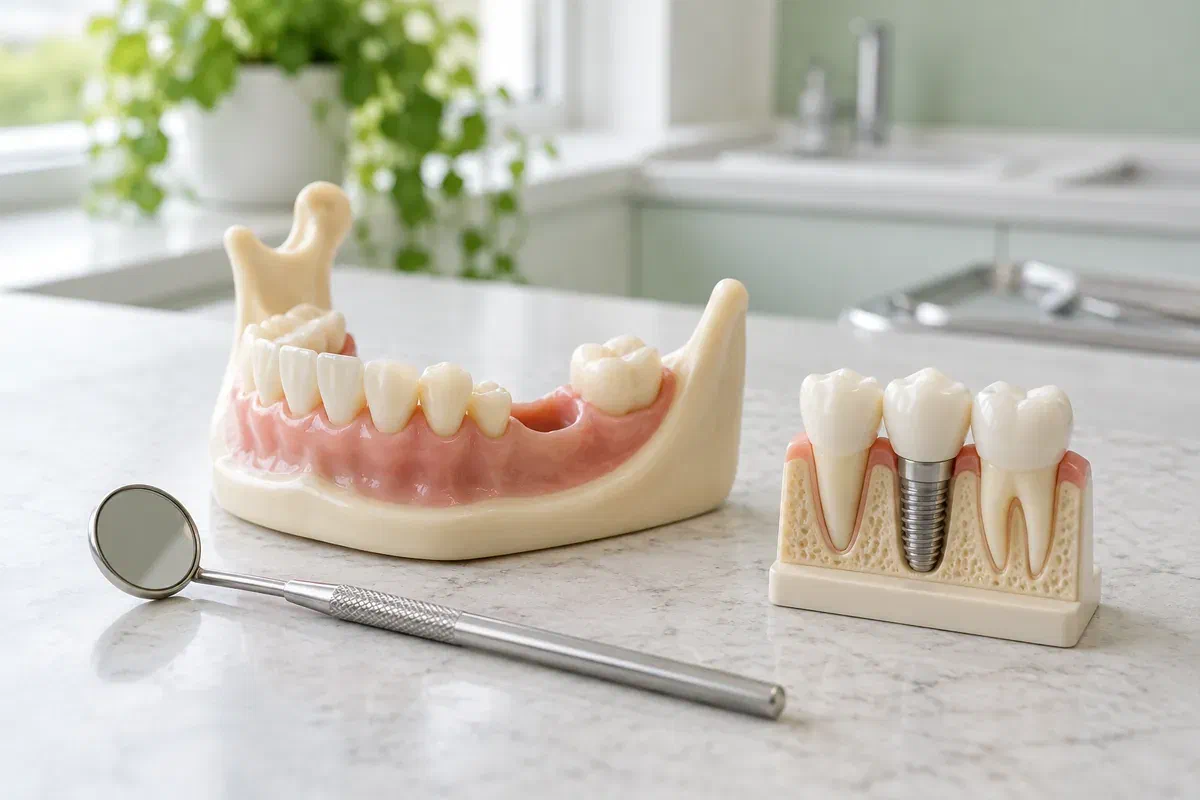
Dental teaching models showing a missing tooth and an implant-supported crown
What we will want to hear about

Three things shape every implant discussion.

A gap is only part of the picture. Any replacement needs adequate support, a routine you can keep up at home, and an order of treatment that fits your health and your week.

The tooth you have, or the space it left

Let us know whether the tooth is gone already or whether extraction has only been mentioned. When a natural tooth is still there, it deserves a fair look at whether it could reasonably be kept before replacing it becomes the plan.

Your health and the medicines you take

A complete list of prescriptions, supplements and past major treatment gives the dentist a clearer sense of healing and planning factors. Sometimes it also shows that input from your physician or another health professional would be sensible.

How you live with your teeth day to day

Talk about how easily you can clean, how often you can attend, and whether chewing or appearance matters more. A plan can be possible in theory and still be hard to look after, so these practical points are part of the assessment.

Please keep taking your prescribed medicines as directed. If a medication might affect dental planning, that decision belongs with the clinicians who prescribe and manage it.

Why assess before you decide

Clarity about your own mouth.

An assessment sorts out what needs to be understood before implant care goes any further. That could be the health of the gums, the bone and space at the site, the condition of nearby teeth, or a medical factor that changes the order of steps.

The answer at the end of a first visit is not always a recommendation. It may be a scan, a closer examination or an opinion from another clinician. Whenever more information is suggested, ask what question it is meant to settle and how the result will feed into your choice.

A grounded sense of what is possible

The visit separates what looks feasible from what is still uncertain. That keeps a timeline seen in an advertisement, or a neighbour's experience, from becoming your expectation.

Every option on the same table

Compare an implant with a bridge, a removable appliance or another approach using the same questions: how much preparation, how many visits, what upkeep, and which limits come with each.

Knowing who does which part

Assessment, placement, the final crown and long-term care are sometimes handled by different clinicians. Sorting that out early makes referrals, fees and the right person to call much easier to follow.

How the visit unfolds

Gather what is needed, then plan.

One appointment may not settle everything. We aim to tell you what can be judged on the day, which records might be needed, and at what point a fuller recommendation becomes realistic.

  1. Talk through the gap and your hopes

    Share how long the space has been there, any earlier replacement, and what you want to be different. We also go over your health history, medicines, past dental experiences and any worries about treatment or home care.

  2. Look closely at the mouth and the site

    The dentist checks the teeth, gums, bite and the room available for a replacement. If decay or gum problems need care first, we explain where that treatment sits in the overall order.

  3. Decide which records would help

    Imaging or other records may be suggested to understand the site and the structures near it. You can ask why each one is justified, whether older records might be useful, and whether another clinician's view would add something.

  4. Go over findings and possible next steps

    We discuss what is known, what remains uncertain and the routes that could follow. Ask for a plain account of any preparation, surgery, temporary tooth, final restoration, fees and upkeep before you choose.

Once you have talked it through

Know exactly what happens next.

Finishing an assessment does not mean surgery has been booked. Before you head home, be clear on what you have agreed to, which appointments or records come next, and how any current dental problem will be handled in the meantime.

Keep your paperwork in one place

Hold on to the treatment outline, any estimate and referral details so you can read them again at home. If a word or step is unclear, ask for it in plain language before agreeing to anything further.

Follow through on preparation

Gum treatment or work on other teeth may come before any further implant decision. Ask how that progress will be checked and what has to be true before the site is considered ready.

Tell us when something changes

If your medicines, medical care or dental symptoms change while you are still planning, please let the clinic know. New details can alter the order of care, and an older assessment should not be treated as current indefinitely.

Other ways to fill the gap

An implant is one option among several.

Implants are a single family of tooth replacements. Your neighbouring teeth, the size of the gap, your health and what you value most will point to which alternatives are worth a serious look.

When the full assessment supports it

A tooth or appliance supported by implants

In a suitable case, an implant can hold a crown or another restoration. Think about the preparation, surgery, healing and lifelong care involved, not only the tooth you will eventually see.

Fixed, without placing an implant

A bridge anchored to nearby teeth

Where the adjacent teeth and the space are suitable, a bridge may work. Ask how much those teeth would need to be prepared and how the design would change cleaning and future maintenance.

When another balance suits you better

A removable replacement or a different plan

A removable option can be worth considering, particularly when several teeth are missing or your priorities lean another way. Where it is clinically reasonable, the effects of watching a gap without replacing it yet can be discussed too.

Common questions in Milton

Ask anything before you agree to anything.

An assessment is the right place for simple questions as well as detailed ones. You do not need to know the technical terms to book the first visit.

(905) 876-4488
If I book an assessment, am I signing up for implant treatment?
No. The visit is for understanding your situation and talking through choices. You can explore alternatives, ask for anything to be explained again, and look over the proposed stages before making up your mind. Ask which assessment fees apply, and what any extra investigation would cost, before it is arranged.
My dentist says a tooth may need extracting. Should I be assessed first?
It can help to plan while the tooth is still there. The dentist should first consider whether it can reasonably be kept and, if removal is the right call, how that affects replacement options. When any implant step could happen depends on your individual findings.
Do implants need special cleaning?
An implant-supported tooth still needs daily brushing and cleaning between teeth, plus regular professional check-ups. Mainstream patient guidance notes that the gums around implants can become inflamed if plaque builds up. Ask the team to show you the cleaning tools that would suit the design being discussed.
Does smoking affect whether an implant is suitable?
Smoking is widely recognised as a factor that can affect healing and gum health, so the dentist will want to know about it. Being honest about tobacco or vaping use helps the assessment. It does not automatically rule anything out, but it may shape the advice and the plan.
Can I come back with a family member to go over the plan?
Yes. Many people find it useful to have someone with them when options and stages are explained. Because we are local, a second discussion can usually be arranged at a time that suits you. Bring your written outline and any questions you noted since the first visit.
What happens if I decide not to replace the tooth right now?
That is a choice you can make. Ask what monitoring would involve and whether leaving the gap could affect neighbouring teeth or your bite over time. The dentist can explain what to watch for and when it would be sensible to reassess.
Implant planning on Bronte Street

Come in with questions. Leave with a clearer picture.

Our Bronte Street practice is part of everyday life in Milton. Visit to talk about a missing or failing tooth and the assessment needed to compare replacements fairly. We will help you see the starting point, the open questions and the practical stages of a sensible plan.

Medical and medication details are best shared with the clinical team at your appointment, not in a general online message.

Visit Milton Dental Clinic
Unit 1, 342 Bronte St. S, Milton, ON L9T 5B7
Get directions Clinic hours
Monday–Thursday
11am–7pm
Friday–Sunday
By appointment only

Areas we serve

  • Milton
  • Oakville
  • Mississauga
  • Georgetown
  • Halton Hills
  • Acton
  • Campbellville
  • Brampton
  • Burlington
  • Puslinch
  • Rockwood
  • Erin
  • Caledon
  • Etobicoke
  • Old Milton
  • Bronte Meadows
  • Timberlea
  • Dorset Park
  • Dempsey
  • Clarke
  • Beaty
  • Coates
  • Harrison
  • Scott
  • Willmott
  • Ford
  • Bowes
  • Cobden
  • Walker
  • Mountain View
  • Milton Heights
  • Hawthorne Village
  • Valley View
  • Fallingbrook
  • Nassagaweya
  • Trafalgar
  • Esquesing
  • Nelson
  • Brookville
  • Moffat
  • Glen Williams
  • Norval
  • Limehouse
  • Stewarttown
  • Ashgrove
  • Hornby
  • Silver Creek
  • Speyside
  • Scotch Block
  • North Oakville
  • River Oaks
  • Glen Abbey
  • West Oak Trails
  • Palermo
  • Bronte Creek
  • College Park
  • Joshua Creek
  • Uptown Core
  • Preserve
  • Iroquois Ridge
  • Lisgar
  • Meadowvale
  • Meadowvale Village
  • Churchill Meadows
  • Erin Mills
  • Central Erin Mills
  • Streetsville
  • East Credit
  • Creditview
  • Heartland
  • Sheridan
  • Mount Pleasant
  • Credit Valley
  • Huttonville
  • Churchville
  • Springbrook
  • Northwest Brampton
  • Bram West
  • Fletcher's Meadow
  • Fletcher's Creek South
  • Alton Village
  • Orchard
  • Millcroft
  • Headon Forest
  • Tansley
  • Brant Hills
  • Tyandaga
  • Kilbride
  • Lowville
  • Aberfoyle
  • Morriston
  • Arkell
  • Hillsburgh
  • Freelton
  • Carlisle
  • Waterdown
  • Flamborough
  • Mountsberg

How can we help?

Milton Dental Clinic

Have a question about your smile? Choose the option that works best for you.

For urgent dental concerns, please call.
Messages are reviewed during clinic hours.