

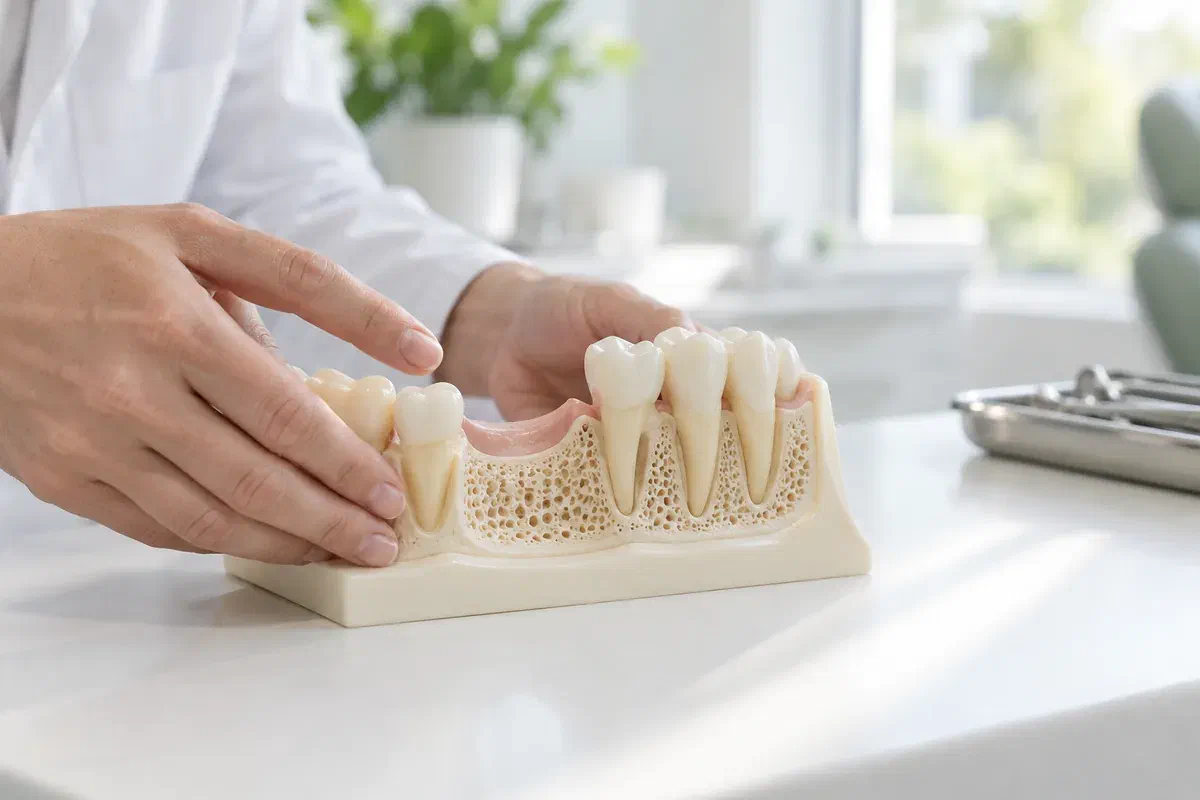
Illustrative consultation using a jaw model to discuss implant bone support
Restorative Dentistry

Dental Implant Bone Grafting in Old Milton

A tooth that came out years ago, or an old bridge you would like to retire, can raise questions about the bone left behind. Talk with our team near Old Milton about grafting, its stages and the alternatives.

Old Milton · grafting before implants

Years after the tooth, a closer look at the bone.

Some people living in Milton’s historic downtown have managed a gap, a partial denture or an older bridge for a long time before deciding to ask about an implant. When that conversation starts, the bone under the old space becomes an important question, and a graft is sometimes suggested to give the implant a workable position.

That suggestion can mean several different things. A small amount of material might be added while the implant is placed, or a separate surgery may come first, followed by healing before anything more is done. Each version changes the visit count, the recovery and the overall length of treatment, so ask which one applies.

Our Bronte Street practice sits close to Old Milton, and our team is glad to explain what prompted the recommendation and what needs answering before you go ahead: the benefit you can reasonably expect, the other choices, who would perform the graft and how healing will be reviewed.

Ask about the bone under an old gap
Educational jawbone model showing the contour beneath a missing tooth
Reasons the bone gets attention

Has the space changed since the tooth came out?

An old gap may look settled, but the visible space says little about what an implant would rest in. Your clinician looks at the site itself and at how a future tooth would be supported and kept clean.

Contour that shifted over time

The ridge beneath a long-standing gap may no longer match the position an implant would need. Mention roughly when the tooth was lost and any treatment done there, knowing that today’s examination is what describes the site.

Anatomy close to the planned position

Bone shape and neighbouring structures can affect what is possible. Ask how your X-rays or scans led to the recommendation and whether a specialist opinion or more detailed records would be sensible before a method is chosen.

Old work that needs a plan too

If a bridge or partial denture is involved, ask how removing or adapting it fits with the graft, the implant and the final crown. Healing sets the pace for several steps, so a single finish date is rarely certain.

Many implant sites need no graft at all. Where one is done, it does not guarantee that an implant can be placed afterwards, and the area is reassessed before each next step.

Why a graft might help

Rebuilding where the old space falls short.

In the right situation, a graft aims to increase the bone available where the implant is planned. You should hear which finding at your own site makes it relevant, not a general statement that grafting is simply part of every implant.

Against that aim sit a further procedure, extra healing time, added cost and the chance of complications or less support than hoped. Before deciding, ask what would happen in that case and whether another approach could still give you what you want.

Patient information: Cambridge University Hospitals — bone grafting for dental implants

A position chosen with the final tooth in mind

The implant should sit where the replacement above it will make sense. Ask how the graft supports that tooth and which compromises might still remain after the site has healed.

Room to pause and reassess

Staged treatment can allow the graft to heal and be checked before the implant goes in. If that is proposed, ask what will be examined at the review and what readiness looks like.

An honest comparison with keeping your current option

Understanding the full preparation helps you compare an implant with your existing bridge or denture, or another replacement. Count the graft and its follow-up when judging whether the complete plan suits you.

From records to review

What happens, in order?

Each grafting procedure comes with its own steps and recovery advice. The clinician doing the work should explain the approach clearly, along with any referral and how your follow-up visits will be set up.

  1. Examine the site and your health picture

    Your mouth, medical history, current medicines and appropriate imaging are reviewed. The clinician explains why grafting is being considered and whether other dental problems should be settled before the procedure is planned.

  2. Choose the approach together

    Go over where the material would come from, how extensive the work is and whether a second area is involved. Discuss risks, benefits, alternatives and comfort measures, along with the chance that later findings alter the plan.

  3. Have the graft performed

    The agreed procedure is completed and you receive written aftercare for it. Before leaving, make sure you know what to expect over the next days, which medicines apply and how to reach the right person with questions.

  4. Review the site before moving on

    At follow-up, the clinician looks at how the area is healing and whether more information is needed. The implant or final restoration goes ahead when the findings support it, not simply when a calendar date arrives.

Looking after a healing graft

Follow the advice written for your procedure.

Grafts vary, so generic tips cannot stand in for your clinician’s directions. Keep the instructions and phone numbers where you can find them, and ask again about anything that feels unclear once you are home.

Treat the area gently

Confirm what to eat, how to clean, how much activity is fine and whether a partial denture or temporary tooth can touch the site. Leave stitches alone and do not probe the area. Call if anything looks unlike what was described.

Keep to the medication plan

Take medicines exactly as directed, and ask the clinician or a pharmacist about possible interactions with what you already take. Avoid adding or dropping anything on the strength of general recovery advice.

Show up for checks, and call when unsure

Healing visits matter even when you feel well. If symptoms are unexpected or worsening, use your postoperative contact instructions straight away instead of waiting for the next planned implant appointment.

Paths to compare

Graft now, graft first, or no graft?

A grafting recommendation should come with a look at the other sensible routes. Compare them by the replacement each one produces, how demanding each would be and how much uncertainty each carries.

Where one visit can cover both

Combined with implant placement

In some cases the graft and implant happen together. Ask why that is considered suitable for your site, what might change the plan on the day, and how the area will be protected and checked after.

Where healing has to come first

A staged graft before the implant

A separate graft may be advised ahead of implant placement. Your clinician should outline the expected healing period, how progress is judged and what happens if more preparation turns out to be needed.

Where grafting is not preferred

Staying with or choosing another replacement

A new bridge, an updated partial denture or another suitable approach may avoid grafting. Ask what each involves and whether it would genuinely deal with the problems that led you to ask about implants.

Questions from Old Milton

Practical answers for a long-standing gap.

These questions often come up for people replacing a tooth lost some time ago. Raise them before agreeing to a graft so the larger plan is clear.

(905) 876-4488
My tooth was removed many years ago. Does that make a graft more likely?
It can make it worth checking carefully, since bone often changes after a tooth is lost. Time alone does not decide the answer, though. An examination and suitable imaging show what your site currently offers and whether added support would help.
Can I keep wearing my partial denture while a graft heals?
Possibly, but it may need adjusting or limited use if it presses on the treated area. Bring it to the consultation and ask exactly how and when to wear it during healing, rather than assuming nothing changes.
Is the graft material always taken from my own body?
Not always. Material may come from your own bone, processed donor tissue, animal-derived sources or synthetic products, depending on the procedure and clinical judgement. Ask what is proposed and mention any personal or religious preferences so alternatives can be weighed.
Will I need a referral to someone else for the graft?
Sometimes, depending on the site and the procedure. If a specialist is involved, ask who will perform each stage, how records will be shared and whom to call during recovery. Knowing this in advance makes the stages easier to follow.
If the graft heals, is the implant then certain?
No. The healed site is examined again, and the amount of usable support decides the next step. Ask beforehand what result your clinician is aiming for and which alternatives would be discussed if it falls short.
What should I bring to a grafting consultation?
Bring a list of medicines and health conditions, any denture or appliance you wear, and records or X-rays from previous dental work if you have them. Questions written down ahead of time also help you cover everything.
Implant bone grafting near Old Milton

Start with what the bone can support.

Book a consultation at our Bronte Street practice to look at the site you would like to restore and any recommendation for added bone. We can help you understand the reason for it, the order of the steps and what to settle before choosing a pathway.

Already had a graft and worried about how it is healing? Contact the clinician responsible for that procedure using the aftercare arrangements you were given.

Visit Milton Dental Clinic
Unit 1, 342 Bronte St. S, Milton, ON L9T 5B7
Get directions Clinic hours
Monday–Thursday
11am–7pm
Friday–Sunday
By appointment only

Areas we serve

  • Milton
  • Oakville
  • Mississauga
  • Georgetown
  • Halton Hills
  • Acton
  • Campbellville
  • Brampton
  • Burlington
  • Puslinch
  • Rockwood
  • Erin
  • Caledon
  • Etobicoke
  • Old Milton
  • Bronte Meadows
  • Timberlea
  • Dorset Park
  • Dempsey
  • Clarke
  • Beaty
  • Coates
  • Harrison
  • Scott
  • Willmott
  • Ford
  • Bowes
  • Cobden
  • Walker
  • Mountain View
  • Milton Heights
  • Hawthorne Village
  • Valley View
  • Fallingbrook
  • Nassagaweya
  • Trafalgar
  • Esquesing
  • Nelson
  • Brookville
  • Moffat
  • Glen Williams
  • Norval
  • Limehouse
  • Stewarttown
  • Ashgrove
  • Hornby
  • Silver Creek
  • Speyside
  • Scotch Block
  • North Oakville
  • River Oaks
  • Glen Abbey
  • West Oak Trails
  • Palermo
  • Bronte Creek
  • College Park
  • Joshua Creek
  • Uptown Core
  • Preserve
  • Iroquois Ridge
  • Lisgar
  • Meadowvale
  • Meadowvale Village
  • Churchill Meadows
  • Erin Mills
  • Central Erin Mills
  • Streetsville
  • East Credit
  • Creditview
  • Heartland
  • Sheridan
  • Mount Pleasant
  • Credit Valley
  • Huttonville
  • Churchville
  • Springbrook
  • Northwest Brampton
  • Bram West
  • Fletcher's Meadow
  • Fletcher's Creek South
  • Alton Village
  • Orchard
  • Millcroft
  • Headon Forest
  • Tansley
  • Brant Hills
  • Tyandaga
  • Kilbride
  • Lowville
  • Aberfoyle
  • Morriston
  • Arkell
  • Hillsburgh
  • Freelton
  • Carlisle
  • Waterdown
  • Flamborough
  • Mountsberg

How can we help?

Milton Dental Clinic

Have a question about your smile? Choose the option that works best for you.

For urgent dental concerns, please call.
Messages are reviewed during clinic hours.