

Illustrative dental hygienist demonstrating home care to an implant patient
Restorative Dentistry

Dental Implant Cleaning in Acton

Lost a tooth to gum disease and replaced it with an implant? That history still matters. Our Milton team can help you from Acton with closer maintenance, careful checks of the tissue around the implant, and a home routine built for your situation.

When gum disease is part of your past

A new tooth, the same gums

Replacing a tooth lost to periodontal disease solves one problem, but the tendency that led there does not vanish with the extraction. Inflammation can also affect the tissue around an implant, and a history of gum disease is one of the factors clinicians weigh when planning its upkeep.

The implant crown itself is immune to cavities. What needs protecting is the soft tissue and bone it sits in. Depending on your restoration, plaque may collect at the margins of a single crown, along the underside of a bridge, or around the posts that hold a removable overdenture.

Tell us about your gum history, along with any recent bleeding, tenderness or change in taste near the implant. We clean, look closely at the tissue and practise your routine with you, and if signs of disease or a mechanical problem appear, we set out what a separate treatment plan would cover.

Book closer implant maintenance
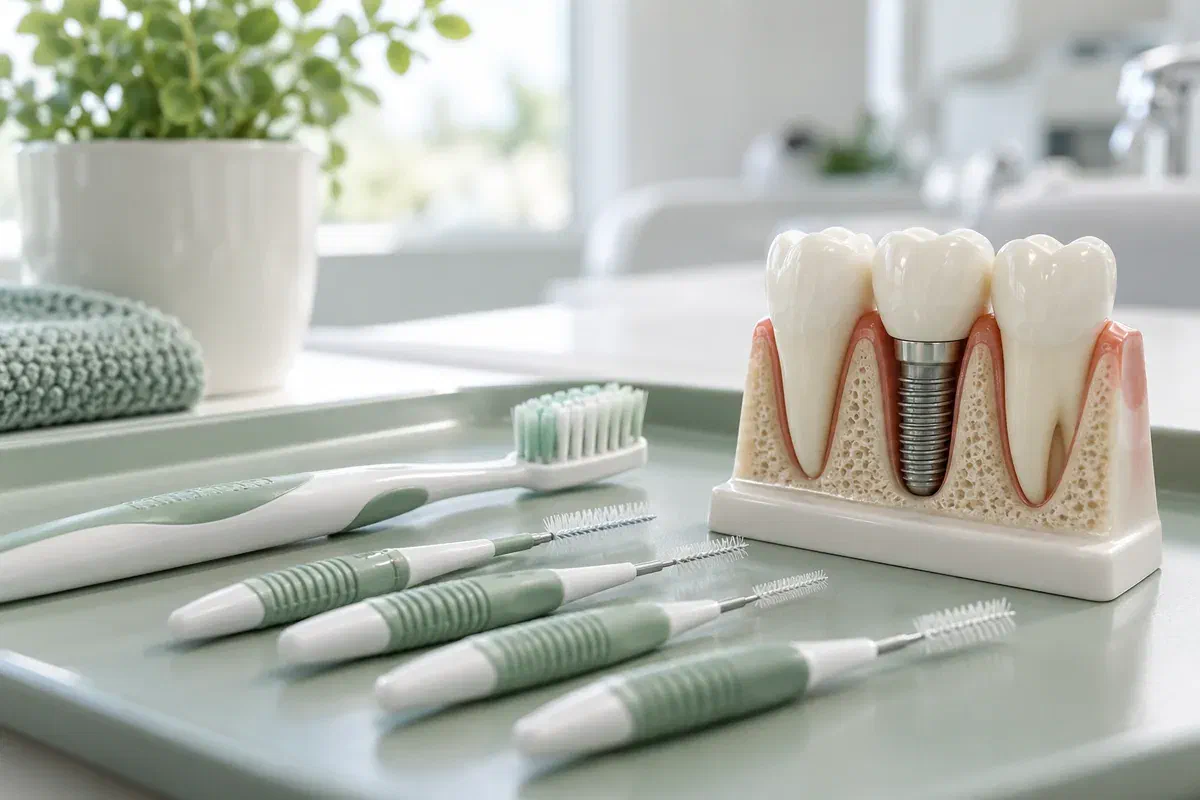
Soft toothbrush and interdental brushes beside an implant teaching model
Watch points for a gum-disease history

Early signals are easier to act on

With a periodontal history, small changes deserve more weight. Report what you see at home and let the clinician check what lies beneath, even if the implant feels completely fine while eating.

New bleeding around the implant

Bleeding during brushing or between-teeth cleaning is worth a mention every time it shows up. An exam can tell whether the issue lies in how you are cleaning or in inflammation needing care, so you are not left to avoid the area.

Spots that are slipping in your routine

Be honest about which areas get missed. Spacing and restoration shape set what fits, and a tool forced into a tight gap is no substitute for a technique shown on your own mouth.

Pockets of food or a changing restoration

Food packing, a new gap or any shift in a crown or bridge may involve the restoration itself. Those changes need assessment of their own, not simply more cleaning appointments.

Call promptly about swelling, pus or discharge, a loose implant crown or discomfort that is building. With a gum-disease history, it is better not to wait for the next scheduled cleaning.

Why closer upkeep helps

Keeping a watchful eye on vulnerable tissue

Maintenance visits remove deposits around the implant and give the clinician regular opportunities to examine the surrounding tissue. They also let you confirm that your home routine is reaching the margins and spaces where plaque tends to settle.

Even frequent care cannot guarantee that an implant will avoid complications, and established peri-implant disease may need treatment beyond cleaning. The team should explain any worrying finding and whether further assessment, care or a specialist is advisable.

Patient information: American Academy of Periodontology — peri-implant diseases

A plan that accounts for your history

Your restoration type and your periodontal history both shape the visit. If treatment was done at another practice, bring records of past gum care and implant work so the full picture is available.

Technique that keeps up with you

Demonstrations make a routine easier to sustain. Mention if grip, vision or gagging makes a method hard, and other aids or approaches can be explored with you.

Findings compared over the years

Regular review allows today's results to be read against earlier records where they exist. Ask what is being measured and why your interval was chosen given your gum history.

Coming in from Acton

A visit planned around your gum history

Your past periodontal care and today's findings shape the appointment. If there has been recent surgery near the implant, tell us so we can work alongside the clinician managing that healing.

  1. Revisit your periodontal and implant history

    We review the restoration, earlier maintenance, the gum disease you have had and any health changes. Explain your current routine and where it tends to break down.

  2. Examine tissue and restoration

    The clinician assesses the area and considers whether X-rays or other records would help. Signs of inflammation, reduced support or a restoration problem are explained before anyone concludes that cleaning is enough.

  3. Clean with implant-suited methods

    The approach fits the implant surfaces, the restoration and the findings. Point out tender spots, and ask what any added care is intended to achieve.

  4. Refine your routine and set the interval

    You practise the recommended technique and confirm which aids fit each space. Your next visit is timed with your history in mind, along with clear signs that should bring you back sooner.

Home care that counts

Consistency matters more than intensity

Gentle, thorough cleaning done every day beats occasional hard scrubbing. If part of your routine is not working, ask us about technique rather than piling up products that do not suit your restoration.

Use aids in the sizes recommended

Each interdental brush or threader should match its space. Follow the placement you practised, and if something catches or you feel uncertain, request another demonstration instead of forcing it.

Look after removable parts properly

If your appliance comes out, follow the steps you were given for the appliance and for the posts that remain behind. Check which products suit its materials and avoid household cleaners.

Keep a note of recurring changes

Bleeding, soreness, repeated food trapping or a restoration that feels different should be followed up. With a gum-disease history, contact us if it persists rather than waiting for a distant appointment.

If the tissue tells a story

Different findings, different responses

Whether routine maintenance fits or a particular issue needs care depends on what the exam shows. It is fair to ask exactly what turned up and how each recommendation responds to it.

Site is stable for now

Closer maintenance

Regular cleaning and review can keep watch over a healthy or well-managed implant. Intervals should reflect your periodontal history rather than a timetable used for everyone.

Tissue is inflamed

Managing peri-implant inflammation

First we gauge how extensive the inflammation is and what is driving it. You will learn if improved plaque control plus professional care is a reasonable first step, or if more investigation and treatment are needed.

Support or design is a concern

Restorative or specialist involvement

Bone loss around the implant, a loose component or a hard-to-clean design may need a wider plan. Ask whether a periodontist's input or restoration changes should be considered.

Acton implant questions

Gum history and implant care

Choosing the right aid and pressure is something we can work out together. Practise during the visit and leave knowing which signs mean you should call.

(905) 876-4488
Does having had gum disease make implant problems more likely?
A history of periodontal disease is generally considered a risk factor for problems around implants. That is one reason maintenance plans are individualized. Ask how your history affects your recommended care.
Is peri-implant inflammation the same as gum disease?
They are related but not identical. Both involve inflammation linked to plaque, but they affect different structures. The clinician can explain what any findings around your implant mean.
Can I still see my periodontist for my implant?
Yes, care can be shared. Let us know who else is involved so records can be coordinated, and ask how visits with each provider should be spaced.
What happens if my gum history means I need more frequent visits?
The clinician will explain why a shorter interval is recommended and what it is meant to monitor. The interval may be reviewed as your findings and home care change.
Does smoking affect the tissue around an implant?
Smoking is commonly linked with gum and implant problems. If you smoke or have recently quit, mention it so it can be considered in your care plan, and ask about support if you want it.
Is it worth combining implant upkeep with other errands when driving down from Acton?
Many people find it helps to plan trips around appointments. Let us know what else is on your list for that day, and we will look for an appointment that fits around it.
Implant maintenance for Acton

Protect the implant you worked hard for

Our Bronte Street practice can review your implant restoration and home routine with your gum history in mind. We look at access, examine anything that concerns you and tell you clearly whether ongoing maintenance is enough or more care is needed.

Mention swelling, discharge, movement or worsening discomfort when calling, so the visit can be planned as an assessment instead of routine upkeep.

Visit Milton Dental Clinic
Unit 1, 342 Bronte St. S, Milton, ON L9T 5B7
Get directions Clinic hours
Monday–Thursday
11am–7pm
Friday–Sunday
By appointment only

Areas we serve

  • Milton
  • Oakville
  • Mississauga
  • Georgetown
  • Halton Hills
  • Acton
  • Campbellville
  • Brampton
  • Burlington
  • Puslinch
  • Rockwood
  • Erin
  • Caledon
  • Etobicoke
  • Old Milton
  • Bronte Meadows
  • Timberlea
  • Dorset Park
  • Dempsey
  • Clarke
  • Beaty
  • Coates
  • Harrison
  • Scott
  • Willmott
  • Ford
  • Bowes
  • Cobden
  • Walker
  • Mountain View
  • Milton Heights
  • Hawthorne Village
  • Valley View
  • Fallingbrook
  • Nassagaweya
  • Trafalgar
  • Esquesing
  • Nelson
  • Brookville
  • Moffat
  • Glen Williams
  • Norval
  • Limehouse
  • Stewarttown
  • Ashgrove
  • Hornby
  • Silver Creek
  • Speyside
  • Scotch Block
  • North Oakville
  • River Oaks
  • Glen Abbey
  • West Oak Trails
  • Palermo
  • Bronte Creek
  • College Park
  • Joshua Creek
  • Uptown Core
  • Preserve
  • Iroquois Ridge
  • Lisgar
  • Meadowvale
  • Meadowvale Village
  • Churchill Meadows
  • Erin Mills
  • Central Erin Mills
  • Streetsville
  • East Credit
  • Creditview
  • Heartland
  • Sheridan
  • Mount Pleasant
  • Credit Valley
  • Huttonville
  • Churchville
  • Springbrook
  • Northwest Brampton
  • Bram West
  • Fletcher's Meadow
  • Fletcher's Creek South
  • Alton Village
  • Orchard
  • Millcroft
  • Headon Forest
  • Tansley
  • Brant Hills
  • Tyandaga
  • Kilbride
  • Lowville
  • Aberfoyle
  • Morriston
  • Arkell
  • Hillsburgh
  • Freelton
  • Carlisle
  • Waterdown
  • Flamborough
  • Mountsberg

How can we help?

Milton Dental Clinic

Have a question about your smile? Choose the option that works best for you.

For urgent dental concerns, please call.
Messages are reviewed during clinic hours.