

Illustrative dental hygienist demonstrating home care to an implant patient
Restorative Dentistry

Dental Implant Cleaning in Milton

A new implant crown changes what your evening routine has to reach. Close to home in Milton, we check the gum and bone around it, show you how to clean each surface, and say plainly when something needs more than maintenance.

The first months with an implant

Finished treatment, new habits

Once the final crown goes on, it is tempting to think the work is done. The crown itself will not decay the way enamel does, yet the gum and bone holding the implant can still become inflamed if plaque sits against them. That is why the site keeps needing attention long after the last treatment appointment.

What you clean depends on what was built. A lone implant crown has open spaces on either side, a fixed bridge leaves a gap underneath, and a removable overdenture has attachments that stay in the mouth. Advice printed on a package cannot know which of these you have, so the method is best shown on your own restoration.

During the visit, point out the spots your brush skips and mention any bleeding, soreness or odd taste you have noticed. Our team can cover technique while we clean, and if we find signs of disease or a loose part, we will explain why that calls for its own plan.

Book an implant cleaning in Milton
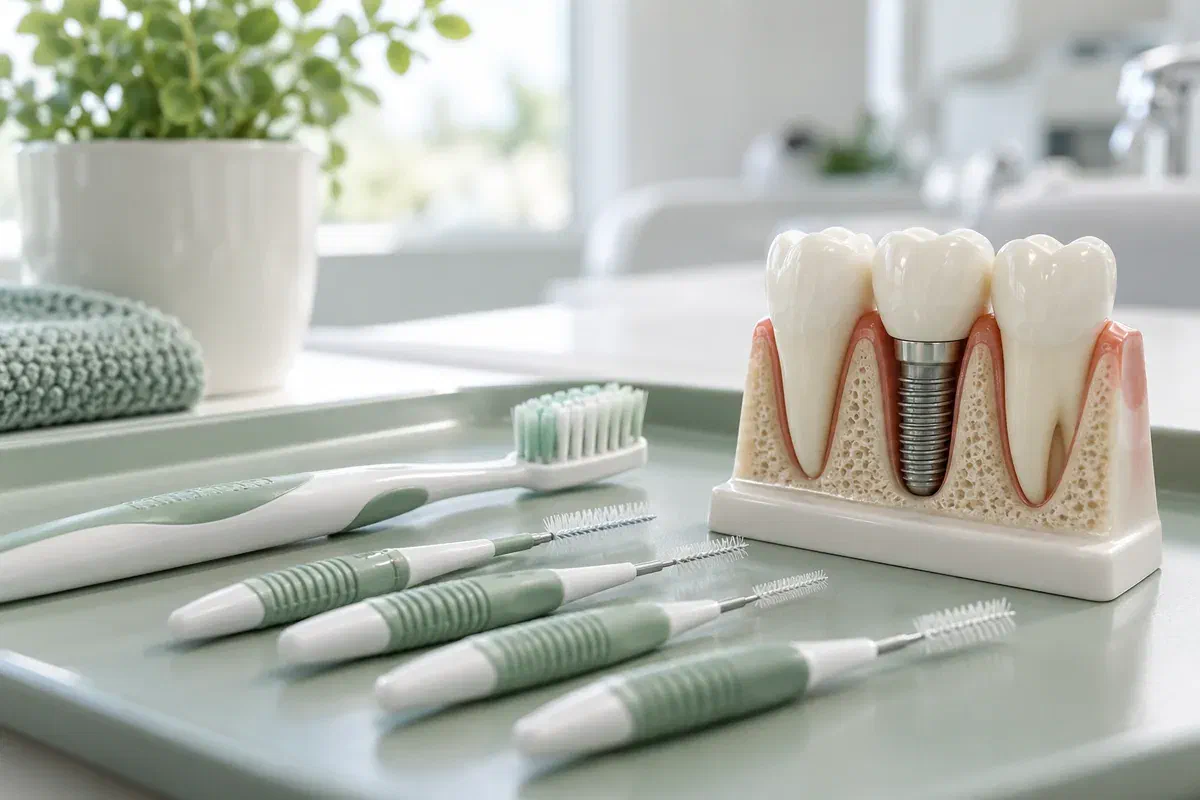
Soft toothbrush and interdental brushes beside an implant teaching model
Signs worth mentioning

When an implant feels normal but something has changed

You know the area better day to day; the clinician sees what lies below the gumline. Bring both kinds of information, including small changes, even if chewing on the implant tooth still feels completely ordinary.

Gums that bleed near the implant

Pink on the brush or a little blood after cleaning between teeth is worth reporting. We can look at the tissue and help work out whether the cause is technique or inflammation, instead of telling you to leave that spot alone.

A space your tools will not reach

Tell us where floss snags or a brush refuses to pass. Spacing and restoration design shape what will fit, and pushing harder against resistance is no replacement for being shown a method that suits the gap.

Food catching or a crown that seems different

Food that wedges in after most meals, a new gap or any shifting in a crown or bridge deserves a conversation. The restoration itself may be involved, so the answer is not always to clean more often.

Swelling, pus, an implant crown that moves or pain that keeps building should be checked soon. Call us rather than holding the question until your next scheduled cleaning.

What regular care offers

Professional visits work best alongside your own routine

A maintenance appointment lets the team remove deposits you cannot reach and look closely at the gum and supporting tissues. It is also a checkpoint for your home routine, a chance to see whether the brush and aids you use are truly reaching the surfaces they are meant for.

No cleaning schedule can promise an implant will stay free of complications, and disease that has already set in may need treatment beyond maintenance. If we see something concerning, we will explain it and say whether further assessment, care or a specialist opinion makes sense.

Patient information: American Academy of Periodontology — peri-implant diseases

Care matched to the restoration

A single crown, a bridge and a removable implant-retained appliance each call for a different approach. If your implant was restored at another office, bring whatever details you have so we can understand how it was built.

Hands-on help with tricky spaces

Being shown a technique usually helps more than a shopping list. Let us know if limited grip, eyesight or a strong gag reflex makes a method hard to use, and we can look at other ways to reach the area.

Notes that build over the years

Each visit adds to a record that later findings can be compared with. Ask what we are watching for and why the suggested interval suits your history and how the site looks right now.

Your Milton maintenance visit

From history to hands-on practice

Each visit is shaped by your implant history and what we find on the day. If you have had recent surgery around the implant, tell us first, so your care can be coordinated with the clinician who is overseeing that healing.

  1. Catch up on your history

    We ask about the kind of restoration you have, earlier maintenance, any past gum disease and changes in your health or symptoms. Describe how you clean the site now and which steps tend to get skipped.

  2. Examine the implant site

    The clinician looks at the tissue and the restoration and decides whether X-rays or other records are needed. If inflammation, reduced support or a problem with the crown shows up, we explain it rather than assuming a cleaning will cover it.

  3. Clean with implant-safe methods

    Instruments and techniques are chosen to suit implant surfaces, the restoration and what the exam showed. Speak up if any spot feels tender, and ask what any extra recommended care is meant to achieve.

  4. Practise and plan the next visit

    You try the suggested technique yourself and confirm which brush sizes fit your spaces. We then talk about how soon to return and which changes should prompt a call before that date.

Your routine at home

Reach the right surfaces, every day

The best routine is one you can comfortably repeat and that is aimed at the spots that matter. When something is not working, ask for help with your technique instead of buying product after product that never quite fits.

Stick with the sizes you were shown

An interdental brush or threader should match the space it goes into. Use it the way the clinician demonstrated, and if it starts to catch or feel forced, stop and ask for another look rather than pushing through.

Clean removable parts the right way

If your appliance comes out, ask how to look after both the appliance and the attachments that stay in your mouth. Check which cleaners suit its materials, and never reach for a household product instead.

Notice what keeps coming back

Repeated bleeding, tenderness, food that keeps catching or a change in how the restoration feels all deserve attention. Contact us if a problem lingers, even when your next maintenance visit is months off.

Matching care to findings

Maintenance, treatment or a wider review

What we see decides whether ongoing cleaning is enough or whether a particular problem needs its own care. Ask us to name what we found and which part of our suggestion is meant to deal with it.

For a stable implant site

Ongoing professional maintenance

Regular cleaning and review suit an implant that is healthy or well managed. Your interval and home instructions should reflect your own history, not a single timetable applied to everyone.

For gums that need care

Treating inflamed tissue

When inflammation appears, we look at how far it extends and what may be feeding it. The clinician can explain whether better plaque control plus professional care will do, or whether more investigation and treatment are needed.

For problems cleaning cannot fix

Restorative or specialist review

A design that is hard to keep clean, a loose component or loss of support may need a broader plan. Ask whether changes to the restoration or a specialist assessment should sit alongside your hygiene routine.

Implant cleaning questions

Straight answers for life after placement

You do not have to work out which aid fits where on your own. Bring your questions, practise the routine in the chair, and leave knowing which changes mean you should call us.

(905) 876-4488
When should my first implant cleaning happen after the crown is placed?
The timing depends on how the site healed and what the clinician who restored it recommends. Ask at your final restorative appointment when a first maintenance visit makes sense, and let us know if anything feels different before then.
Can I use my regular toothbrush on an implant crown?
Often a soft brush is part of the routine, but the crown is only one surface. The areas beside and under the restoration may need an interdental brush or another aid, so ask us to check what your current brush is missing.
Does an implant still need cleaning when it cannot decay?
Yes. The crown and implant do not get cavities, but plaque can still inflame the gum and affect the bone around them. Your natural teeth nearby also still need their regular preventive care and checkups.
Is it normal for the gum around a new implant to look different from my other teeth?
The tissue around an implant can look and feel a little different from gum around a natural tooth. What matters more is change, such as bleeding, swelling or soreness, so mention anything new and the clinician can assess it.
What should I do if a fixed implant bridge feels loose?
Call the clinic and describe what you notice. Do not try to tighten, remove or test it yourself. A loose component needs to be assessed so the cause can be found, whether it involves the restoration, the implant or the tissue.
How do you decide how often I should come in for implant cleaning?
We base the interval on your gum history, how the tissue looks now, how well you can reach the area and how the restoration is designed. Ask why a schedule was chosen and whether it should change if your health or routine does.
Implant care in Milton

Keep your implant on a routine that works

Book time at our Bronte Street practice to have your implant restoration reviewed alongside your daily cleaning. We will look at access, check any areas that worry you and explain whether maintenance or further care is the right next step.

When you call, mention any swelling, discharge, movement or pain that is getting worse, so the team can arrange an assessment instead of a routine maintenance slot.

Visit Milton Dental Clinic
Unit 1, 342 Bronte St. S, Milton, ON L9T 5B7
Get directions Clinic hours
Monday–Thursday
11am–7pm
Friday–Sunday
By appointment only

Areas we serve

  • Milton
  • Oakville
  • Mississauga
  • Georgetown
  • Halton Hills
  • Acton
  • Campbellville
  • Brampton
  • Burlington
  • Puslinch
  • Rockwood
  • Erin
  • Caledon
  • Etobicoke
  • Old Milton
  • Bronte Meadows
  • Timberlea
  • Dorset Park
  • Dempsey
  • Clarke
  • Beaty
  • Coates
  • Harrison
  • Scott
  • Willmott
  • Ford
  • Bowes
  • Cobden
  • Walker
  • Mountain View
  • Milton Heights
  • Hawthorne Village
  • Valley View
  • Fallingbrook
  • Nassagaweya
  • Trafalgar
  • Esquesing
  • Nelson
  • Brookville
  • Moffat
  • Glen Williams
  • Norval
  • Limehouse
  • Stewarttown
  • Ashgrove
  • Hornby
  • Silver Creek
  • Speyside
  • Scotch Block
  • North Oakville
  • River Oaks
  • Glen Abbey
  • West Oak Trails
  • Palermo
  • Bronte Creek
  • College Park
  • Joshua Creek
  • Uptown Core
  • Preserve
  • Iroquois Ridge
  • Lisgar
  • Meadowvale
  • Meadowvale Village
  • Churchill Meadows
  • Erin Mills
  • Central Erin Mills
  • Streetsville
  • East Credit
  • Creditview
  • Heartland
  • Sheridan
  • Mount Pleasant
  • Credit Valley
  • Huttonville
  • Churchville
  • Springbrook
  • Northwest Brampton
  • Bram West
  • Fletcher's Meadow
  • Fletcher's Creek South
  • Alton Village
  • Orchard
  • Millcroft
  • Headon Forest
  • Tansley
  • Brant Hills
  • Tyandaga
  • Kilbride
  • Lowville
  • Aberfoyle
  • Morriston
  • Arkell
  • Hillsburgh
  • Freelton
  • Carlisle
  • Waterdown
  • Flamborough
  • Mountsberg

How can we help?

Milton Dental Clinic

Have a question about your smile? Choose the option that works best for you.

For urgent dental concerns, please call.
Messages are reviewed during clinic hours.