

Illustrative dental hygienist demonstrating home care to an implant patient
Restorative Dentistry

Dental Implant Cleaning in Old Milton

Had your implant for years, maybe placed by a dentist you no longer see? Near Old Milton, our team can pick up its care, gather what records exist, and review how the gum, bone and restoration are holding up today.

Implants with a long history

Years in place, still worth watching

Many implants quietly do their job for a long time, and that success can make them easy to overlook. Titanium and porcelain do not get cavities, but the tissue wrapped around an implant can still react to plaque, and that reaction may develop slowly without much discomfort.

An implant restored a decade ago may also differ from today's designs. Knowing whether you have a single crown, a bridge spanning several implants or an overdenture that snaps onto attachments tells us which surfaces are hard to reach. Your cleaning method should be fitted to that particular build.

Before or at the appointment, share anything you remember about who placed the implant and when. Mention bleeding, tenderness or a strange taste too. We will combine cleaning with a technique check, and if we find disease or a worn component, we will explain why separate treatment may be needed.

Arrange a review of your implant
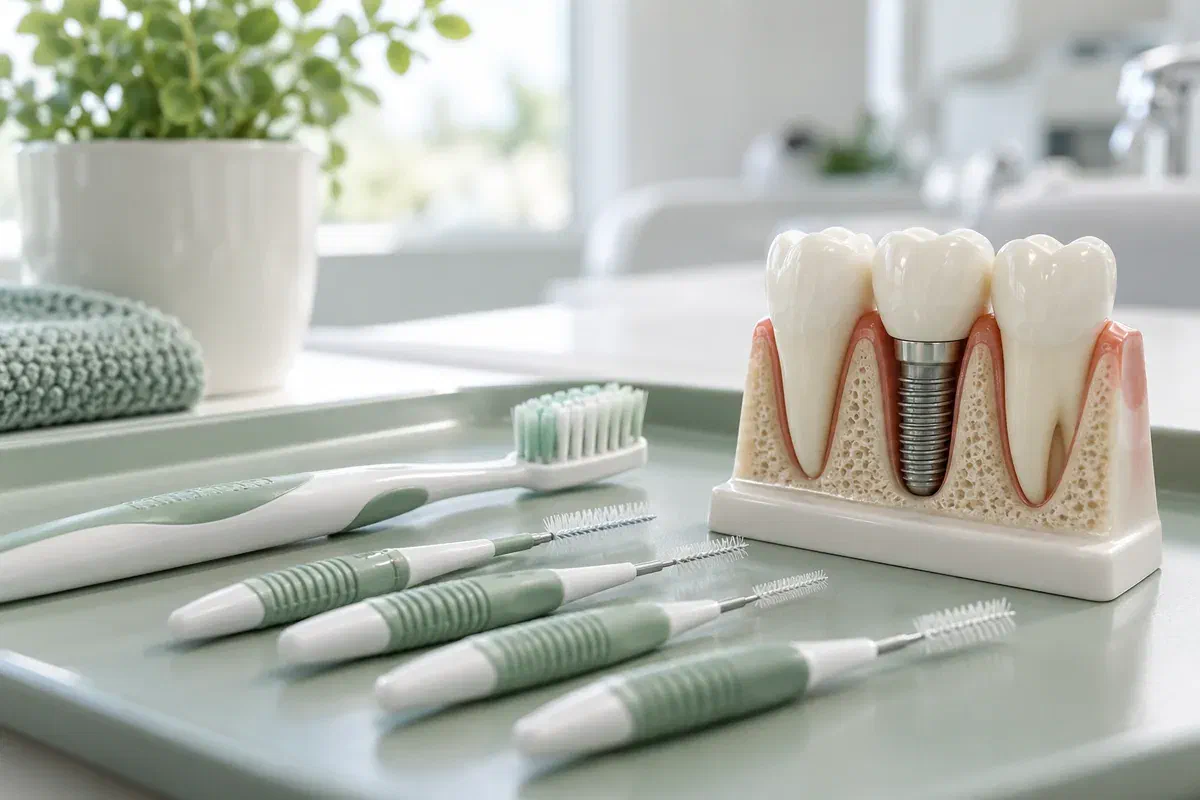
Soft toothbrush and interdental brushes beside an implant teaching model
Changes to bring up

What a comfortable implant can hide

Long-standing implants are judged on more than how they feel at dinner. Your observations at home and the clinician's examination together give the clearest picture, so raise any concern even if eating feels normal.

Tender or bleeding gum tissue

Blood when you brush or clean between teeth near the implant should be mentioned. The clinician can examine the tissue and help decide whether your method needs adjusting or inflammation needs care, rather than suggesting you avoid the spot.

A surface you have stopped reaching

Over time, people sometimes quietly give up on an awkward gap. Show us where cleaning has become hard, because the shape of the restoration matters, and the right demonstration will do more than forcing an aid in.

Trapped food or a restoration that has shifted

Food packing in, a widening space or slight movement in a crown or bridge can point to the restoration as well as hygiene. These changes call for a proper look, not simply a more frequent cleaning schedule.

A restoration that wobbles, gum swelling, discharge or discomfort that keeps increasing needs prompt attention. Call the clinic rather than waiting for a planned maintenance date.

Why steady upkeep matters

Pairing chairside care with daily effort

Professional maintenance removes buildup and gives the clinician a careful look at the tissues around your implant. It is equally a chance to test your home routine, confirming whether the tools in your bathroom are actually cleaning the places they were bought for.

Regular cleaning cannot rule out complications, and problems already established may need more than a maintenance visit. When findings raise concern, the team should explain them and say whether further assessment, treatment or a specialist referral is warranted.

Patient information: American Academy of Periodontology — peri-implant diseases

Care built around your restoration

A crown, a bridge and a removable implant-retained appliance each need a different review. If the work was done at another office, bring any notes, cards or records you have kept so we understand the existing setup.

Coaching for awkward spaces

Watching a technique often makes it far easier than reading a product label. Mention if stiff hands, changing vision or gagging gets in the way, and alternatives can be talked through with you.

A running picture of change

Repeated visits let current findings be read against earlier records when those exist. Ask what the clinician is tracking and how your interval connects to your history and current needs.

What happens at the visit

Four steps, starting with your story

The plan reflects where your implant came from and how it looks now. If you have had surgery on the site recently, let the team know so care can be coordinated with whoever is supervising your healing.

  1. Piece together the history

    We talk through the restoration type, past maintenance, any previous gum disease and recent health changes. Explain how you clean around it now and which parts of that routine are hardest to keep up.

  2. Look closely at tissue and restoration

    The clinician assesses the area around the implant and considers whether images or other records would help. Any sign of inflammation, lost support or a restoration issue is explained before cleaning is assumed to be enough.

  3. Clean in a way that suits implants

    Methods are chosen for the implant surfaces, the restoration and what the assessment found. Tell the team about any tender spots and ask what each additional step of care is meant to do.

  4. Rehearse your routine and set a return

    You practise the method suited to your restoration and confirm which aids fit each space. The next visit is timed to your needs, along with clear signs that should prompt an earlier phone call.

Daily care between visits

A routine you can keep for years

Habits last when they are comfortable and aimed at the right places. If a tool is not working, ask for a refresher on technique instead of filling a drawer with products that do not suit your restoration.

Use the aids you were fitted with

Interdental brushes and threaders should match the gap and the restoration. Place and move them as shown, and if you feel unsure or meet resistance, ask for another demonstration rather than forcing them.

Look after removable parts properly

For an appliance that comes out, learn how to clean the appliance itself and the attachments left in your mouth. Check which products suit its materials and do not substitute household cleaners.

Watch for changes that linger

Ongoing bleeding, soreness, food that keeps getting caught or a different feel to the restoration are worth reporting. Contact us if something persists, even if your next maintenance visit is a while away.

Deciding what comes next

Not every finding needs the same answer

Whether routine cleaning fits or a specific problem needs treatment depends on what is found. Ask what was identified and which part of the recommendation is aimed at it.

If the site is stable

Regular maintenance visits

Ongoing cleaning and review can be scheduled around a healthy or well-controlled implant. Intervals and home instructions should match your own history rather than one fixed plan for everybody.

If the gum needs treatment

Managing inflamed tissue

Inflammation is assessed for how far it extends and what is contributing. The clinician can explain whether stronger plaque control and professional care should be enough or further tests and treatment are needed.

If cleaning cannot resolve it

Restoration changes or specialist input

A design that is hard to clean, a loose part or disease affecting support may call for a wider response. Ask whether restorative work or a specialist opinion should be considered alongside your hygiene routine.

Old Milton implant questions

About older implants and ongoing care

Nobody expects you to know which brush suits which gap. Use the appointment to try the technique and learn which warning signs mean it is time to come back sooner.

(905) 876-4488
My implant was placed many years ago. Is it too late to start regular maintenance?
It is not too late to begin. The clinician will assess the current condition of the tissue and restoration, then explain what maintenance and home care make sense from here, along with anything that needs further attention.
What if I do not know what brand or system my implant is?
Bring whatever you have, such as an implant card, old invoices or the name of the office that placed it. The team can request records where possible and will assess the site as it is today.
Can older implant crowns wear or loosen over time?
Restorations and their components can change with years of use. Mention any movement, rough edges or a different bite feel. The clinician will look at the restoration and explain whether repair, adjustment or monitoring is appropriate.
Does the gum around an implant bleed for the same reasons as around a tooth?
Plaque-related inflammation can affect both, though the tissues are not identical. Do not abandon the area or scrub harder. Arrange an assessment so the team can find out why bleeding is happening and guide a gentle technique.
Do I need a water flosser for an older implant bridge?
Not automatically. Some people find one helpful, but whether it belongs in your routine depends on the space under the bridge, your technique and what else you use. Ask for a demonstration tailored to your restoration.
If I live in the historic part of town, can I combine implant cleaning with my regular checkup?
Often the visits can be planned together, depending on what your implant and natural teeth need. Mention it when booking, and the team can suggest how to arrange the appointments around your schedule.
Implant upkeep close to Old Milton

Give a long-standing implant some attention

Visit our Bronte Street practice, close to Milton's historic downtown, to have your implant restoration and cleaning routine reviewed. We can look at access, check any area that concerns you and explain what maintenance or extra care would help.

If you notice swelling, discharge, movement or pain that is getting worse, say so when you call, so the team can plan an assessment rather than routine maintenance.

Visit Milton Dental Clinic
Unit 1, 342 Bronte St. S, Milton, ON L9T 5B7
Get directions Clinic hours
Monday–Thursday
11am–7pm
Friday–Sunday
By appointment only

Areas we serve

  • Milton
  • Oakville
  • Mississauga
  • Georgetown
  • Halton Hills
  • Acton
  • Campbellville
  • Brampton
  • Burlington
  • Puslinch
  • Rockwood
  • Erin
  • Caledon
  • Etobicoke
  • Old Milton
  • Bronte Meadows
  • Timberlea
  • Dorset Park
  • Dempsey
  • Clarke
  • Beaty
  • Coates
  • Harrison
  • Scott
  • Willmott
  • Ford
  • Bowes
  • Cobden
  • Walker
  • Mountain View
  • Milton Heights
  • Hawthorne Village
  • Valley View
  • Fallingbrook
  • Nassagaweya
  • Trafalgar
  • Esquesing
  • Nelson
  • Brookville
  • Moffat
  • Glen Williams
  • Norval
  • Limehouse
  • Stewarttown
  • Ashgrove
  • Hornby
  • Silver Creek
  • Speyside
  • Scotch Block
  • North Oakville
  • River Oaks
  • Glen Abbey
  • West Oak Trails
  • Palermo
  • Bronte Creek
  • College Park
  • Joshua Creek
  • Uptown Core
  • Preserve
  • Iroquois Ridge
  • Lisgar
  • Meadowvale
  • Meadowvale Village
  • Churchill Meadows
  • Erin Mills
  • Central Erin Mills
  • Streetsville
  • East Credit
  • Creditview
  • Heartland
  • Sheridan
  • Mount Pleasant
  • Credit Valley
  • Huttonville
  • Churchville
  • Springbrook
  • Northwest Brampton
  • Bram West
  • Fletcher's Meadow
  • Fletcher's Creek South
  • Alton Village
  • Orchard
  • Millcroft
  • Headon Forest
  • Tansley
  • Brant Hills
  • Tyandaga
  • Kilbride
  • Lowville
  • Aberfoyle
  • Morriston
  • Arkell
  • Hillsburgh
  • Freelton
  • Carlisle
  • Waterdown
  • Flamborough
  • Mountsberg

How can we help?

Milton Dental Clinic

Have a question about your smile? Choose the option that works best for you.

For urgent dental concerns, please call.
Messages are reviewed during clinic hours.