

Illustrative dental hygienist demonstrating home care to an implant patient
Restorative Dentistry

Dental Implant Cleaning in Puslinch

Stiff fingers, changing eyesight or a strong gag reflex can turn implant cleaning into a nightly struggle. For people coming from Puslinch, our Milton team adapts the routine to what your hands can manage, cleans the restoration and checks the gum.

When the routine is physically hard

Tools that suit your hands, not the other way round

Tiny interdental brushes and fiddly threaders assume steady fingers, good light and a mouth that tolerates a tool at the back. Arthritis, a tremor, reduced vision or gagging can make every evening feel like a battle, and skipped steps often follow.

Those missed surfaces matter. Although an implant crown is not vulnerable to cavities, plaque left near it can still inflame the gum and bone that support it. The hardest spots differ by restoration: the sides of a single crown, the underside of a fixed bridge, or the posts beneath a removable overdenture.

Tell us plainly what is difficult, and mention any bleeding, tenderness or unusual taste. Besides cleaning the area, we try different handles, angles and aids with you until something is manageable, and we explain if the exam reveals disease or a loose part that needs its own plan.

Arrange an adapted implant visit
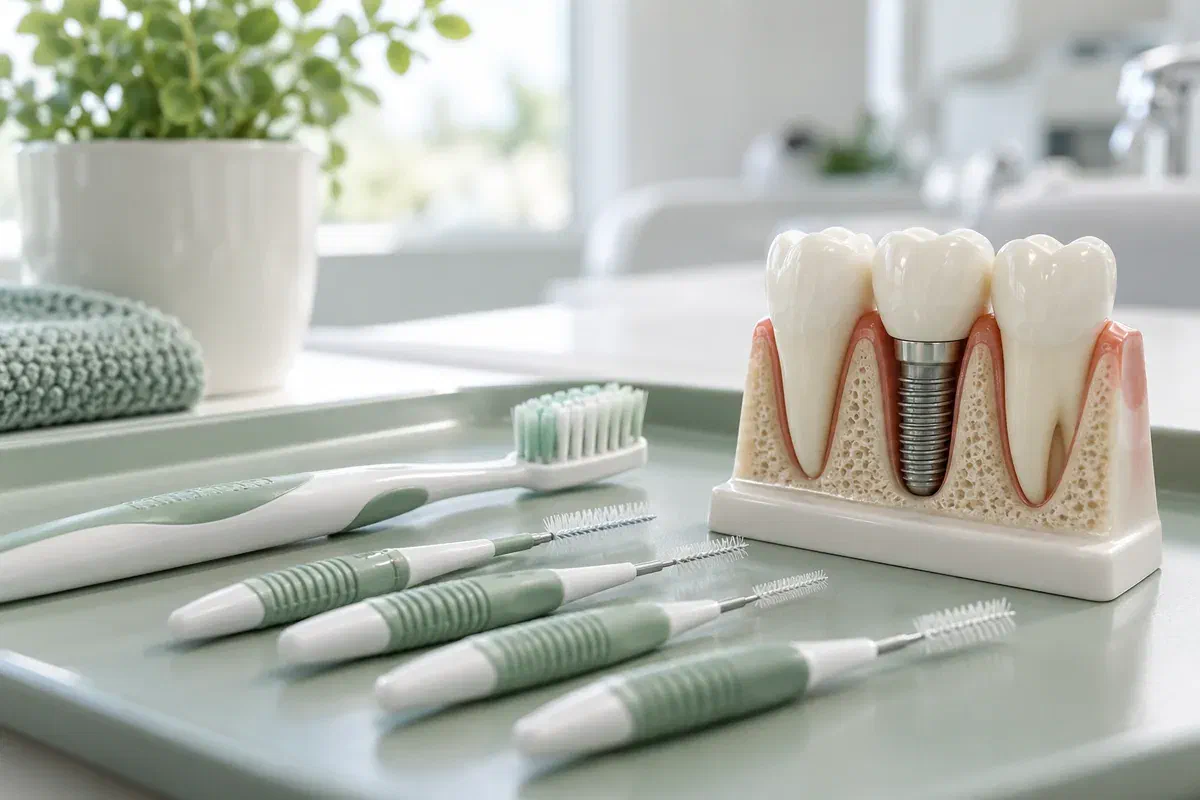
Soft toothbrush and interdental brushes beside an implant teaching model
Signs to raise with us

Struggling to clean is itself worth reporting

If parts of the routine have slipped because they are physically hard, say so. Your account plus a clinical look shows where things stand, even when the implant tooth still chews comfortably.

Bleeding where cleaning is hardest

Gum that bleeds in the areas you find awkward to reach may be telling you plaque is staying there. An exam can separate a reach problem from inflammation that needs care, and neither should mean giving up on the spot.

An aid you cannot grip or guide

Small handles, thin wires and threaders can be tough to control. Let us see what you use; a thicker handle, a different aid or another angle may work far better than pushing on.

Food catching or a restoration that feels unusual

Food packing, a new space or movement in a crown or bridge may stem from the restoration rather than your cleaning. Those concerns should be assessed instead of simply adding more hygiene steps.

Swelling, discharge, a loose restoration or pain that is getting worse needs a prompt look. Please call rather than waiting for a planned maintenance appointment.

How regular visits help

Professional support where home care falls short

When reaching every surface is hard, professional cleaning becomes even more useful. The team removes buildup and examines the gum around the implant, and each visit is a chance to rework the parts of your routine that have become difficult.

Maintenance, however regular, is not a guarantee against implant complications, and established disease may need treatment beyond cleaning. Concerning findings will be explained along with whether you need further assessment, care or a specialist's view.

Patient information: American Academy of Periodontology — peri-implant diseases

A review that considers your restoration

Crowns, bridges and dentures that clip onto implants each need different handling. If yours was made elsewhere, bring any details you have so the team knows how it fits together.

Adaptations you can actually use

Options may include different handle shapes, powered brushes or alternative aids, depending on your needs. Tell us what has been hard so the suggestions are realistic for you.

Progress you can see over time

Comparing each visit with earlier notes, where available, shows whether adaptations are working. Ask what is being tracked and how your interval reflects your history and abilities.

Visiting from Puslinch

An unhurried visit with hands-on practice

We build the appointment around your implant history, findings and what you can comfortably manage. If you have had recent surgery near the implant, tell us so we stay in step with the clinician supervising your recovery.

  1. Talk about history and difficulties

    We review the restoration, past maintenance, any gum disease and health changes, including conditions affecting your hands or vision. Describe which steps you can and cannot manage.

  2. Examine around the implant

    The clinician checks the tissue and restoration and decides whether imaging would help. Inflammation, reduced support or a restoration problem is explained before cleaning is presumed to be enough.

  3. Clean the site with care

    Instruments are picked with the implant's surfaces, your restoration and today's results in mind. We can pause whenever you need to. Mention tender spots or gagging, and ask what any extra care is for.

  4. Trial adapted aids and plan ahead

    You try different tools and positions until one works for you. We then agree on a return interval and talk through signs that should prompt an earlier call.

Making home care manageable

Simpler, steadier, still thorough

A routine you can physically keep up is better than a perfect one you avoid. When a step stops working, call and we will rethink it with you, so you are not left buying more tools that may not suit your hands or your restoration.

Stick with the adapted tools

Use the aids and handle styles chosen for you, in the way you practised. If one starts to catch or your grip changes, call for another demonstration instead of forcing it.

Handle removable parts safely

If your appliance comes out, clean it over a folded towel or a sink of water in case it slips. Clean the posts left in the mouth as shown, and avoid household cleaners.

Speak up about lasting changes

Persistent bleeding, soreness, food trapping or a restoration that feels different deserves follow-up. Get in touch if it continues, even when your next maintenance is some way off.

What comes after the exam

Maintenance or more: it depends on findings

The exam shows whether routine upkeep suits you or a specific problem needs care. You are entitled to hear what was seen and how each recommendation answers it.

Implant is stable

Supported maintenance

Regular cleaning and review can help keep a healthy or managed implant on track. Your interval may reflect how much of the cleaning you can manage at home.

Tissue is inflamed

Treating gum inflammation

We look at how much inflammation there is and what is feeding it. The clinician can explain whether adapted home care with professional cleaning may be enough, or if more investigation and treatment are needed.

Design or support is the issue

Restoration or specialist options

A restoration that is very hard to clean, a loose component or bone loss may call for a broader plan. Ask whether design changes or specialist assessment could make long-term care easier.

Puslinch implant care questions

When cleaning is hard on your hands

You do not have to find the right tool by trial and error. Handle several options yourself during the appointment, and go home with a short list of warning signs that mean it is time to phone us.

(905) 876-4488
Is a powered toothbrush helpful if I have arthritis?
Some people with limited grip find a powered brush easier, but it does not reach every implant surface on its own. Ask the clinician which combination of tools suits your hands and restoration.
Can a family member or caregiver learn my implant routine?
Yes. Bring them to the appointment if you are comfortable, and the team can demonstrate the technique so they can help at home. It often helps for them to watch you practise as well, so they understand where you need a hand and which aid belongs in each space.
What can I do if I gag when cleaning around a back implant?
Mention it, since there are often ways to adjust the aid, angle or timing. The clinician can try alternatives with you so cleaning the area becomes more tolerable.
Are there implant cleaning aids with larger handles?
Many aids come in different handle sizes and shapes. The team can show you options and help you check which ones still fit the spaces around your restoration. Bring anything you already own, because a familiar tool that fits may be worth keeping.
Does a weaker routine mean I need more frequent cleanings?
It may be one factor. The clinician considers your gum history, findings and how well you can clean when recommending an interval, and can explain the reasoning.
Can a longer appointment be booked when coming from Puslinch?
Mention that you would like extra time for practice when you call. The team will look at what can be arranged around your needs, and whether a second short session to fine-tune the routine makes sense.
Implant cleaning for Puslinch

A routine your hands can keep up with

At our Bronte Street practice, we clean around your implant restoration and work with you on tools you can actually use. We check access, examine any area of concern and explain whether routine upkeep or further care is right.

When calling, mention any swelling, discharge, movement or increasing pain, so we can schedule an assessment rather than a routine maintenance visit.

Visit Milton Dental Clinic
Unit 1, 342 Bronte St. S, Milton, ON L9T 5B7
Get directions Clinic hours
Monday–Thursday
11am–7pm
Friday–Sunday
By appointment only

Areas we serve

  • Milton
  • Oakville
  • Mississauga
  • Georgetown
  • Halton Hills
  • Acton
  • Campbellville
  • Brampton
  • Burlington
  • Puslinch
  • Rockwood
  • Erin
  • Caledon
  • Etobicoke
  • Old Milton
  • Bronte Meadows
  • Timberlea
  • Dorset Park
  • Dempsey
  • Clarke
  • Beaty
  • Coates
  • Harrison
  • Scott
  • Willmott
  • Ford
  • Bowes
  • Cobden
  • Walker
  • Mountain View
  • Milton Heights
  • Hawthorne Village
  • Valley View
  • Fallingbrook
  • Nassagaweya
  • Trafalgar
  • Esquesing
  • Nelson
  • Brookville
  • Moffat
  • Glen Williams
  • Norval
  • Limehouse
  • Stewarttown
  • Ashgrove
  • Hornby
  • Silver Creek
  • Speyside
  • Scotch Block
  • North Oakville
  • River Oaks
  • Glen Abbey
  • West Oak Trails
  • Palermo
  • Bronte Creek
  • College Park
  • Joshua Creek
  • Uptown Core
  • Preserve
  • Iroquois Ridge
  • Lisgar
  • Meadowvale
  • Meadowvale Village
  • Churchill Meadows
  • Erin Mills
  • Central Erin Mills
  • Streetsville
  • East Credit
  • Creditview
  • Heartland
  • Sheridan
  • Mount Pleasant
  • Credit Valley
  • Huttonville
  • Churchville
  • Springbrook
  • Northwest Brampton
  • Bram West
  • Fletcher's Meadow
  • Fletcher's Creek South
  • Alton Village
  • Orchard
  • Millcroft
  • Headon Forest
  • Tansley
  • Brant Hills
  • Tyandaga
  • Kilbride
  • Lowville
  • Aberfoyle
  • Morriston
  • Arkell
  • Hillsburgh
  • Freelton
  • Carlisle
  • Waterdown
  • Flamborough
  • Mountsberg

How can we help?

Milton Dental Clinic

Have a question about your smile? Choose the option that works best for you.

For urgent dental concerns, please call.
Messages are reviewed during clinic hours.