

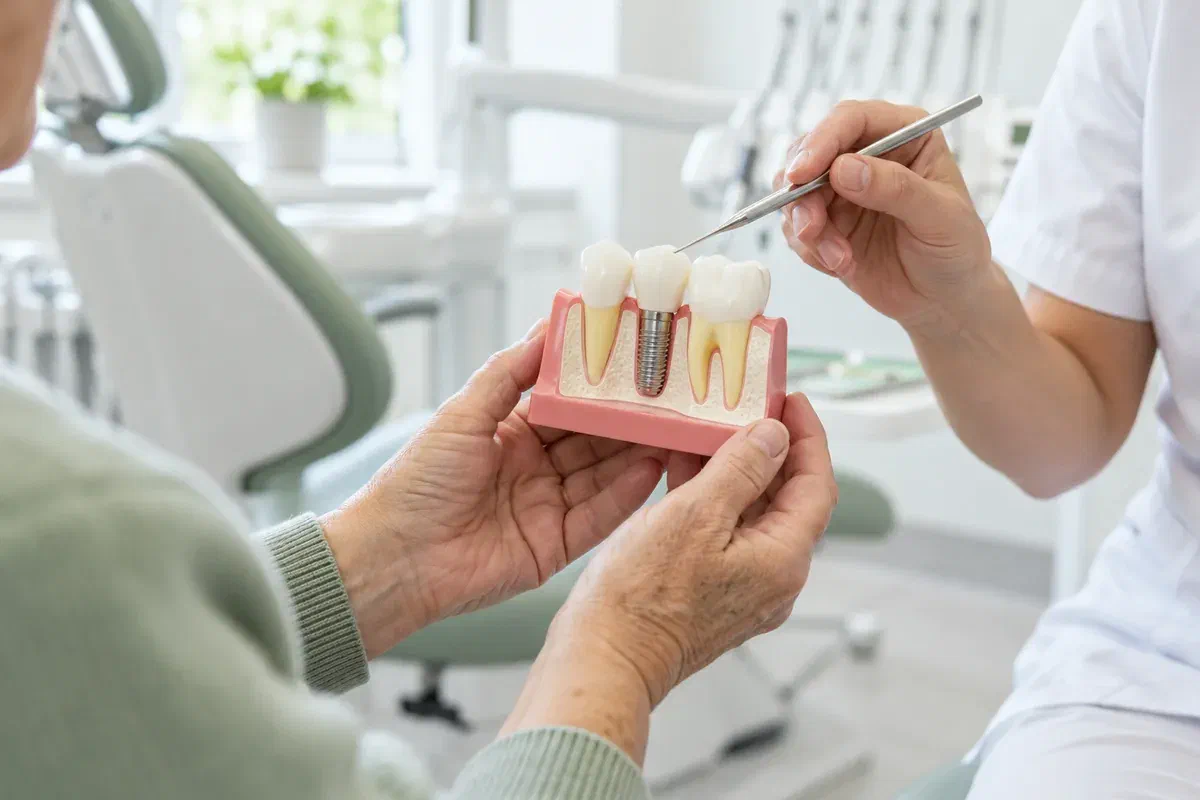
Illustrative older adult discussing implant options with a dentist
Restorative Dentistry

Dental Implant Consultations for Seniors in Acton

Told long ago that implants were not for you? Seniors travelling from Acton can have that question looked at again, with a fresh examination, an honest review of health and bone, and a fair comparison with denture options.

Revisiting an old answer

An answer from years ago deserves a second look.

Maybe a dentist once said there was not enough bone, or that your health made it unwise, or simply that a denture would do. Circumstances and techniques both change. Asking again is not about chasing a different answer. It is about getting one that reflects your mouth and your life as they are now.

A fresh assessment still starts from first principles: would implant treatment be appropriate and worth it for you? Being older is not a reason to rule it out. Instead, the dentist looks closely at your medical background, gums and jawbone, remaining teeth, the demands of treatment, and the daily cleaning involved.

Making the trip from Acton for this conversation is a good moment to bring along any old records or notes you still have. A companion is welcome too. You will hear what has or has not changed, what an implant could and could not do, the alternatives, and the care that follows.

Request a fresh assessment
Older patient's hands holding an implant teaching model during a consultation
What a new assessment covers

Then and now

Your earlier answer was based on a snapshot. A current review considers today's health and mouth, and also the practical side: appointments, healing time, a cleaning routine and years of maintenance.

Health that may have shifted

Some conditions improve, others appear, and medicines change over the years. Bring an up-to-date list and recent medical history so the dentist can reconsider planning and healing and decide whether your doctor should be involved.

The denture you settled for

If you accepted a denture back then, explain how it is working now: does it move, irritate, look tired or limit meals? Bring it in. Sometimes improving it is the most sensible step, whatever the implant answer.

Practical life today

Describe your grip, eyesight, mobility, transport and any help at home as they are now. These shape which replacement would be realistic and how its upkeep would need to be organized going forward.

Please keep taking your medicines as prescribed while you look into implants again. Any change made for dental reasons has to be planned individually with the clinicians in charge of your care.

Why ask again

A current answer beats an old assumption.

Anchor the review to one specific goal, such as a lower denture that will not settle or a gap that makes chewing awkward. With the goal stated, you can weigh whether any newly possible treatment would bring enough improvement to justify what it involves.

A second look does not guarantee a different conclusion, and implants are not automatically right just because they might now be possible. A balanced discussion covers your wishes, your health, what the examination finds, and how a replacement could be maintained over time.

Patient information: ITI — advanced age and medical conditions in implant care

Your goals frame the review

Explain what you most want to improve and what you would rather not go through. Options are then compared against those wishes, instead of assuming the most ambitious treatment is the target.

Bone and gum are assessed today

Imaging and examination show the current state of the jaw. If bone is limited, the dentist can explain whether additional procedures might be discussed, what they would add to treatment, and whether simpler choices make more sense.

Maintenance is part of the answer

Ask how any proposed replacement would be cleaned, repaired and checked over the years. A plan you can sustain is worth more than one that only looks good on the day it is finished.

How the review works

Starting over, carefully

You can have things repeated, noted on paper, or explained to the person with you. This visit exists to make the current picture clear, and nothing is booked unless you choose it.

  1. Share the history

    Tell the dentist what you were told before, which teeth are missing, and what appliance you wear. Mention worries about surgery, cost, recovery or upkeep at the start so they inform the review.

  2. Examine and image afresh

    Your medical history and medicines are reviewed, then gums, remaining teeth and existing work are examined. New X-rays or other records may be advised to understand the bone as it is today.

  3. Set out what is realistic now

    Compare implant and non-implant choices, the stages each involves, the effort required and the upkeep that follows. If another clinician should weigh in, ask which question that referral is meant to resolve.

  4. Decide what you want next

    You may want more detail, time to reflect, or detailed planning. A written outline of any agreed appointments helps, along with a note of existing problems that should be treated regardless.

Afterwards

Compare the new answer with the old one.

A review can introduce unfamiliar terms and more than one route. Keep the written notes alongside any older records and the clinic's number, so you can see what has changed, weigh the options and follow up.

Is it the improvement you wanted?

Reflect on whether the proposed treatment would truly address what made you ask again. List questions about fees, healing, temporary teeth or maintenance rather than relying on memory.

Line up help if needed

If you would need transport, a second listener or someone at home after a procedure, sort that out before treatment is booked. A trusted person can handle arrangements while you make the call.

Keep your information current

New medicines, medical care or changes in how easily you manage daily cleaning can alter the advice. Share updates before procedures and at later reviews so the plan stays suitable.

Choices to compare today

Three directions, weighed fairly

Approaches trade stability, effort, cleaning and expense in different ways. Only an assessment can show what suits you, and the most involved plan is not automatically the one that best fits your goals.

When the appliance is worn or ill-fitting

A better version of your denture

An adjustment, reline or new denture may resolve a fit or design issue without surgery. Ask what improvement to expect and what would still be limited, particularly if your gums have changed shape over the years.

When more retention is now worth assessing

Implants holding a removable denture

In suitable mouths, implants may help secure certain removable denture designs. Discuss the surgery, any extra preparation the bone might need, the attachments and their upkeep, and daily removal for cleaning.

When the mouth and maintenance allow

Fixed teeth or a different approach

A crown on an implant or a fixed implant bridge may be considered for an appropriate gap, and a conventional bridge could also be relevant. Compare cleaning access, repairs and the full sequence of visits.

Second-look questions

What people ask when revisiting implants

Every person's goals, health and support differ. These questions explore how a fresh assessment works and what it can and cannot tell you.

(905) 876-4488
I was told I did not have enough bone. Is that still true?
It may be, or the situation may now be viewed differently. Current imaging can show the bone as it is today, and the dentist can explain whether extra procedures could be discussed or whether other options make more sense.
Should I bring old X-rays or notes from my previous dentist?
If you have them, yes. Older records can show how things have changed. You can also ask a previous clinic to send records. New images may still be needed to assess your mouth today.
Can a health condition that once ruled out implants be reconsidered?
Possibly. How a condition is managed now, and your medicines, will be reviewed. Some situations may still make implants unsuitable. The dentist may seek your physician’s input before giving an answer.
Does turning seventy or eighty make implants less likely?
Age alone is not the deciding factor. Health, oral condition, the expected benefit and your ability to manage treatment and upkeep matter much more. Ask how those apply to you.
If implants are still not suitable, what can be done for my denture?
Quite a lot, often. A reline, adjustment or new denture can improve fit and comfort for many people. Ask what is realistic in your case and what limitations you should expect.
How can I make the journey from Acton efficient for this review?
Bring old records, your denture and a medication list so the first visit can cover as much as possible. Ask whether imaging can happen the same day, and request an outline of any further visits so you can plan rides.
Senior implant consultations for Acton

Ask the question again.

Visit our Bronte Street practice for a current look at tooth replacement, with your health, preferences and routine in mind. Bring your denture, a medication list, and any old records or notes you still have.

Let the clinic know about support-person, mobility, hearing or vision needs so the appointment can be set up comfortably.

Visit Milton Dental Clinic
Unit 1, 342 Bronte St. S, Milton, ON L9T 5B7
Get directions Clinic hours
Monday–Thursday
11am–7pm
Friday–Sunday
By appointment only

Areas we serve

  • Milton
  • Oakville
  • Mississauga
  • Georgetown
  • Halton Hills
  • Acton
  • Campbellville
  • Brampton
  • Burlington
  • Puslinch
  • Rockwood
  • Erin
  • Caledon
  • Etobicoke
  • Old Milton
  • Bronte Meadows
  • Timberlea
  • Dorset Park
  • Dempsey
  • Clarke
  • Beaty
  • Coates
  • Harrison
  • Scott
  • Willmott
  • Ford
  • Bowes
  • Cobden
  • Walker
  • Mountain View
  • Milton Heights
  • Hawthorne Village
  • Valley View
  • Fallingbrook
  • Nassagaweya
  • Trafalgar
  • Esquesing
  • Nelson
  • Brookville
  • Moffat
  • Glen Williams
  • Norval
  • Limehouse
  • Stewarttown
  • Ashgrove
  • Hornby
  • Silver Creek
  • Speyside
  • Scotch Block
  • North Oakville
  • River Oaks
  • Glen Abbey
  • West Oak Trails
  • Palermo
  • Bronte Creek
  • College Park
  • Joshua Creek
  • Uptown Core
  • Preserve
  • Iroquois Ridge
  • Lisgar
  • Meadowvale
  • Meadowvale Village
  • Churchill Meadows
  • Erin Mills
  • Central Erin Mills
  • Streetsville
  • East Credit
  • Creditview
  • Heartland
  • Sheridan
  • Mount Pleasant
  • Credit Valley
  • Huttonville
  • Churchville
  • Springbrook
  • Northwest Brampton
  • Bram West
  • Fletcher's Meadow
  • Fletcher's Creek South
  • Alton Village
  • Orchard
  • Millcroft
  • Headon Forest
  • Tansley
  • Brant Hills
  • Tyandaga
  • Kilbride
  • Lowville
  • Aberfoyle
  • Morriston
  • Arkell
  • Hillsburgh
  • Freelton
  • Carlisle
  • Waterdown
  • Flamborough
  • Mountsberg

How can we help?

Milton Dental Clinic

Have a question about your smile? Choose the option that works best for you.

For urgent dental concerns, please call.
Messages are reviewed during clinic hours.