

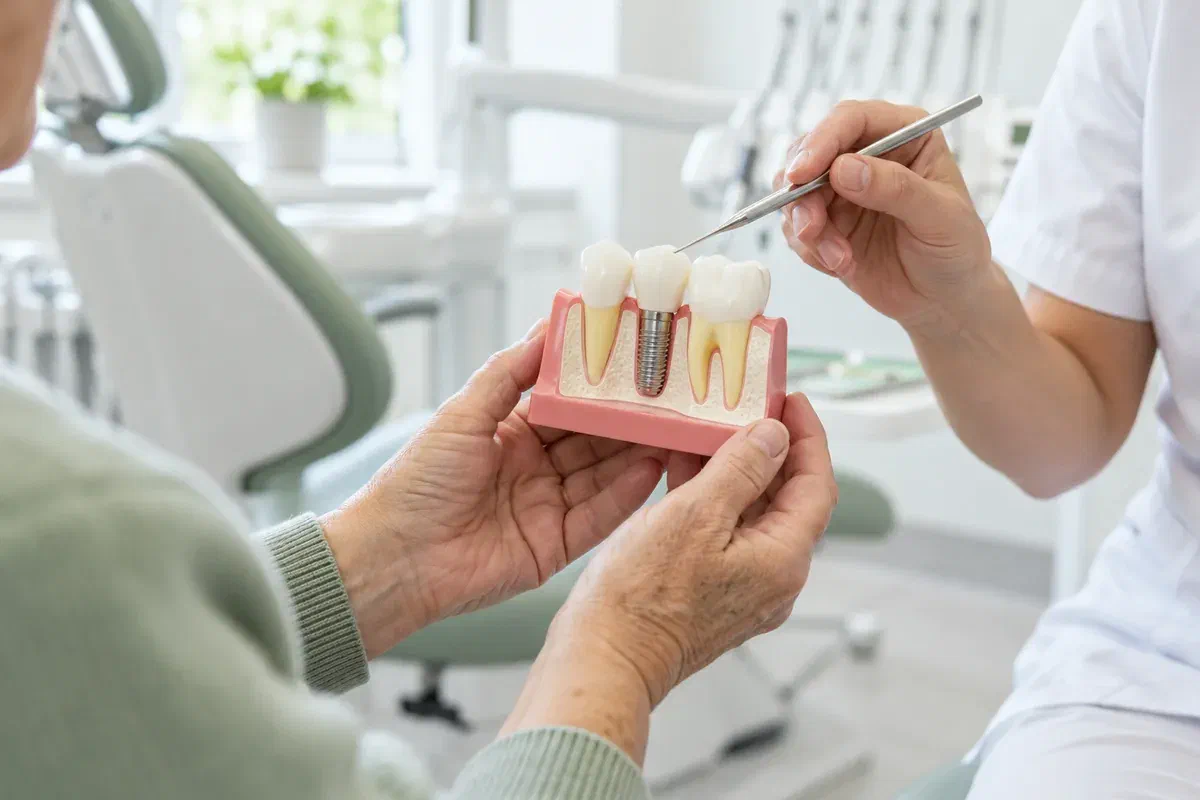
Illustrative older adult discussing implant options with a dentist
Restorative Dentistry

Dental Implant Consultations for Seniors in Brampton

Implant terms can feel like a new language. Older adults travelling from Brampton can expect a consultation that explains each option plainly, puts key points in writing, and leaves room for the questions you and your family bring.

Understanding before deciding

Clear words first, choices second.

Abutment, overdenture, graft, osseointegration. Many people leave a first implant conversation with a head full of unfamiliar words and a vague sense of what was suggested. A good consultation slows down, checks that each point makes sense, and gives you something written to take home.

Underneath the vocabulary sits a simple question: would this treatment be suitable and worthwhile for you? Age does not settle it. Your health, gums, bone and remaining teeth, the effort of treatment, and whether you could maintain the replacement all come into the answer.

Families travelling from Brampton often come as a group, with an adult child or spouse helping to listen and translate where needed. You are welcome to do the same. Tell the team how you would like information shared, and your own preferences will guide every part of the discussion.

Ask us to explain your options
Older patient's hands holding an implant teaching model during a consultation
Worth bringing up

The details that shape a realistic plan

Chewing comfort is one part of the decision. A replacement also brings appointments, recovery, cleaning and long-term maintenance, and those practical demands deserve the same plain explanation as the clinical findings.

Medicines and medical history

Bring your medication list, including supplements and any traditional or herbal remedies, and mention recent treatments. The dentist needs this to consider healing and planning, and to see whether your physician should be consulted.

Problems with your current denture

Say what troubles you most, such as movement, soreness, appearance or particular foods. Bring the denture so the dentist can check it, since improving the existing appliance may be possible before implants are discussed.

Hearing, vision and daily routines

Let the team know about hearing or vision changes, hand strength, mobility, transport, or the help you get at home. These shape how information is shared with you and which restoration would be practical to look after.

Please continue your medicines exactly as prescribed. If dental treatment were to require a change, it would need an individual plan agreed with the clinicians who prescribe them.

What you gain from the conversation

Understanding the commitment, not just the result

Tying the discussion to one specific goal, such as eating more comfortably with a lower denture or replacing a front tooth, keeps it from becoming overwhelming. With the goal clear, you can judge whether the expected improvement justifies the treatment involved.

Implants are not automatically the best answer because they exist, and they are not off limits because of age. A balanced conversation considers your preferences, your health, the examination results, and how the replacement would be maintained if your circumstances changed.

Patient information: ITI — advanced age and medical conditions in implant care

Explanations at your pace

Ask for terms to be defined, diagrams to be drawn, or key points repeated. Options can then be compared against your priorities rather than being presented as a single recommended package.

Practical arrangements raised early

Transport, appointment length, recovery and help at home can all change how treatment is organized. Discussing them before any booking lets the team explain what is needed and what may be adjusted.

Maintenance explained in everyday terms

Ask how the replacement would be cleaned, repaired and checked, and who could help if needed. Knowing this from the start helps you choose an option that will remain manageable for years.

How the visit works

Each stage, explained as you go

Feel free to ask for anything to be repeated, written down, or explained to a person you bring. The first appointment is for understanding the assessment route, not for committing to a procedure.

  1. Share your concerns in your own words

    Describe the missing teeth, your current appliance and the daily tasks that have become difficult. Mention worries about surgery, expense, healing or upkeep early so they become part of the conversation.

  2. Health review and examination

    Expect questions about your health and prescriptions, followed by a look at your gums, natural teeth and earlier dental work. The dentist may want images to see the bone in the spot being considered for an implant.

  3. Compare options with plain explanations

    Review implant and non-implant approaches, including their stages, demands and maintenance. If a referral is suggested, ask what question it should answer and how the results will be explained to you.

  4. Decide on a next step

    Perhaps you need more facts, a few evenings to talk it over at home, or a start on detailed planning. Any of these is fine. Take away a written note of agreed appointments and of problems that need care regardless of the replacement decision.

Once the visit is over

Read it again with fresh eyes.

New words and several possible routes can be hard to hold in mind. Keep the written plan and the clinic's phone number together so you and your family can go over it, compare options, and call about anything unclear.

Check the plan answers your question

Consider whether the proposed treatment addresses the concern that brought you in. Jot down questions about fees, recovery, temporary teeth or maintenance so you are not relying on memory.

Choose the support you want

If you would need transport, help with communication, or someone with you after treatment, arrange those details before booking. A relative can help with logistics while the decision remains yours.

Keep the dentist up to date

New medicines, medical treatment or changes in how you manage daily cleaning may affect the plan. Share these before procedures and at later checkups so the advice continues to fit.

Comparing the main approaches

Different needs, different replacements

Each approach offers its own mix of stability, treatment effort, cleaning and cost. Suitability depends on assessment, and the most extensive option is not necessarily the one that fits your priorities.

When the current appliance can improve

Adjusting or replacing the denture

A fit or design issue may be correctable without implants. Ask what an adjustment, reline or new denture could achieve and what limitations you should still expect.

When better hold is the goal

Implants to steady a removable denture

In suitable cases, implants can help retain certain removable dentures. Ask about the surgery, the attachments and their maintenance, and how you would take the denture out to clean it.

When the mouth and routine can support it

A fixed tooth or bridge

An implant crown or fixed restoration may suit an appropriate gap, while a conventional bridge or another plan may also be relevant. Compare cleaning access, repairs and the full treatment sequence.

Questions families ask

Answers you can share at home

Goals and support differ from person to person. These questions cover communication and practical arrangements alongside the clinical side of implant planning.

(905) 876-4488
What is the difference between an implant and an overdenture?
An implant is a small post placed in the jawbone that can support a crown, bridge or denture. An overdenture is a removable denture that clips onto implants or remaining roots. Ask which, if either, relates to your concern.
Can I have the plan written down to read at home?
Yes, ask for a written summary of the options discussed, the stages involved and the next steps. Having it on paper makes it easier to review with family and come back with questions.
Can a relative help translate during my appointment?
You can bring a trusted family member or friend to help with communication. Let the clinic know in advance. The dentist will still want to hear your own wishes, so ask your helper to relay your words fully.
Is there an age when implants are no longer offered?
There is no automatic age limit. Health, the condition of your mouth, the benefit you hope for and your ability to manage treatment and care are what matter. Ask how they apply to you personally.
What should I do if I hear the dentist poorly in the chair?
Tell the team at the start. They can face you when speaking, talk before the mask goes on, or write points down. Bring hearing aids if you use them, and ask for anything to be repeated.
How should a family from Brampton plan rides for a staged treatment?
Request a list of the likely visits, marking those after which someone else should drive. Some timing depends on healing and cannot be compressed, but knowing the sequence early helps everyone plan.
Seniors' implant consultations for Brampton

Come with questions. Leave with answers in writing.

Visit our Bronte Street clinic to explore tooth replacement with your health, preferences and routine in mind. Please bring your current denture if you have one, a medication list, and anything you want explained.

Let the clinic know about hearing, vision, mobility, language or support-person needs so the visit can be arranged comfortably.

Visit Milton Dental Clinic
Unit 1, 342 Bronte St. S, Milton, ON L9T 5B7
Get directions Clinic hours
Monday–Thursday
11am–7pm
Friday–Sunday
By appointment only

Areas we serve

  • Milton
  • Oakville
  • Mississauga
  • Georgetown
  • Halton Hills
  • Acton
  • Campbellville
  • Brampton
  • Burlington
  • Puslinch
  • Rockwood
  • Erin
  • Caledon
  • Etobicoke
  • Old Milton
  • Bronte Meadows
  • Timberlea
  • Dorset Park
  • Dempsey
  • Clarke
  • Beaty
  • Coates
  • Harrison
  • Scott
  • Willmott
  • Ford
  • Bowes
  • Cobden
  • Walker
  • Mountain View
  • Milton Heights
  • Hawthorne Village
  • Valley View
  • Fallingbrook
  • Nassagaweya
  • Trafalgar
  • Esquesing
  • Nelson
  • Brookville
  • Moffat
  • Glen Williams
  • Norval
  • Limehouse
  • Stewarttown
  • Ashgrove
  • Hornby
  • Silver Creek
  • Speyside
  • Scotch Block
  • North Oakville
  • River Oaks
  • Glen Abbey
  • West Oak Trails
  • Palermo
  • Bronte Creek
  • College Park
  • Joshua Creek
  • Uptown Core
  • Preserve
  • Iroquois Ridge
  • Lisgar
  • Meadowvale
  • Meadowvale Village
  • Churchill Meadows
  • Erin Mills
  • Central Erin Mills
  • Streetsville
  • East Credit
  • Creditview
  • Heartland
  • Sheridan
  • Mount Pleasant
  • Credit Valley
  • Huttonville
  • Churchville
  • Springbrook
  • Northwest Brampton
  • Bram West
  • Fletcher's Meadow
  • Fletcher's Creek South
  • Alton Village
  • Orchard
  • Millcroft
  • Headon Forest
  • Tansley
  • Brant Hills
  • Tyandaga
  • Kilbride
  • Lowville
  • Aberfoyle
  • Morriston
  • Arkell
  • Hillsburgh
  • Freelton
  • Carlisle
  • Waterdown
  • Flamborough
  • Mountsberg

How can we help?

Milton Dental Clinic

Have a question about your smile? Choose the option that works best for you.

For urgent dental concerns, please call.
Messages are reviewed during clinic hours.