

Illustrative older adult discussing implant options with a dentist
Restorative Dentistry

Dental Implant Consultations for Seniors in Etobicoke

Thinking about implants but wary of a long string of trips? Seniors coming from Etobicoke can use one well-prepared consultation to understand the stages, health checks, upkeep and visit schedule before deciding anything.

Making a longer trip worthwhile

How many visits would this really take?

For someone coming from the west end of Toronto, that question can matter as much as any clinical detail. Implant care often unfolds over months, with healing between steps. Knowing the likely rhythm of appointments early lets you decide whether the plan fits your energy, your driver and your calendar.

The central question, though, is the same for everyone: would this treatment suit you and be worth what it asks? Age is not the answer. Your health, your gums and jawbone, your remaining teeth, your appetite for treatment and your ability to clean a replacement all count.

To make the trip from Etobicoke productive, arrive with your medication list, the denture you wear, and a note of your main concerns. Bring a companion if that helps. The dentist will go through the gains, the limits, the alternatives and the ongoing care, and you will leave with time to think.

Plan a focused first visit
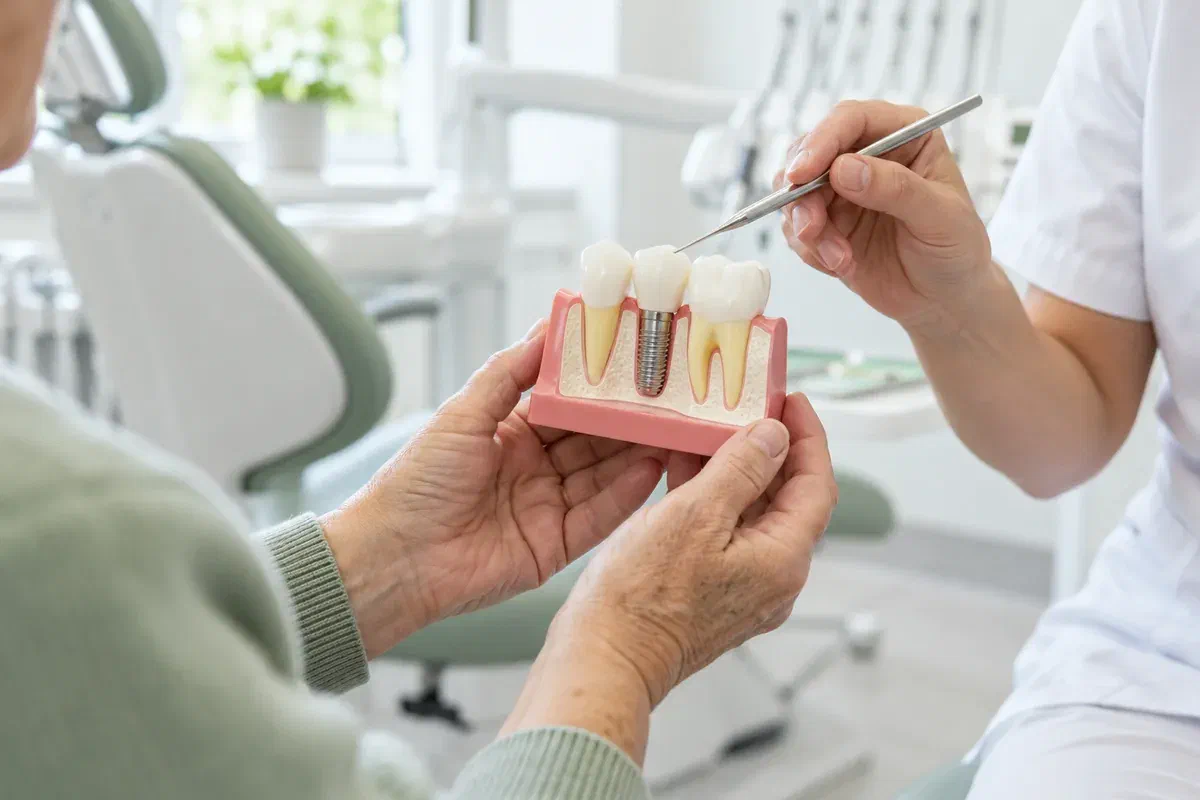
Older patient's hands holding an implant teaching model during a consultation
Preparing from Etobicoke

Bring these three things into the room.

Comfortable chewing is the hoped-for result, but getting there involves appointments, recovery, cleaning and later checkups. For anyone travelling a distance, those practical steps deserve as much attention as the examination.

A complete health summary

A printed list of medicines, supplements and recent medical care saves time and lets the dentist think through healing and planning on the day. It also shows whether a note from your physician or specialist should be requested.

The appliance you wear now

Wear or pack your denture and be ready to say what fails: lifting, rubbing, its appearance, or certain foods. A fit problem might be corrected without implants, which could also mean fewer journeys overall.

Your travel and support picture

Explain who drives you, how you manage long days, and any help with grip, eyesight or mobility. These details help the team suggest a design you can maintain and a schedule that respects the distance.

Keep every prescribed medicine going as usual while you consider implants. Any change related to dental work has to be planned individually with the doctors who look after that part of your health.

Why plan before you commit

Know the full journey, not just the destination.

Pinning the discussion to one concrete aim, such as a lower denture that will not stay put or a gap that spoils chewing, gives you something to measure the plan against. You can then ask honestly whether the benefit outweighs the treatment and the travel it would take.

Implants are not the obvious answer simply because they are an option, and they are not closed to you because of your age. A sound discussion brings together your wishes, your health, the clinical findings, and what upkeep would look like if your situation changed.

Patient information: ITI — advanced age and medical conditions in implant care

Priorities lead the comparison

Name what you want to improve and what you would rather avoid, including extra trips. The dentist can then set the realistic options beside that list, rather than opening with the most elaborate treatment.

Visit numbers are discussed openly

Ask how many appointments each approach usually involves, how long each might last, and which ones might call for a driver. Knowing this up front makes it easier to judge what is workable from a distance.

Follow-up is part of the picture

Implant restorations need periodic review and occasional repairs. Ask how often you would need to come back and what could be handled during routine checkups, so ongoing care stays manageable.

A well-used first appointment

One visit, four clear stages

Points can be repeated, jotted down, or explained to the person who came with you. The aim is to map the road ahead in a single trip, without any expectation that you will book surgery before leaving.

  1. Open with what you want fixed

    Describe the teeth that are gone, the appliance you rely on, and the meals or conversations that have become awkward. Air any doubts about surgery, cost, recovery or maintenance right away.

  2. Medical history, then the examination

    After reviewing your health and medicines, the dentist checks your gums, natural teeth and current dental work. If imaging would help, ask whether it can be done on the same day to avoid an extra trip.

  3. Compare the routes and their schedules

    Go through implant and non-implant choices, the number of stages, the effort and the upkeep. Should another clinician's opinion be advised, ask what it would clarify and where that appointment would take place.

  4. Leave with a written outline

    You might want more time, more facts or further planning. In each case, ask for the next steps on paper. Confirm which existing problems should be treated anyway, and whether any of that could be combined with later visits.

Back home after the trip

A plan you can review without coming back in

Consultations can raise new words and several options. Keep the written summary and the clinic's number together. Questions about the paperwork can often be raised by phone or through the contact page, which may save a journey.

Test the plan against your goal

Does the proposed treatment deal with the specific problem that prompted the visit? Note any questions about cost, recovery, temporary teeth or upkeep and send them in, instead of trying to recall everything later.

Know where to go for urgent care

If swelling, heavy bleeding, fever or severe pain develops after any procedure, call the clinic promptly. For an emergency that cannot wait, seek care closer to home and let the dental team know afterward.

Report health changes before treatment

New medicines, a hospital admission or more difficulty with daily cleaning can alter the advice you receive. Share them before any procedure and at later reviews so recommendations stay appropriate.

Approaches to consider

Some answers need fewer appointments than others.

Every option balances stability, treatment demands, cleaning and cost in its own way. Assessment decides what is suitable, and the most involved route is not automatically the one that suits your priorities or travel.

When the appliance is the main problem

A better-fitting denture

An adjustment, reline or new denture may solve a fit issue without any surgery. Ask what improvement is realistic, what would still be limited, and how many visits each choice usually involves.

When added grip is worth a closer look

Implants that retain a removable denture

For suitable mouths, implants can help hold some removable dentures steady. Talk through the surgery, the attachments that wear over time, and daily removal for cleaning, along with the follow-up schedule.

When your mouth and upkeep can support it

A fixed restoration or another approach

An implant crown or fixed bridge may be considered for a suitable gap, and a traditional bridge could also fit. Compare cleaning access, likely repairs and how many appointments each would need.

Planning-focused questions

What older adults ask before committing

Goals, health and support vary from one person to the next. These questions focus on the practical and scheduling side of implant care, along with the assessment.

(905) 876-4488
Could X-rays or scans be done on the day of the consultation?
It depends on which records are needed and how the day is scheduled. Ask when booking whether imaging could fit into the same visit. Some specialized scans may require a separate appointment, so find out early where and when that would happen.
What should I do if something goes wrong after a procedure and I am far away?
Call the clinic first for advice. If you have severe swelling, trouble swallowing or breathing, uncontrolled bleeding or a high fever, seek emergency care near you right away and let the dental team know.
Can follow-up questions be handled by phone instead of in person?
Many can. Questions about the written plan, scheduling or costs can often be answered without a visit. Anything that requires an examination, such as a sore spot or a loose part, will still need an appointment.
Do older adults heal more slowly after implant surgery?
Healing varies from person to person and is influenced by health, medicines and habits as much as by age. The dentist will consider your history when planning and explain what recovery might look like for you.
Must I list medicines I take only occasionally?
Yes. Include everything, even occasional pain relievers and supplements, plus any treatment for bone health or blood clotting. Keep taking prescribed medicines and ask how any medical advice will be arranged.
Is the drive from Etobicoke worth it for a first consultation?
That depends on your priorities. A first visit can answer whether implants are realistic, what the alternatives are, and how many trips each route would take. Some people find that clarity helps them decide whether to continue.
Implant consultations for seniors from Etobicoke

Make the first trip count.

Visit our Bronte Street clinic to explore tooth replacement with your health, travel and daily routine in mind. Bring your denture, a medication list and your questions so we can cover as much as possible in one visit.

Mention travel limits, preferred appointment times, mobility needs or a support person when you book so the visit can be organized around them.

Visit Milton Dental Clinic
Unit 1, 342 Bronte St. S, Milton, ON L9T 5B7
Get directions Clinic hours
Monday–Thursday
11am–7pm
Friday–Sunday
By appointment only

Areas we serve

  • Milton
  • Oakville
  • Mississauga
  • Georgetown
  • Halton Hills
  • Acton
  • Campbellville
  • Brampton
  • Burlington
  • Puslinch
  • Rockwood
  • Erin
  • Caledon
  • Etobicoke
  • Old Milton
  • Bronte Meadows
  • Timberlea
  • Dorset Park
  • Dempsey
  • Clarke
  • Beaty
  • Coates
  • Harrison
  • Scott
  • Willmott
  • Ford
  • Bowes
  • Cobden
  • Walker
  • Mountain View
  • Milton Heights
  • Hawthorne Village
  • Valley View
  • Fallingbrook
  • Nassagaweya
  • Trafalgar
  • Esquesing
  • Nelson
  • Brookville
  • Moffat
  • Glen Williams
  • Norval
  • Limehouse
  • Stewarttown
  • Ashgrove
  • Hornby
  • Silver Creek
  • Speyside
  • Scotch Block
  • North Oakville
  • River Oaks
  • Glen Abbey
  • West Oak Trails
  • Palermo
  • Bronte Creek
  • College Park
  • Joshua Creek
  • Uptown Core
  • Preserve
  • Iroquois Ridge
  • Lisgar
  • Meadowvale
  • Meadowvale Village
  • Churchill Meadows
  • Erin Mills
  • Central Erin Mills
  • Streetsville
  • East Credit
  • Creditview
  • Heartland
  • Sheridan
  • Mount Pleasant
  • Credit Valley
  • Huttonville
  • Churchville
  • Springbrook
  • Northwest Brampton
  • Bram West
  • Fletcher's Meadow
  • Fletcher's Creek South
  • Alton Village
  • Orchard
  • Millcroft
  • Headon Forest
  • Tansley
  • Brant Hills
  • Tyandaga
  • Kilbride
  • Lowville
  • Aberfoyle
  • Morriston
  • Arkell
  • Hillsburgh
  • Freelton
  • Carlisle
  • Waterdown
  • Flamborough
  • Mountsberg

How can we help?

Milton Dental Clinic

Have a question about your smile? Choose the option that works best for you.

For urgent dental concerns, please call.
Messages are reviewed during clinic hours.