

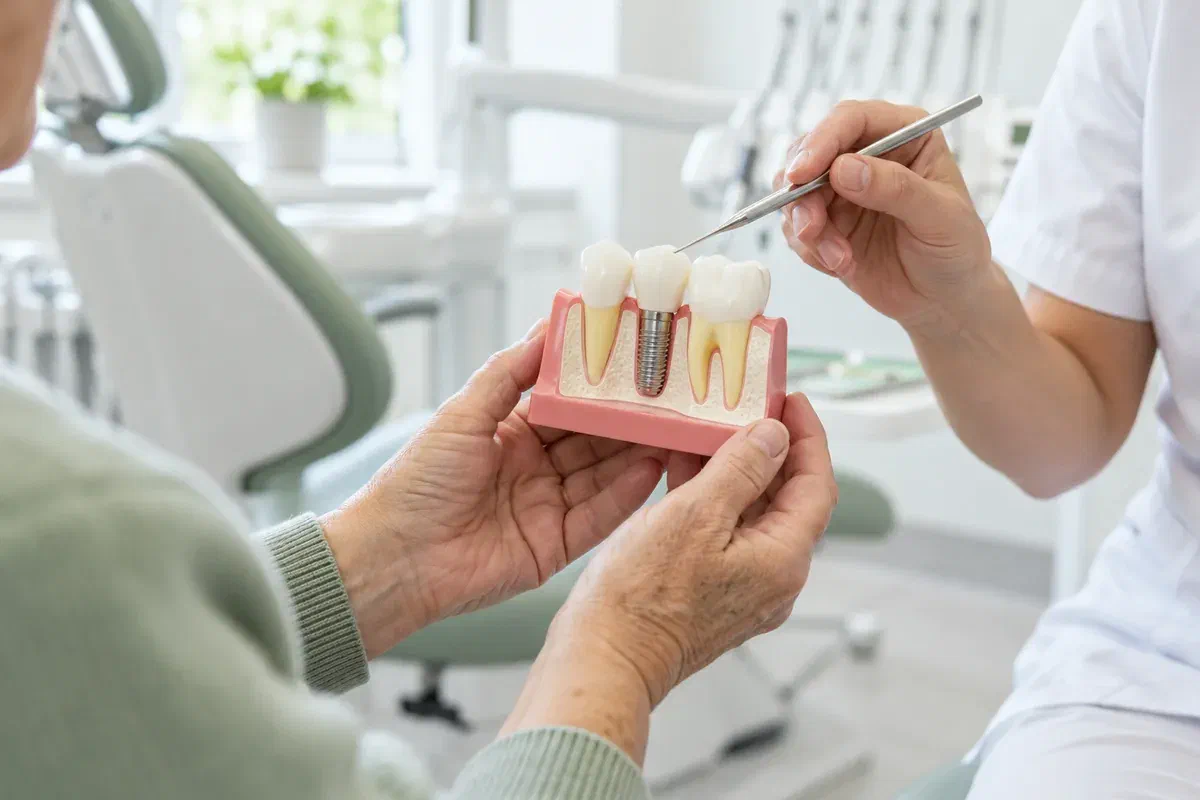
Illustrative older adult discussing implant options with a dentist
Restorative Dentistry

Dental Implant Consultations for Seniors in Halton Hills

Will today's choice still work in ten years? Seniors from across Halton Hills can talk through implants and alternatives with an eye on future cleaning, changing health, and the help that may one day be needed at home.

Looking further ahead

Picture yourself cleaning it at ninety.

It sounds blunt, but it is one of the most useful ways to think about tooth replacement later in life. Arthritis may stiffen the fingers, eyesight may fade, and someday a family member or care worker might be the one brushing. A replacement that is easy now should still be manageable then.

That forward view sits alongside the familiar questions. Is the treatment suitable for your health? Is the bone and gum in good enough shape? Are you willing to go through the stages involved? Age by itself answers none of these, so each one gets examined on its own merits.

From Georgetown, Acton, Glen Williams or one of the smaller Halton Hills hamlets, a single unhurried consultation can cover all of it. Bring a spouse, adult child or friend if you like. You will hear what each approach offers, where it falls short and what it takes to maintain, and the decision stays with you.

Plan for the years ahead
Older patient's hands holding an implant teaching model during a consultation
Questions for Halton Hills households

Today's needs and tomorrow's

Eating comfortably is the headline goal, but every replacement also carries appointments, healing, a cleaning routine and maintenance for as long as you have it. Those long-term demands belong in the first conversation.

Health as it is and as it may change

List all medicines, supplements and recent treatments. Mention conditions that could progress, such as arthritis or memory concerns, so the dentist can think about healing, planning, and whether contacting your physician would help.

Where the current denture falls short

Be specific: does it rock, rub, look wrong, or stop you eating certain foods? Bring it along. A well-made conventional denture is simple to clean and may be improvable before implants are considered.

Who might help with care later

Talk about grip, vision, mobility and transport now, and also about who might assist in future. These details help identify a design that another person could clean and handle if that ever became necessary.

Continue all prescribed medicines as normal while you think about implants. Any change for dental reasons must come from an individual plan made with the clinicians responsible for that treatment.

The value of planning ahead

A good result is one you can keep up.

Start with a precise goal, perhaps a lower denture that floats or a single gap that traps food. That goal becomes the yardstick: you can ask whether the expected improvement justifies the surgery, the visits and the decades of upkeep a replacement may involve.

Implants are not the right choice merely because they exist, and they are not wrong simply because you are older. A thoughtful review combines your wishes and health, the examination, and a realistic look at how care would work if your abilities or living situation changed.

Patient information: ITI — advanced age and medical conditions in implant care

Simplicity can be a priority

Tell the dentist if an easy routine matters to you more than maximum stability. Options can be weighed against that preference rather than starting with the most extensive treatment available.

Support at home is discussed early

Who drives you, how you would recover, and whether someone could help with cleaning all affect how a plan should be shaped. Raising them now lets the team explain what is needed and what can flex.

Future adjustments are considered

Ask whether a proposed restoration could be modified, simplified or converted later if cleaning became harder. A plan with room to adapt can stay workable through changing circumstances.

During the visit

Here is how the hour usually goes

Request repetition, written notes or an explanation for your companion whenever it helps. This first appointment is meant to clarify the path ahead and carries no obligation to proceed.

  1. Explain the problem and your outlook

    Describe missing teeth, the appliance you wear and what has become hard. Share how you feel about surgery, cost, recovery and long-term upkeep, so those views guide the plan from the outset.

  2. Health check and a full examination

    Your medical history and medicines are reviewed, and the dentist examines gums, remaining teeth and existing restorations. Imaging or other records may be needed to understand bone at a possible implant site.

  3. Weigh each route, including later life

    Compare implant and non-implant options for their stages, demands and maintenance, now and in years to come. If a specialist opinion is recommended, ask exactly what it should clarify.

  4. Pick your next step

    That might be more information, a pause to reflect, or further planning. Ask for a written outline of any agreed visits and which current dental issues need treatment regardless of the replacement choice.

After you get home

Share the plan with whoever might help one day.

Consultations introduce new terms and sometimes several routes. Keep the written plan with the clinic's number, and consider showing it to the person most likely to support your care, so you can review it together and follow up.

Compare it with your goal

Check whether the suggested treatment solves the concern that brought you in. Note questions about cost, recovery, temporary teeth or upkeep rather than depending on recall.

Arrange support that suits you

If you would need a ride, help with instructions, or company after treatment, organize those details before booking. A relative can take care of logistics while you keep control of the decision.

Tell the team about changes

New prescriptions, medical treatment or growing difficulty with daily care may affect what is advisable. Let the dentist know before procedures and at later checkups so the plan keeps fitting.

Options with the future in mind

Stability, simplicity and everything between

Approaches differ in stability, treatment demands, cleaning and cost. Suitability needs assessment, and the most extensive option is not necessarily the one that will serve you best over the long run.

When an easy routine matters most

A refitted or new conventional denture

An adjustment, reline or new denture may fix a fit or design problem without surgery, and remains simple to clean. Ask what it could improve and what limits would remain.

When more hold is worth the upkeep

A removable denture on implant attachments

In suitable mouths, implants can help keep certain removable dentures steady. Discuss the surgery, the attachments that need servicing, and whether you or a helper could remove and clean it easily.

When the mouth and long-term care allow it

Fixed teeth or a conventional bridge

An implant crown or fixed restoration may suit an appropriate gap, and a traditional bridge might also be relevant. Compare cleaning access, repairs and what maintenance would look like if dexterity declined.

Long-view questions

Thinking ten years ahead

Every person's goals and support are different. These questions look at how implant choices hold up as needs change, alongside the clinical assessment.

(905) 876-4488
Can an implant denture be changed later if it becomes hard to manage?
Sometimes. Depending on the design, attachments may be adjusted or the appliance remade in a simpler form. Ask before treatment what modifications would be possible and what they might involve.
Could a caregiver clean implant teeth for me?
Many designs can be cleaned by another person with some guidance, though some are easier than others. Ask the dentist to show how a helper would do it, and consider that when comparing options.
Does arthritis in my hands affect which option suits me?
It can. Removing a denture, working floss under a bridge or cleaning around attachments each need different dexterity. Mention it early so the dentist can suggest designs and aids that fit your hands.
Is a person in their eighties still assessed for implants?
Yes, if they wish. Age alone does not exclude anyone. The assessment looks at health, oral condition, the expected benefit and the demands of treatment and upkeep for that individual.
What medical details does the dentist need to know?
All prescriptions, supplements and past treatments, especially anything affecting bone or blood clotting. Some details may need input from your physician. Keep taking your medicines as prescribed in the meantime.
How should someone in Halton Hills plan rides for staged treatment?
Ask for a timeline of likely visits and which ones may need a driver afterward. Healing intervals cannot always be shortened, but knowing the sequence lets you line up help well in advance.
Senior implant consultations for Halton Hills

Choose with the next decade in mind.

Visit our Bronte Street practice to discuss tooth replacement in light of your health, preferences and routine, now and later. Bring your current denture, a medication list, and the questions you want covered.

Let the clinic know about mobility, hearing, vision or support-person arrangements so the appointment can be made comfortable.

Visit Milton Dental Clinic
Unit 1, 342 Bronte St. S, Milton, ON L9T 5B7
Get directions Clinic hours
Monday–Thursday
11am–7pm
Friday–Sunday
By appointment only

Areas we serve

  • Milton
  • Oakville
  • Mississauga
  • Georgetown
  • Halton Hills
  • Acton
  • Campbellville
  • Brampton
  • Burlington
  • Puslinch
  • Rockwood
  • Erin
  • Caledon
  • Etobicoke
  • Old Milton
  • Bronte Meadows
  • Timberlea
  • Dorset Park
  • Dempsey
  • Clarke
  • Beaty
  • Coates
  • Harrison
  • Scott
  • Willmott
  • Ford
  • Bowes
  • Cobden
  • Walker
  • Mountain View
  • Milton Heights
  • Hawthorne Village
  • Valley View
  • Fallingbrook
  • Nassagaweya
  • Trafalgar
  • Esquesing
  • Nelson
  • Brookville
  • Moffat
  • Glen Williams
  • Norval
  • Limehouse
  • Stewarttown
  • Ashgrove
  • Hornby
  • Silver Creek
  • Speyside
  • Scotch Block
  • North Oakville
  • River Oaks
  • Glen Abbey
  • West Oak Trails
  • Palermo
  • Bronte Creek
  • College Park
  • Joshua Creek
  • Uptown Core
  • Preserve
  • Iroquois Ridge
  • Lisgar
  • Meadowvale
  • Meadowvale Village
  • Churchill Meadows
  • Erin Mills
  • Central Erin Mills
  • Streetsville
  • East Credit
  • Creditview
  • Heartland
  • Sheridan
  • Mount Pleasant
  • Credit Valley
  • Huttonville
  • Churchville
  • Springbrook
  • Northwest Brampton
  • Bram West
  • Fletcher's Meadow
  • Fletcher's Creek South
  • Alton Village
  • Orchard
  • Millcroft
  • Headon Forest
  • Tansley
  • Brant Hills
  • Tyandaga
  • Kilbride
  • Lowville
  • Aberfoyle
  • Morriston
  • Arkell
  • Hillsburgh
  • Freelton
  • Carlisle
  • Waterdown
  • Flamborough
  • Mountsberg

How can we help?

Milton Dental Clinic

Have a question about your smile? Choose the option that works best for you.

For urgent dental concerns, please call.
Messages are reviewed during clinic hours.